TL;DR
- Feedback on a piece of work is a different craft from feedback on a person. Review in order: purpose, audience, structure, argument, then sentences. Line edits on a draft that needs restructuring are wasted work for both of you.
- Label every comment as one of three kinds: this is wrong, this would be stronger changed, or this is my preference. Most arguments about drafts are two people treating a preference as a defect.
- Decide who holds the pen and who decides before the review starts. Comments from four reviewers with no decider produce a worse document than comments from one.
A draft lands in your inbox with a note: "Any thoughts?" An hour later you have left forty-one comments, three of which matter. The author reads them in order, spends a day fixing commas in a section that should not exist, and sends back version two with the same problem version one had.
This article is about feedback on a piece of work rather than on a person. A report, a board paper, a client proposal, a deck, a policy, a page of website copy. The craft is different from performance feedback and almost nobody is taught it. You will find the order to review in, the three kinds of comment, weak and better comment examples across several kinds of document, how to say a draft needs restarting without flattening the person who wrote it, what to do when four reviewers disagree, what changes when the draft was written with AI assistance, and how to receive it yourself.
Comments on work and feedback on a person both work better when there is one place to put them. See how New Dynamics continuous feedback keeps everyday feedback together instead of scattered across inboxes.
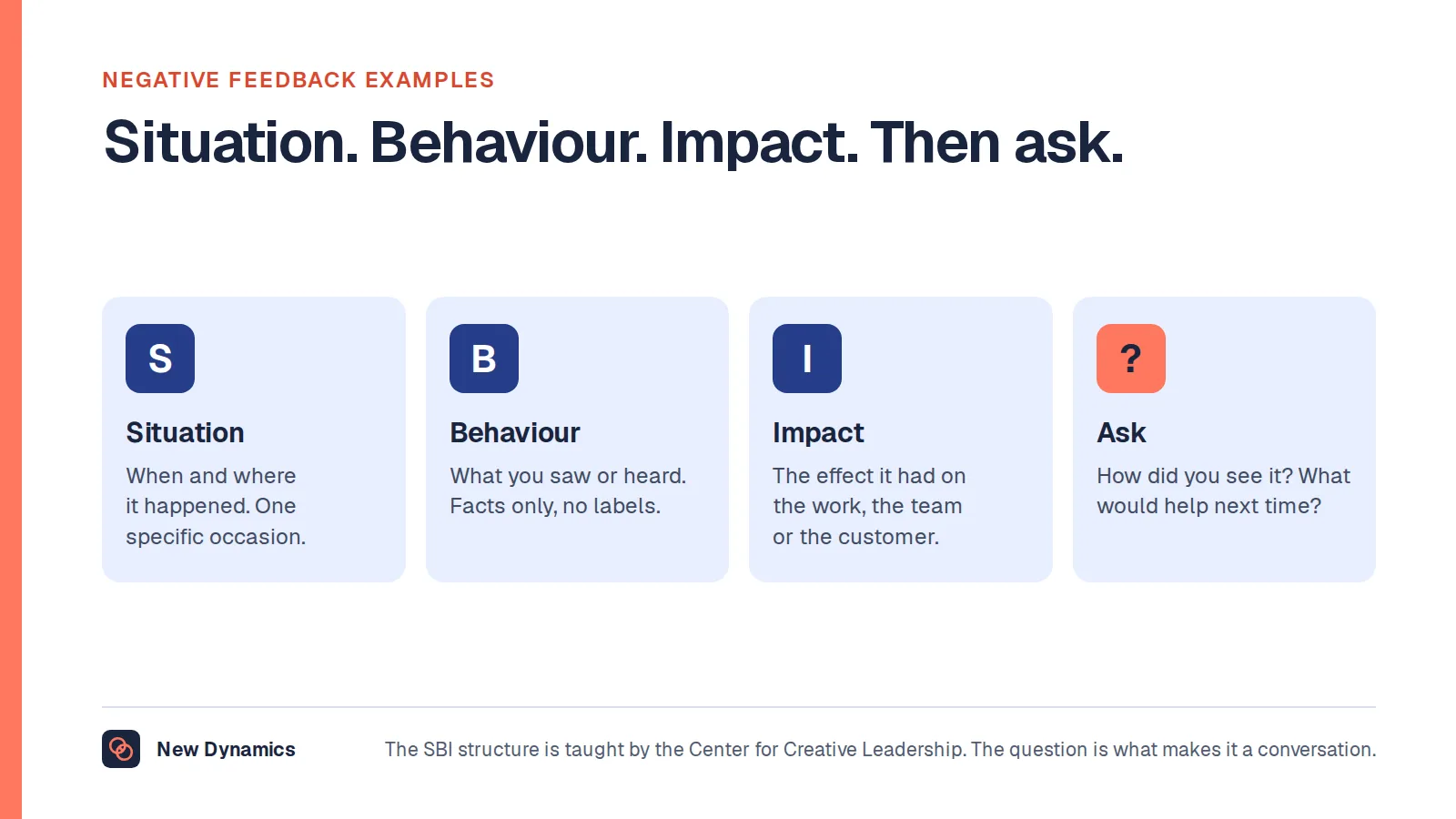
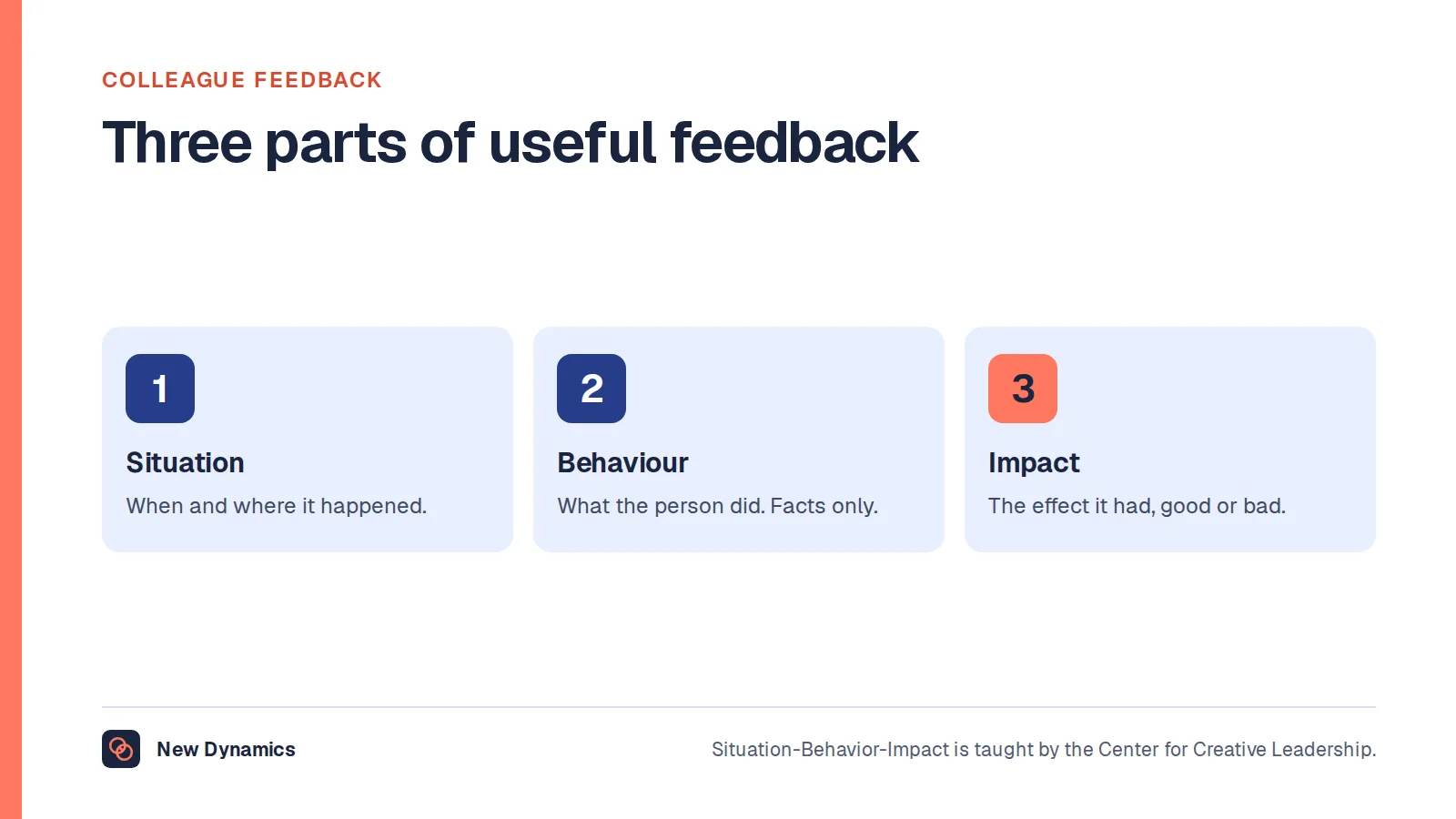
If what you actually need is feedback on how somebody works rather than on what they produced, start with our negative feedback examples or, for peer comments, our colleague feedback examples.
Why feedback on a piece of work goes wrong
Five failures account for most of it, and none of them is about being too harsh.
You rewrite it yourself. It feels helpful and fast. It teaches the author nothing, it removes their judgement from a document that still has their name on it, and you now own every sentence you touched. Rewrite someone's work three times and you have not given feedback three times. You have quietly taken the job.
You line edit a draft whose structure is wrong. This is the expensive one. Fixing sentences in a section that is about to be deleted is wasted work for you and demoralising for the author, who did the edits in good faith and then watched them disappear.
You drown the author in comments. Forty comments with no ranking are not forty times as useful as three. The author cannot tell which ones would stop publication, so they either do all of them mechanically or lose confidence in the whole draft.
You contradict another reviewer. Two senior people leave opposite instructions in the margin and leave. The author now has to choose which colleague to disappoint, which is not a decision they can make, so the document stalls.
You give a verdict instead of a comment. "Not quite there" and "needs more work" are feelings, not feedback. Both read as a judgement of the author rather than of the draft.
Review in this order: purpose, audience, structure, argument, sentences
Read the whole thing once without touching the keyboard. Then work from the outside in.

- Purpose. What is this document for? What should change because it exists, and who has to decide something after reading it? A paper written to inform when it needed to ask for a decision cannot be rescued by better prose.
- Audience. Who reads it, what do they already know, and what will they do with it? The Government Digital Service puts this first too. Its guidance says that "every piece of published content should meet a valid user need", and its template for writing one has three parts: "As a... I need to... So that...". That template works just as well on a client proposal as on a government page.
- Structure. Does the order of the sections carry the argument, or is the conclusion on page four? Can a reader who stops after the first paragraph still act correctly?
- Argument and evidence. Is each claim supported, is the source named, is the document honest about what it does not know? This is where you find the invented statistic, the figure that contradicts the appendix and the recommendation nobody can afford.
- Sentences. Only now. Length, clarity, repetition, jargon, tone, typographical errors.
Two reasons the order matters. The author's effort is finite, and you want it spent on the level that is actually broken. And feedback from the outside in reads as help, while feedback from the inside out reads as fussing.
If you only have twenty minutes, review levels one to three and say so: "I have looked at purpose, audience and structure only, not the detail."
The three kinds of comment, and why you should label them
Nearly every unproductive argument about a draft is two people treating different kinds of comment as the same kind. Separate them, and say in the comment which one you mean.

- Wrong. A fact, figure, name, date, claim or legal statement that is incorrect, or something that breaks a rule the organisation has to follow. These are not negotiable and the author does not get to weigh them against anything.
- Weaker. The draft works as it is, but it would land better changed. A buried conclusion, a missing counter-argument, an example that will not mean anything to this audience. These need a reason, and the author can push back with a better one.
- Preference. You would have written it differently. You dislike the word. You prefer shorter paragraphs. This is taste, not a defect, and it is the single biggest source of pointless rework in document review.
Three habits make the labels work.
Say the word. "Wrong: the headcount figure is 214, not 240." "Weaker: this would be stronger with the risk named before the benefit." "Preference, ignore if you like: I would cut this sentence."
Keep your preferences rare and visibly optional. A reviewer whose preferences arrive labelled as preferences gets taken seriously when they say wrong.
Count your comments before sending them. More than about eight on a first draft usually means you are reviewing at the wrong level. Group them into themes and write three.
Weak comment, better comment: worked examples
A better comment usually does four things: it says which kind of comment it is, it names the exact place, it gives the reason, and it says what happens next. The names, figures and documents below are fictional.

A board report
Weak: "This is too long."
Better: "Weaker: the recommendation is on page six and the board reads the first page. Move the ask and the three numbers behind it to the top, and the rest becomes an appendix. That alone will do it, so please do not rewrite the body."
Why it is better: it names the real problem (position, not length), gives the reason, states the fix and rules out the bigger job the author might otherwise start.
A client proposal
Weak: "Can you make it sound more confident?"
Better: "Weaker: four of the five sections open with what we cannot promise. The caveats are right and they should stay, but put each one after the commitment it qualifies rather than before it. Section three already does this well, so copy that pattern."
Why it is better: "more confident" is a feeling the author cannot act on. This names the pattern, keeps the thing that was correct, and points at a model inside their own draft.
A policy document
Weak: "Legal will hate this."
Better: "Wrong: paragraph 4 says managers can extend probation indefinitely, and our own procedure caps it. Change it to match the procedure, then send it to the people team to check before it goes any further."
Why it is better: a prediction about someone else's reaction is not reviewable. A named paragraph and the rule it breaks are.
A slide deck
Weak: "Slides 8 to 14 are a mess."
Better: "Weaker: slides 8 to 14 each carry three points, so the argument is hard to follow out loud. Could you give each slide one point and one piece of evidence? If that makes twenty slides, that is fine, because you are presenting it rather than sending it."
Why it is better: "a mess" tells the author you are unhappy and nothing else. This names the pattern, suggests the rule and removes the constraint the author was probably protecting.
A page of website copy
Weak: "Not very engaging."
Better: "Preference, so treat it as optional: I would cut the first two sentences and start at 'You can apply online in ten minutes'. Weaker, and this one I would fix: the page never says who is eligible, and that is the first question a reader will have."
Why it is better: it separates the taste from the gap and says which is which, so the author spends their effort on the one that matters.
A technical specification
Weak: "I do not understand the data section."
Better: "Weaker: I got lost at the second diagram, because the field names there do not match the ones in the table above it. I do not know which set is right, so could you make them consistent and add one sentence saying what the diagram shows?"
Why it is better: it says where comprehension failed rather than that it failed, and offers a cause the author can check.
A colleague's first draft of anything
Weak: "I have left comments throughout."
Better: "Three things, in order. First, the purpose: I think this is asking for a decision, but it reads as an update, so the top needs to say what you want from the reader. Second, structure: sections two and four overlap and could become one. Third, a handful of small corrections in the margin, none of which matter until the first two are settled."
Why it is better: it ranks the comments, which is the service the author actually needs, and tells them not to bother with the small ones yet.
Negative feedback in the body of a document or message
This phrase gets searched for in three senses, and all three deserve a plain answer. If you arrived looking for negative feedback as a biological mechanism, the loops that keep body temperature and blood sugar stable, that is homeostasis and this is the wrong page: it is a physiology topic with nothing to do with work. The other two senses are about where criticism sits in a piece of writing.
Criticism written in the body of a document. Margin comments are for the reviewer and the author. Text in the body is for everyone who ever opens the file. Keep criticism of the work in comments or in a covering message, never in tracked prose that might survive into the final version, and never write anything about the author's competence anywhere in the file. Drafts get forwarded, attached to tenders, filed and recovered years later, and a sentence that was a private aside becomes a sentence with your name on it.
Criticism in the body of a message or email. If you are writing to the author rather than commenting on the file, put the hardest thing in the body of the message plainly, near the top, in your own words. Do not bury it under three paragraphs of warm-up or leave it to be inferred from an attachment. A useful shape is three lines: what the document is for, the one thing that has to change, and the offer of a conversation.
Example: "Thanks for this. Before it goes to the client, the pricing section needs to match the approved rate card, because two of the figures are below it and we cannot honour them. Everything else I would leave as it is. Fifteen minutes this afternoon if it is easier to talk it through?"
Note what that does not do. It does not open with praise it does not mean, it does not list every small thing, and it does not leave the author guessing which comment is the blocking one.
A separate point on tone, because it costs people relationships. Comments are read without your face attached. A clipped "No." or "Why?" in a margin lands far harder than it sounded in your head, and short questions written at speed are routinely read as contempt. Write the half-sentence of reason. Our post on feedback on attitude at work makes the same case in reverse: manner is interpreted, and interpretations vary.
How to say a draft needs restarting
Sometimes the honest answer is that version one cannot become version two by editing. The structure is wrong, or the document answers a question nobody asked. Saying so is kinder than letting the author polish it for a week, and it is survivable if you do four things.
Say it early and directly. The worst version of this conversation happens on the fourth draft. "I think this needs to start again, and I should have said so on Tuesday" beats any amount of hedging.
Separate the draft from the person, out loud. "The draft is not right" and "you did this badly" are different sentences, and the author will not hear the difference unless you make it. Name what was genuinely good: the research, the interviews, the fact that the hard question got asked at all.
Explain the diagnosis, not just the verdict. "This is written for the project team and it needs to be written for the finance committee" tells the author what went wrong and what the next version looks like. "Start again" does not.
Take your share. Most restarts trace back to a brief nobody agreed. If you did not say who the reader was, who decides and how long it should be, say that first, then agree the brief in writing before anything else is written.
Wording to adapt: "I have read it twice and I think we need a different document rather than a better version of this one. The analysis is strong and I want to keep all of it. But this reads as a review of what happened, and what the committee needs is a choice between two options with a recommendation. That is my fault for not agreeing the question with you before you started. Can we spend twenty minutes agreeing the shape, and then you keep the evidence and rebuild the frame?"
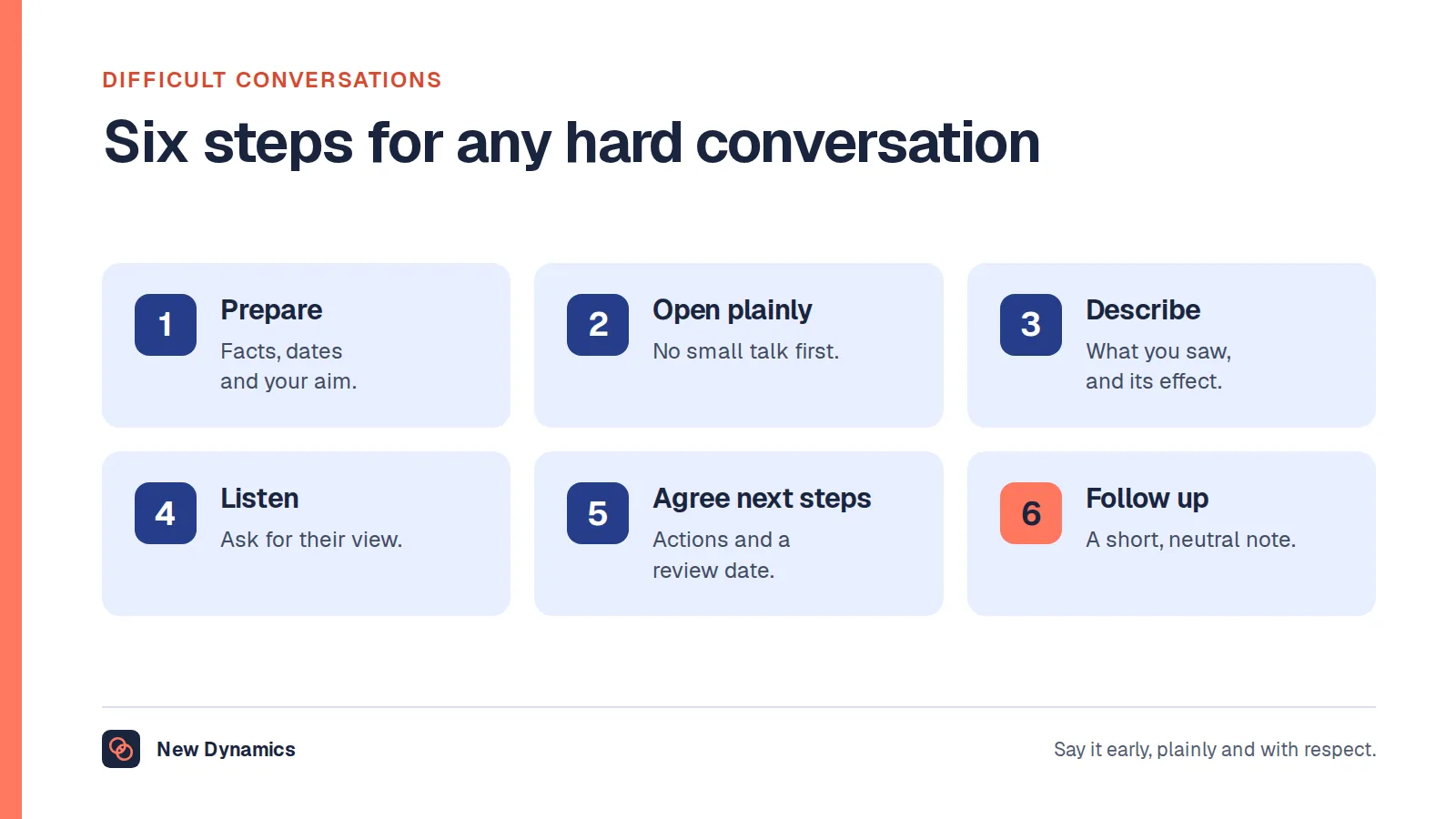
For harder versions of this conversation, including ones where the pattern repeats, see our difficult conversations examples.
Comments in the document, or a conversation
Both have a place, and choosing wrong is a common cause of avoidable upset.
Write comments in the document when the points are specific and local, the author is experienced, the changes are mostly corrections, there are several reviewers who need to see each other's points, or a record of who asked for what is useful later.
Have a conversation when the problem is structural, the draft may need restarting, you disagree with the author about something substantive, the author is new, junior or clearly anxious about the work, or you have more than about eight comments. Talk first, then write down what you agreed.
A hybrid works well on big documents. Fifteen minutes on purpose, audience and structure, then comments on the detail once the shape is settled. That also avoids the commonest waste in document review, which is careful line edits delivered on a draft that is about to change shape.
One rule for both: the author keeps the pen. The reviewer comments and the author edits. That keeps the document in one voice, keeps the author accountable for it, and stops a file turning into a patchwork of four people's half-sentences.
Several reviewers, and who decides
Four reviewers and no decider is worse than one reviewer, because the author inherits every disagreement. Settle three things before the draft goes out.
Who decides. One named person who resolves conflicting comments. Not a committee, not the most senior person present by accident. The author should be able to say "the decider said keep it" and have that end the discussion.
Who reviews for what. Give each reviewer a lane: the argument, the numbers, compliance or legal wording, house style. Reviewers without a lane all review the sentences, because sentences are the easiest thing to have an opinion about.
When. Reviewers who arrive at different stages reopen settled decisions. Collect comments in one window, close it, and tell latecomers which decisions are made.
Then run it as one pass rather than a relay. Everyone comments in the same file so they can see each other, and the decider resolves the clashes before the author starts editing. Where two comments genuinely conflict, the decider writes the resolution in the file: "Both points are fair. We are going with Priya's version because the committee has seen the old framing before."
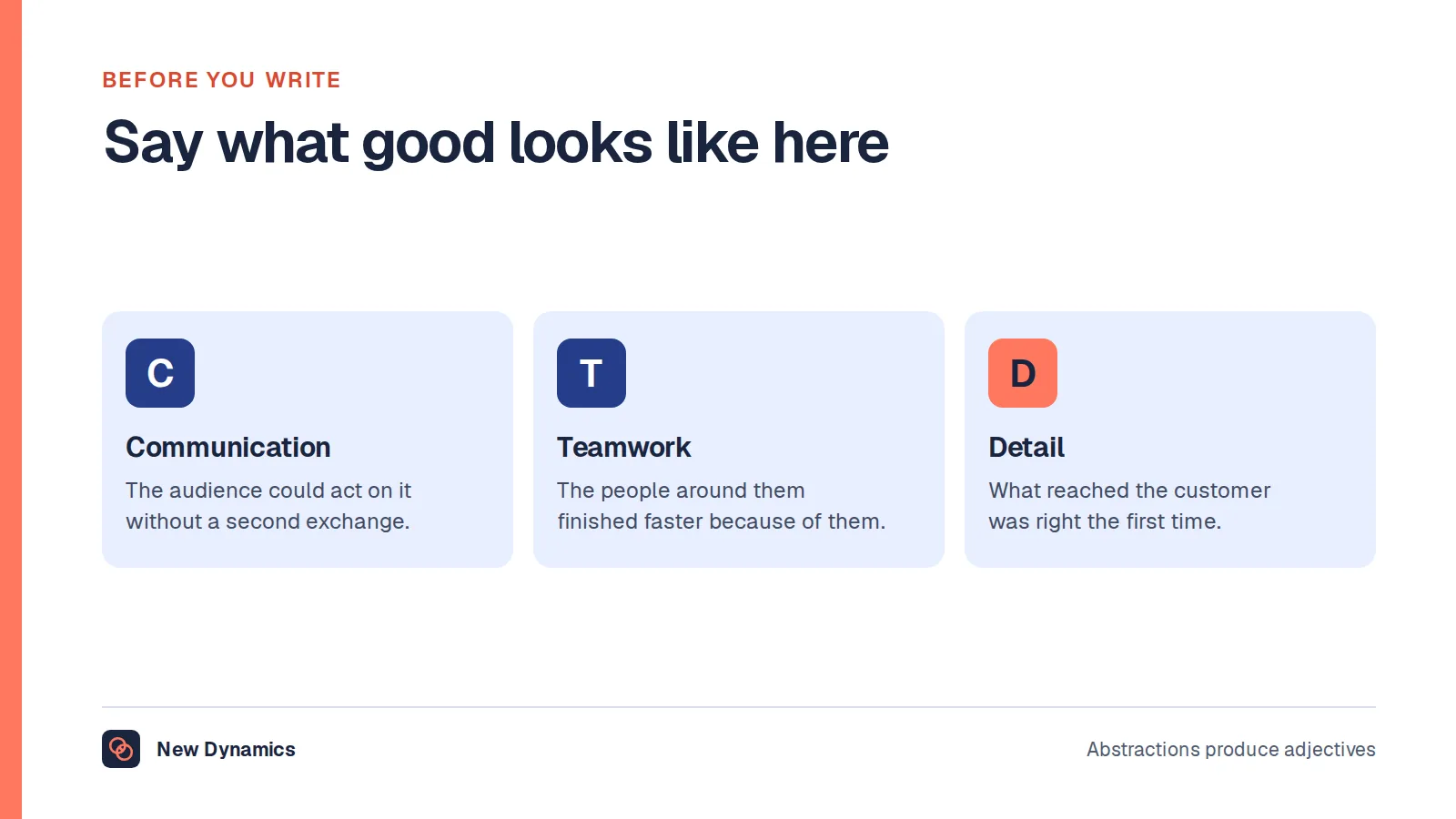
A note on the written record. Comments on a document are about the work, and they are not a performance record. If the same problem appears in draft after draft, that is a performance conversation, and it belongs in a one-to-one and in the review cycle rather than in the margin of a file. Acas, whose guidance covers England, Wales and Scotland, says of performance reviews that "it's important to keep a written record of what is discussed" and that this should be shared with the employee afterwards, and that alongside formal reviews managers "should still talk to employees informally about their performance on a regular basis". That is general information and not legal advice. Our post on feedback examples for communication, teamwork and attention to detail covers how to word a repeated pattern when it does reach a review.
Feedback on work produced with AI assistance
More drafts now arrive with a model's fingerprints on them, and three things change about reviewing them.
Check the facts, the figures and the sources, not the fluency. Fluent text reads as checked text, and that is the trap. The UK government's AI Playbook, published in February 2025, tells teams that they should understand how to "monitor and mitigate for potential drift, bias, and, in the case of generative AI, hallucinations", and sets out as a principle that you should have "meaningful human control at the right stages". On a document, that means opening the sources, checking that quoted figures exist and are current, and treating a confident citation as unverified until you have seen it.
Review the thinking, not the prose. The common failure in an assisted draft is not bad writing. It is a document that is smooth, balanced, generic and committed to nothing: no recommendation, no judgement, no acknowledgement of the awkward fact everybody knows. Useful comment: "Weaker: this says everything true about the market and nothing about what we should do, so I cannot tell what you think."
Keep the accountability with the author. Whoever's name is on the document is answerable for every sentence in it, whatever helped produce it. Ask plainly what was drafted with assistance and what was checked, and if your organisation has a position on confidential information going into external tools, say which documents are in scope. Our guide to prompting for HR work covers using a model on a draft, and AI tools for HR teams sets out where it helps.
One thing does not change: do not use a model as the reviewer of record. It will find typographical errors. It will not know that the finance committee has rejected this idea twice, which is the comment that matters.
Receiving feedback on your own written work
The author's side is half the craft, and it is where most of the value is lost.
Ask for the level you want. "This is a first draft, so I am after purpose and structure. Please ignore the sentences." Reviewers follow that instruction gratefully, because they usually do not know what stage you are at.
Name the decision you need. "Does this ask the right question?" gets a useful answer. "Any thoughts?" gets comma edits.
Read everything before you change anything. Comment 31 often turns out to be the real problem, and comments 1 to 30 are symptoms of it.
Sort the comments by kind yourself. Wrong, weaker, preference. Do the wrongs. Weigh the weakers. Accept or decline the preferences without guilt, and if you decline several from the same person, tell them why.
Say what you did. A line back closes the loop: "Restructured around the decision as you suggested, moved the figures to an appendix, kept the long example because the client asked for it." Reviewers who never learn what happened to their comments stop making good ones.
Push back with a reason, not a defence. "I kept it because the audience includes two people who were not in the project" is a reason. "I disagree" is not, and explaining why each comment is wrong before considering it is the fastest way to stop getting help.
Separate the work from yourself. Easier written than done on something you have spent a week on. The useful question is not "was I criticised?" but "is the next version better?" Our guide to employee feedback covers the wider habit, and the HR statistics hub gathers what is published about feedback and reviews in the UK.
Frequently asked questions
How do you give feedback on a document?
Read it once without commenting. Then review in order: purpose, audience, structure, argument and only then sentences. Label each comment as wrong, weaker or preference, name the exact place, give the reason and say what happens next. Keep it to a handful of ranked points on a first draft.
What are good examples of content feedback?
A weak comment says "this is too long". A better one says: "Weaker, the recommendation is on page six and the board reads the first page. Move the ask and the three numbers behind it to the top, and make the rest an appendix." The second names the problem, the reason and the fix.
How do you give feedback on a report without rewriting it?
Comment, do not edit. The author keeps the pen, so the document stays in one voice and they stay accountable for it. Describe the problem and the reason rather than supplying your sentence, and if you find yourself rewriting a third time, have a conversation about the brief instead.
What does negative feedback in the body mean?
At work it has two readings, and in biology a third that is unrelated: negative feedback there means a homeostatic loop, not criticism. At work, criticism written into the body of a document should move to comments or a covering message, because body text survives into the final file. Criticism in the body of a message should be stated plainly near the top, in two or three lines, rather than buried under a warm-up.
How do you tell someone their draft needs to start again?
Say it early, separate the draft from the person, give the diagnosis rather than the verdict, and take your share if the brief was never agreed. Name what is worth keeping, explain what the next version is for, and agree the shape together before any more writing happens.
Does feedback on someone's writing belong in a performance review?
Comments on a draft are about the work, not the person. A repeated pattern across many drafts is a performance conversation, and it belongs in a one-to-one and in the review cycle, with specific dated examples. Acas guidance for England, Wales and Scotland asks for a written record of what is discussed at a review. This is general information, not legal advice.
Your next step: review the next draft in order
- Before you open the file, write down what the document is for and who decides.
- Read it once, start to finish, without touching the keyboard.
- Write no more than five comments, each labelled wrong, weaker or preference.
- If more than one of them is structural, close the file and book fifteen minutes instead.
- Tell the author which comment is the blocking one.
For making feedback a habit rather than an event, read and download our employee feedback guide. The guide is free to read, and the PDF uses our short download form.
Want everyday feedback, comments and review notes in one place instead of four inboxes? Book a New Dynamics demo and bring the review process you run today. You can also email contact@new-dynamics.com.