TL;DR
- Agreement is the default and the deadline is statutory. Section 4(1) of the Employment Rights Act 1996 requires the employer to give the worker a written statement of the change, and section 4(3) says it must be given at the earliest opportunity and in any event not later than one month after the change.
- Fire and rehire is still lawful today and is being restricted. The statutory Code of Practice on dismissal and re-engagement came into force on 18 July 2024 and carries a tribunal uplift of up to 25%. GOV.UK's timeline lists fire and rehire protections under measures that will take effect in March 2027, and the new section 104I of the 1996 Act is in force only to allow regulations to be made.
- Silence is not agreement, but conduct can be. Acas says an employee's actions could count as affirming the change where they continue to work under the changed terms and do not put an objection in writing.
A contract variation question usually arrives late. Someone has already decided that the shift pattern is changing, or that the bonus scheme is being rebuilt, and the question put to HR is how to get everyone onto the new terms by the end of the quarter. The honest answer is that the method decides the risk, and there are only three methods. Picking the wrong one turns an operational change into a tribunal claim.
This article covers England, Scotland and Wales, where GOV.UK and Acas guidance applies and where the statutory code on dismissal and re-engagement has effect. Northern Ireland has separate legislation and separate guidance, so check the position there on its own. This is general information and not legal advice, and anything involving pay cuts, pensions or dismissal is worth a professional read before it goes out.
Most of what goes wrong is record keeping rather than law. The consultation happened, the letter went out, and two years later nobody can show who agreed what and on which date. See how New Dynamics workflows let you define the stages, participants and approvals once, so the consultation and the confirmation leave a dated trail rather than a folder of attachments.
What a contract variation is, and why agreement is the default
A variation is a change to one or more terms of an existing contract of employment. Acas notes that changing a contract "is sometimes called 'varying a contract'", and the starting position is mutual: "Both you and the employee can propose changes to the agreed terms and conditions. You must both agree to the changes. This is unless there's a clause in the contract that allows you to make a change without agreement." That is from Acas guidance on changing your employees' contracts, last updated on 27 October 2026.
GOV.UK puts the same rule to employers in one line on its guidance about changing an employment contract: "You must get an employee's agreement if you want to make changes to their contract." The page adds that employers should "consult or negotiate with employees or their representatives" and "listen to alternative ideas from employees". The statutory Code of Practice on dismissal and re-engagement says the same at paragraph 2: contracts of employment "are legally binding agreements and their terms cannot usually be changed by just one party".
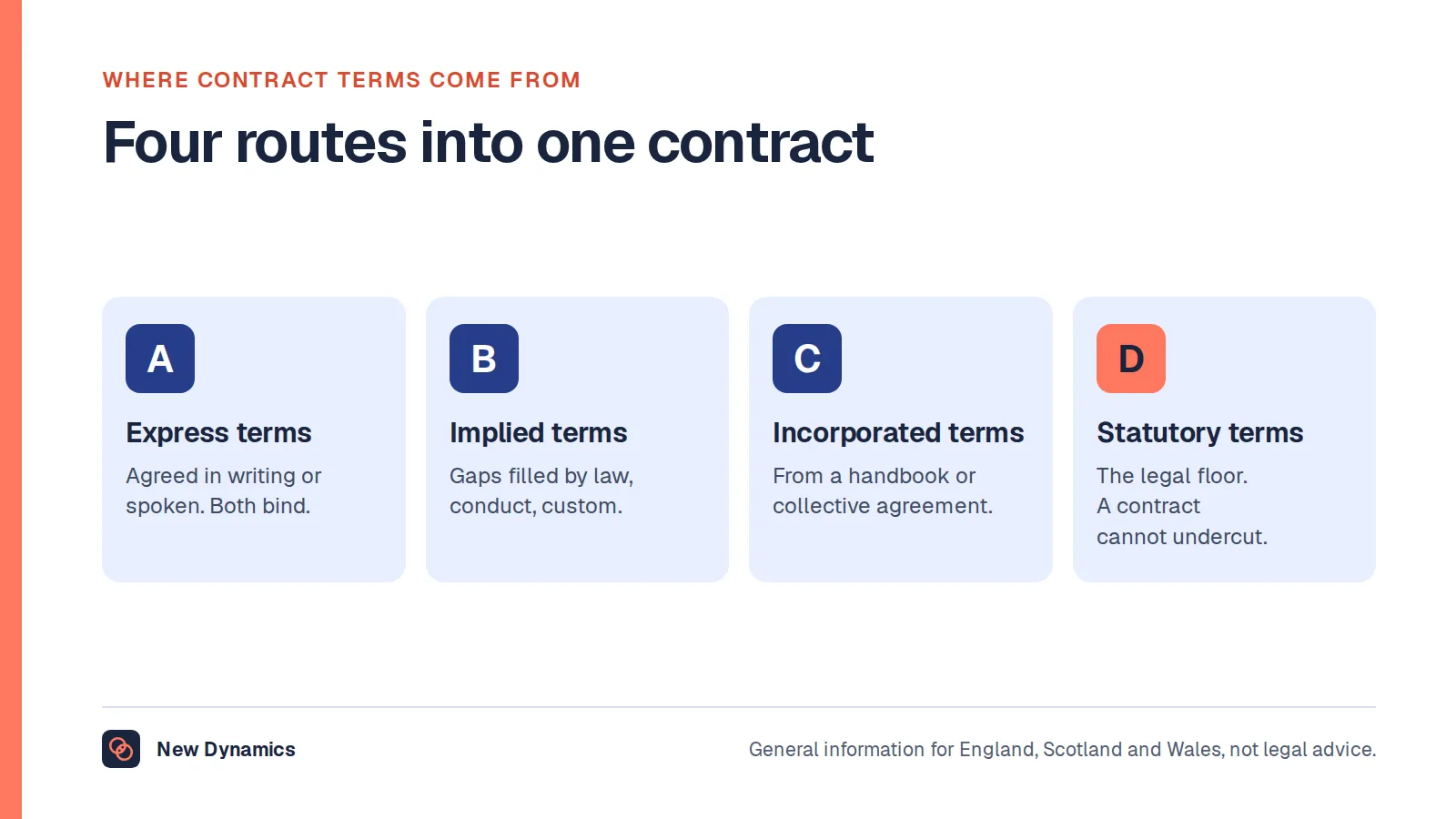
For where the terms come from in the first place, including the ones nobody wrote down, our post on the employment contract sets out the five sources.
The written deadline: one month, by statute
This is the part that gets missed even when the change itself is handled well. Section 4 of the Employment Rights Act 1996 is headed "Statement of changes". Section 4(1) provides that where there is a change in any of the particulars required in the written statement, "the employer shall give to the worker a written statement containing particulars of the change".
Section 4(3) sets the timing. The statement "shall be given at the earliest opportunity and, in any event, not later than" either "one month after the change in question" or, where the change results from the worker being required to work outside the United Kingdom for more than a month, the time they leave to begin that work, if that is earlier. The revised text of section 4 of the Employment Rights Act 1996 on legislation.gov.uk is stated to be up to date with all changes in force on or before 7 November 2026.
Acas words the same duty as "By law, you must put a change in writing within 1 month of the change", and removes the usual excuse for delay: "Employees do not have to sign a new contract for changes to take effect." It also notes that if a change affects only one employee "you must write to them individually".
The three routes to a contract variation, and the risk attached to each

Route one: agreement
The only route without inherent legal risk. Acas describes several ways agreement can be reached: a change proposed by either side and then discussed and agreed, a collective agreement where a recognised trade union agrees changes on employees' behalf, a flexibility clause already in the contract, or custom and practice, where "terms and conditions change over time and everyone's agreement can be implied".
Before proposing anything, Acas asks employers to consider "what issue you're trying to solve" and "if a contract change is definitely needed to solve it". The risks it lists for badly handled changes include "legal claims, for example claims of breach of contract or constructive dismissal" and discrimination where a change disadvantages a protected group.
Route two: a flexibility or variation clause
A clause agreed at the outset can allow some change without fresh agreement. Acas calls these "'flexibility' or 'variation' terms or clauses" and says a clause should be "clear and easy to understand" and should provide "reasonable advance notice before you introduce any relevant contract change".
The limit matters more than the clause. Acas is explicit: "Flexibility clauses must only be used to make reasonable changes." Its worked example is a relocation at short notice to somewhere outside reasonable commuting distance, where "doing this may be a breach of contract even if there is a flexibility clause that appears to allow it". Acas advises consulting even where you think the clause covers the change.
A flexibility clause is therefore not a shortcut for a pay cut. It is a narrow permission to make the kind of change the clause actually describes.
Route three: imposing the change
Acas sets out the position plainly: "If you impose a change to a contract before getting agreement you will be 'in breach of contract'." Imposition means giving notice that the change takes effect from a stated date, without agreement, and Acas lists the exposure as legal claims, long term damage to morale, industrial action where there is a union, and reputational damage.
Imposition is not the same thing as dismissal and re-engagement, though they are often confused. Imposing keeps the contract alive and breaches it. Dismissal and re-engagement ends the contract and starts a new one, which is a dismissal in law even where the person never leaves the building.
What happens if an employee refuses
Three things, and the sequence is usually this.
Working under protest. The employee keeps working the new terms while making clear they do not accept them. Acas says this should normally be for a short time only, that the employee should tell the employer they do not agree, that they are working under protest and that they may take legal action, and that they should "put this in writing" and do so "on a regular basis", for example every time they get paid. Possible claims while working on include breach of contract, unlawful deduction from wages where pay is affected, and discrimination.
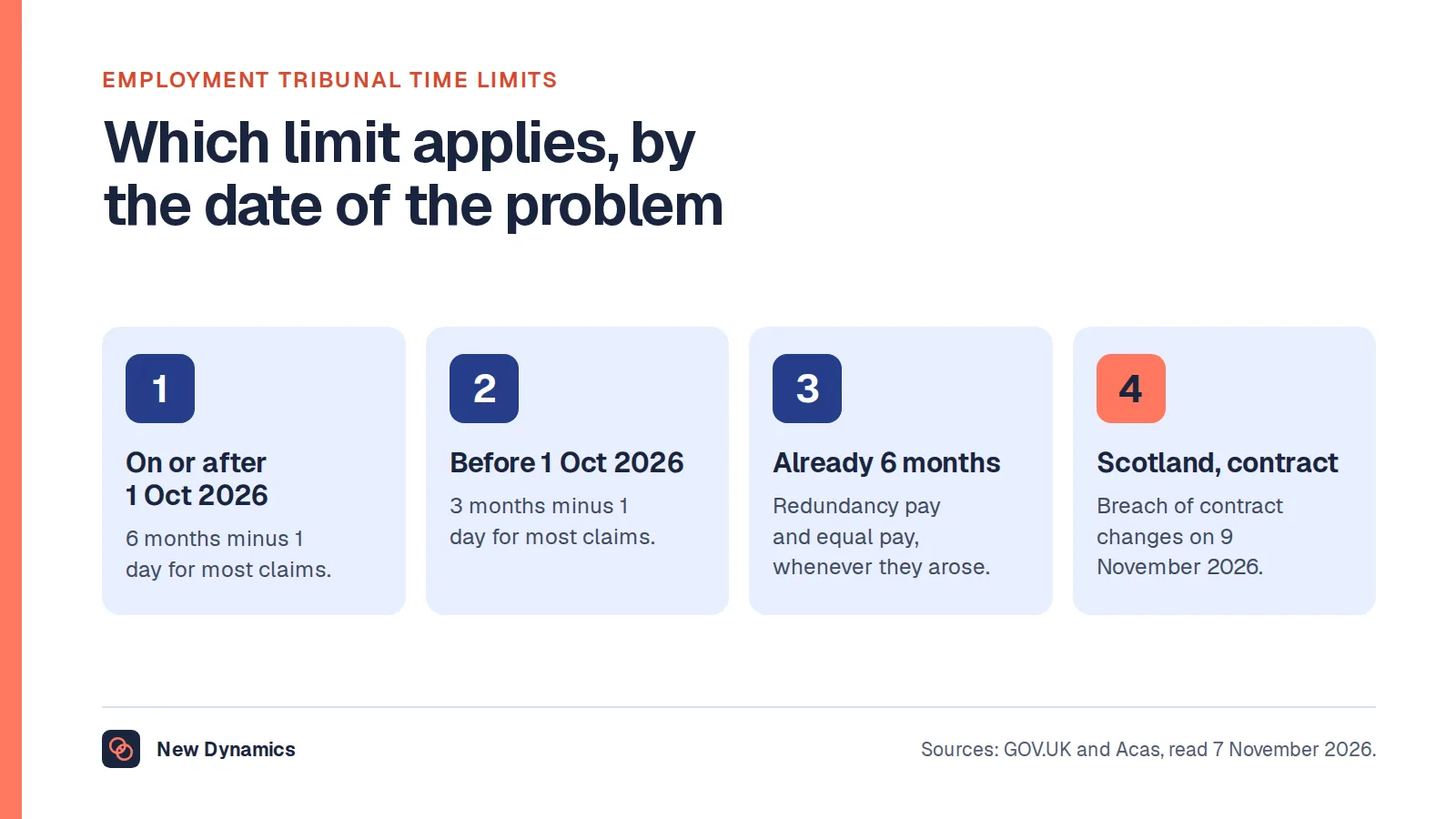
Resigning and claiming constructive dismissal. Where the imposed change is a fundamental breach, the employee may resign and claim constructive dismissal at a tribunal. Acas is candid about the odds: "A constructive dismissal claim can be very difficult to win at a tribunal." Time limits apply, and our post on employment tribunal time limits covers the current periods.
Dismissal and re-engagement. The employer ends the contract and offers a new one on the changed terms. That is the route the law is in the middle of closing, and it is the next section.
Dismissal and re-engagement: what is in force now, and what changes in March 2027
Here is the position as at 7 November 2026, with nothing read forward.
The statutory code is in force. The code states in its preamble that it "is issued by the Secretary of State under section 203 of the 1992 Act and came into force on 18 July 2024". Paragraph 12 says that "A failure to follow the code does not, in itself, make a person or organisation liable to proceedings", but paragraph 13 says any relevant provision "must be taken into account by the court, tribunal or committee". Paragraph 14 carries the sanction: where an employee brings a claim listed in Schedule A2 to the 1992 Act on a matter the code covers, the tribunal can "increase any award it makes by up to 25%, if the employer has unreasonably failed to comply with the code", and cut an award by up to 25% where it is the employee who has unreasonably failed to comply. Paragraph 47 says the option is one an employer "should treat as a last resort", and paragraph 107 asks the employer to contact Acas "for advice before raising the prospect of dismissal and re-engagement".
The practice has not been banned yet. Section 28 of the Employment Rights Act 2025 inserts a new section 104I into the Employment Rights Act 1996, under which an employee dismissed for refusing a "restricted variation", or so the employer can re-engage them or employ someone else on varied terms, "is to be regarded for the purposes of this Part as unfairly dismissed". Restricted variations include a reduction of, or removal of an entitlement to, any sum payable in connection with the employment, changes to pension terms, changes to the hours an employee must work, and a clause allowing such changes without agreement. A narrow exception applies where the employer shows the variation was needed to address financial difficulties affecting its ability to carry on as a going concern and that it could not reasonably have avoided the need.
That section is not yet operative. The commencement regulations brought it into force only "to enable the making of regulations in anticipation of those sections coming fully into force", in the words of the explanatory note to the Employment Rights Act 2025 (Commencement No. 1 and Transitional and Saving Provisions) Regulations 2026. A proposal is not the law, and until commencement the old position governs.
The date on the record is March 2027. GOV.UK's implementation timeline lists "fire and rehire protections" under "Measures that will take effect in March 2027", and warns that "All future dates remain subject to parliamentary processes and may change". Acas carries the same date and the same caution: "Important: The law on fire and rehire is expected to change sometime in March 2027. In most cases, fire and rehire will be an automatically unfair dismissal. We will publish detailed advice on the new law in December 2026."
The code is being rewritten to match. A consultation on a revised version was published on 22 October 2026 and closes at 11:59pm on 17 December 2026. Until the revised code is finalised and brought into effect, the 2024 code applies.
Collective consultation where 20 or more employees are affected
A variation exercise large enough to involve dismissals pulls in a second, separate duty. Acas states it directly: "If you're proposing to fire and rehire 20 or more employees, by law you must collectively consult on the proposed dismissals."
The threshold and the timetable come from section 188 of the Trade Union and Labour Relations (Consolidation) Act 1992, which applies where an employer proposes to dismiss as redundant "20 or more employees at one establishment" within "a period of 90 days or less". Section 188(1A) requires consultation to begin "in good time" and in any event at least 45 days before the first dismissal where 100 or more employees are proposed for dismissal, and at least 30 days otherwise. It must cover "avoiding the dismissals", "reducing the numbers of employees to be dismissed" and "mitigating the consequences of the dismissals", with a view to reaching agreement with the appropriate representatives.
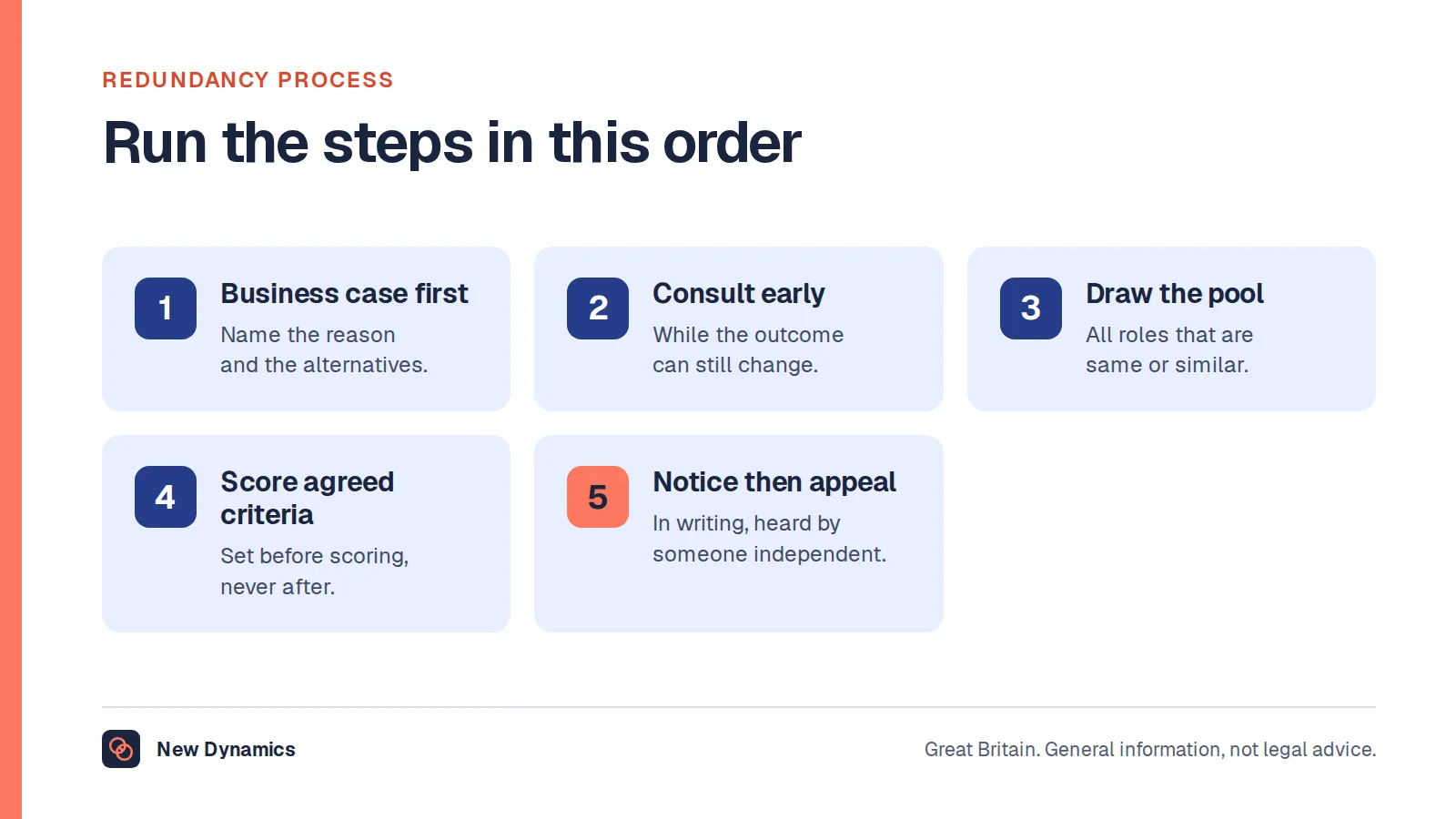
Two points about the overlap with redundancy. The same collective process applies even where the reason is not redundancy but some other substantial reason, as Acas says: "You must follow the same process as for collective consultation in redundancy situations." And the dismissal and re-engagement code does not apply where the only reason the employer envisages dismissal is redundancy as defined in the 1996 Act, so a genuine redundancy runs on the redundancy rules instead. Our post on the redundancy process covers that route.
The penalty for getting the collective duty wrong has doubled. Section 189(4) of the 1992 Act now says the protected period "shall not exceed 180 days", substituted with effect from 6 April 2026 by section 30(2) of the Employment Rights Act 2025. Acas records it in the same terms: "From 6 April 2026, this can be up to 180 days' full pay for each affected employee. Before 6 April 2026, the maximum protective award was 90 days' pay." No qualifying service is needed for a protective award, and an unreasonable failure to follow the code can increase one by up to 25%. For the wider set of employment figures we keep in one place, see the HR statistics hub.
What a contract variation letter should record

Acas asks for the change in writing, and for the content to be clear about "what the change is", "why it has been introduced", "exactly what the change will mean for them", "when and how it will take effect" and "for how long it will last, if it's a temporary change". It also asks employers to invite the employee to "check that it describes accurately what they have agreed".
The statutory code adds a restraint that is easy to breach by accident. At paragraph 52 it says: "The employer should ensure that the only terms which are changed are those which have been subject to the information-sharing and consultation process, and should not use this as an opportunity to make any further changes." Reissuing a whole contract instead of writing a variation letter is how an unconsulted clause arrives alongside an agreed one.
A workable variation letter therefore records seven things: the term being changed, the old wording and the new wording, the date the change takes effect, whether it is temporary or permanent, the consultation it followed, that nothing else in the contract has changed, and a request to come back with any correction. Keep the superseded version. The question in a dispute is almost never what the terms are today.
The trap: silence is not agreement, but working the new terms can be
Not signing proves nothing either way, which is why this trap catches both sides. Acas tells employees that "Even if you do not sign anything, your actions could legally count as 'affirming' (agreeing to) the change" where both of two things apply: "you continue to work under the changed terms and conditions" and "you do not put in writing to your employer that you object to the change". Acas tells employers the same thing from the other side, listing continuing to work the changed terms and not informing the employer of disagreement as circumstances where "an employee's actions might count as agreeing to the change".
So conduct over time can create agreement, and a signature does not. For an employer, that means the record is not a countersigned page but a dated sequence: what was proposed, when, what was consulted on, what was confirmed in writing, and what the person did next. For an employee, it means an objection has to be written down and repeated, because carrying on quietly is the one response that can be read as acceptance.
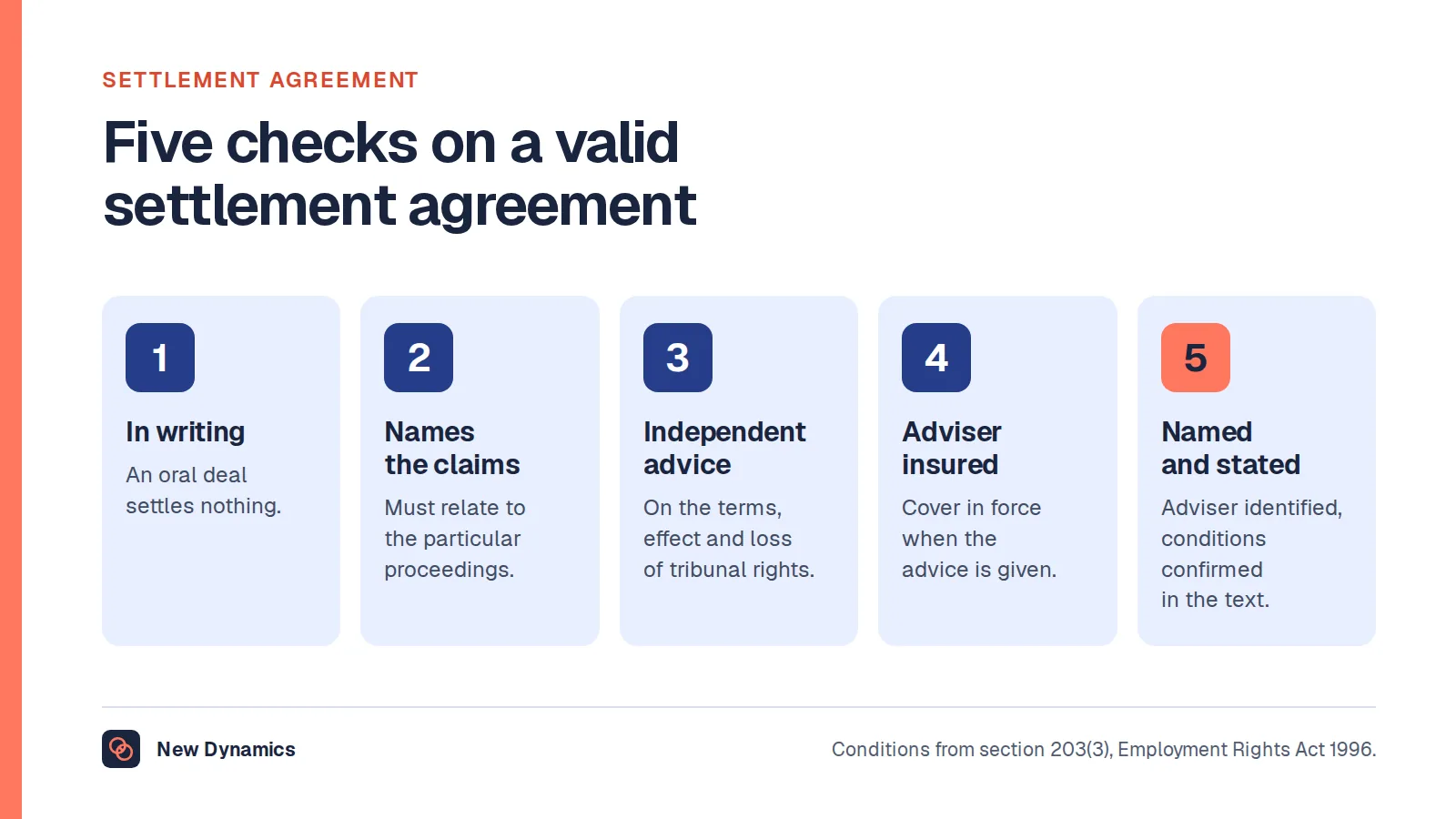
Where a variation is really a negotiated exit, the instrument is different again, and our post on settlement agreements covers that. Where terms are changed around a transfer, the restrictions are tighter, and our post on the TUPE transfer covers it.
Frequently asked questions
What is a contract variation?
A contract variation is a change to one or more terms of an existing contract of employment. Acas notes that changing a contract is sometimes called varying a contract, and says both sides can propose changes but both must agree to them, unless there is a clause in the contract allowing a change without agreement.
Can an employer change a contract without the employee's agreement?
Only in limited circumstances. GOV.UK tells employers they must get an employee's agreement to change their contract. A flexibility or variation clause may permit some change, but Acas says such clauses must only be used to make reasonable changes and with reasonable advance notice. Imposing a change without agreement puts the employer in breach of contract, in Acas's words, and risks claims of breach of contract or constructive dismissal.
How long does an employer have to confirm a contract variation in writing?
One month. Section 4(1) of the Employment Rights Act 1996 requires the employer to give the worker a written statement containing particulars of the change, and section 4(3) says it must be given at the earliest opportunity and in any event not later than one month after the change in question.
Does an employee have to sign a new contract for a variation to take effect?
No. Acas states that employees do not have to sign a new contract for changes to take effect. Conduct matters more than signature: Acas says an employee's actions could count as affirming the change where they continue to work under the changed terms and do not put an objection in writing.
What can an employee do if they refuse a contract change?
Acas describes three responses to an imposed change. They can work under protest, continuing on the new terms while telling the employer in writing, regularly, that they do not agree. They can resign and claim constructive dismissal if the change is a fundamental breach, though Acas warns such a claim can be very difficult to win. Or they can claim while still working, for example breach of contract, unlawful deduction from wages or discrimination.
Is fire and rehire still legal in the UK?
As at 7 November 2026 it remains lawful as a last resort, and the statutory Code of Practice on dismissal and re-engagement, in force since 18 July 2024, is the minimum procedure. A tribunal can increase an award by up to 25% where an employer has unreasonably failed to comply with it. GOV.UK's implementation timeline lists fire and rehire protections under measures that will take effect in March 2027, noting future dates remain subject to parliamentary processes and may change, and Acas says that in most cases fire and rehire will then be an automatically unfair dismissal.
Your next step: fix the record before you propose the change
- List every variation made in the past two years and check each was confirmed in writing within a month, as section 4(3) of the Employment Rights Act 1996 requires.
- Read your flexibility clauses against the change you actually want to make. If the clause does not describe that change in plain words, treat the route as agreement rather than clause.
- For any proposal that could end in dismissal, work to the 2024 code now, and diarise the revised code after the consultation closes on 17 December 2026.
- Count the affected employees before you set a timetable. Twenty at one establishment within 90 days changes the legal process, not just the paperwork.
- Decide where the variation record lives, and make sure superseded versions survive. One current document per person cannot answer what applied two years ago.
For the consultation sequence, the communication plan and the decision points in a workforce change, read and download our HR change management guide. The guide is free to read, and the PDF uses our short download form.
Want proposals, consultation records and signed confirmations held against each person with their dates intact? Book a New Dynamics demo and bring your current variation letter template. You can also email contact@new-dynamics.com.