TL;DR
- There is a free government route. GOV.UK says employers can use the 'Find a job' service to advertise jobs online, names the Department for Work and Pensions as the service's provider, and states that the service "is only available for England, Scotland and Wales", with a different service for Northern Ireland. The government's own employer campaign site says: "Post jobs for free on Find a Job, our easy-to-use online jobs board, reaching ready-to-work candidates."
- Free changes where the cost sits rather than removing it. A posting with no fee still consumes screening time, usually reaches a narrower or less predictable audience, and leaves you with no applicant record unless you build one. Acas suggests advertising "in at least 2 different ways or places" partly for that reason.
- A free advert carries the same duties as a paid one. In the United Kingdom, GOV.UK states that "You must not state or imply in a job advert that you'll discriminate against anyone" and warns that "Where you advertise might cause indirect discrimination". This article is general information and not legal advice.
The vacancy is approved, the manager wants someone in post next month, and there is no advertising budget. That is an ordinary situation in a small organisation, and the answer is not "pay for a posting anyway". There are real places a UK employer can advertise a vacancy for nothing, and one of them is run by the government.
This article answers a practical question: where to post jobs for free, what each channel is good for, and what the free version quietly costs you instead. It names no commercial job boards and ranks nothing, because we do not review or rank job boards.
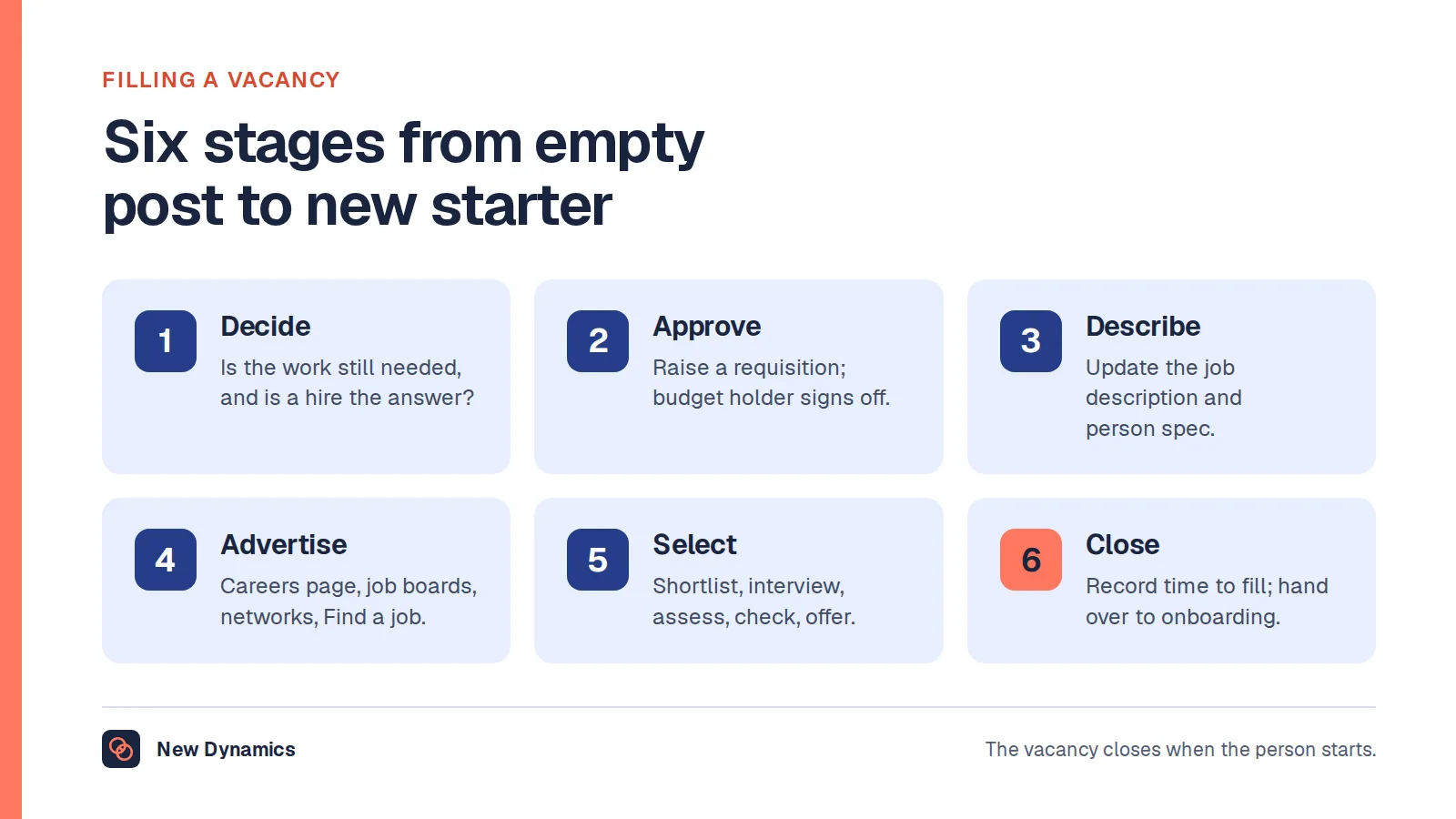
Advertising starts a process with approvals, stages and a decision somebody has to defend later. See how New Dynamics workflows let you define that process yourself rather than keep it in a spreadsheet and a mailbox.
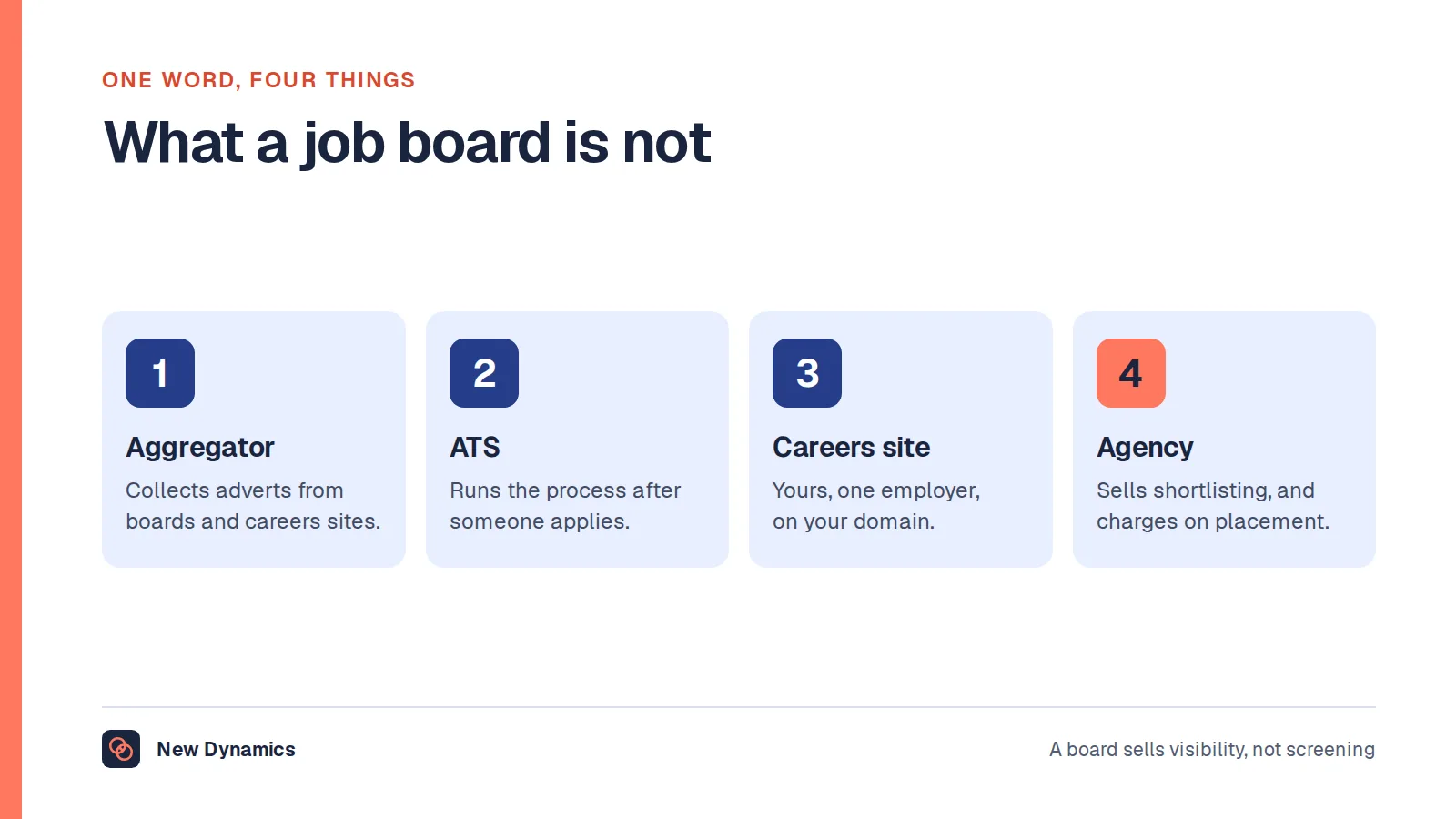
If you are unsure how a board differs from an aggregator, an applicant tracking system and a careers site, our post on what a job board is covers the category. This article only asks which of those places will take your vacancy without an invoice.
What "free" means when you advertise a vacancy
"Free job posting sites" is one phrase covering three different arrangements, and it is worth separating them before you choose.
- Genuinely free, permanently. A public service funded for the purpose, or a channel you already own. The government's Find a job service and your own careers page are the two clear examples.
- Free to post, paid to be seen. The listing costs nothing and the visibility costs money. Promotion, boosting, featured slots or sponsored placement are then offered as the way to get applications. This is the most common commercial model behind "free job posting", and the free tier is a sample rather than the product.
- Free for now. A trial, a launch offer, a first posting included. Worth using once, not worth building a hiring process around.
Free is not a bad choice, just a choice with a shape. Treat the first category as the foundation, use the second with open eyes, and ignore the third.
One note on context. In its Vacancies and jobs in the UK bulletin of 20 October 2026, the Office for National Statistics reported that "Vacancy estimates decreased on the quarter, with early estimates for July to September 2026 suggesting a decrease of 21,000 (2.9%) vacancies to 691,000, compared with April to June 2026; this is the first time the total has been below 700,000 since February to April 2021." That is the market a free advert sits in, for that reference period. For more published figures, see our HR statistics hub.

Find a job: the government service, free to employers
This is the one route that answers "where can I post a job for free" without a commercial catch, so it is worth being precise.
GOV.UK's advertise a job page says employers can use the "Find a job" service to advertise jobs online, and GOV.UK names the Department for Work and Pensions as the service's provider. The page is direct about two limits: "This service is only available for England, Scotland and Wales", and "There's a different service to advertise vacancies in Northern Ireland". It also says what to expect at the front door: "You'll need to sign in to use this service. If you do not have sign in details you'll be able to create them."
The cost is stated on the government's own employer campaign site, Recruit with Jobcentre Plus, last updated on 17 July 2026. It calls itself "The no-fee recruitment service with access to government funding for training and apprenticeships", and says plainly: "Post jobs for free on Find a Job, our easy-to-use online jobs board, reaching ready-to-work candidates."
So the summary for an employer with no budget is short. In England, Scotland and Wales there is a government job posting portal, it is free to employers, and you create an employer sign-in to use it. Northern Ireland has its own separate service.
What to expect from it
Treat it as distribution, not a hiring system. It publishes your advert and routes applications the way you choose. It does not sift, score, schedule or keep your records, which is the division of labour described in our post on what an applicant tracking system does.
So decide before you post how applications should reach you: an advert that sends fifty messages to a mailbox nobody owns is worse than no advert. And write for a stranger rather than for your intranet, because internal job titles cost you applications before anyone reads a word.
Setting up the employer account takes longer than clicking "post", and that is deliberate: a service anyone could publish to would fill with fake vacancies and lose its audience. If you hire repeatedly, do the setup once, before you need it.
Your own careers page: the free channel you already own
The cheapest place to post a job free is a page on your own website, and most small employers under-use it. Nobody charges you, nobody expires the advert, and the applicant arrives looking at you rather than at twelve employers in a list.
It only works if three things are true.
- One indexable page per vacancy, with a plain job title in the heading and the location in the text. A vacancy buried in a PDF, or added to one "Careers" page as a line of text, cannot be found.
- A visible date and a closing date. Candidates abandon careers pages showing roles from two years ago, and so do search engines.
- An application route that works on a phone, end to end, including any account creation. Test it on your own phone, on mobile data, before you promote it anywhere.
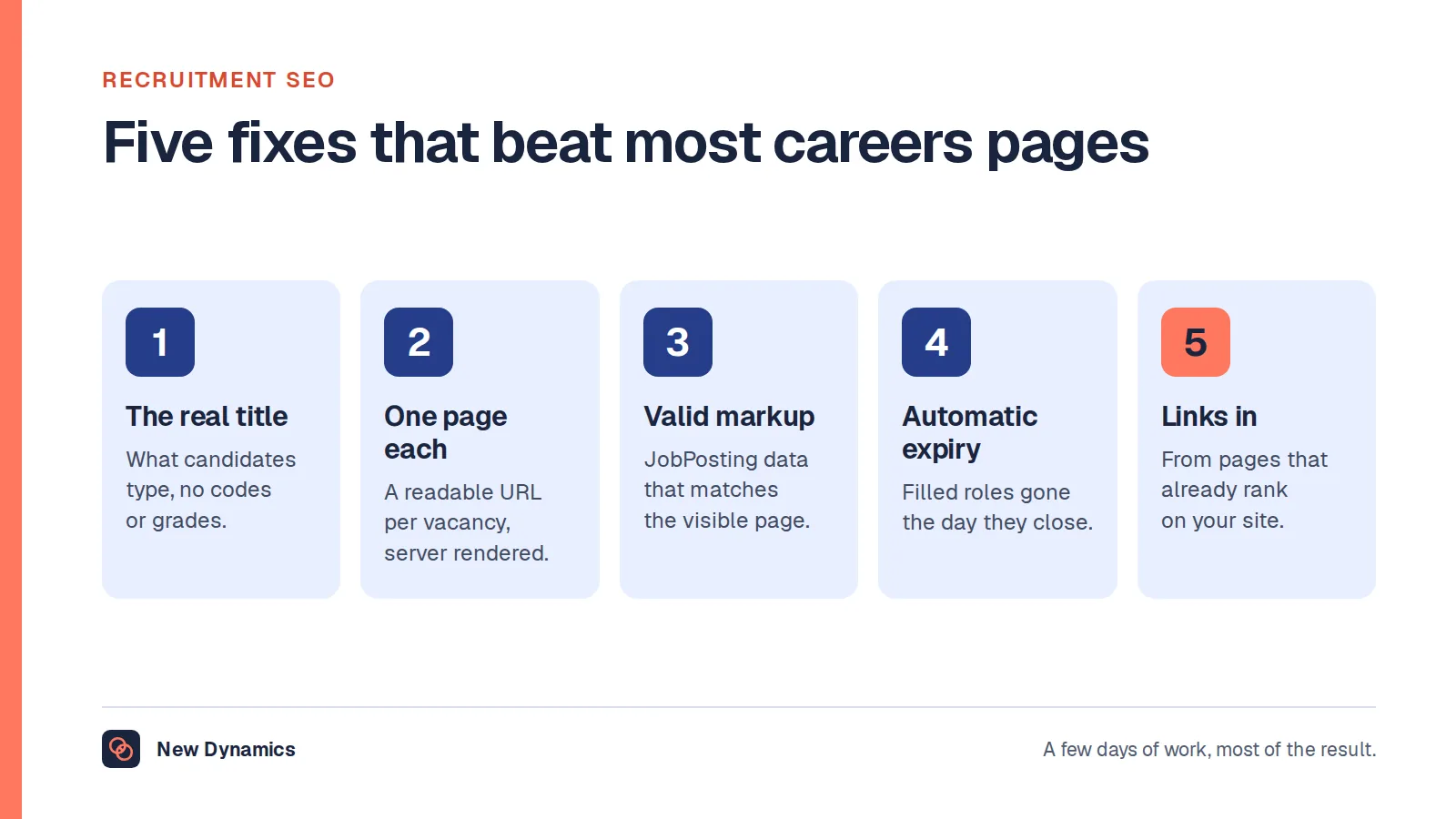
Our post on recruitment SEO covers the structured data, titles and expiry that decide whether your vacancy pages appear in search at all.
A careers page also does something no free job ads site can: it is the destination every other free channel points at. Write the advert once, publish it there, and link to it from everywhere else. That is the biggest time saving in a no-budget hiring process.

Social and professional networks
Networks are free to post on, and they are where "free" most often means "free to publish, paid to reach". A small organisation's page post reaches a fraction of its followers unless something pushes it further, and that is usually money or your own staff.
- Your own page or profile. Publish the vacancy as an ordinary post, in plain language, with a link to your careers page and a named person to ask questions. One post, not a campaign.
- Your staff. Ask the team to share it, voluntarily. A share from a real employee reaches people a page post never will.
- Professional networks. Useful where the people who do the job are visibly on the network. Much weaker for shift work, site work and most frontline roles.
- Groups and communities. Local, trade, professional and alumni groups. Read the rules first: many allow vacancies only on certain days or in certain threads.
There is a fairness problem in this channel, and the official guidance names it. Acas's guidance on how to advertise a job warns that "If you put an advert on Facebook it might only be seen by people from a certain background or age range." GOV.UK puts the same point in legal terms, saying that "Where you advertise might cause indirect discrimination". Both are reasons to treat a social post as one of several channels rather than the whole advert.
Posting a vacancy on a Facebook Page
The dependable version of posting a job on Facebook is the one that has not changed in a decade: publish it as a post on your organisation's Page.
Write a short post with the job title in the first line, the location and pay next, a line or two about the work, and a link to the full advert on your careers page. Pin it while the vacancy is open, ask colleagues to share it, and answer comments quickly.
Keep the application itself off the comment thread. Applications in public comments are a data protection problem as well as an administrative mess, because they put candidates' personal information in front of every visitor.
Facebook's job posting feature: what we could not verify
Search for how to post a job on Facebook and you will find instructions for a dedicated jobs feature, with applications collected inside the platform and managed from the Page. That feature has been introduced, changed and withdrawn in different countries at different times.
We tried to confirm its current state before describing it. On 5 November 2026 we opened Meta's own Help Centre pages for the jobs product, including the page titled "Update on the Facebook Jobs product", and could not retrieve their content: they returned an error or served no readable text. So we will say exactly that rather than describe a feature we could not verify.
Check Meta's Help Centre, or your Page's current publishing options, before planning around a jobs feature. If a dedicated job post option appears, it costs nothing to use. If it does not, the Page post above is the version that works, and it does not depend on a product decision outside your control.
Local and sector channels that cost nothing
These are the channels most employers forget, and often where the best free applications come from, because the audience is smaller and far more relevant.
- Trade and professional bodies. Many run a sector vacancy page or a members' newsletter, and a good number carry members' vacancies at no charge. If you are a member, you may already be paying for it.
- Local authority and community job pages. Councils, employment hubs and community organisations often publish local vacancies as part of their own employment work.
- Physical notice boards. Libraries, community centres, places of worship, shop windows and the staff room. For local, part-time and shift roles these still work.
- Sector newsletters and forums. A mailing list with four hundred readers who all do the job can outperform a general audience of hundreds of thousands.
- Your own network of similar employers, where a good candidate you could not hire this month hears about a role elsewhere.
The limitation: these channels are patchy and not searchable in one place, and what exists in Carlisle is not what exists in Croydon. Finding them is the work, and you do it once per area and sector. Write the list down.
Universities, colleges and apprenticeship routes
For early-career roles, the education sector is a free channel built for the purpose and staffed by people whose job is to help you use it.
- University careers services. Most run a vacancy service for students and graduates, often free to employers, particularly for graduate roles, placements and internships.
- Further education colleges. Underused, and often the better route for technical, trade and administrative roles. Colleges want local employers to take their leavers.
- Apprenticeships. There is a separate government route for advertising apprenticeship vacancies, and colleges and training providers usually advertise as part of taking on an apprentice. The government's employer campaign also describes funding attached to apprenticeships and to hiring young people, so start with the provider.
- Alumni networks and student societies, which are free, specific and fast.
One caution. Targeting your advertising at recent leavers is not the same as writing "recent graduate" in the advert. The first is a channel decision. The second is wording both Acas and GOV.UK give as an example of possible age discrimination.
Jobcentre Plus: the free support behind the free advert
Posting on the government service is the self-service version. There is a staffed version alongside it, also at no charge.
The government's employer campaign site says: "Whether you have 1 vacancy or 100, our Recruitment Consultants are here to help you find the right people for your business." It describes the offer as covering everything "From advertising your vacancies and sifting applications to guidance on sector-specific training, apprenticeships and work experience", and says "we can tailor our no-fee service to meet your recruitment needs". The page gives an enquiry form and a number for Employer Services, 0800 169 0178.
One note on expectations. The site's own terms state that "Employers need to have a vacancy to access the vacancy-filling services", and that some of the enhanced services depend on employers being "prepared to consider Jobcentre Plus candidates for their roles". Better to know that before the call.
This suits employers hiring for volume, for entry-level and frontline roles, or in one local labour market. It suits a single senior specialist hire least, because the audience is unlikely to be there.
What we will not tell you, and why
Many searches behind this article are really asking us to rank commercial sites: which free job ads site is best, which free job posting portal gets the most applications. We do not answer that.
Commercial boards change their free tiers, coverage, terms and pricing continually, and often by employer size, sector and country. A ranked list published today is wrong within months. We also sell performance management software rather than recruitment advertising, so a league table from us would be an opinion dressed as research.
Here is the test instead. For any free job posting site, ask these questions.
- What is free, exactly? The posting, the duration, the number of live vacancies, the applications, or the visibility. Get it from the site's own terms.
- How long does the free listing stay live, and what happens when it expires.
- Where do applications go? Your mailbox, their system, or a portal you have to log into and will forget about.
- Does it reach the people who do this job, or people who search for jobs generally.
- What does it do with candidate data, and what are applicants told. A free service still has to answer this, and so do you.
- What is the upgrade path, and what happens to your advert if you do not take it.
That list works on any site, next year as well as this one. For when a system is worth paying for, see our post on choosing recruiting software.
What free actually costs you

No fee does not mean no cost. It means the cost has moved somewhere nobody invoices, which is usually somebody's week.
- Screening time. The big one. A free, broad channel produces more applications that do not match the role, and each has to be read by a person for the process to stay fair. That is the cost people leave out of every cost-per-hire calculation.
- Reach, and its predictability. A paid posting buys a known audience. Free channels give a less predictable one: fine for a local administrator, poor for a specialist role with forty qualified people in the country.
- No applicant tracking. The hidden one. Free postings leave applications in a mailbox: no single record per candidate, no record of who was rejected and why, no audit trail six months later.
- Your own time, repeatedly. Four channels mean four posting jobs, four sets of questions, four places to take the advert down. Write once and link, or this multiplies.
- A fairness risk if every channel is the same. If all your channels reach broadly the same kind of person, your applicant pool narrows in a way that is hard to see from the inside.
The useful comparison is not free against paid. It is free plus four hours of your time against paid plus one hour, for this vacancy, at this urgency. Sometimes free wins comfortably. Sometimes one paid posting is cheaper once you price the reading.
The legal and fairness points of a free advert
A free advert is held to the same standard as one you paid for. This section describes the position in the United Kingdom and is general information, not legal advice. Take advice on your own facts.
What should appear
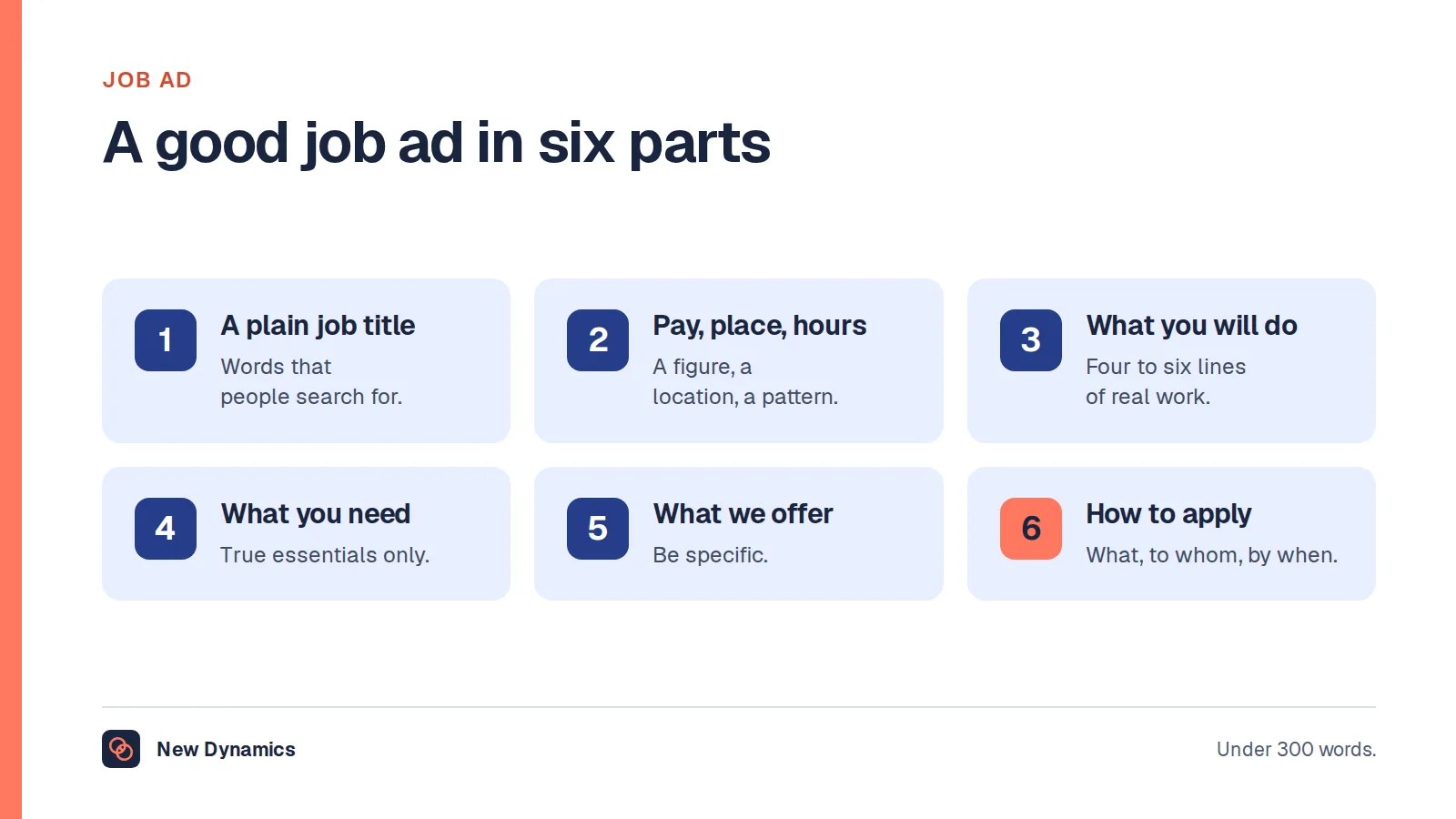
Nothing in the free route changes what makes an advert work, and most of what makes it work also lowers your legal risk, because specificity keeps an advert about the job rather than about the applicant.
- The job title, in words people outside your organisation use.
- The location and working pattern: site, hybrid days, shifts, hours.
- The pay, or a range, covered below.
- A few specific lines on what the person will actually do.
- What is genuinely essential, separated from what is desirable.
- How to apply, to whom, and by when.
- A named contact for questions about reasonable adjustments.
Our post on how to write a job ad has the full structure and a sample you can copy.
What must not appear
GOV.UK's guidance on discrimination in recruitment is short and clear on the advert itself: "You must not state or imply in a job advert that you'll discriminate against anyone." It adds the channel point already quoted, that "Where you advertise might cause indirect discrimination".
On health and disability, the same guidance limits when you can ask at all: "You can only ask about health or disability if: there are necessary requirements of the job that cannot be met with reasonable adjustments", if you are finding out whether someone needs help to take part in a selection test or interview, or if you are using positive action to recruit a disabled person. A question about sickness absence does not become acceptable because the posting was free.
Acas puts the same duty plainly: "You must not ask for or exclude anyone with a certain protected characteristic. This could be discriminatory."
Wording that creates risk
The examples in the official guidance are worth learning, because they are the ones that appear in adverts written in a hurry.
- Age. "Recent graduate" and "highly experienced" are both named as phrases that can discriminate on age. Say what the job needs instead: the skill, the responsibility, the qualification.
- Sex. "Barmaid" and "handyman" imply a sex. Bar staff and maintenance assistant do not.
- Race and nationality. Specifying a nationality rather than a language can discriminate on race. If the job needs German, ask for a German speaker, not for a German.
- Clothing and appearance requirements are also flagged by Acas, so check any dress code you were about to put in the advert.
- Culture language. "Young, dynamic team" and "digital native" describe the applicant you imagine rather than the work.
One editorial test catches most of it: every requirement should describe the job, not the person. If a line describes the person, tie it to a task or delete it.
Stating pay
Publish the pay or a range. Candidates ask anyway, and in a free channel with no promotional push behind it a stated salary is one of the few things that makes people stop and read.
Pay also has a floor. GOV.UK's National Minimum Wage and National Living Wage rates page states that "The rates change on 1 April every year", and for April 2026 lists the rate for "21 and over", the National Living Wage, as £12.71 an hour, "18 to 20" as £10.85, and both "Under 18" and "Apprentice" as £8. If the advert is for hourly-paid work, check the figure against the rate for the band, and check it again if the vacancy straddles 1 April. A lawful rate today can be an unlawful one next quarter.
The right to work check comes later
This one affects the wording of the advert. GOV.UK's guidance on checking a job applicant's right to work says "You must check that a job applicant is allowed to work for you in the UK before you employ them", and warns that "You could face a civil penalty if you employ an illegal worker and have not carried out a correct right to work check." The timing is the point: before you employ them, not before they apply.
The same guidance also says "You must not discriminate against anyone because of where they're from." An advert that demands nationality documents up front, or tells whole groups of people not to apply, creates a discrimination risk while doing nothing for your compliance position. Say in the advert that the successful candidate will need to provide evidence of their right to work in the UK, and run the check properly before employment starts.
A free posting plan for one vacancy
Here is the order that wastes the least time.
- Write the advert once, to the structure above, as a page on your own site. Everything else links to it.
- Check the wording against the Acas and GOV.UK examples, before publication rather than after a complaint.
- Publish on the government service if you are in England, Scotland or Wales, or on the Northern Ireland service, with the employer account created in advance.
- Choose two more channels that reach the people who do this job. Acas suggests advertising "in at least 2 different ways or places", and asks you to "Consider whether the places you advertise reach a diverse range of people."
- Ask your staff to share it, voluntarily, with the link to your own page.
- Decide where applications land, and who owns that mailbox, before the first one arrives.
- Record the source of every application, by asking on the form rather than guessing afterwards.
- Take the advert down everywhere when it closes, and reply to everyone who applied. That second half is the one free hiring processes skip, and the one candidates remember.
Half a day of work, no invoice, and a process you could explain to someone who challenged it.
What to measure when nothing is paid for
Free channels tempt you to skip measurement. Measure anyway: the scarce resource is your time, and you are about to hire again.
- Applications by source, recorded rather than estimated. If the source is a guess, every number after it is fiction.
- Shortlist rate by source. Fifty applications producing one interview is worse than eight producing three.
- Hires by source, over several vacancies, because one hire tells you nothing about a channel.
- Hours spent screening per channel. The number that tells you whether free was actually cheap.
- Who applied, in aggregate, if you collect diversity monitoring information separately from selection. Acas's list of what to send applicants includes "an equality and diversity monitoring form", and the point of collecting it is to look at it.
Two vacancies' worth of these numbers will tell you more about where to post job vacancies for free than any list of sites, including this one.
Frequently asked questions
Where can I post a job for free in the UK?
Start with the government service. GOV.UK says employers can use the "Find a job" service to advertise jobs online and names the Department for Work and Pensions as its provider, and the government's employer campaign site says "Post jobs for free on Find a Job, our easy-to-use online jobs board". That service covers England, Scotland and Wales, with a separate service for Northern Ireland. Then use your own careers page, your networks, local and sector channels, and colleges or university careers services for early-career roles.
Are free job posting sites any good for employers?
They work, with a known shape. The government service and your own careers page cost nothing permanently. Commercial free tiers usually let you publish at no charge and then sell visibility, which is a sample rather than the product. The test is what is free exactly, how long the listing lives, where applications go, and whether the audience includes people who do your job. We do not rank job boards, so check the site's own terms.
How do I post a job on Facebook?
Publish it as a post on your organisation's Page: job title in the first line, location and pay next, a short description, and a link to the full advert on your own site. Pin it while the vacancy is open and ask colleagues to share it. Facebook has also offered a dedicated jobs feature at various times, and it has changed repeatedly. We opened Meta's own help pages on 5 November 2026 and could not retrieve their content, so we cannot confirm what it does today. Check Meta's Help Centre or your Page's current publishing options first.
Does a free job advert still have to follow the law?
Yes. In the United Kingdom the duties are the same whether you paid or not. GOV.UK states that "You must not state or imply in a job advert that you'll discriminate against anyone", and warns that "Where you advertise might cause indirect discrimination". Right to work checks happen before employment starts rather than before someone applies, and hourly pay must meet the minimum wage rate for the worker's age band. This is general information, not legal advice.
How many free places should I post a vacancy?
At least two, and chosen deliberately. Acas advises advertising "in at least 2 different ways or places" and asks employers to "Consider whether the places you advertise reach a diverse range of people". Three or four is the practical ceiling for a small team, because each extra channel adds posting, answering and taking-down work.
Is there a catch with free job posting portals?
Usually one of three. Visibility is the paid upgrade, so the free listing sits where few people look. Applications land in a portal you have to log into rather than your mailbox. Or the listing expires quickly and quietly. None of that is hidden: it is in the terms, and reading them takes less time than a week of wondering why nobody applied.
Your next step: one advert, three channels, one record
- Write the advert once as a page on your own site, and check the wording against the Acas and GOV.UK examples before it goes live.
- Set up the government employer account now, so the next vacancy takes minutes.
- Add two more free channels chosen for who they reach, and ask the team to share the link.
- Record the source of every application, and compare shortlist rates rather than application counts.
For the process after the advert, including criteria, shortlisting, scoring and a decision you can defend, read and download our recruitment and selection guide. The guide is free to read, and the PDF uses our short download form.
Once someone accepts, the question is whether their first ninety days and first review actually happen. Book a New Dynamics demo and bring the process you run today. You can also email contact@new-dynamics.com.