TL;DR
- A construction site manager runs the site: the programme on the ground, the sequence of trades, the subcontractors, the quality, the records and the safety of everyone who comes through the gate. The National Careers Service lists site manager as an alternative title for construction manager, a job it describes as organising building projects to make sure they are completed safely, within budget and on time, with typical hours of 41 to 43 a week.
- The safety part is not a paragraph at the end of the advert. On a project in Great Britain with more than one contractor, the site manager normally acts for the principal contractor, who under regulation 13 of the Construction (Design and Management) Regulations 2015 must plan, manage and monitor the construction phase and coordinate matters relating to health and safety during it. The same regulations require a construction phase plan and a suitable site induction.
- HSE's report Construction statistics in Great Britain, 2025, published on 20 November 2025 with data up to March 2025, records 35 fatal injuries to workers in 2024/25p, a provisional figure, against an annual average of 40 over 2020/21 to 2024/25p. Falls from a height accounted for 53% of deaths over that five-year period. This article is general information and no substitute for competent safety advice.
A construction site manager is judged on whether thirty or forty people, almost none of them on the payroll, went home in the same condition they arrived, and on whether the building moved a day closer to finishing while that happened. That makes a site manager construction job description hard to write: adverts are strong on the programme and weak on the part carrying personal consequences.
A site manager's objectives are easy to name and hard to review fairly: a programme held, a defect avoided, a near miss reported rather than buried. See how New Dynamics performance reviews let you run the cycle on your own form, so what the site manager is accountable for sits in one place instead of three spreadsheets. This is general information about the role and the law named, not legal advice, and no substitute for competent safety advice.
What a construction site manager does
The National Careers Service, the government's careers service in England, publishes no profile titled site manager. It publishes a construction manager profile and lists "Site manager" as an alternative title for it: "Construction managers organise building projects to make sure they're completed safely, within budget and on time."
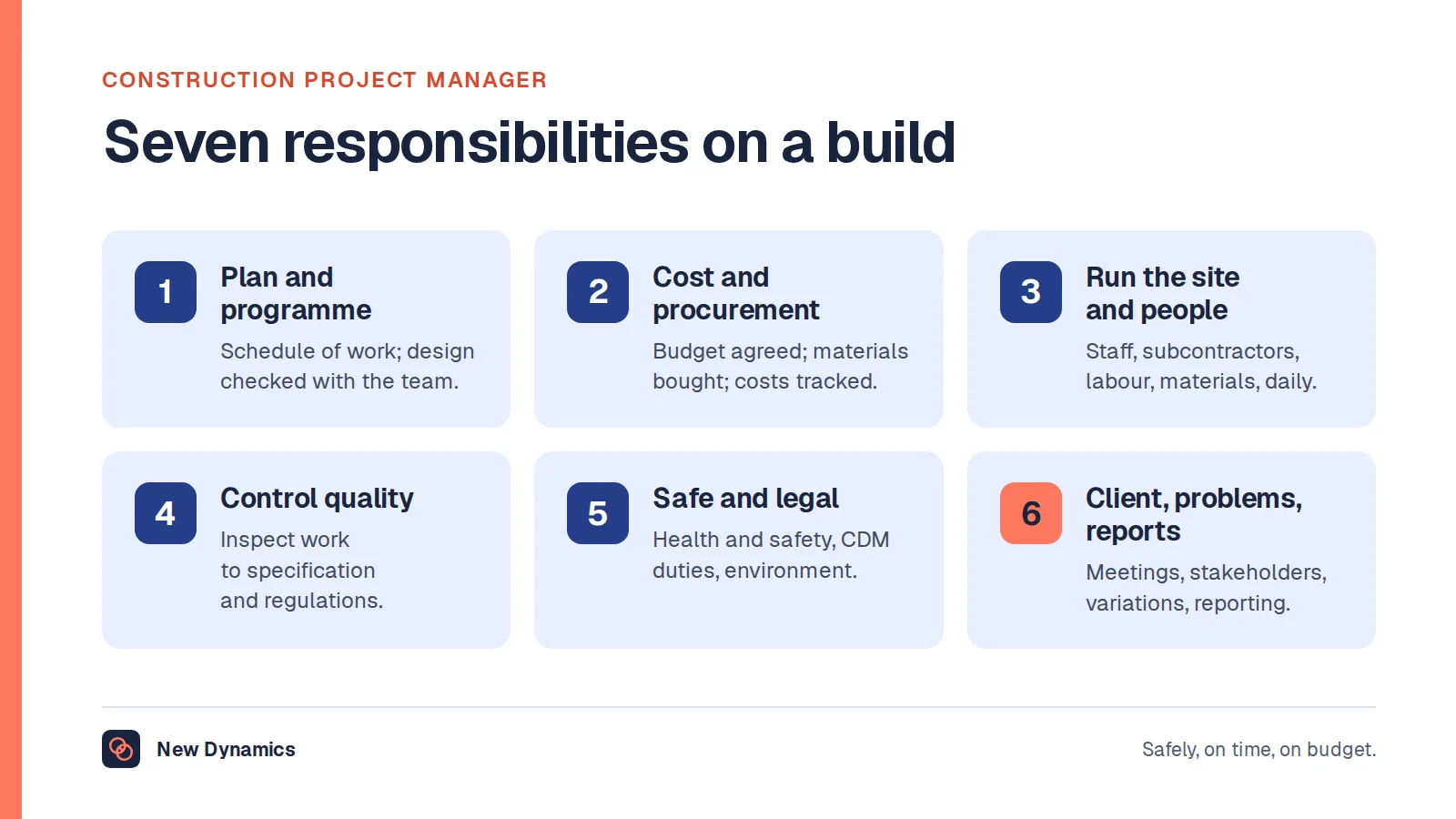
Its day-to-day tasks are to review plans with architects, surveyors and engineers; hire staff and make sure the site has the materials it needs; organise work schedules; monitor progress and costs; check the quality of the work; report progress to clients and local communities; and "maintain and promote health and safety". The working environment "may be outdoors in all weathers, at height and you may spend nights away from home", typical hours are 41 to 43 a week, and a driving licence is required.
One complication. The service also publishes a construction site supervisor profile whose alternative titles include "Building site manager, site inspector, clerk of works". Site manager therefore sits against two official profiles with two different jobs behind them, so the advert has to describe the job rather than rely on the name. In practice the site manager holds the site: what happens on this scaffold, in this excavation, this morning, is their decision.
The day, and the project
Across a day. Before the gates open: the forecast, today's deliveries, who has access where, what the security log left behind. Then the briefing, the permits, and the walk. The afternoon is programme defence. At the end, the records, the handover note and making the site secure.

Across a project. Mobilisation sets the site up: access, hoarding, welfare, storage, traffic routes, the construction phase plan. HSE's guidance on planning for construction work says to find out about the history of the site and its surroundings, paying attention to "asbestos or other contaminants", "overhead power lines and underground services", "unusual ground conditions" and "nearby schools, footpaths, roads or railways". Most of a site manager's worst weeks were decided here.
Substructure, superstructure, fit-out and handover each ask something different, so say which stages the post covers.
Site manager, project manager, contracts manager, site supervisor
Four titles, often on one project, with boundaries that move:
| Role | Scope | Owns |
|---|---|---|
| Site supervisor | A trade, gang or section | Today's work in one area, under the site manager |
| Site manager | The site | Who is on it, the short-term programme, safety, quality |
| Project manager | The project | The whole programme, the budget, the client |
| Contracts manager | Several projects | The contracts, the commercial position, the managers |
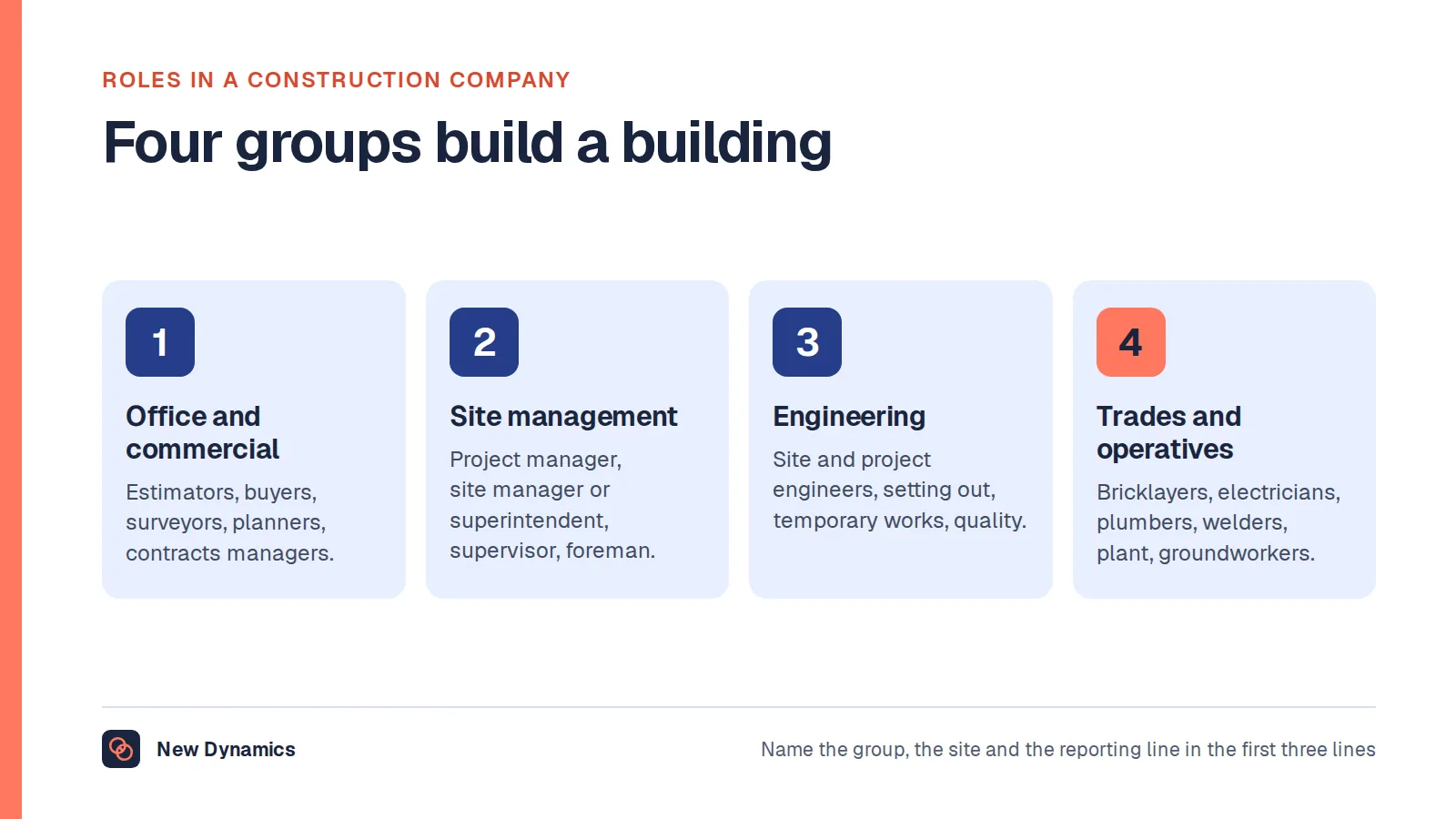
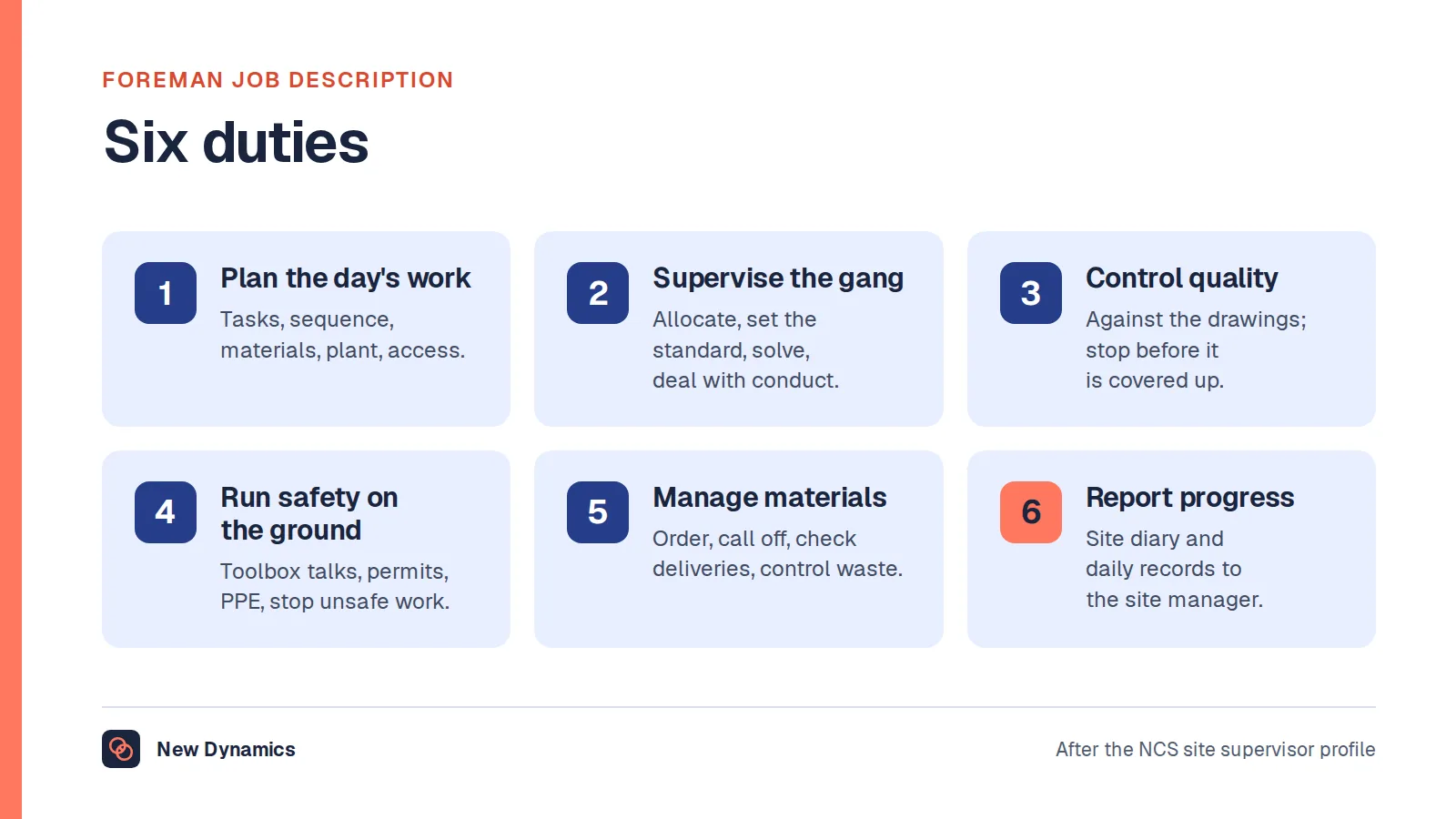
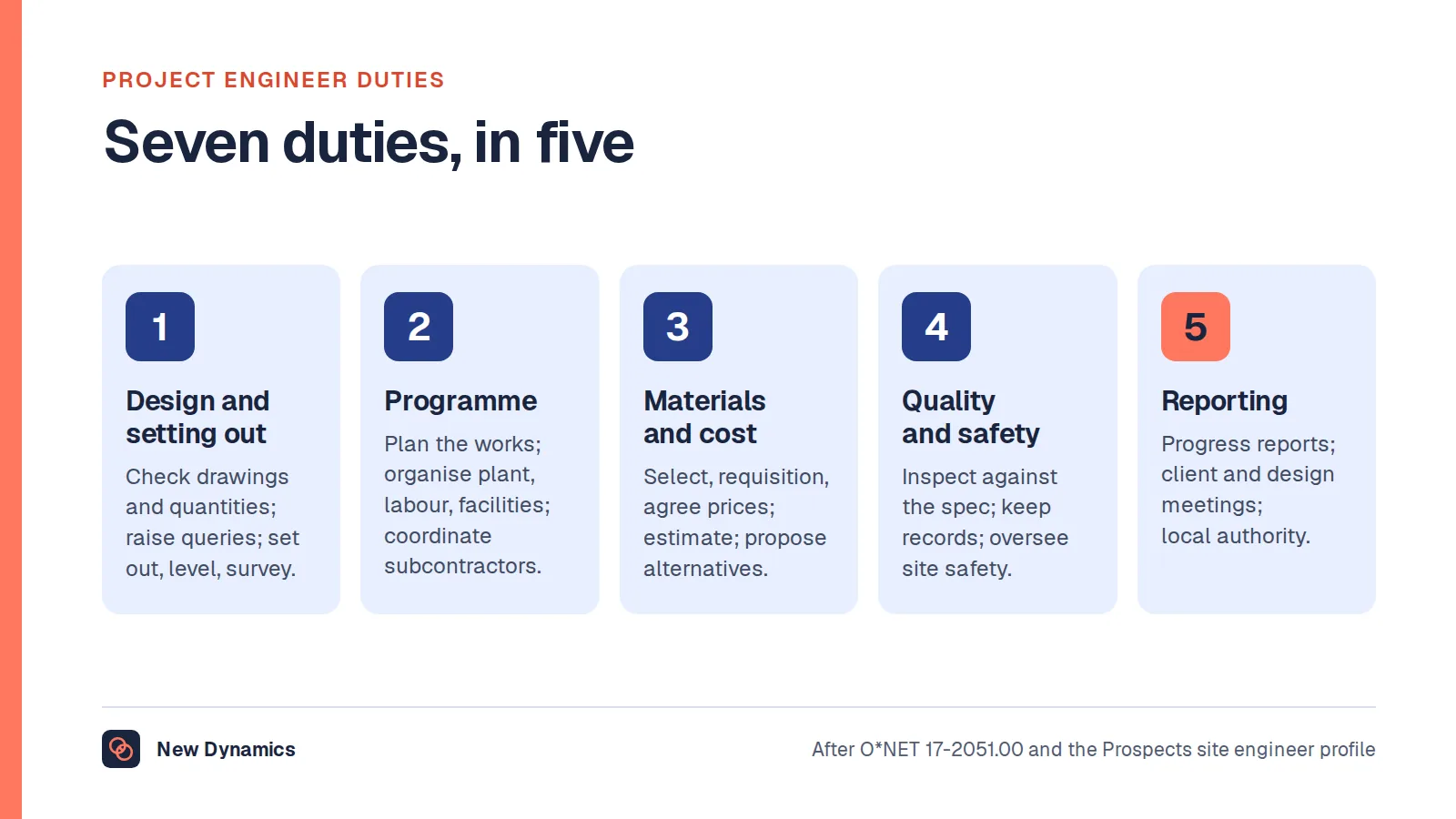
The National Careers Service describes a construction contracts manager as overseeing "the contractual and legal requirements of work on building projects", with typical hours of 38 to 40 a week worked "between 8am and 6pm". The contracts manager is not the person waiting for the concrete. Our construction project manager job description covers the role above, our foreman job description the role below, and the project engineer job description the engineers alongside.
The commercial side: programme, sequencing, variations and delay
Site managers are rarely handed a budget to defend, and are almost always the person whose decisions move it.
Programme and sequence. The site manager's version is the two or four week look-ahead, where contract logic meets the weather, the delivery and the subcontractor who sent four people instead of eight. The expensive mistakes are sequence, not productivity. HSE's planning guidance asks you to work out "which trades will need to go where and when". A sequence that is unsafe is usually also slow.
Subcontractors. Most of the work is subcontracted, so the levers are the order of the trades, the attendance given (access, power, lighting, craneage) and the record of what was provided. HSE says to "discuss proposed working methods with contractors before letting contracts".
Variations and delay. A site manager does not value a variation, but generates the evidence that decides who pays for it: the instruction given verbally, the day the area was unavailable, the people stood down, the hour the delivery arrived. Make that a duty rather than a habit, and write the trade-off between programme, cost, quality and safety into the performance goals instead of discovering it later.
The people side: most of the workforce is not yours
This is what makes the job unlike other management roles. A site manager directs bricklayers employed by one company, scaffolders by another, a partly self-employed groundworks gang, an agency labourer on their first day, and a client representative who wants to walk the building in trainers. None are on the payroll; all are their responsibility.
No line management authority, full responsibility. You cannot discipline a subcontractor's operative. You can remove them from site, escalate to their employer and refuse to let work start. Those are blunt instruments that cost programme, so the job runs on consistency.
Induction is the one moment you control. HSE's page on site rules and induction states that "Every site worker must be given a suitable site induction" and that it "should be site specific and highlight any particular risks ... and control measures that those working on the project need to know about".
Language and turnover. The same guidance says site rules "should be clear and easily understandable", with translations considered where there are non-English speaking workers on site. On a high-turnover site, a rule explained in March is not a rule the September workforce has heard.
Reporting works against the grain. HSE notes that reported injury data "needs to be interpreted with care since it is known that non-fatal injuries are substantially under-reported, especially for the self-employed". A self-employed bricklayer losing a week's work is not waiting for sick pay, so near misses get reported only where reporting is never punished.
The safety duties: CDM 2015 and the principal contractor
Everything in this section is the law of Great Britain, meaning England, Scotland and Wales. Regulation 3 of the Construction (Design and Management) Regulations 2015 says they apply "in Great Britain", and to certain premises and activities outside it. Northern Ireland is not covered and has its own equivalent, the Construction (Design and Management) Regulations (Northern Ireland) 2016.
The duty holders
HSE publishes a summary of duties under CDM 2015. Commercial clients must "make suitable arrangements for managing a project", including appointing the other duty holders and making sure "sufficient time and resources are allocated"; a domestic client's duties normally transfer to the contractor or principal contractor. Designers must eliminate, reduce or control foreseeable risks arising during construction and during "the maintenance and use of a building once it is built". Principal designers plan, manage, monitor and coordinate health and safety in the pre-construction phase and principal contractors in the construction phase, and workers must "report anything they see which is likely to endanger either their own or others' health and safety".

Under regulation 5, where there is more than one contractor, or it is reasonably foreseeable that there will be, the client "must appoint in writing" a principal designer and a principal contractor before the construction phase begins. The duty holder is the organisation; the site manager is normally the person through whom the principal contractor discharges it on site, so the appointment and the job description should be read against each other.
What the principal contractor must do
Regulation 13 is the core of it. As worded, regulation 13(1) says:
"The principal contractor must plan, manage and monitor the construction phase and coordinate matters relating to health and safety during the construction phase to ensure that, so far as is reasonably practicable, construction work is carried out without risks to health or safety."
Regulation 13(2) adds that when deciding "design, technical and organisational aspects ... in order to plan the various items or stages of work which are to take place simultaneously or in succession", and when "estimating the period of time required to complete the work or work stages", the principal contractor "must take into account the general principles of prevention". That is a programming duty inside a safety regulation, and the clause most often forgotten when a date is pulled forward.
Regulation 13(3) requires the principal contractor to "organise cooperation between contractors (including successive contractors on the same construction site)" and to "coordinate implementation by the contractors of applicable legal requirements for health and safety". Regulation 13(4) requires it to ensure that "a suitable site induction is provided", that "the necessary steps are taken to prevent access by unauthorised persons to the construction site", and that welfare facilities complying with Schedule 2 "are provided throughout the construction phase".
Regulation 14 adds consultation: the principal contractor must "make and maintain arrangements" enabling it and the workers "to cooperate effectively in developing, promoting and checking the effectiveness of measures to ensure the health, safety and welfare of the workers", and must consult them "in good time on matters connected with the project which may affect their health, safety or welfare".
HSE's principal contractors page states the competence requirement plainly: principal contractors "must have the skills, knowledge, experience and, where relevant, organisational capability to carry out this work".
The construction phase plan
Regulation 12(1): "During the pre-construction phase, and before setting up a construction site, the principal contractor must draw up a construction phase plan, or make arrangements for a construction phase plan to be drawn up." Regulation 12(2) says it "must set out the health and safety arrangements and site rules taking account, where necessary, of the industrial activities taking place on the construction site and, where applicable, must include specific measures concerning work which falls within one or more of the categories set out in Schedule 3".
It is not written once. Regulation 12(4) requires the principal contractor to ensure throughout the project that it "is appropriately reviewed, updated and revised from time to time so that it continues to be sufficient to ensure that construction work is carried out, so far as is reasonably practicable, without risks to health or safety". A plan that still describes the site as it was at mobilisation has not been reviewed, updated and revised in the way that wording requires.
HSE's short guide for small jobs says "a construction phase plan is required for every construction project. This does not need to be complicated." Among its essential points are naming "the person responsible for ensuring the job runs safely" and explaining "how supervision will be provided": on most projects both answers are the site manager.
Site induction and site rules
HSE's induction guidance says the construction phase plan "must set out the health and safety arrangements and site rules during the period construction work is carried out and suitable site inductions must be provided". Its suggested topics for site rules lift straight into a job description: "Personal protective equipment; Use of radios and mobile phones; Smoking; Restricted areas; Hot works; Traffic management systems; Pedestrian routes; Site tidiness; Fire prevention; Permit-to-work systems; and Emergency arrangements." For the induction itself it names senior management commitment, an outline of the project and how it is managed, first-aid and incident reporting arrangements, ongoing briefing such as toolbox talks, and the individual worker's responsibility for health and safety.
What kills and injures people in construction
These are HSE's own figures, from "Construction statistics in Great Britain, 2025", published on 20 November 2025 with data up to March 2025. The report states that "p is used in this document to indicate provisional figures due to be finalised in 2026", so every figure carrying that marker is provisional.
Deaths. "There were 35 fatal injuries to workers in 2024/25p", against "the annual average number of 40 fatalities for 2020/21-2024/25p", and "53% of deaths over the same five-year period were classified as Falls from a height". "The fatal injury rate in Construction is 1.92 per 100,000 workers", which HSE says "is around 4.8 times the all industry rate", averaged over 2020/21 to 2024/25p.
Non-fatal injuries. On a Labour Force Survey average estimate over 2022/23 to 2024/25, there were "an estimated 50,000 workers who reported sustaining a workplace non-fatal injury", and "29% of these workplace non-fatal injuries resulted in absence from work of over 7 days". Around 2.5% of workers in the sector sustained one, a rate HSE calls "statistically significantly higher than that for workers across all industries (1.8%)". Employers separately reported "3,726 non-fatal injuries to employees ... under RIDDOR in 2024/25p".
Ill health. Over the same three-year period there were "an estimated 79,000 workers suffering from work-related ill health (new or long-standing)" and "53% were musculoskeletal disorders". Dust, noise, vibration and manual handling are managed by the same sequencing decisions as the obvious risks. These survey estimates carry 95% confidence intervals, so use a national figure to decide which risks get the first hour of your week, not as a target for your site. For the figures we use, with the reference period named for each, see our HR statistics hub.
Work at height, the largest single killer
HSE's guidance on assessing all work at height states it without qualification: "Work at height is the biggest single cause of fatal and serious injury in the construction industry, particularly on smaller projects." It adds that "Over 60% of deaths during work at height involve falls: from ladders, scaffolds, working platforms and roof edges".
The law for Great Britain is the Work at Height Regulations 2005, which regulation 3 says apply "in Great Britain" and, as provided, outside it; Northern Ireland has the Work at Height Regulations (Northern Ireland) 2005. Regulation 4(1) is the duty a site manager discharges every day: every employer must ensure that work at height is "properly planned", "appropriately supervised" and "carried out in a manner which is so far as is reasonably practicable safe".
Two further parts of the same regulation are routinely missed. Regulation 4(2): "Reference in paragraph (1) to planning of work includes planning for emergencies and rescue." A harness with no rescue plan is half a control. Regulation 4(3) adds that work at height must be "carried out only when the weather conditions do not jeopardise the health or safety of persons involved".
Regulation 6 sets the order. Regulation 6(2): "Every employer shall ensure that work is not carried out at height where it is reasonably practicable to carry out the work safely otherwise than at height." Where it is, regulation 6(3) requires "suitable and sufficient measures to prevent, so far as is reasonably practicable, any person falling a distance liable to cause personal injury", and only where those do not eliminate the risk does regulation 6(5) bring in equipment to minimise the fall.
HSE says the hierarchy "must be followed systematically" and that "It is not acceptable to select work equipment from lower down the hierarchy e.g. personal fall arrest, such as harnesses and lanyards in the first instance".

RIDDOR: what gets reported, and by whom
In Great Britain the reporting duties sit in the Reporting of Injuries, Diseases and Dangerous Occurrences Regulations 2013; Northern Ireland has the Reporting of Injuries, Diseases and Dangerous Occurrences Regulations (Northern Ireland) 1997.
Who reports. Regulation 3 defines the "responsible person". For an injury to an employee it is "that employee's employer". For "a person not at work or a self-employed person, or in relation to any other dangerous occurrence" it is "the person who by means of their carrying on any undertaking was in control of the premises where the reportable or recordable incident happened, at the time it happened". On a subcontracted site that decides who reports.
What gets reported. HSE's guidance on types of reportable incident says a report "is only required when the accident is work related, and it results in a reportable injury". The categories are deaths, the specified injuries in regulation 4, over-seven-day incapacitation, injuries to people not at work taken "directly from the scene of the accident to hospital for treatment to that injury", certain occupational diseases, dangerous occurrences and gas incidents. Specified injuries include "any bone fracture diagnosed by a registered medical practitioner, other than to a finger, thumb or toe", amputation and "loss of consciousness caused by head injury or asphyxia".
The timing. For over-seven-day injuries, regulation 4(2) requires a report "as soon as practicable and in any event within 15 days of the accident", and HSE adds that the seven-day period "does not include the day of the accident, but does include weekends and rest days". More than three consecutive days of incapacitation is recorded in the accident book rather than reported. Put the duty in the job description: who the site manager tells, within what time, and that a report is never a disciplinary matter.
The paperwork that is really the job
On a construction site the paperwork largely is the work: it is the only evidence that planning happened before the thing that went wrong. HSE's page on construction administration lists what has to exist: notifications, risk assessments, the CDM plan and file, thorough examination and inspection reports, method statements, and records of injuries and dangerous occurrences. It is blunt: "You must have systems in place to ensure that these requirements are met and that the required 'paperwork' is in order and submitted or available to Inspectors and others as required."
The records a site manager holds day to day are the construction phase plan kept current; inductions recorded per person; permits for whatever the site rules say needs one; inspection reports, because HSE says "Excavations, scaffolds, ladders and fall arrest systems etc must all be inspected at specified times with reports prepared and retained"; thorough examination records for lifting equipment; method statements, recorded in writing before demolition or structural alteration begins; the site diary; and competence records.
A site manager carries personal responsibility here. The duties fall on organisations and employers, but the person who was in control of the site, who signed the plan, who ran the induction and who decided the work could start is the person an investigation will ask. Nothing here replaces competent safety advice on your own project. For the hiring process around the document, read our recruitment and selection guide.
Qualifications, cards, pay and progression
Routes in. The National Careers Service lists a university course, an apprenticeship, working towards the role, or applying directly. The university route is usually a foundation degree, higher national diploma or degree in "building studies or building engineering", "surveying or civil engineering" or "construction site management". The apprenticeships named are the Construction Site Management and Design and Construction Management Level 6 Degree Apprenticeships, which "typically take between 3 and 4 years to complete".
Cards. The service says you will need a recognised construction skills certification card, or an equivalent, to train and work on a construction site. A card of that kind records a relevant qualification and a passed health and safety test at a level matching the job. We name no provider, because which card a site accepts is set by the principal contractor and the client.
Pay. The service gives an average salary for the construction manager and site manager profile of "£27,000 Starter to £65,000 Experienced", with "£30,000 Starter to £60,000 Experienced" for site supervisor and "£30,000 Starter to £70,000 Experienced" for contracts manager. It names no reference period, so treat these as what it publishes rather than current market pay. No official UK source we are aware of publishes site manager pay by region or project type, and we will not borrow an unofficial figure.
Progression. With experience, the service says, you could move into contract management or consultancy, and with further training into health and safety or building inspection. It also notes the route to chartered status through a professional body. Our construction company job descriptions post covers the neighbouring roles.
Site manager job description template
Replace everything in square brackets. The bracketed figures are placeholders, not benchmarks.
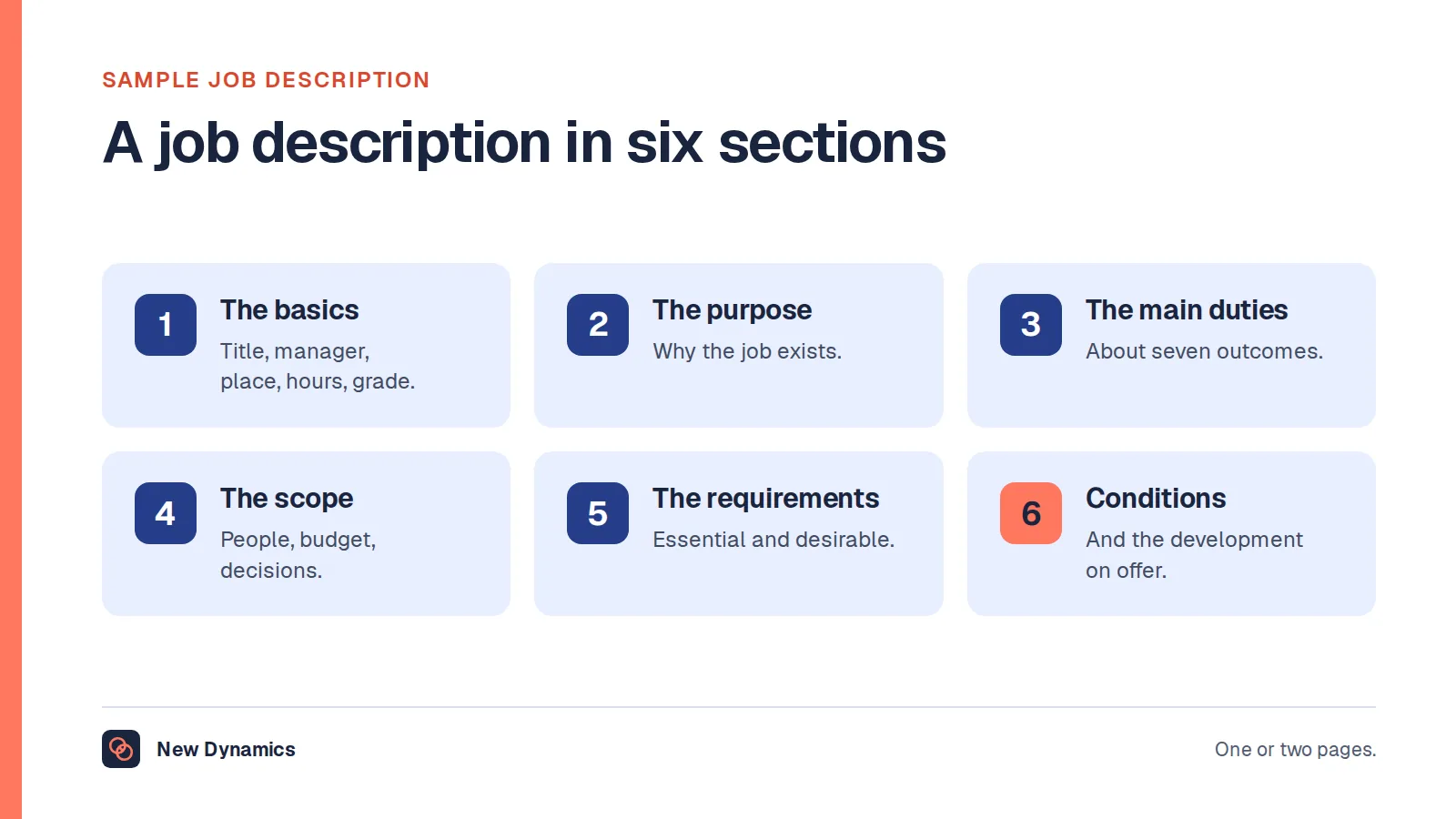
Job title: Site manager [or construction manager]. Reports to: [project manager or contracts manager]. Based: [site], [permanent or fixed term for the project].
Scope: [project type and value band]. [Stages covered.] [Site supervisors, engineers and subcontract packages.] [Peak operatives on site.]
Purpose: To run the site day to day so that the works are built safely, to specification and to programme, and to act for the principal contractor in managing health and safety during the construction phase.
Main duties
- Plan, manage and monitor the construction work on site, and coordinate health and safety during the construction phase.
- Prepare, implement and review the construction phase plan, and keep it current as the site changes.
- Hold the short-term programme, sequence the trades, and protect the start dates of work that has not begun.
- Coordinate subcontractors and organise cooperation between them, including successive contractors in the same area.
- Deliver or oversee site-specific inductions for every worker and visitor, and keep the records.
- Operate the site rules and permit systems, including [hot works, confined spaces, excavation, roof access, live systems].
- Plan, supervise and check all work at height, applying the order of avoid, prevent and mitigate, with rescue arrangements and weather limits.
- Carry out and record the inspections required for [scaffolds, excavations, fall arrest and lifting equipment], and act on the findings.
- Check quality against the drawings, close defects, and control access, security, welfare, traffic routes and protection of the public.
- Keep a dated site diary; record and report accidents, near misses and dangerous occurrences, and never penalise a report; consult the workforce; and report progress, cost, risk and safety performance to [the project manager] at [frequency].
Essential: [number] years running a site of this type and scale; [the card and level we require, or an equivalent]; a recognised site management safety qualification; working knowledge of CDM 2015 and the Work at Height Regulations 2005 [or the Northern Ireland equivalents]; the ability to direct people who are not employees; a full driving licence.
Hours and conditions: [hours] a week, [start and finish], [weekend and evening expectations], [away from home], outdoors in all weathers and at height. Reviewed on: [the measures, the frequency, and the trade-off between programme, cost, quality and safety].
Frequently asked questions
What does a construction site manager do?
A construction site manager runs a building site day to day: holding the short-term programme, sequencing the trades, coordinating subcontractors, checking quality, controlling access and welfare, keeping the records, and managing health and safety for everyone on site. The National Careers Service lists site manager as an alternative title for construction manager, a job it describes as organising building projects so they are completed safely, within budget and on time.
What are a site manager's duties and responsibilities?
Ten groups cover most sites: plan and monitor the work, keep the construction phase plan current, hold the programme, coordinate subcontractors, induct everyone who comes through the gate, run the site rules and permits, supervise work at height, record inspections, check quality, control the site, and report.
What is the difference between a site manager and a project manager in construction?
Scope and location. The site manager owns the site: who is on it, what they are doing, whether it is safe, and whether today's work happened. The project manager owns the project and the client relationship, including the whole programme and the budget. On a small job one person does both jobs.
Which safety duties does a construction site manager carry?
On a project in Great Britain with more than one contractor, the site manager normally acts for the principal contractor. Regulation 13 of the Construction (Design and Management) Regulations 2015 requires the principal contractor to plan, manage and monitor the construction phase and coordinate health and safety matters during it, to organise cooperation between contractors, and to ensure a suitable site induction is provided and unauthorised access prevented. Regulation 12 requires a construction phase plan, reviewed and updated. Northern Ireland has its own equivalent regulations. General information, not legal advice.
How dangerous is construction work in the UK?
HSE's report Construction statistics in Great Britain, 2025, published on 20 November 2025 with data up to March 2025, records 35 fatal injuries to workers in 2024/25p, a provisional figure, against an annual average of 40 over 2020/21 to 2024/25p, and states that 53% of deaths over that five-year period were classified as falls from a height. On a Labour Force Survey average over 2022/23 to 2024/25 it estimates 50,000 workers sustaining a non-fatal injury, around 2.5% against 1.8% across all industries.
What qualifications and cards does a site manager need?
No single qualification. The National Careers Service lists a university course, a degree apprenticeship such as Construction Site Management at level 6, working up from a role such as site supervisor, or applying directly with management experience. It also says you will need a recognised construction skills certification card, or an equivalent, to work on a construction site, and which card a site accepts is set by the principal contractor and the client.
Your next step
- Decide which job you are advertising, and which stages of the project the post covers.
- Write the safety duties into the main duties: the construction phase plan, the inductions, the permits, work at height and the inspections.
- State the card and level you require, and whether you pay for it.
- Describe the people reality: operatives at peak, how much of the workforce is subcontracted, and that the post holder directs people who are not employees.
- Say what the job will be reviewed on, and name the programme, cost, quality and safety trade-off.
Running one review cycle across site-based and office-based staff is what our construction and property pages are written for. For the method behind the document, see how to write a job description and our job description template.
Want the site manager's objectives, evidence and review conversation in one place instead of three spreadsheets? Book a New Dynamics demo and bring the site manager advert you use today. You can also email contact@new-dynamics.com.