TL;DR
- A prevailing wage is not a national floor. The Department of Labor calculates it for each classification in each locality, and under the Davis-Bacon survey method the rate is the one paid to a majority of workers, or, failing that, the one paid to the greatest number provided that number is at least 30 percent.
- Two statutes carry two different thresholds. Davis-Bacon applies to federally funded or assisted construction contracts "in excess of $2,000", and the McNamara-O'Hara Service Contract Act to service prime contracts "in excess of $2,500". Davis-Bacon work also carries weekly pay and weekly certified payroll.
- The words mean something else in immigration. For labor certification the Department defines the prevailing wage as "the average wage paid to similarly employed workers in a specific occupation in the area of intended employment", which is a different calculation from the Davis-Bacon one.
Two people searching for "prevailing wages" are often asking unrelated questions. One has won a federally funded construction contract and needs to know which hourly rate to put on the payroll. The other is sponsoring a visa and has been told to pay the prevailing wage for the role. Both terms are real, both are set by the United States Department of Labor, and they are calculated in different ways by different offices. Treating them as one term is the most common way this subject goes wrong.
This article answers both, for the United States. It covers the Davis-Bacon Act and federally funded construction, the Service Contract Act and service contracts, how a wage determination is produced and where to find it, the fringe benefit component and the ways it can be discharged, certified payroll and what the paperwork actually costs, apprentices and trainees, what follows a violation, and then the separate prevailing wage used in labor certification. It is general information about the position in the United States and not legal advice.
Prevailing wage work is classification work before it is payroll work, and the record has to survive an audit. See how New Dynamics workflows let you set the stages, participants and approvals around your own process, so a classification decision is recorded once rather than reconstructed later.
A prevailing wage is a local rate, not a national floor
The federal minimum wage is one number for the whole country. A prevailing wage is the opposite idea: a rate found for one classification of worker, in one locality, for one type of work, and then written into a specific contract. Two bricklayers doing the same work in neighbouring counties can be owed different amounts, lawfully, because the surveys behind their counties returned different answers.
The obligation also arrives through the contract rather than through general employment law. If your contract does not contain a wage determination, there is nothing to pay from. If it does, the rates in it are the minimum, whatever your own pay scale says.

The Davis-Bacon Act: federally funded construction
The Davis-Bacon Act is codified at 40 U.S.C. 3141 to 3148. The Department of Labor publishes the text of the Davis-Bacon Act, as Amended, where section 3142(a) sets the coverage test: "The advertised specifications for every contract in excess of $2,000, to which the Federal Government or the District of Columbia is a party, for construction, alteration, or repair, including painting and decorating, of public buildings and public works of the Government or the District of Columbia ... shall contain a provision stating the minimum wages to be paid various classes of laborers and mechanics." The $2,000 figure sits in the statute itself. It was carried into title 40 by Public Law 107-217 of 21 August 2002, an Act passed "To revise, codify, and enact without substantive change certain general and permanent laws", so the threshold has not moved with inflation and is not an annual update.
The Wage and Hour Division states the duty on its page on the Davis-Bacon and Related Acts: "Davis-Bacon Act and Related Act contractors and subcontractors must pay their laborers and mechanics employed under the contract no less than the locally prevailing wages and fringe benefits for corresponding work on similar projects in the area."
The "Related Acts" matter more than the Act in practice. Fact Sheet #66, dated October 2023, explains that many federal laws authorising assistance "through grants, loans, loan guarantees, insurance, and other methods" are Davis-Bacon Related Acts, and names the Federal-Aid Highway Acts, the Housing and Community Development Act of 1974 and the Federal Water Pollution Control Act as examples. A contractor with no federal contract at all can be covered because the money behind the project is federal.
Two companion rules travel with Davis-Bacon work. Above $100,000 in prime contract value, the Contract Work Hours and Safety Standards Act requires "at least one and one-half times their regular rate of pay for all hours worked over 40 in a workweek" for laborers and mechanics including guards and watchmen. And the Copeland "Anti-Kickback" Act, at 40 U.S.C. 3145, requires the weekly statement of wages that becomes certified payroll.
One current caveat is worth knowing. The Department's own page records that on 24 June 2024 a federal district court issued "a nationwide preliminary injunction" against three provisions of the 2023 final rule, including the provision requiring prevailing wages for delivery truck drivers for onsite time "that is more than de minimis" and the provision at 29 CFR 5.5(e) applying the Acts by operation of law where an agency left the clauses out of a contract. The Department states that "these three provisions may not be implemented or enforced at this time" while "the remainder of the Department's final rule remains in effect". Check that page before relying on truck driver coverage.
The Service Contract Act: services rather than construction
Construction is carved out of the service statute and services are carved out of the construction one, so the first question on any contract is which of the two you are in. The Wage and Hour Division states the test on its page on the McNamara-O'Hara Service Contract Act: the Act "requires contractors and subcontractors performing services on prime contracts in excess of $2,500 to pay service employees in various classes no less than the wage rates and fringe benefits found prevailing in the locality, or the rates (including prospective increases) contained in a predecessor contractor's collective bargaining agreement."
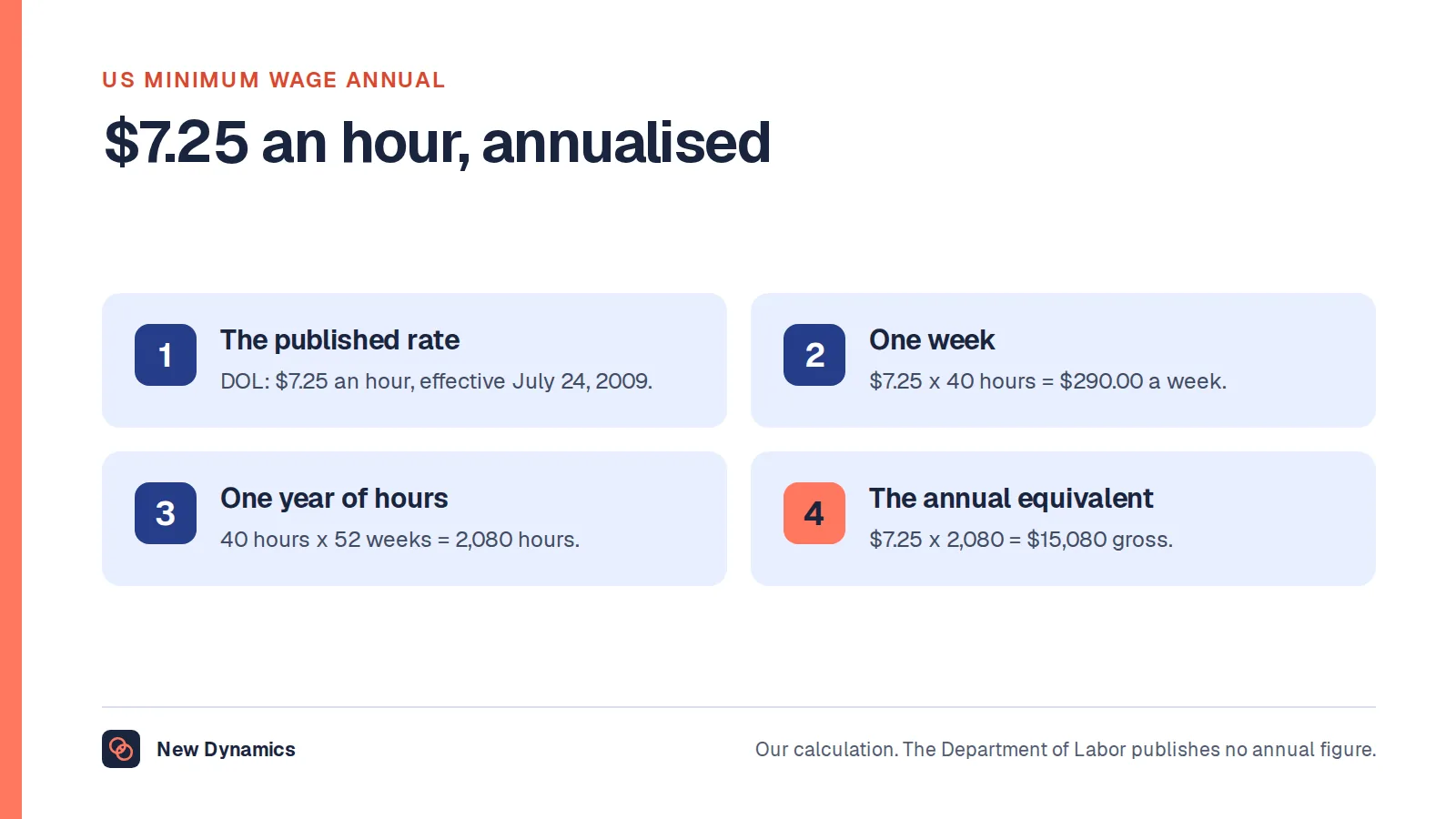
Three points follow from that sentence. First, the threshold is $2,500 of prime contract value, not $2,000. Below it, the Department states that "contractors are required to pay the federal minimum wage as provided in Section 6(a)(1) of the Fair Labor Standards Act", which Fact Sheet #67 gives as "$7.25 per hour effective July 24, 2009, under the 'Fair Minimum Wage Act of 2007'". Second, a predecessor's collective bargaining agreement can displace the surveyed rate, including increases that have not happened yet. Third, the Department "issues wage determinations on a contract-by-contract basis in response to specific requests from contracting agencies", so a determination is not something you look up once a year for your industry.
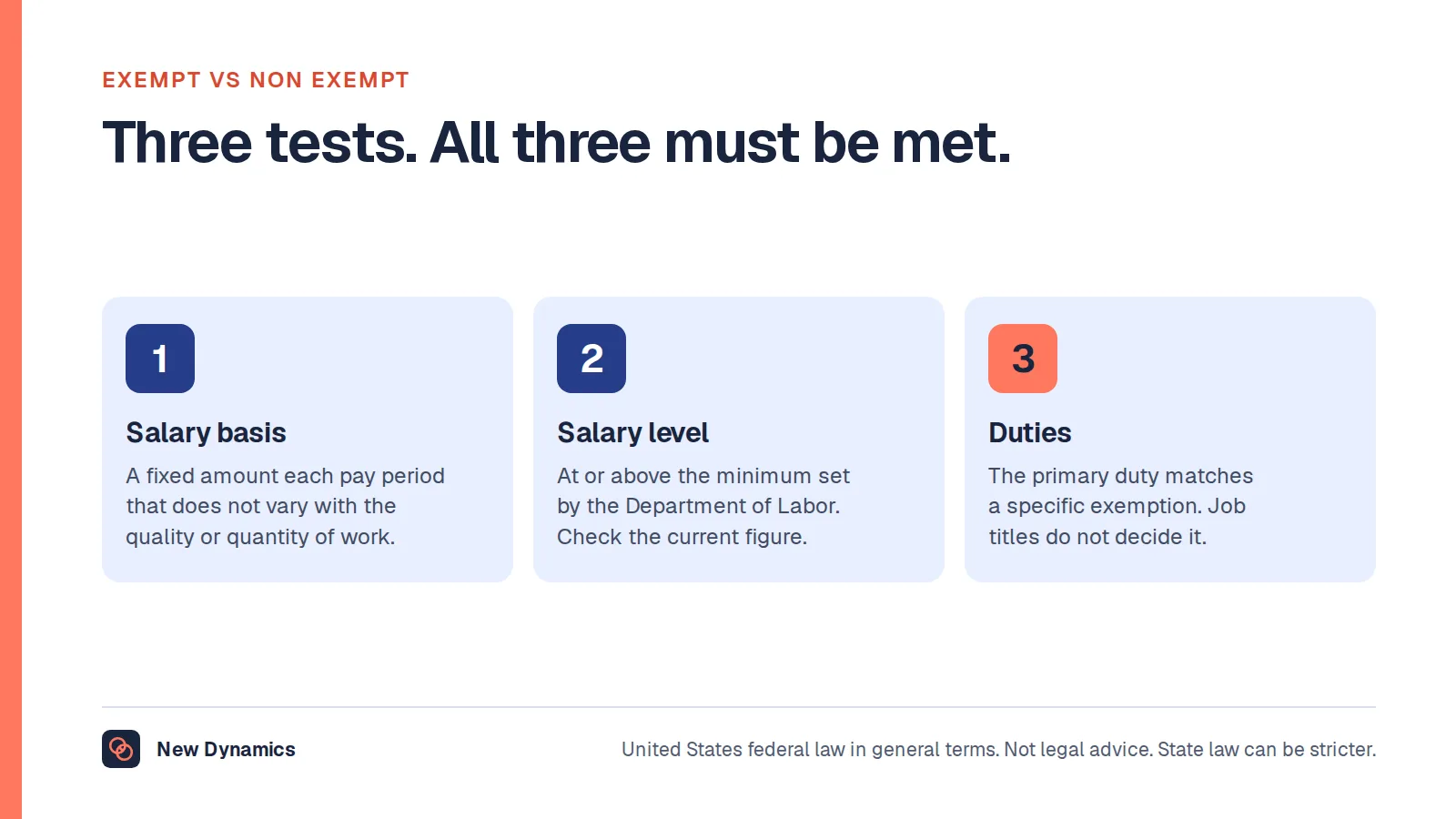
Coverage runs on the contract's principal purpose. Fact Sheet #67 excludes, among others, construction covered by Davis-Bacon, carriage of freight or personnel at published tariff rates, public utility services, and "services performed outside the U.S.", and it defines a service employee as anyone performing on a covered contract "other than a bona fide executive, administrative, or professional employee" meeting the tests in 29 CFR Part 541. Deciding who is exempt under those tests is the same analysis set out in our post on exempt and non-exempt employees, and the Department lists getting it wrong among the typical problems on service contracts.
How a wage determination is calculated, and where to find one
Davis-Bacon rates come from surveys of real projects. The Department's page on construction surveys explains that data is collected on form WD-10 from contractors and other interested parties, verified, and then used to calculate "the basic hourly rate first, and then ... any prevailing fringe benefits". The calculation rule is the part worth memorising:
"The regulations define the prevailing wage rate as the wage paid to the majority of workers in a classification. If the same wage is not paid to a majority of workers, then the prevailing wage will be the wage paid to the greatest number, provided that such greatest number is at least 30 percent. If no wage is paid to 30 percent or more, then a weighted average is calculated."
So a Davis-Bacon rate is usually the most common rate rather than the average one. Fringe benefits go through the same three steps, with a prior question: "if a majority of workers in the classification are not paid any fringe benefits, then no fringe benefit will be included on the wage determination for that classification." Rates are normally issued by county, and the area may be widened where one county returns too little data. Work is split into four construction types, building, residential, highway and heavy, and the Department's page defines residential as "single family houses or apartment buildings of no more than four stories in height".

Service Contract Act rates are built differently. The Department's questions on the issuance of SCA wage determinations explain that a single rate paid to "a majority (more than 50%) of the workers in a classification" prevails, but that where Bureau of Labor Statistics or other survey data is used, "statistical measurements of central tendency (median) and the average (mean) are considered reliable indicators", and that "use of the median is the general rule". Classifications with no survey data are priced by "slotting" against the federal grading system.
Published determinations for both statutes live on the System for Award Management. Fact Sheet #66 states that Davis-Bacon wage determinations "are published on the System for Award Management (SAM) website for contracting agencies to include them into covered contracts". If the classification you need is not listed, you cannot invent a rate: the conformance procedure under 29 CFR 5.5(a)(1)(iii) adds it, and on service contracts the Department requires the request to reach the contracting officer "no later than 30 days after the unlisted class of employee performs any contract work".
The fringe benefit component, and how it is discharged
The number on a wage determination is two numbers. Fact Sheet #66 puts it plainly: "The Davis-Bacon 'prevailing wage' is the combination of the basic hourly rate and any fringe benefits listed in a Davis-Bacon wage determination." Both must be paid "for all hours worked on the site of the work", including overtime hours.
The statute allows real flexibility about how. Section 3142(d), headed Discharge of Obligation, provides that the obligation "may be discharged by making payments in cash, by making contributions described in section 3141(2)(B)(i) of this title, by assuming an enforceable commitment to bear the costs of a plan or program referred to in section 3141(2)(B)(ii) of this title, or by any combination of payment, contribution, and assumption", so long as the total is not less than the basic rate plus the fringe amount. Fact Sheet #66E, dated October 2023, works it through on a determination of $27.00 basic hourly rate and $14.00 fringe benefits, a $41.00 total obligation, which a contractor may meet with "$41.00 in cash wages", with "$27.00 plus $14.00 in any combination of bona fide fringe benefits", or with "$35.00 plus $6.00 in any combination of bona fide fringe benefits".

The Service Contract Act does not work that way, and this is the single most expensive difference between the two regimes. Fact Sheet #66E says so in passing: "Under the DBRA (unlike the Service Contract Act), cash wages paid in excess of the BHR may be used to offset the fringe benefit portion of a contractor's prevailing wage obligation." Fact Sheet #67B, dated October 2024, spells out the service side with its own example. Where a determination requires a Cook Level II rate of $19.50 an hour and $4.98 an hour of health and welfare benefits, "the contractor cannot pay a $25.00 per hour wage rate and no health and welfare fringe benefits", and cannot pay "$22.00 per hour wage rate, and $2.48 in health and welfare fringe benefits" either. The benefit has to be furnished separately, and the obligation is per employee: "The employer cannot average the cost across all employees." Health and welfare payments are due for all hours paid, including vacation, sick leave and holidays, "up to a maximum of 40 hours per week and 2,080 hours per year for each contract". Our post on fringe benefits covers what counts as a benefit more generally.
Two traps sit inside the word "bona fide". Contractors "may not take credit for any benefit required by federal, state, or local law such as workers' compensation, unemployment compensation, and social security contributions". And an unfunded plan, where the contractor pays costs out of pocket as they arise, needs the Administrator's approval in advance before any credit is taken, except for vacation and holiday pay.
Certified payroll, and what the reporting actually costs
Davis-Bacon contractors pay weekly and report weekly. Fact Sheet #66: "Contractors are required to pay covered workers weekly and submit weekly certified payroll records to the contracting agency." The legal root is the Copeland Act at 40 U.S.C. 3145, which the Department quotes as requiring contractors "on a weekly basis, 'furnish a statement on the wages paid each employee during the prior week'", with 29 CFR 5.5(a)(3)(ii) directing where the submission goes.
The Department's instructions for the weekly certified payroll form WH-347 are the most detailed statement of what is wanted. Use of the form itself is optional, but the reporting is not, and each submission must carry a signed Statement of Compliance "indicating that the certified payrolls are accurate and complete, and that each laborer or mechanic has been paid not less than the required Davis-Bacon prevailing wage rate(s) (including any fringe benefits) for the work performed". Three details catch employers out. Full Social Security numbers "must not be included", only an individual identifying number. A worker who works in more than one classification in a week is shown on separate rows for each. And the Statement of Compliance, although it need not be notarised, "is subject to the penalties provided by 18 U.S.C. 1001, namely, a fine, possible imprisonment of not more than 5 years, or both".
The burden is quantified on the same page. Under OMB Control No. 1235-0008, the Department estimates "that it will take an average of 55 minutes to complete this collection of information, including time for reviewing instructions, searching existing data sources, gathering and maintaining the data needed, and completing and reviewing the collection of information". That is per weekly payroll, per contractor, per project. A 40 week job run by a prime and four subcontractors is roughly 183 hours of form filling before anyone checks a rate. Our post on payroll records covers retention, and the wider collection of workforce figures is in our HR statistics hub.
Apprentices and trainees on covered work
Paying an apprentice below the determination rate is allowed, narrowly. Fact Sheet #66 states the condition: apprentices "may be paid less than the rates listed in the applicable wage determination only when they are individually registered in an apprenticeship program registered with the Department of Labor or with a state apprenticeship agency recognized by the Department, and the terms of the apprenticeship program are met."
The Department's Davis-Bacon frequently asked questions add the detail. Registration can be individual, or the worker can be "in the first 90 days of probationary employment as an apprentice in such an apprenticeship program", properly certified as eligible. The reduced rate is available "only if the apprentices are utilized on the job site at a ratio (of apprentices to journeyworkers) that is no greater than ratio under the approved program", or the ratio for the project's locality where that differs. The rate itself is the percentage of the journeyworker rate specified by the programme.
Get either condition wrong and the position is unforgiving. Workers who "have not been properly registered within the meaning of the regulations and the contract stipulations or are utilized at the job site in excess of the permitted apprentice to journeyworker ratio ... must be paid the applicable wage rates for laborers and mechanics employed on the project performing in the classification of work they actually performed", regardless of what the payroll says and "regardless of their level of skill". Separately, on Federal-Aid Highway Acts projects, apprentices and student trainees enrolled in programmes certified by the Secretary of Transportation under 23 U.S.C. 113 are recognised categories paid at rates set under that statute. On the WH-347, each registered apprentice is flagged "RA" with their level of progression, and the programme has to be named on page 2.
What happens on a violation
Enforcement starts with the money that has not yet been paid out. Fact Sheet #66: "Contract payments may be withheld in sufficient amounts to satisfy liabilities of the contractor for unpaid wages, and for liquidated damages for overtime violations." Beyond that, violations "may be grounds for contract termination, contractor liability for any resulting costs to the government, and debarment from future contracts for a period of three years". The debarment period is statutory on the Davis-Bacon side: 40 U.S.C. 3144(b)(2) provides that "No contract shall be awarded to persons appearing on the list ... until three years have elapsed from the date of publication of the list." On the service side the Department's own pages word it two ways: Fact Sheet #67 says "debarment from future contracts for up to three years", while its questions on service contract wage determinations say the Act allows the Department to "debar from future government contracts for a period of three years any persons or firms who have violated the SCA". Three years is the outer limit on both readings, and the "up to" wording leaves room for less.
Findings can be challenged. Contractors "may challenge the Wage and Hour Division's determinations of violations and debarment before an Administrative Law Judge", interested parties may appeal to the Department's Administrative Review Board, and final Board decisions "may be appealed to and are enforceable through the federal courts".
The Department also names the compliance failures it sees most often, and none of them are exotic: misclassification of laborers and mechanics; failure to pay the full prevailing wage including fringe benefits for all hours worked; incomplete recordkeeping, such as "not recording hours worked in each classification by an individual who worked in two or more classifications during a day"; failure to keep the apprenticeship programme and individual registration documents; failure to submit certified payrolls weekly; and failure to post the Davis-Bacon poster WH-1321 and the wage determination at the site. Retaliation against a worker who complains is prohibited and "may also be grounds for debarment".
The other prevailing wage: labor certification
Now the second meaning, which has nothing to do with construction contracts. The Department's Office of Foreign Labor Certification explains on its page on prevailing wage information that the Immigration and Nationality Act "requires that the hiring of a foreign worker will not adversely affect the wages and working conditions of U.S. workers comparably employed", and that to comply "the wages offered to a foreign worker must be the prevailing wage rate for the occupational classification in the area of employment".
Then the definition that separates the two senses of the term: "The prevailing wage rate is defined as the average wage paid to similarly employed workers in a specific occupation in the area of intended employment." Average, not majority. A Davis-Bacon rate is normally the most commonly paid rate, and only becomes a weighted average when the survey will not support anything else. A labor certification prevailing wage starts as an average. Quoting one at a hearing about the other is a real and avoidable mistake.
The mechanics differ too. Effective 4 January 2010, employers obtain the rate "by submitting a request to the National Prevailing Wage Center (NPWC), or by accessing other legitimate sources of information such as the OFLC Wage Search". A determination is requested on Form ETA-9141. The underlying wage data comes from the Bureau of Labor Statistics Occupational Employment and Wage Statistics programme, which the Department has supplied for this purpose "since 1998", classified by the Standard Occupational Classification. For the H-1B, H-1B1 and E-3 programmes the employer must pay "the prevailing wage or the actual wage paid by the employer to workers with similar skills and qualifications, whichever is higher", and obtaining a determination from the Center carries "safe-harbor status", meaning the Wage and Hour Division "will not challenge the validity of the prevailing wage as long as it was applied properly (i.e., correct geographic area, occupation, and skill level)".
There is no prevailing wage regime in the United Kingdom
A UK reader should stop looking for one. The United Kingdom has no system of locally determined, occupation-specific minimum rates written into public contracts. The nearest comparisons are the National Minimum Wage, which is a single national floor banded by age rather than a rate found locally by trade, and the equal treatment rules for agency workers, which compare an agency worker with a hirer's own staff rather than with a local market. Our post on base salary and the UK minimum wage rules covers the UK floor, and our post on the US minimum wage annually covers the American floor that prevailing wages sit above.
Frequently asked questions
What is a prevailing wage?
In the United States it is the wage and fringe benefit rate that the Department of Labor has found to prevail for a particular classification of worker in a particular locality, written into a specific federal contract as the minimum payable. On Davis-Bacon construction work it is the combination of a basic hourly rate and a fringe benefit amount listed in a wage determination.
Which contracts are covered by the Davis-Bacon Act?
Contracts in excess of $2,000 with the federal government or the District of Columbia for the construction, alteration or repair, including painting and decorating, of public buildings and public works. The same standards reach most federally assisted construction through the Related Acts, which include the Federal-Aid Highway Acts and the Housing and Community Development Act of 1974.
What is the Service Contract Act threshold?
Prime contracts in excess of $2,500 for services performed through service employees. The Department of Labor states that on contracts equal to or less than $2,500, contractors must pay the federal minimum wage under section 6(a)(1) of the Fair Labor Standards Act, which Fact Sheet #67 gives as $7.25 per hour effective 24 July 2009.
How is a prevailing wage determination calculated?
For Davis-Bacon, from surveys of projects in the area. The rate paid to a majority of workers in the classification prevails. If no rate is paid to a majority, the rate paid to the greatest number prevails provided that number is at least 30 percent, and otherwise a weighted average is used. Service Contract Act rates generally use the median of survey data.
Where do I find the wage determination for my contract?
In the contract. Federal agencies are required to incorporate the applicable determination, and published determinations for both statutes are hosted on the System for Award Management website. If your classification is not listed, the conformance procedure adds it, with the contracting officer submitting the request to the Department of Labor.
Can fringe benefits be paid in cash?
Yes, under both statutes, but differently. On Davis-Bacon work the whole obligation can be paid as cash wages, and cash above the basic hourly rate can offset the fringe portion. On Service Contract Act work the benefit must be furnished separately from the monetary wage, so paying a higher hourly rate instead does not satisfy it.
Do apprentices have to be paid the full prevailing wage?
Only if they are not properly registered or the ratio is exceeded. A worker individually registered in an apprenticeship programme registered with the Department of Labor or a recognised state agency, or in the first 90 days of certified probationary employment, may be paid the programme percentage of the journeyworker rate, provided the apprentice to journeyworker ratio on site is within the approved programme.
What happens if a contractor underpays?
Contract payments can be withheld to cover the unpaid wages and any liquidated damages, the contract can be terminated with the contractor liable for the government's resulting costs, and the contractor can be debarred from federal contracts for three years. Determinations of violation and debarment can be challenged before an Administrative Law Judge and appealed to the Administrative Review Board.
Is the prevailing wage for a visa the same thing?
No. For labor certification the Department defines the prevailing wage as the average wage paid to similarly employed workers in a specific occupation in the area of intended employment, requested from the National Prevailing Wage Center on Form ETA-9141. Davis-Bacon rates come from the Wage and Hour Division's construction surveys and are usually the most commonly paid rate rather than an average.
Your next step: read the contract before the payroll
- Find the wage determination in the contract and note its number and revision. If there is none and you believe the work is covered, raise it with the contracting officer in writing rather than guessing a rate.
- Decide which statute you are in. Construction of public buildings or works points to Davis-Bacon, services to the Service Contract Act, and a contract that contains both can carry both.
- List every classification of worker you will actually use on site, and check each one appears on the determination. Start a conformance request for any that does not.
- Split the rate in two on your own records: basic hourly rate, and fringe benefit amount. Then write down, per worker, how the fringe amount is being discharged and keep the evidence for it.
- Set up the weekly cycle before work starts. Weekly pay, weekly certified payroll with a signed Statement of Compliance, hours recorded by classification, and registered apprentices flagged with their programme and level.
- Post the wage determination and the required notice at the site, where the Department expects them to be "easily seen by the workers".
For the policy that sits behind pay decisions on and off government contracts, read and download our compensation policy guide. The guide is free to read, and the PDF uses our short download form.
Want classification decisions, approvals and the evidence behind them held in one place rather than in a spreadsheet nobody owns? Book a New Dynamics demo and bring one covered contract with you. You can also email contact@new-dynamics.com.