TL;DR
- Four minimum wage rates run across one rota. From 1 April 2026 GOV.UK sets £12.71 for workers aged 21 and over, £10.85 for 18 to 20, and £8 for under 18s and first-year apprentices, and the rates change on 1 April every year.
- Tips never count towards the minimum wage, but since 1 October 2024 section 27D of the Employment Rights Act 1996 requires the whole amount to be allocated fairly, and section 27G sets the deadline at the end of the month after the customer paid.
- Three retention clocks run at once: PAYE records for 3 years from the end of the tax year, minimum wage records for 6 years, and the tipping record for 3 years from the date each tip was paid.
An office pay run has one wage rate, fixed hours, and nothing arriving from customers. A restaurant pay run has four wage rates on one rota, hours that change weekly, money from customers that is not wages, and small deductions that each carry their own legal test. Restaurant payroll is not harder arithmetic. It is a different rule set applied to the same thirty payslips. This article covers the parts an office never meets, for an employer in the United Kingdom. It is general information and not legal advice.
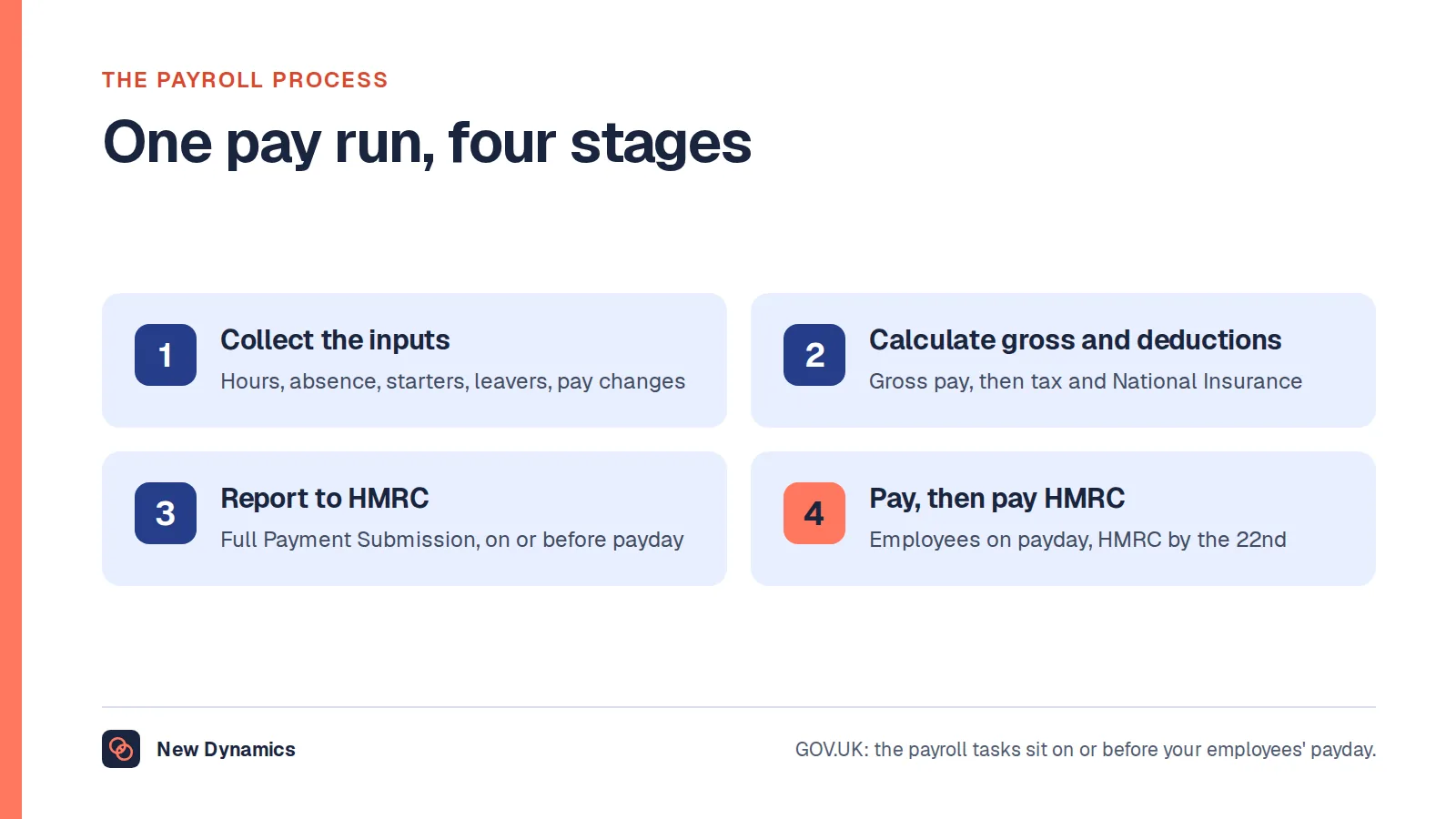
Most of these failures happen at handovers, not in the calculation. A birthday nobody flagged, a trial shift arranged by text, a uniform charge agreed on the floor. See how New Dynamics workflows give each of those a named owner and a due date, so the fact reaches payroll before the cut-off. New Dynamics does not run payroll, file to HMRC or move money; it holds the people data a pay run depends on. For the run itself, see our walkthrough of the payroll process.
Four wage rates, one rota
GOV.UK's page on National Minimum Wage and National Living Wage rates states that "The rates change on 1 April every year", and that a worker must be aged 21 to get the National Living Wage. For 1 April 2026 to 31 March 2027 the published rates are £12.71 for 21 and over, £10.85 for 18 to 20, £8 for under 18s and £8 for apprentices. The Department for Business and Trade publication Minimum wage rates for 2027, published 28 October 2026, sets the next set at £13.21, £11.27, £8.31 and £8.31.

Hospitality trips over this because a kitchen and a floor team routinely span all four bands at once, and many staff sit exactly on the rate rather than above it. So a birthday is a payroll event: someone turning 18, or 21, changes band from the start of the next pay reference period, and nobody in the building will mention it. The apprentice rate is narrower than it looks too, because GOV.UK restricts it to apprentices aged under 19, or aged 19 and over in the first year.
The cost of missing one is published. GOV.UK's guidance on enforcing the minimum wage states that the penalty "can be up to 200% of the value of the minimum wage arrears, up to a maximum penalty £20,000 per worker." For wider pay figures, see our HR statistics hub.
The hours you may not be counting
Rates are the easy half. GOV.UK's guidance on working hours for which the minimum wage must be paid counts, for time work, "time spent at the workplace and required to be available for work", and adds that it makes no difference whether or not you actually provide work for that time. Training counts. Travel between work premises counts, while travel between home and work does not.
Against a real service, that catches the pre-shift briefing, setting up before the clock starts, cashing up after the last table leaves, and the quiet hour when a server is kept on the floor with nothing to do. If the rota says seven hours and attendance is seven hours forty, the average hourly rate for the pay reference period falls, and on someone paid exactly the National Living Wage it falls below it.
Tips since 1 October 2024
Two things are true at once, and conflating them is where restaurant payroll goes wrong.
Tips are never minimum wage pay. HMRC's guidance When National Insurance and PAYE is due on tips, gratuities and service charges (E24), last updated 18 July 2025, states that for pay reference periods starting on or after 1 October 2009, amounts paid by the employer that represent "tips, gratuities, service charges or cover charges paid by customers do not count towards National Minimum Wage pay."
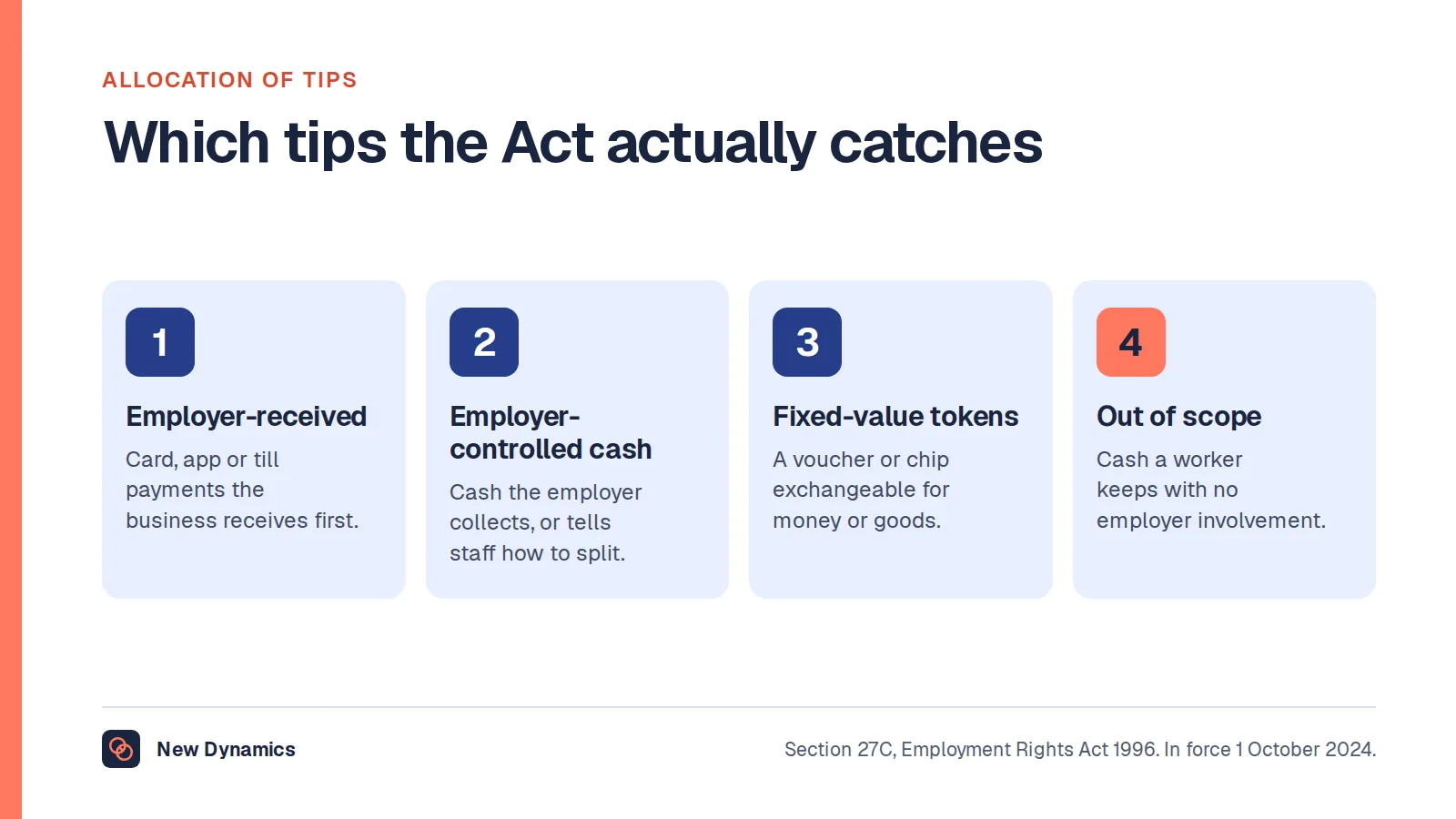
The whole amount must still reach staff. Section 2 of the Employment (Allocation of Tips) Act 2023 inserted section 27D(1) of the Employment Rights Act 1996, which requires an employer to ensure "that the total amount of the qualifying tips, gratuities and service charges paid at, or otherwise attributable to, a place of business of the employer is allocated fairly between workers of the employer at that place of business." Legislation.gov.uk records it in force from 1 October 2024 by S.I. 2024/829. Section 4 inserts section 27G and fixes the deadline at the end of the month following the month the customer paid. The statutory Code of Practice on fair and transparent distribution of tips, issued under section 9 of the Act and in force the same day, gives the example at paragraph 33: "if a customer leaves a tip on 23 June, it must be distributed by 31 July at the latest."
Our post on the allocation of tips covers the duty, the written policy and the enforcement route in full. For payroll the point is narrow: the tip pot is not a pay budget, it cannot be used to reach the minimum wage, and its deadline is not your payday.
Troncs, and the National Insurance question
A tronc is where hospitality payroll becomes genuinely unusual, because the National Insurance answer turns on a question of fact: who decides the shares.
E24 section 7 sets out two conditions. A gratuity is exempt from National Insurance if either "it is not paid, directly or indirectly, to the employee by the employer and does not comprise or represent monies previously paid to the employer" or "it is not allocated, directly or indirectly, to the employee by the employer". HMRC then gives the default: "In most cases where you pass tips to an employee, you are liable for both employer and employee National Insurance contributions because neither of the 2 conditions are satisfied."

Four points from the same guidance decide most real cases.
- A mandatory service charge sits outside this. E24 section 3: "If you impose a mandatory service charge and the money is paid out to your employees, National Insurance contributions are always due on the payments."
- A director or partner cannot be the troncmaster for this purpose. Where the employer, a business partner or a company official performs that role, E24 says "they are considered to be making payments as if they were the employer".
- Indirect allocation counts. HMRC's own example has an owner devising a points system which the troncmaster then operates: that is indirect allocation, and National Insurance is due. If the staff committee adopts the same system itself, with no element of compulsion, it is not.
- The tronc needs its own PAYE scheme. GOV.UK's guidance on tips through a tronc says "You must tell HMRC who the troncmaster is so that they can set up a PAYE scheme for the tronc." E24 lets the troncmaster use the employer's software, but their PAYE records must be kept separate.
Section 27F, inserted by section 3 of the Act, treats an employer as having allocated fairly where it arranges for an independent tronc operator to do so and it is fair to make that arrangement. No official source publishes how many UK hospitality businesses run a tronc, or what a typical share looks like, so figures circulating on that are trade estimates rather than statistics.
Where two official pages disagree
E24 section 12 still cites the minimum wage rule on tips as "regulation 31(1)(e) of the National Minimum Wage Regulations 1999 (SI 1999 Number 584)". Legislation.gov.uk titles that instrument The National Minimum Wage Regulations 1999 (revoked). The live provision is regulation 10(m) of the National Minimum Wage Regulations 2015, which excludes "payments paid by the employer to the worker representing amounts paid by customers by way of a service charge, tip, gratuity or cover charge". The substance is identical and the 2015 Regulations govern. The citation in E24 is out of date.
Holiday pay when hours change weekly
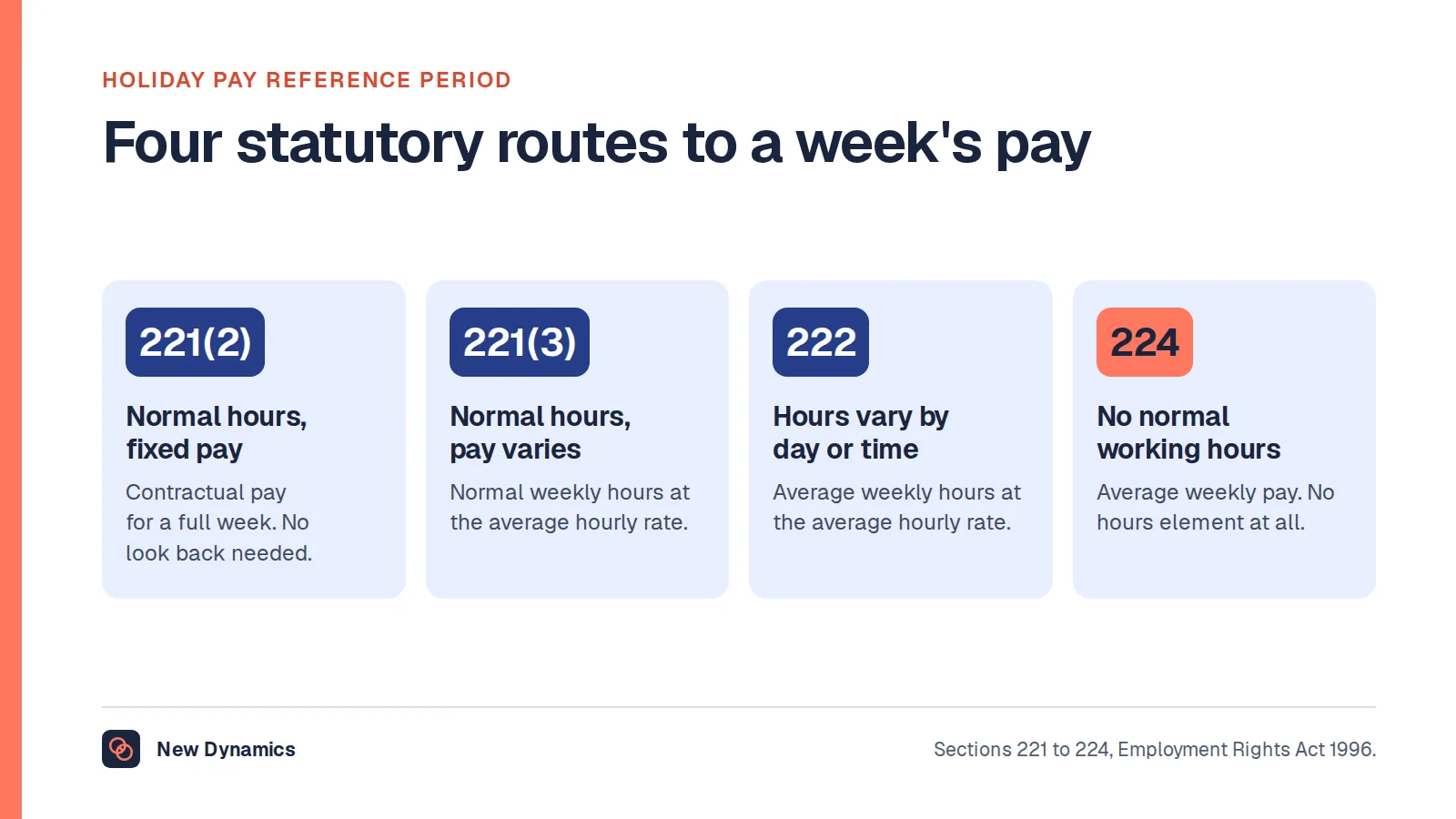
GOV.UK's guidance on holiday pay and entitlement reforms from 1 January 2024 defines an irregular hours worker as one where "the number of paid hours that they will work in each pay period during the term of their contract in that year is, under the terms of their contract, wholly or mostly variable."
Note what that excludes. The same guidance gives the example of a worker on a fixed two-week rotating shift pattern, with fixed contracted hours and no overtime, and says he would not qualify. A rota is not by itself irregular hours. The contract decides.
For leave years beginning on or after 1 April 2024, entitlement for irregular hours and part-year workers "will be calculated as 12.07% of actual hours worked in a pay period". Payment then follows one of two routes. Rolled-up holiday pay is 12.07% of total pay in the pay period, and GOV.UK requires it to be "clearly marked as a separate item on each payslip" and "paid in addition to the worker's normal salary, which should be at National Minimum Wage or above", so it is a top-up and not a way of reaching the floor. The 52-week reference period averages previous pay instead, and GOV.UK is specific that it "must only include weeks for which the worker was actually paid", with unpaid weeks replaced from earlier paid weeks and the look back going no more than 104 weeks.
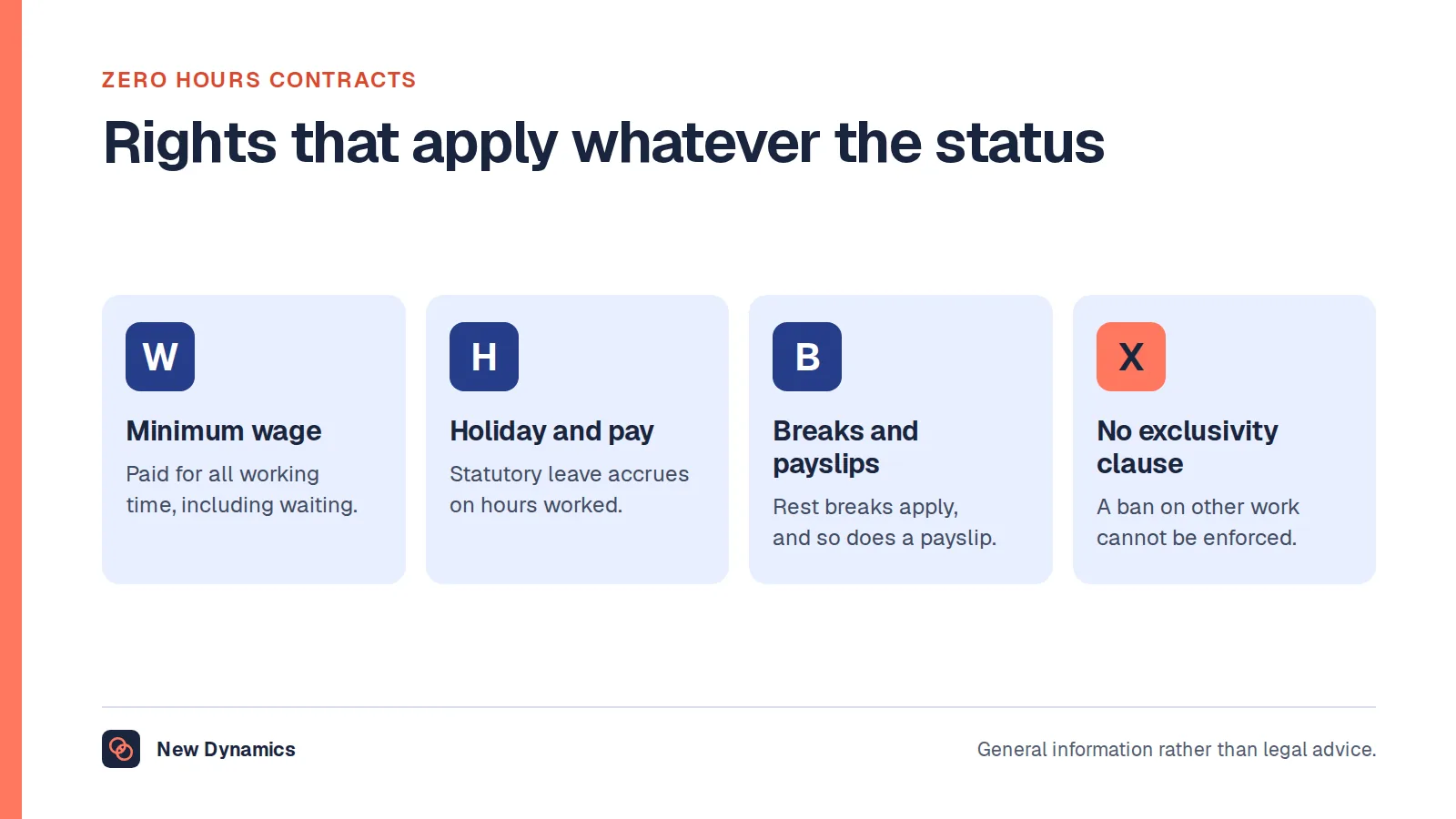
Our post on the holiday pay reference period works through the averaging, and zero hours contracts covers the contractual side.
Unpaid trial shifts
GOV.UK's guidance on eligibility for the minimum wage is unusually candid: "Current law does not define a 'trial work period' or state precisely when at least the minimum wage must be paid." It then gives the line that settles most hospitality cases, that "in the government's view an individual conducting work in a trial lasting longer than one day is likely to be entitled to the minimum wage in all but very exceptional circumstances".
The worked examples on that page come from this sector. A two hour Saturday trial for a café waiter job, with the owner watching and guiding, is unlikely to attract the minimum wage. A twelve hour trial for a trainee chef on the restaurant's busiest day, spent preparing vegetables and loading dishwashers, is likely to, and so is a week of trial shifts in a new bar where management has not decided how many people it will hire. The only general unpaid exception named is a Jobcentre Plus work trial of 6 weeks or less.
Uniform, breakages and till shortages
Two separate rules apply to the same deduction, and they give different answers.

Does it reduce minimum wage pay? GOV.UK's guidance on calculating the minimum wage states that "If you do not supply uniforms but require workers to wear specific items in connection with their job then any deductions for those items will always reduce minimum wage pay regardless of whether the purchase is made from you or a third party", and that this holds whether the requirement is contractual or just local practice. Where you do supply a uniform, "any reasonable, additional charges incurred through ordinary wear and tear of the uniform, such as cleaning, laundry or repair charges, will again reduce the workers' pay for minimum wage purposes." Staff food is caught too: "If you provide meals to workers, any deductions for these may reduce a worker's pay for minimum wage purposes." Where staff buy generic black shirts and trousers themselves, GOV.UK suggests a reimbursed "reasonable limit", and publishes no figure for it, so do not borrow one.
Then the counter-intuitive part. The same page lists deductions that, despite being for the employer's own use and benefit, do not reduce minimum wage pay, and the first entry is "deductions or payments in respect of the worker's conduct or any other event where the worker is contractually liable (for example, a restaurant worker breaks a glass and their wages are docked to pay for the breakage)".
Is the deduction lawful at all, and capped? A breakage or till deduction that passes the minimum wage test still has to satisfy the Employment Rights Act 1996. Section 17 defines retail employment to include carrying out retail transactions directly with members of the public, and a retail transaction as the sale or supply of goods or the supply of services, so restaurant service sits inside it. Section 18(1) then limits the amount: it "shall not exceed one-tenth of the gross amount of the wages payable to the worker on that day", and section 18(3) requires the first deduction within twelve months of the employer establishing the shortage. A £60 till shortfall on a day with £120 of gross wages can take £12 that day at most.
Our post on payroll deductions sets out the closed list of lawful grounds behind all of this.
Three retention clocks, not one
Hospitality payroll satisfies three retention periods at once, and they do not match.
- PAYE records: 3 years. GOV.UK's guidance on keeping records as an employer states that "Your records must show you've reported accurately, and you need to keep them for 3 years from the end of the tax year they relate to."
- Minimum wage records: 6 years. GOV.UK's enforcement guidance states that "From 1 April 2021, employers are required to keep records for a minimum of 6 years after the end of the pay reference period following the one that the records cover." The same page puts the burden of proving the minimum wage was paid on the employer, names failing to keep records as one of six criminal offences, and gives a worker 14 days for a written request.
- The tipping record: 3 years from the tip. The statutory Code at paragraph 43 requires a record of all qualifying tips and the amount allocated to each worker, and says "This record must be maintained for a period of three years beginning with the date on which the tip was paid."
Our post on payroll records covers the PAYE side. In a restaurant the practical answer is to keep hours, rates and tip allocations for six years rather than run three archives.
Frequently asked questions
What is the minimum wage in a UK restaurant in 2026?
GOV.UK publishes the rates for 1 April 2026 to 31 March 2027 as £12.71 an hour for workers aged 21 and over, £10.85 for 18 to 20, £8 for under 18s and £8 for apprentices. The rates change on 1 April every year, and the published 2027 figures are £13.21, £11.27, £8.31 and £8.31.
Do tips count towards the minimum wage?
No. HMRC's E24 guidance states that for pay reference periods starting on or after 1 October 2009, amounts representing tips, gratuities, service charges or cover charges paid by customers do not count towards National Minimum Wage pay. Regulation 10(m) of the 2015 Regulations excludes them from a worker's remuneration.
When must tips be paid out under the Tipping Act?
Section 27G of the Employment Rights Act 1996, inserted by section 4 of the Employment (Allocation of Tips) Act 2023 and in force from 1 October 2024, requires allocation and payment no later than the end of the month following the month the customer paid. The statutory Code gives the example of a tip left on 23 June having to be distributed by 31 July at the latest.
Is National Insurance due on tips paid through a tronc?
It depends who decides the shares. HMRC's E24 guidance exempts a gratuity where the employer did not pay it directly or indirectly and it did not represent money previously paid to the employer, or where the employer did not allocate it. HMRC says that in most cases where an employer passes tips on, neither condition is met and National Insurance is due. On a mandatory service charge it is always due.
Are unpaid trial shifts legal in a restaurant?
Sometimes, and length decides it. GOV.UK says current law does not define a trial work period, but states the government's view that a trial lasting longer than one day is likely to attract the minimum wage in all but very exceptional circumstances. A short observed trial of a couple of hours may not. A full shift of real production work almost certainly does.
Can we deduct a till shortage from a server's pay?
Only within two limits. GOV.UK treats a deduction for conduct or contractual liability as not reducing minimum wage pay, but section 18(1) of the Employment Rights Act 1996 caps deductions for cash shortages or stock deficiencies in retail employment at one-tenth of the gross wages payable that pay day, and section 18(3) requires the first deduction within twelve months of the shortage being established.
How long do we keep restaurant payroll records?
Three periods apply together. PAYE records run for 3 years from the end of the tax year they relate to, minimum wage records for at least 6 years after the end of the pay reference period following the one they cover, and the tipping record for three years from the date the tip was paid.
Your next step: five checks before the next pay run
- List everyone turning 18 or 21 before the next two paydays, and set the rate change against the start of the pay reference period.
- Compare rota'd hours with real attendance for one busy week, including briefings, setup and cashing up, then recalculate the average hourly rate for the lowest-paid person on that shift.
- Write down who decides each tronc share. If the answer involves the owner, a director or a points system you imposed, National Insurance is due.
- Check your written tipping policy reaches every worker including agency staff, and that the tipping record shows an amount per worker per period.
- Test every deduction you make, uniform, laundry, meals, breakages and till shortages, against both the minimum wage floor and the one-tenth retail cap.
Pay decisions arrive at payroll as instructions, so they should be made and recorded properly before they get there. Read and download our compensation policy guide for a clear approach to setting and approving pay. The guide is free to read, and the PDF uses our short download form.
Want birthdays, contract changes and approved pay decisions to reach payroll with an owner and a date against each one? Book a New Dynamics demo and bring your current rota and payslip. You can also email contact@new-dynamics.com.