TL;DR
- The default is unenforceability. The Department for Business and Trade's own working paper says the starting point under current law is that a non-compete clause, as with any clause in restraint of trade, is unenforceable unless the employer can demonstrate it is reasonable.
- Breadth is what kills these clauses. Acas says an employer will not usually be able to enforce restrictive covenants unless they are clear, specific and time-restricted, and the narrower the restriction the easier it is to defend.
- No statutory cap exists. A 3 month limit on non-compete clauses was announced on 12 May 2023 and never legislated, and a text search of legislation.gov.uk for non-compete returns nothing in employment law.
Two things are true at once about a post-termination restriction. The clause is in the contract and the employee signed it. The clause is also void until the employer justifies it. Most arguments about restrictive covenants go wrong because one side assumes the signature settled the matter and the other assumes the clause is worthless.
This article covers when a restriction actually binds, what makes one covenant easier to enforce than another, how duration and scope are judged, what an employer can lose through its own breach, and how a garden leave clause interacts with the restriction that follows it. It covers England and Wales. Scotland has its own legal system and its own remedies, and Northern Ireland has its own employment legislation, so take both separately. This is general information and not legal advice: enforceability turns on the facts and on the exact drafting.
Most of the damage is done when the contract is issued, not when someone resigns. See how New Dynamics onboarding keeps the signed contract and the version of terms the person actually agreed to attached to the record, so nobody is reconstructing it two years later.
The starting point is that the clause is void
The doctrine is not in a statute. It is restraint of trade, built by the courts over more than a century, and it inverts the normal rule that people are held to what they agreed.
The clearest official statement of it comes from the Department for Business and Trade, in its working paper on options for reform of non-compete clauses, published on 26 November 2025. Paragraph 11 reads: "The starting point under current law is that a non-compete clause, as with any clause in restraint of trade, is unenforceable, unless the employer can demonstrate it is reasonable, which is assessed by a court if a challenge is brought as to the clause's enforceability."
The same paragraph adds the part employers rely on in practice: "However, there are few constraints on employers including non-compete clauses in employment contracts, whether enforceable or not." Nothing stops a bad clause being written. Something stops it being enforced, and only if someone challenges it. The working paper puts prevalence at "around 5 million employees in Great Britain working under a contract that contains a non-compete clause with a typical duration of around 6 months". For wider UK employment data, see our HR statistics hub.
What a legitimate business interest means
Reasonableness is tested against something. The employer has to identify an interest worth protecting and then show the clause goes no further. The working paper uses the phrase when describing one reform option, allowing smaller firms longer clauses "provided they are reasonable to protect a legitimate business interest". Acas puts the same idea plainly in its guidance covering exclusivity clauses and restrictive covenants, last updated on 1 July 2026: "Restrictive covenants restrict employee's activities after they leave, to protect the employer's business interests."
In practice courts recognise a short list: confidential information and trade secrets, connections with customers and suppliers, and the stability of the remaining workforce. That list comes from case law rather than statute, so treat it as the general position the courts take rather than a rule you can look up. What it excludes matters more. An employer has no protectable interest in preventing competition as such, and none in the skill, experience and general know-how the employee built up at work.
The four usual covenants, and why the narrow ones survive
Acas lists four examples. A non-competition clause, "preventing employees from working for a competitor or starting a competing business for a period of time, or within a certain distance". A non-disclosure clause, "preventing employees from sharing sensitive or confidential information after they leave". An anti-poaching clause, "preventing employees from encouraging others to leave with them". And a non-solicitation clause, "preventing former employees from trying to get the business of their previous employer's clients or customers".
Drafters usually add a fifth, the non-dealing clause, which bars doing business with a former customer even where the customer made the approach. Acas does not name it and no official source sets out its test, so read what follows as the general position rather than a published rule.

The ranking is consistent. A non-poaching clause aimed at identifiable colleagues interferes least with the person's ability to earn, so it is easiest to defend. Non-solicitation of customers the person actually dealt with is next. Non-dealing is harder, because it catches business the leaver did nothing to win. The non-compete is hardest, because it stops the person working in their field at all, and a court will ask why the narrower clauses were not enough. If non-solicitation would protect the interest, a non-compete on top of it is difficult to justify.
How duration and geographic scope are judged
Acas is direct about what breadth does: "An employer will not usually be able to enforce restrictive covenants unless they're clear, specific and time-restricted. Even then, this area of the law can be complex."
Duration is judged against how long the protected interest actually lasts. For customer connections that is roughly how long a competent successor needs to build their own relationship with the account, which depends on how often the customer buys. For confidential information it is how long the information stays commercially useful. A twelve month blanket period applied to everyone from a graduate to a director is a sign nobody did that thinking.
Geographic scope is judged the same way, against where the employer trades and where the employee's influence reached. A radius drawn around a head office is weak if the customers were national. A national clause is weak if the person worked one city. There is no official table of acceptable periods or distances, and anyone offering one is guessing.

Seniority, and what the employee actually knows
The same clause can be reasonable for one person and void for another, because the question is what this individual could damage. A director holding the pricing model, the pipeline and the key relationships is a different case from a colleague who used the same systems but held none of it.
Two things follow. A standard covenant pasted into every contract will be too wide for most people who get it. And seniority is a proxy, not the test: what counts is the information and connections the person holds on their last day. The working paper shows how far these clauses have spread, reporting that while "prevalence is higher in senior roles, 20 to 30% of workers in lower-paid jobs believe they are covered by non-competes".
Consideration, and covenants added mid-employment
A covenant needs something given in return. At hire that is straightforward, because the job itself is the consideration.
Mid-employment is where employers come unstuck. Asking an existing employee to sign new restrictions with nothing offered in exchange leaves the employer arguing that continued employment was itself the consideration, which is a weak position. That is the general position in the case law rather than anything in a statute. The practical fix is to attach new covenants to something real, a promotion, a pay rise or a payment made specifically for them, and to record what was given and when. A promotion is also the moment to replace covenants drafted for a junior job, rather than assuming they grew with the person.
A repudiatory breach by the employer can release the covenants
This is the asymmetry employers forget. If the employer commits a fundamental breach and the employee accepts that breach and leaves, the general position taken by the courts is that the post-termination restrictions fall away. Dismissing without the notice the contract requires can be exactly such a breach.
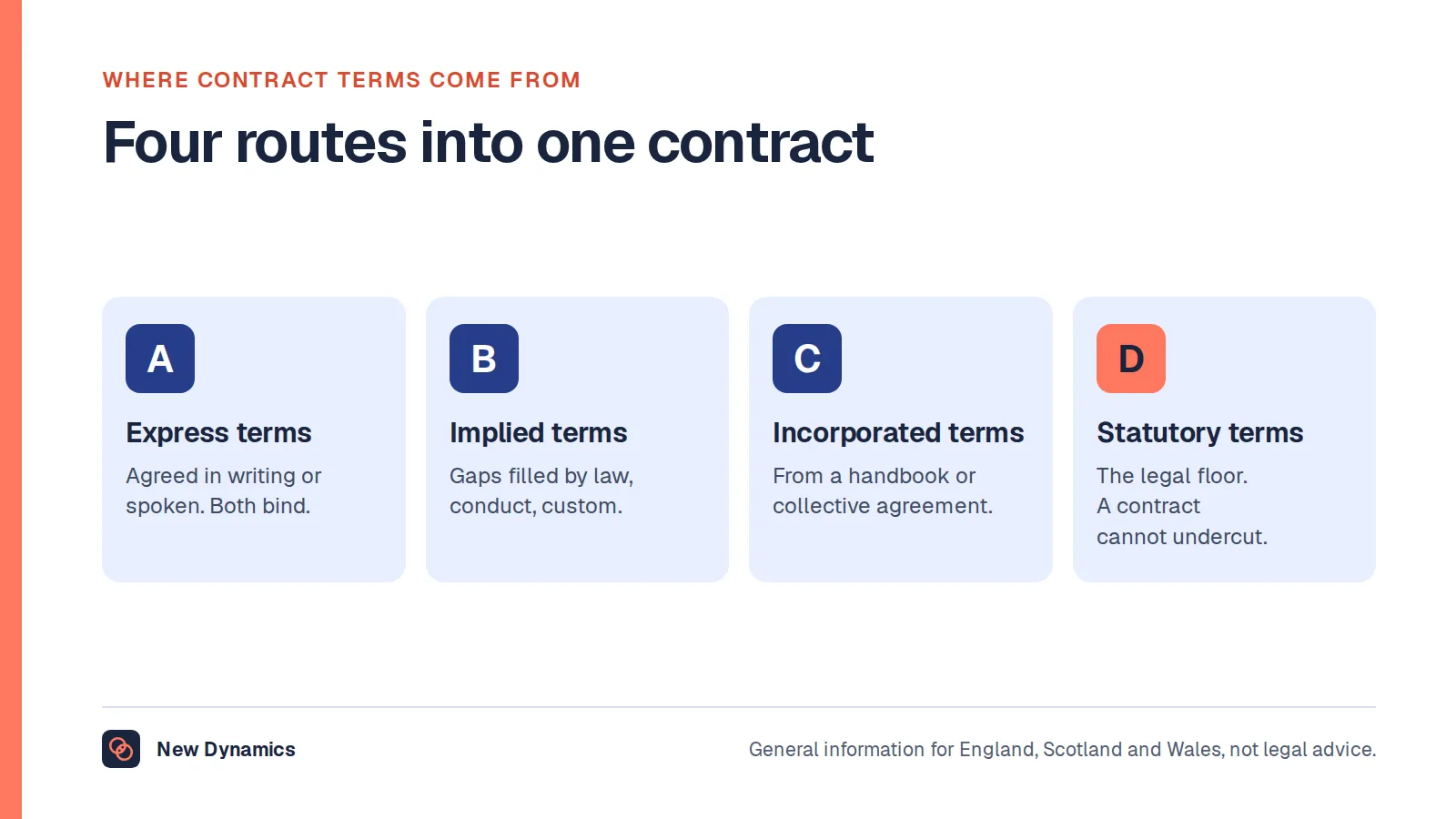
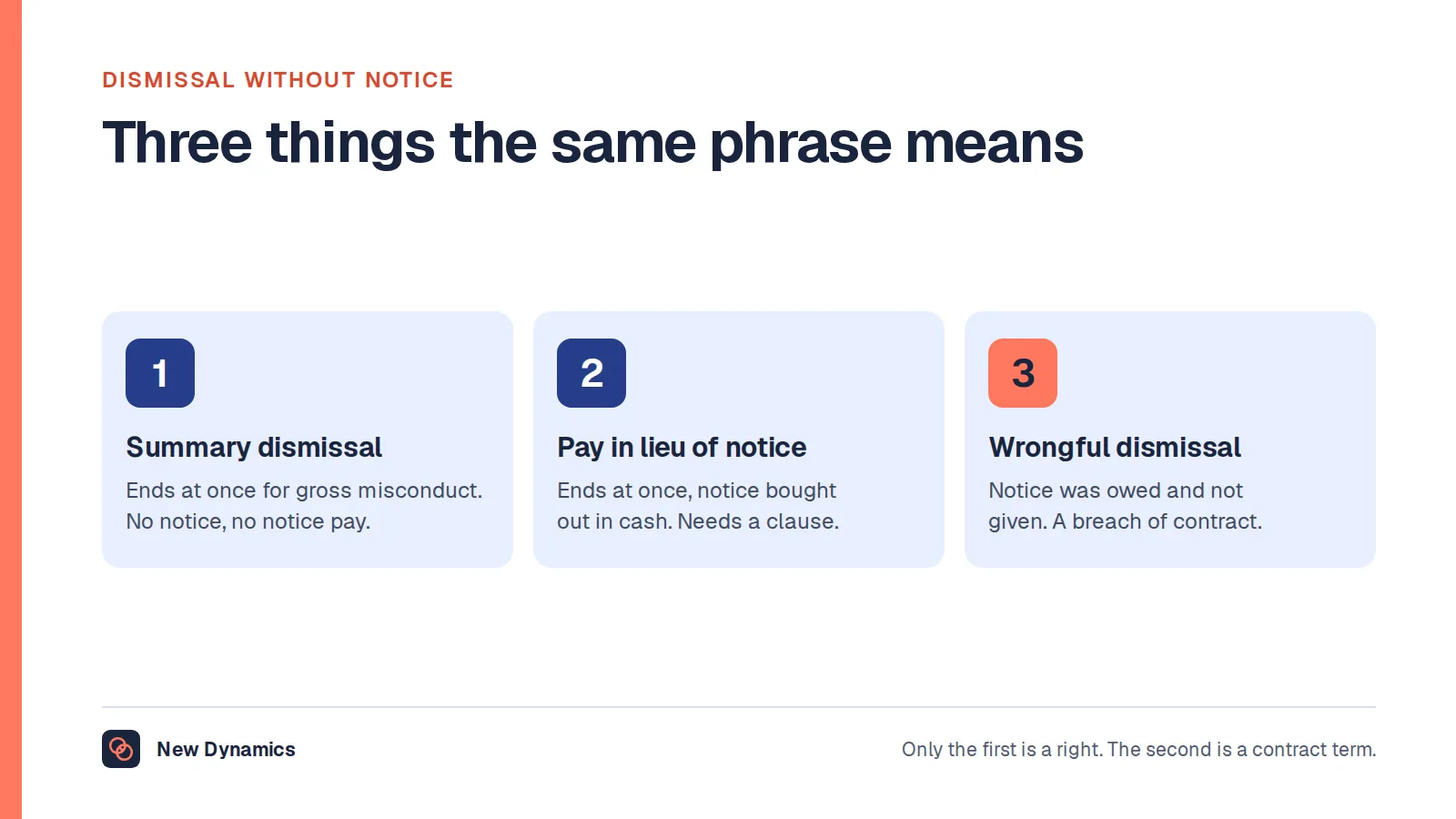
So notice is not a side issue. Section 86 of the Employment Rights Act 1996 sets the floor: notice from the employer "is not less than one week's notice if his period of continuous employment is less than two years", then "not less than one week's notice for each year of continuous employment" up to twelve years, and "not less than twelve weeks' notice if his period of continuous employment is twelve years or more". Section 86(3) adds that the section does not "prevent either party from waiving his right to notice on any occasion or from accepting a payment in lieu of notice". Our post on dismissal without notice covers notice and payment in lieu in full, and our post on the employment contract covers where the terms come from.
The lesson is blunt. An employer that cuts corners on the exit can hand away the covenants it paid to draft.
Severance, and the blue pencil
A covenant that is too wide is not rewritten into something reasonable. Courts will not redraft a clause to save it. What they will sometimes do is sever the offending words, striking them out where the rest still stands on its own and the character of the covenant is unchanged. That is the blue pencil, and it comes from case law, not statute.
So separate restrictions belong in separate, self-contained sub-clauses, where one bad limb can be removed without taking the rest with it. A single long sentence covering competing, soliciting, dealing and poaching across an undefined area is all or nothing, and the nothing is more likely.
Garden leave, and the set-off question
A garden leave clause does a different job. It keeps the employee employed and away from customers, colleagues and systems during the notice period. GOV.UK describes it on its handing in your notice guidance: "Your employer may ask you not to come into work, or to work at home or another location during your notice period. This is called 'garden leave' (also referred to as 'gardening leave')." It adds the key point: "You'll get the same pay and contractual benefits."

That pay obligation is not only guidance. Section 88 of the Employment Rights Act 1996 covers rights of an employee in the period of notice. Where the employee "is ready and willing to work but no work is provided for him by his employer", the employer "is liable to pay the employee for the part of normal working hours covered" at not less than the average hourly rate of remuneration. Sending someone home does not save the notice pay.
Garden leave has two advantages over a covenant. The employee is still bound by the whole contract, including confidentiality and the duty of fidelity, and the employer is paying, which is a more comfortable position in front of a judge than asking for a free restriction. It has two limits. It lasts only as long as the notice period, and it needs express permission in the contract, because keeping a skilled employee idle can itself be a breach of the duty to provide work.
Then the set-off question. Three months of garden leave followed by a six month non-compete is nine months out of the market. A court assessing overall reasonableness takes the garden leave into account, so well-drafted covenants include a set-off clause reducing the post-termination period by time already spent on garden leave. Without one, the combined length is an obvious line of attack. This is the general position rather than a published rule, and the drafting decides it.
Confidential information has its own route
Confidentiality does not depend on a covenant surviving the reasonableness test. The Trade Secrets (Enforcement, etc.) Regulations 2018 came into force on 9 June 2018 and define a trade secret in three limbs. It must be "secret in the sense that it is not, as a body or in the precise configuration and assembly of its components, generally known among, or readily accessible to, persons within the circles that normally deal with the kind of information in question". It must have "commercial value because it is secret". And it must have "been subject to reasonable steps under the circumstances, by the person lawfully in control of the information, to keep it secret".
That third limb is the one employers fail. Information left on an open shared drive was not subject to reasonable steps. Regulation 3 preserves the older route too: "The acquisition, use or disclosure of a trade secret is unlawful where the acquisition, use or disclosure constitutes a breach of confidence in confidential information."
The Regulations also show concretely that Scotland is a separate jurisdiction. Regulation 5 states: "The limitation period is six years. (2) The prescriptive period is five years." Six years in England and Wales, five in Scotland, for the same claim.
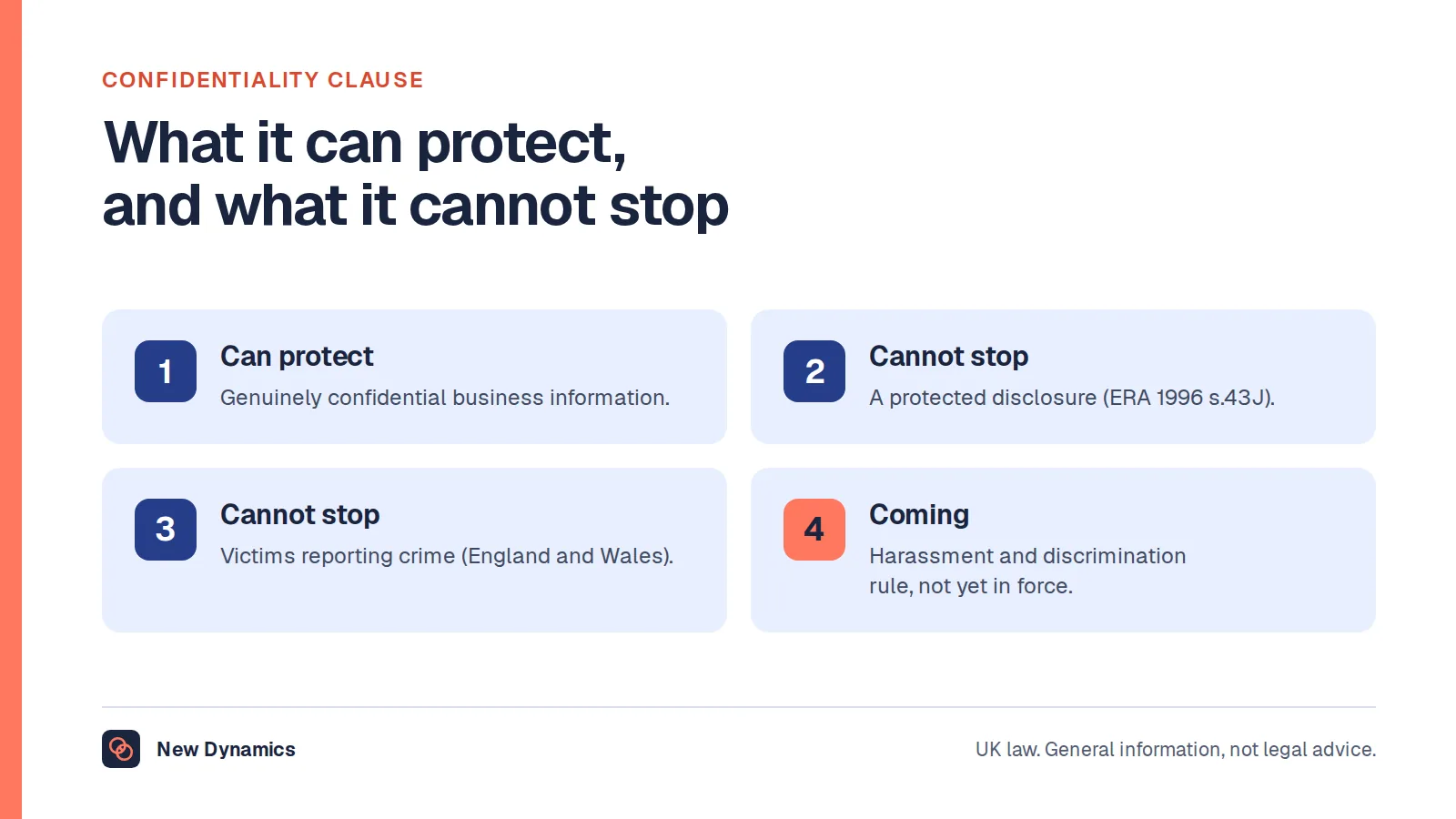
For drafting the confidentiality clause itself, the disclosures it cannot stop and who owns employee inventions and copyright, see our post on the confidentiality clause.
What a court can actually do
Two remedies matter. An injunction stops the former employee, and sometimes the new employer, from doing the restricted thing. It is what employers actually want, because damages after the customers have gone are no use. Interim relief is the usual battleground and speed counts, since an employer that waits months weakens its own case for urgent relief. Under the trade secrets route, regulation 11 lets a court order "the cessation of, or (as the case may be) the prohibition of, the use or disclosure of the trade secret on a provisional basis".
Damages are the fallback where loss can be shown, and loss here is hard to quantify. GOV.UK puts the employee-facing version simply on its restrictive covenants guidance: "Your company could take you to court if you breach the restrictive covenants in your contract." The cost risk runs both ways, and the working paper spells it out: "With claims brought in the county courts or High Court, the losing party will generally bear the winner's legal costs." These are civil proceedings, not tribunal claims.
No statutory cap on non-compete clauses exists
This is worth saying plainly, because a lot of writing on the subject implies otherwise.
On 12 May 2023 the government published its response to the consultation on measures to reform post-termination non-compete clauses, first published on 4 December 2020. The outcome reads: "The government will introduce a statutory limit on the length of non-compete clauses of 3 months and will bring forward legislation to introduce the statutory limit when parliamentary time allows."
It was not legislated. A text search of legislation.gov.uk for "non-compete" returns five results, none of them employment legislation, and the Employment Rights Act 2025 contains no provision on non-compete clauses or restrictive covenants. The subject went back out for views instead: the 2025 working paper lists statutory limits, a ban, a ban below a salary threshold and a combination as options, says it "poses a series of questions to inform engagement with relevant stakeholders before determining which of these proposals are taken forward", and closed for responses at 11:59pm on 18 February 2026. It also records that it "was intended to support discussions, to determine whether and how to take proposals forward, as opposed to a formal consultation".
So there is no statutory maximum today, and the common law test is the only test. The working paper assumes that would hold even after reform, noting the government "would need to make clear that the existing common law principles continue to apply to non-compete clauses shorter than" any statutory limit.
Frequently asked questions
Are restrictive covenants enforceable in the UK?
Sometimes, and only where the employer can justify them. The Department for Business and Trade's working paper states that the starting point under current law is that a non-compete clause, as with any clause in restraint of trade, is unenforceable unless the employer can demonstrate it is reasonable. Acas adds that an employer will not usually be able to enforce restrictive covenants unless they are clear, specific and time-restricted. This is general information rather than legal advice, because the answer depends on the drafting and on the individual's actual role.
How long can a non-compete clause last?
There is no statutory maximum in England and Wales. Duration is judged against how long the protected interest genuinely lasts for that person, so the same period can be reasonable for a director and void for a junior employee. The 2025 working paper records a typical duration of around 6 months in practice, and the 3 month statutory limit announced in May 2023 was never enacted.
Does garden leave count towards a restrictive covenant?
It can, and well-drafted contracts assume it does. A court assessing overall reasonableness looks at the total time someone is kept out of the market, so three months of garden leave followed by a six month restriction is nine months of restraint. That is why covenants usually include a set-off clause reducing the post-termination period by time spent on garden leave.
Do I still get paid on garden leave?
Yes. GOV.UK says that on garden leave "You'll get the same pay and contractual benefits". Section 88 of the Employment Rights Act 1996 backs that up: where an employee is ready and willing to work but no work is provided, the employer is liable to pay for those normal working hours at not less than the average hourly rate of remuneration.
Can an employer add restrictive covenants to an existing contract?
It can ask, but a covenant needs consideration to stand up. Imposing new restrictions on an existing employee with nothing given in return is a weak position, and the general approach of the courts is to look for something real provided in exchange. Attach new covenants to a promotion, a pay rise or a payment made specifically for them, and record what was given and when.
What happens to covenants if the employer breaches the contract?
If the employer commits a fundamental breach, for example dismissing without the notice the contract requires, and the employee accepts that breach and leaves, the general position taken by the courts is that the post-termination restrictions fall away. A rushed or irregular exit can cost an employer the protection it drafted.
Your next step: check the covenants you actually have
- Pull five contracts from different levels and read the restrictions side by side. If they are identical, they are too wide for most of the people holding them.
- For each restriction, write down the interest it protects in one sentence: confidential information, customer connections or workforce stability. If you cannot name one, delete the clause.
- Check whether non-solicitation or non-dealing would do the job before you keep the non-compete. The narrower clause is the one that survives.
- Check that each restriction sits in its own sub-clause, and that a garden leave clause exists with a set-off against the post-termination period.
- Tie covenant reviews to promotions and role changes, not to the hire date.
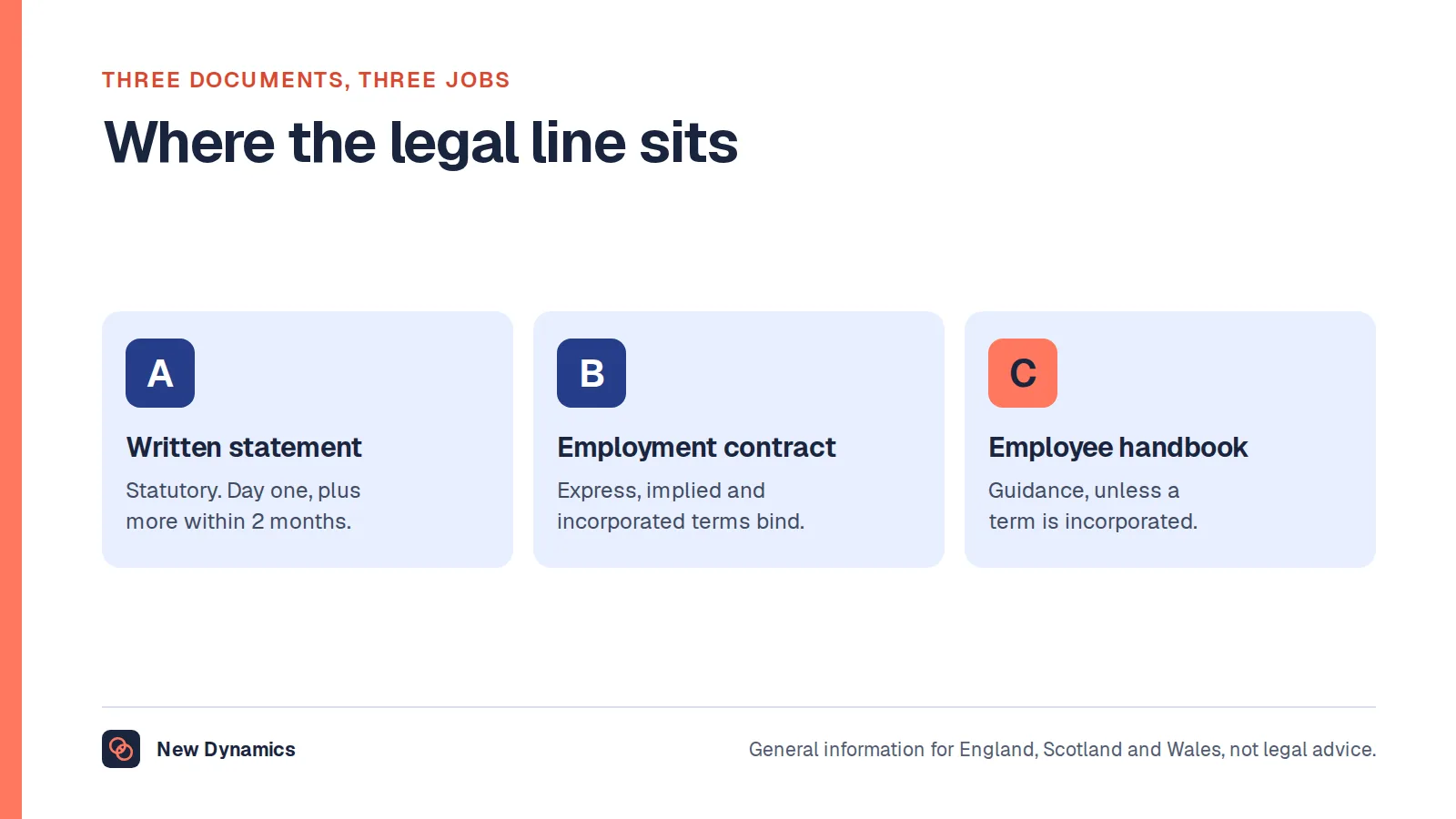
For the policy documents around all of this, read and download our employee handbook guide. The guide is free to read, and the PDF uses our short download form. Acas also advises that employers "should consider getting legal advice before including restrictive covenants in contracts", which is sound: the drafting is the whole case.
Want the signed contract, the role history and the evidence behind a promotion in one place when someone leaves? Book a New Dynamics demo and bring your current contract template. You can also email contact@new-dynamics.com.