TL;DR
- A salary increment, strictly, is a step on a published pay scale: a defined move from one point to the next, on stated criteria. Most of what gets called an increment is a discretionary pay rise, which is a different thing with different consequences.
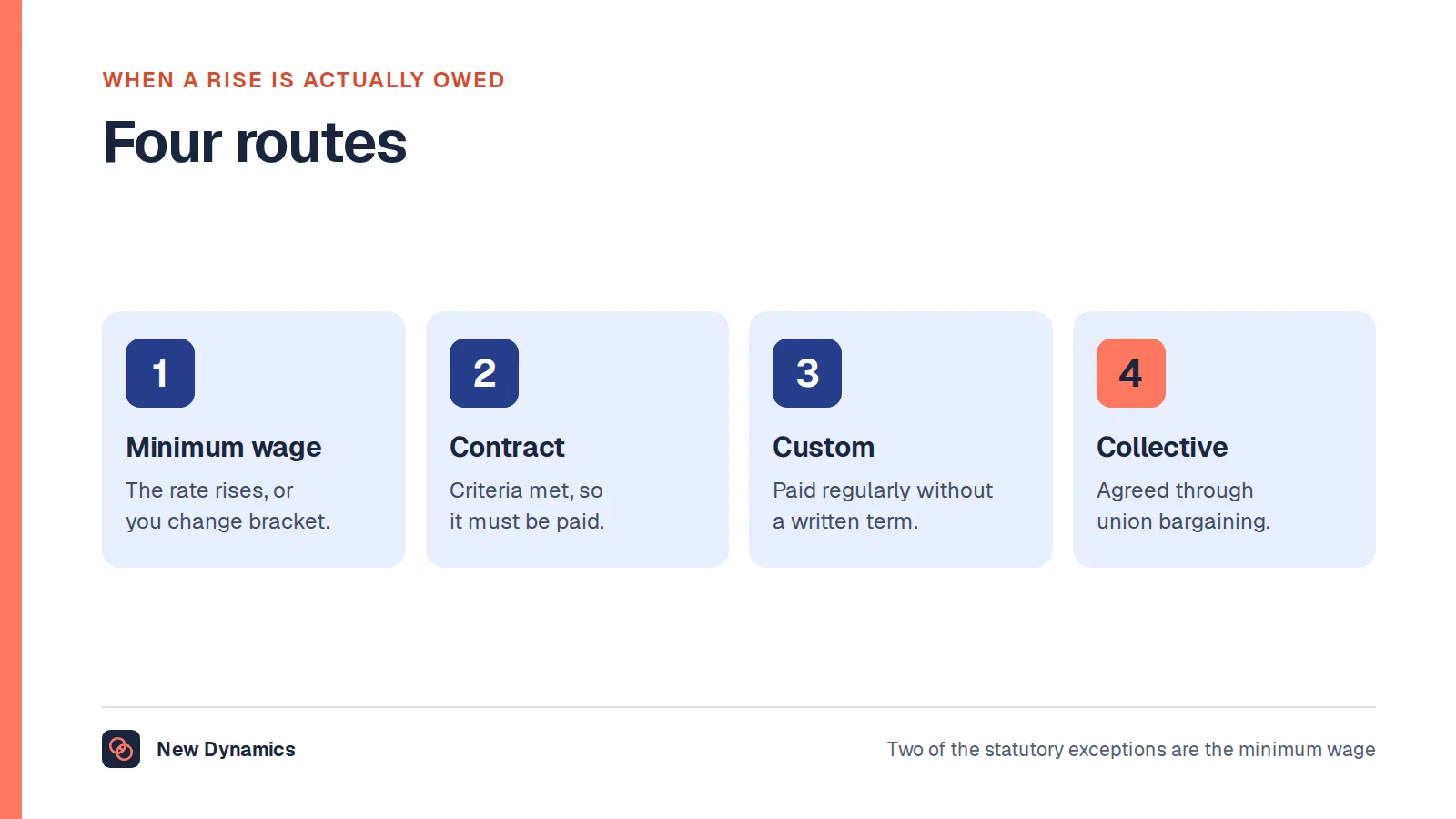
- Acas states the position in the United Kingdom plainly: “There is no legal requirement for an employer to give a pay rise to an employee unless: they earn the minimum wage and it increases; they earn the minimum wage and move into the next age bracket; their contract states they are entitled to one.”
- An annual pay review survives being questioned when the budget, the evidence, the recommendation and the moderation happen in that order, and when every letter names the basis of the award rather than only the percentage.
The letter says three per cent. It does not say what the three per cent is for. Somebody in the team got four, somebody else got nothing, and within a week the only pay structure anybody believes in is the one reconstructed in the kitchen from fragments. The money has been spent and the organisation has bought itself an argument.
This article covers what a salary increment actually is, how to run an annual pay review that holds up when it is questioned, how a cost of living award differs from a progression step and a merit increase, what to write in the letter, what to say when the answer is no, and the equal pay exposure discretionary rises create. It describes the position in the United Kingdom and is general information, not legal advice.
Pay decisions go better when the evidence behind them already exists. See how New Dynamics performance reviews keep the year's goals, feedback and ratings attached to the cycle, so a pay recommendation is read off a record rather than reconstructed from memory in March.
This post is about the process. Our post on pay bands and job evaluation covers the structure underneath it, including band width, midpoints and the compa ratio.
What a salary increment actually is
An increment is a step. The word comes from incremental pay scales, where a job is attached not to a single salary or an open range but to a numbered ladder of points. Each point pays a stated amount, and a published rule says what moves somebody to the next one, usually a year of satisfactory service, sometimes a named qualification or the end of probation.
Two features make it an increment rather than a pay rise. The amount is known in advance, so a jobholder can read their next salary off the scale and there is nothing to negotiate. And the trigger is a rule, not a judgement: somebody checks whether the condition has been met, rather than deciding how generous to feel.
That is why increments are most familiar in parts of the UK public sector and in large unionised employers, where scales are negotiated collectively and then applied. Acas describes that negotiation on its pay rises guidance: "If an employer recognises a trade union, they must carry out 'collective bargaining'." It adds that "Collective bargaining usually includes negotiations about pay" and that "Where collective bargaining leads to a pay increase, it is called a collective agreement."
Why the word travels badly
Most searches for "salary increment", "increment salary" and "increment in salary" come from people describing something that is not an increment: an annual discretionary rise, decided one person at a time, with the amount settled after the decision rather than before it.
Calling that an increment sets an expectation the employer has not created, because an increment implies a ladder, and a ladder implies that next year's step exists and can be seen. If what you run is a yearly decision about whether to award anything, say so in those words. An increment on a published scale also produces a written reason for every difference in pay, while a discretionary rise produces a number and a feeling.
Increment, progression step, merit increase, cost of living award
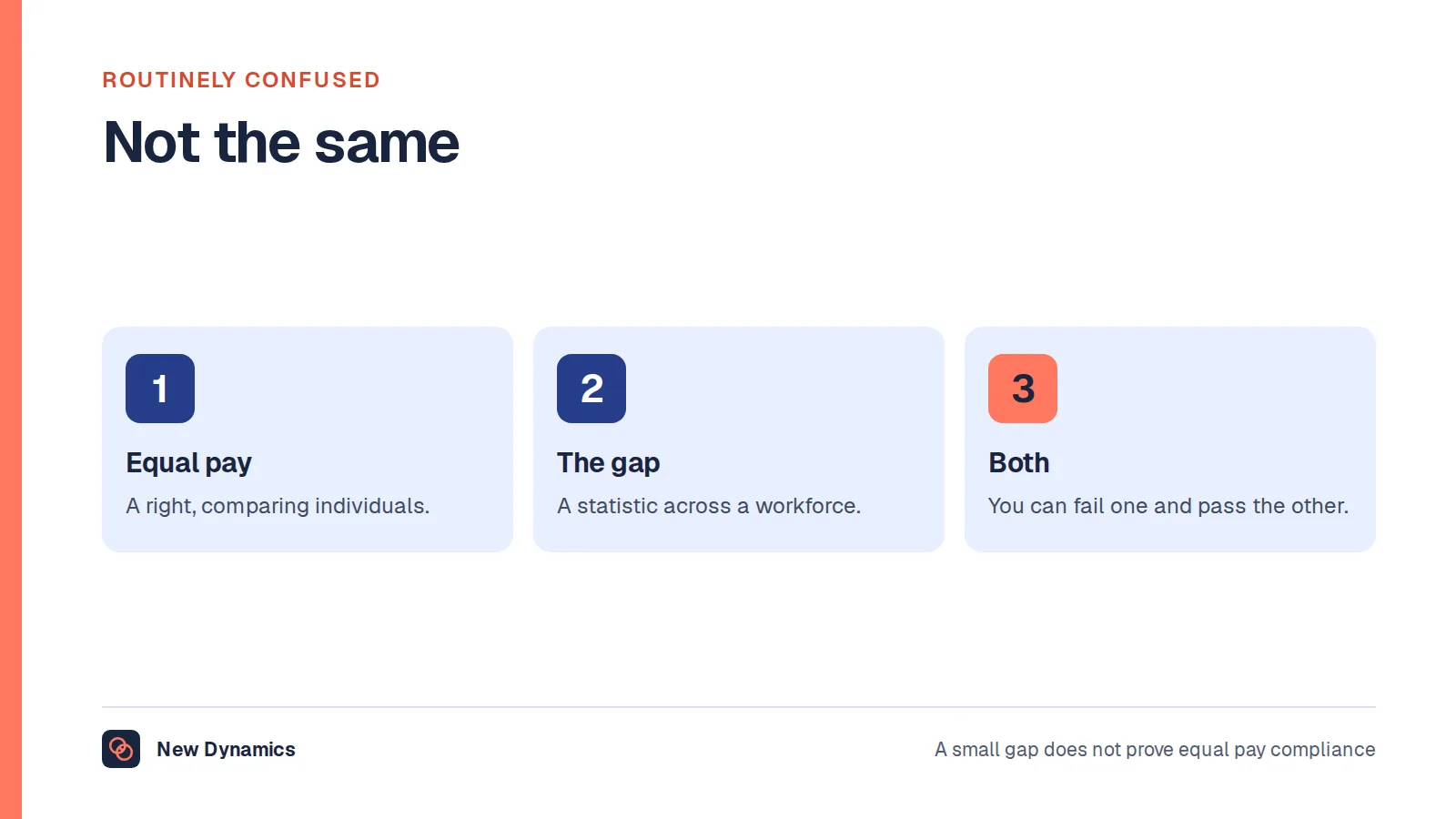
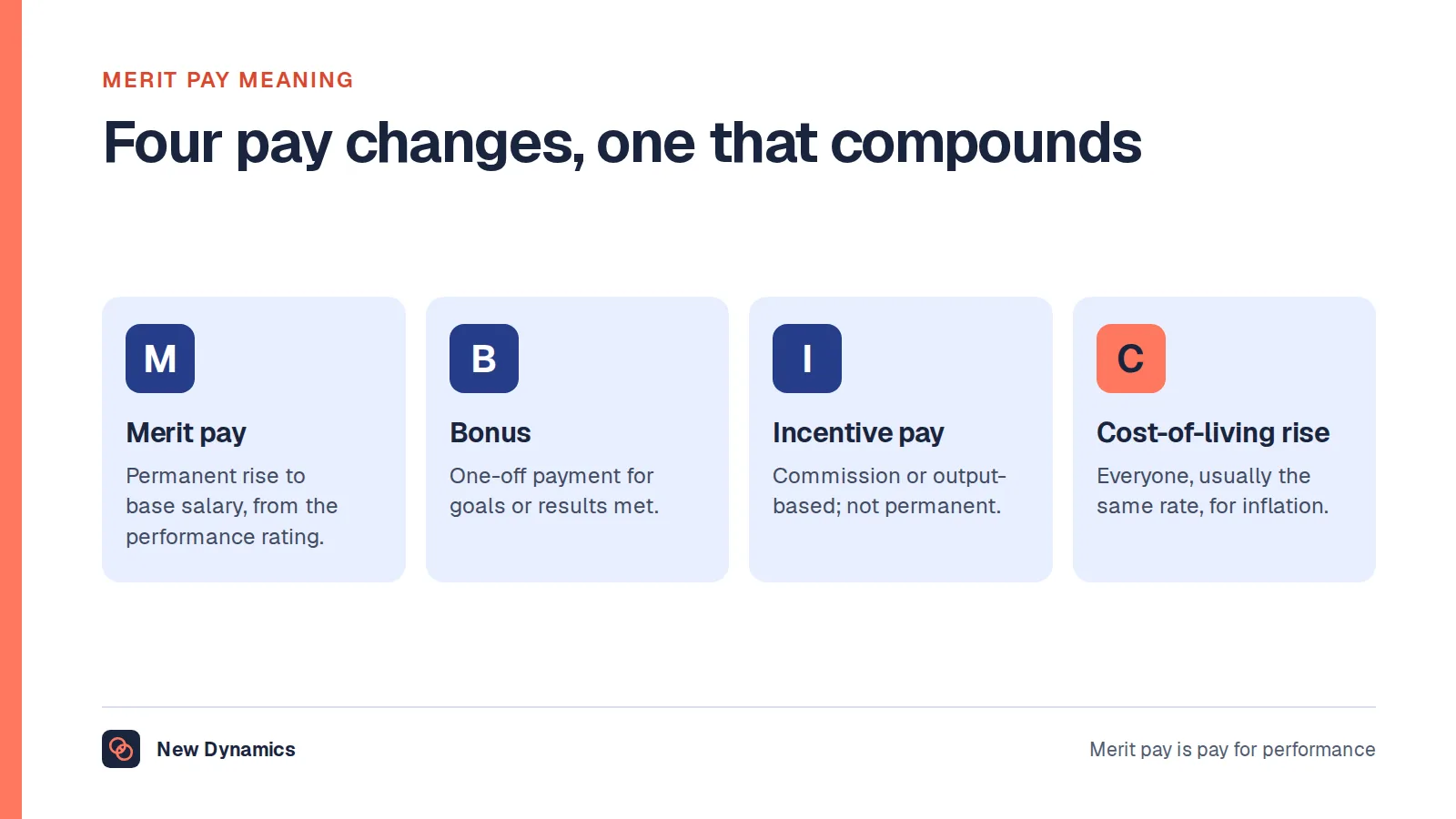
Four different decisions regularly arrive in the same month, expressed as one percentage. Separating them is the highest-value thing an HR team can do to an annual pay review, because each answers a different question.
A cost of living increase answers: has the purchasing power of this salary fallen? It is applied across a group and has nothing to do with how anybody performed. Our post on the cost of living adjustment covers the three choices buried inside the percentage and why a flat rate is not neutral.
A progression step or increment answers: has this person moved up the scale they are on? The criteria were published in advance, so nobody needs to make a case.
A merit increase answers: how well did this person do, and what permanent change to base salary follows? It depends on a rating being trusted. Our post on merit pay covers the matrix, the budget and the ways it fails.
A market or band adjustment answers: is this salary wrong relative to the structure and the evidence? That is a correction, not a reward, and treating it as a reward teaches people that the way to get paid properly is to become a retention risk.

Announcing all four as a single number rewards nobody and reassures nobody: the person who got three per cent in a year of rising prices cannot tell whether they were recognised or merely held level. Write the components separately, even when they land in one payslip line.
What the annual pay review is, and who decides what
An annual pay review, also called an annual salary review or an annual compensation review, is the scheduled exercise in which an organisation decides what to do with base pay for a defined population, within a defined budget, on defined evidence, with a defined effective date. Each of those needs an owner, and most trouble comes from leaving one unowned.
| Decision | Who normally owns it | What they need |
|---|---|---|
| The size of the pot | Finance with the executive | Pay bill, affordability, external earnings data |
| How the pot splits between kinds of increase | HR with the executive | The pay policy, the band structure, the risk picture |
| The individual recommendation | The line manager | Rating, evidence, band position, published rules |
| Whether the pattern is defensible | HR, through moderation | The picture by band, by group, by manager |
| The final sign-off | A named approver | The moderated list and the reasons for outliers |
| The communication | The line manager, in writing | A letter stating the basis, not just the number |
Two rows get skipped. Moderation goes because it is uncomfortable and takes a fortnight, which is what creates the exposure. The letter goes because the payslip appears to have done the job, which guarantees the exposure is found by the people affected rather than by you.
Nothing requires an annual cycle, either, and reviewing on each person's start-date anniversary spreads the load. A single common date costs a fortnight of concentrated work instead, and buys the one condition under which you can see the whole pattern at once and judge whether it is fair.
The order that keeps a pay review defensible
The order matters more than the method. Almost every indefensible pay review got that way by taking recommendations before anybody wrote down the rules they were meant to follow.
- Fix the budget and say what it covers. One pot, as a percentage of the relevant pay bill, stating whether it includes promotions, market corrections and minimum wage compliance. A budget that does not say what it covers gets spent twice.
- Publish the rules first. What is eligible, what a rating means in money, whether band position constrains the award, how a part-year joiner is treated, and who approves an exception. Acas illustrates this kind of rule: "For example, a company decides they will award a 5% pay rise. To be eligible, employees must have been working for the company at the start of the financial year. Charlie joins the company partway through the year and so does not receive the pay rise."
- Assemble the evidence in one place. Salary, band position, last rating, date of last increase, time in role. Managers who have to go and find this will instead go on memory.
- Take recommendations against the published rules, with a required reason for anything outside them.
- Moderate, then test the pattern, not just the individual decisions.
- Sign off against a named approver and keep the reasons, including for exceptions, each with a review date.
- Confirm every decision in writing, including the decisions to award nothing.

Step five earns its place: individually reasonable decisions can still add up to a pattern nobody would defend out loud. If part-timers received on average half what full-timers received, every manager will have a reason and the organisation will still have a problem.
Three tests, each an afternoon's work.
- Spread by group. Average award, and proportion receiving nothing, by sex, by working pattern and by band. You are looking for a difference large enough that somebody will ask, so that you know your answer first.
- Position in band after the review. Awards that pushed people towards the ends of their ranges rather than the intended reference point were about something other than the structure.
- Time since last increase. Anybody with nothing for several cycles is either in the wrong job or has been overlooked, and neither should be reached by default.
Where the pay review sits in the calendar, and why it is not the appraisal
The pay review needs the review cycle to have finished. It does not need to be the same conversation, and in most organisations it should not be.
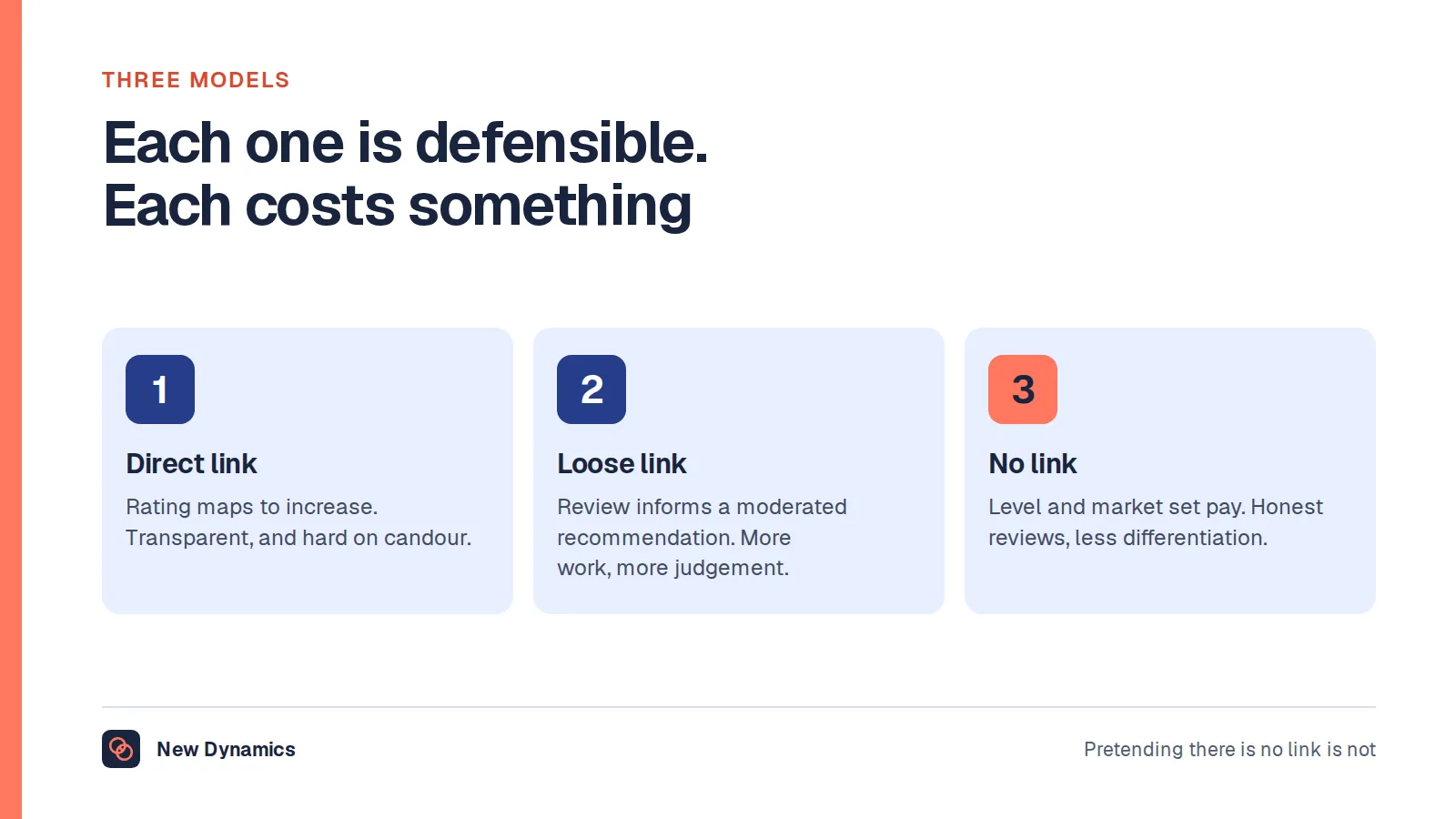
The reason is structural rather than squeamish. An appraisal asks somebody to name what went badly. A pay conversation asks them to make the strongest case for themselves. Run both in one meeting and the second wins, because advocacy is a more urgent instinct than reflection. Our post on whether performance reviews should affect pay covers the three workable models and what each costs.
A sequence that keeps the link and separates the conversations: end-of-year reviews complete, with ratings calibrated; a gap of several weeks, long enough that the development conversation has happened on its own terms; pay decisions made from the recorded ratings, band position and published rules; moderation and sign-off; then a short pay conversation about the decision rather than about the year.
People search for "annual review salary" because the two arrive together and feel like one event. What makes the link honest is that the rating used in March is the rating the employee saw and discussed in January, not a new judgement formed in the pay meeting. Whichever model you run, write it down and tell people. Leaving it unstated is what causes damage, because people infer a link from whatever pattern they can see, and they infer a stronger one than exists.
What the law requires in the United Kingdom
This section is general information about the position in the United Kingdom and not legal advice.
There is usually no right to a pay rise at all. Acas puts it directly on its pay rises guidance: "There is no legal requirement for an employer to give a pay rise to an employee unless: they earn the minimum wage and it increases; they earn the minimum wage and move into the next age bracket; their contract states they are entitled to one."
The minimum wage exception is a hard floor with a date on it. GOV.UK's National Minimum Wage and National Living Wage rates states that "The rates change on 1 April every year" and that you must be "aged 21 to get the National Living Wage". The published rate for workers aged 21 and over is £12.71 an hour from April 2026, rising to £13.21 from April 2027. Acas adds a detail that catches payroll out: "The higher rate starts to apply from the next pay reference period after the increase."
A contractual rise must be paid. Acas says a discretionary rise is "not guaranteed each year", whereas with a contractual one "The employer must pay a contractual pay rise if certain agreed criteria are met." The entitlement "should be recorded in their written statement of employment particulars". A pattern of unwritten rises can also become an entitlement through what Acas calls "custom and practice".
Discretion is not the same as freedom. This is the part employers misread. Acas is explicit: "If a contract says a pay rise is discretionary, the employer should still act fairly when deciding whether to pay it. If some employees will not receive the pay rise, there should be clear reasons for this."
The change must be put in writing within a month. Acas states: "By law, an employer must put a change in writing within one month of the change." The provision is section 4 of the Employment Rights Act 1996, which requires the statement "at the earliest opportunity and, in any event, not later than one month after the change in question". Where one award goes to a group, Acas says the employer "can put the changes in writing for the whole group at the same time".
An agreed rise that is not paid is recoverable. Acas sets out the clocks on resolving problems with pay rises: a tribunal claim for unlawful deduction from wages, where "Employees might only have 3 months minus 1 day from the date of the underpayment", or a breach of contract claim with "up to 6 years from the date of the underpayment" in the county court in England and Wales, and five years in the Scottish sheriff court.
The one figure you should not quote
There is no official UK statistic for "the average pay rise", and the numbers that circulate as one are usually earnings growth, which is a different measure.
The Office for National Statistics publishes earnings growth in Average weekly earnings in Great Britain, released on 20 October 2026. For the period from June to August 2026 it reports that "Annual growth in employees' average earnings was 3.7% for both regular earnings (excluding bonuses) and total earnings (including bonuses)", and that "Annual average regular earnings growth remained at 6.3% for the public sector and 3.0% for the private sector". The same bulletin warns against reading those as pay rises: "AWE is not a measure of rates of pay and can be affected by changes in the composition of an enterprise's workforce."
The annual survey carries the same caveat. In Employee earnings in the UK: 2026, released on 22 October 2026, the ONS reports an increase in median weekly earnings for full-time employees "of 5.8% on the year" to April 2026, while listing among the things these statistics cannot do: "attribute all the differences in levels and growth rates in pay to changes in earnings only".
So official UK data tells you how total earnings moved across the economy, not what a typical employer awarded a typical employee, and no official source publishes that second figure. Anchor your budget to the published series for your sector, name the reference period, and resist any single number offered as the going rate. Our post on UK pay statistics sets out the measures, the wider collection sits in our HR statistics hub, and our post on benchmarking covers judging whether a comparison is valid before you use it.
How to ask for a pay rise, and how to handle the request
Both sides of this conversation are improved by a written case rather than a conversation in a corridor. Acas frames the starting point on asking for and awarding pay rises: "An employee might want to discuss a pay rise with their employer if they do not have a right to one through either: their contract; an existing collective bargaining agreement." It adds that "They could give the reasons why they think they should get a pay rise."
Four things make a request easy to say yes to.
- The evidence, dated. What changed in the work, with the months attached. A case built on the last six weeks invites a comparison with the last six weeks.
- The scope, named. Grown responsibilities, a band position that has fallen behind, or a market comparison. Those are three conversations with three answers.
- A number, or a range. Leaving the figure open hands the decision to somebody with a budget to protect.
- The timing. Asked before the budget is fixed, a case can be built into the pot. Asked in the week the letters go out, the only answer available is no.
Acas's advice after any pay discussion runs in both directions: "the employee should confirm what they've discussed in writing."
For the employer, one rule above the others. Avoid answering an out-of-cycle request with an out-of-cycle number, because every unrecorded individual deal is a future equal pay question nobody can answer. Answer it with a place in the process: here is when the review happens, here is the evidence it will use, and here is what I will put in. If it must be answered out of cycle, record the reason, the approver and a review date.
On the anxiety underneath the question, Acas is reassuring: "Asking for a pay rise is unlikely to be a fair reason to dismiss someone."
What to write in a salary increment letter
A pay rise letter to an employee has one job: to make the decision clear enough that nobody has to ask a second question, and specific enough to be legible in two years when somebody reconstructs how a salary got to where it is.
- The old salary and the new one, in money, not only as a percentage. Percentages are where people make arithmetic errors about their own pay.
- The basis, broken down. If the award is a two per cent group award plus a one per cent merit increase, say that. If it is a progression step, name the scale and the point.
- The effective date, and the first payslip that will reflect it. These are often different, and the gap generates a predictable volume of queries.
- Anything that moves with salary. Pension contributions, overtime rates, percentage allowances.
- What has not changed. Job title, grade, hours and terms. Silence here reads as ambiguity.
- Who to ask. A named person for the decision, payroll for the payment.

A short worked example
The figures below are an arithmetic illustration only. They are not benchmark data, not a recommendation and not drawn from any survey.
Following this year's pay review, your salary will increase from £38,000 to £39,140 a year with effect from 1 April 2027. This reflects the group award of 2% applied to all eligible colleagues, and a merit increase of 1% in recognition of your end-of-year rating. The new salary will appear in your April payslip. Your employer pension contribution, calculated as a percentage of base salary, increases accordingly. Your job title, grade, hours and other terms are unchanged. If you have a question about the decision, please speak to me; for a question about the payment, please contact payroll.
That closes every question the three per cent version leaves open, and it satisfies the written-statement obligation provided it reaches the employee within a month. One caution on backdating: Acas notes that where a rise is backdated and somebody has already left, "whether they are eligible for the pay rise depends on their contract", so an eligibility rule silent on leavers will be read against whoever wrote it.
When the answer is no
Most people in a pay review get less than they hoped and some get nothing. How that is handled decides whether the next cycle begins with a conversation or a grievance.
Say no in person, not by omission. A letter confirming no change is better than silence, and silence is what most organisations send.
Give the actual reason. The budget, the position in the band, the rating, the eligibility rule. "There was no money" is a real reason and people can accept it. "It just wasn't possible this year" is not a reason and people cannot.
Separate "no" from "not yet" and mean it. If there is a route to a different answer, name the evidence, the person who will look at it and the date. If there is no route, say that too. And do not pay for the complaint: where a late award is genuinely right, run it through the same rules and record it as an exception.
Expect a proportion to escalate, and let them. Acas's route is the ordinary one: raise it informally first, then "If the issue cannot be resolved informally, the employee can raise a grievance." A grievance about pay is information about your process, and far cheaper than a tribunal claim about the same decision.
The equal pay exposure of discretionary rises
This is the part that turns an awkward pay review into an expensive one. Again, general information about the United Kingdom rather than legal advice.
Equal pay in Great Britain sits in the Equality Act 2010. Section 66 implies a term into the contract: "If the terms of A's work do not (by whatever means) include a sex equality clause, they are to be treated as including one", with the effect that "if a term of A's is less favourable to A than a corresponding term of B's is to B, A's term is modified so as not to be less favourable."
Acas sets out the scope on its equal pay and the law guidance: "By law, men and women must get equal pay for doing 'equal work'. This is work that equal pay law classes as the same, similar, equivalent or of equal value." What the law applies to includes "basic salary" and "performance-related pay, for example a bonus that's in the employment contract". A pay review decision sits inside that list.
Four features of discretionary pay reviews create the exposure.
The reason is in somebody's head. Section 69 gives the employer a defence of material factor, which applies where "the responsible person shows that the difference is because of a material factor". The burden is on the employer, and a reason never written down is not much use three years later.
Reasons that disadvantage a group need justifying, not just stating. Section 69 continues that where a factor puts one sex doing equal work "at a particular disadvantage when compared with persons of the opposite sex doing work equal to A's", relying on it must be "a proportionate means of achieving a legitimate aim". So apparently neutral practices need testing, including awards that follow length of service, hours worked or availability to travel.
Partial explanations do not close the case. Acas is precise: "If any circumstances only account for part of the difference in pay, someone might still have an equal pay case."
The differences compound. One award two per cent above a colleague's is small. Repeated for six years it is a gap nobody intended and nobody can explain.
So record the reason at the point of decision, not when it is challenged, and run the group test before sign-off, because the pattern is what a claim gets built from. Our post on pay equity covers the audit that finds these gaps.
Pay secrecy does not help you
Employers sometimes respond to the risk by telling people not to discuss their pay. In Great Britain that does not work as intended. Section 77 of the Equality Act 2010 makes such a term "unenforceable against P in so far as P makes or seeks to make a relevant pay disclosure", meaning a disclosure made to find out "whether or to what extent there is, in relation to the work in question, a connection between pay and having (or not having) a particular protected characteristic". Seeking, making and receiving one are also protected acts for victimisation purposes.
So people may compare notes, and penalising them for it creates a second problem on top of the first. The answer is not to keep the numbers quiet, but to make sure the reasons stand up when they are compared.
Frequently asked questions
What is a salary increment?
A salary increment is a step from one point to the next on a published pay scale, where the amount and the criteria are both set in advance. A year of satisfactory service is the most common trigger. In everyday use the word is applied to any annual pay rise, but a discretionary rise differs because the amount is decided at the time rather than published beforehand.
How often should an annual pay review happen?
Once a year on a common date is the usual choice, because it is the only arrangement in which every decision is made against the same budget and the whole pattern can be reviewed at once. Reviewing on each person's start-date anniversary spreads the workload but makes comparison between colleagues harder. Nothing in UK law requires any particular frequency.
Is an employer legally required to give a pay rise?
Not in general. Acas states there is no legal requirement unless the employee earns the minimum wage and it increases, earns the minimum wage and moves into the next age bracket, or has a contract saying they are entitled to one. A regular unwritten practice of awarding rises may also create an entitlement through custom and practice. This is general information about the United Kingdom, not legal advice.
What is the difference between a merit increase and a cost of living increase?
A merit increase is a permanent uplift to base salary based on how the individual performed, decided from a rating. A cost of living increase is applied across a group to protect the value of pay against prices and is unrelated to performance. Announcing them as a single percentage tells the employee nothing about why they received what they received.
What should a salary increment letter say?
State the old and new salary in money as well as any percentage, break the award down by its basis, give the effective date and the first payslip affected, name anything that moves with salary such as pension contributions, confirm what has not changed, and name someone to ask. Acas says a change to main terms must be put in writing within one month of the change.
Does the ONS publish an average pay rise figure?
No. The ONS publishes earnings growth across the economy, which is not the same thing. Its October 2026 average weekly earnings bulletin reports annual growth of 3.7% in regular and total earnings for June to August 2026, while warning that average weekly earnings is "not a measure of rates of pay and can be affected by changes in the composition of an enterprise's workforce". No official source publishes a typical employer award.
Your next step: write the rules before you open the spreadsheet
- Write down, in one page, what your pay review decides: the pot, what it covers, the eligibility rules, what a rating is worth, and who approves an exception.
- Decide this year's group award, progression and merit pots as three numbers rather than one.
- Put the evidence in one place before managers recommend anything: salary, band position, last rating, date of last increase.
- Moderate, then run the three pattern tests before sign-off, recording a reason and a review date for every exception.
- Rewrite your letter template so it names the basis, the dates and a person to ask, and send one even when the answer is no change.
For the policy itself, with the sections and the decisions it has to settle, read and download our compensation policy guide. The guide is free to read, and the PDF uses our short download form.
Want the evidence behind each pay recommendation to exist before the review starts, rather than being reconstructed in the meeting? Book a New Dynamics demo and bring last year's review form. You can also email contact@new-dynamics.com.