TL;DR
- A skill set is the range of things that someone is good at, especially the things that are useful in a particular job.
- Write it as two words: skill set. Skillset, as one word, is an accepted variant. The plural is skill sets. “Skills set” is not in the dictionaries we checked.
- The phrase only becomes useful when you name the skills in it. Map yours by listing what you do, naming the skill behind each task and attaching evidence.
“We are looking for someone with a strong skill set.” “She has a unique skillset.” The phrase is everywhere in hiring, and it is nearly always vague. It also raises a small, practical question that sends many people to a search engine: is it one word or two?
This article gives the definition of skill set, settles the spelling, explains what a skill set contains, shows how to map and describe your own, and sets out how employers use skill sets for hiring, development and planning.
A skill gap only closes when it turns into a goal that someone reviews. See how New Dynamics Goals & OKRs keep development goals visible alongside business goals.
What is a skill set?
The Cambridge Dictionary defines a skill set as “the range of things that someone is good at, especially things that are useful in a particular job”.
The Oxford Learner's Dictionaries give a shorter definition of skill set: “a person's range of skills or abilities”. Its example sentence shows how the phrase is normally used: “This job requires a completely different skill set.”
Two words in those definitions do the work.
- Range. A skill set is a collection. One skill, however strong, is not a set.
- Particular job. The phrase is nearly always relative to a role. Your skill set for running a kitchen and your skill set for managing a budget overlap only in part.
Skill set, skillset or skills set?
| Form | Status | What the dictionaries show |
|---|---|---|
| skill set | The standard form | The headword in both Cambridge and Oxford |
| skillset | An accepted variant | Cambridge lists it as “also skillset” |
| skill sets | The plural | Regular plural of the standard form |
| skills set | Best avoided | Not given by either dictionary |
So write skill set, as two words, in anything formal, such as a CV, a job description or a policy. Skillset is common and will not be marked wrong. Whichever you choose, use it consistently within a document.
The plural follows the normal rule for compound nouns: one skill set, two skill sets. “Skills set” and “skillsets or skill set” are frequent searches, but “skills set” does not appear in either dictionary, and it is safer to avoid it.

What a skill set contains
There are many ways to sort skills. A simple split into two kinds is widely used.
- Hard skills are specific and teachable: using a spreadsheet, welding, writing code, speaking Spanish, reading a balance sheet.
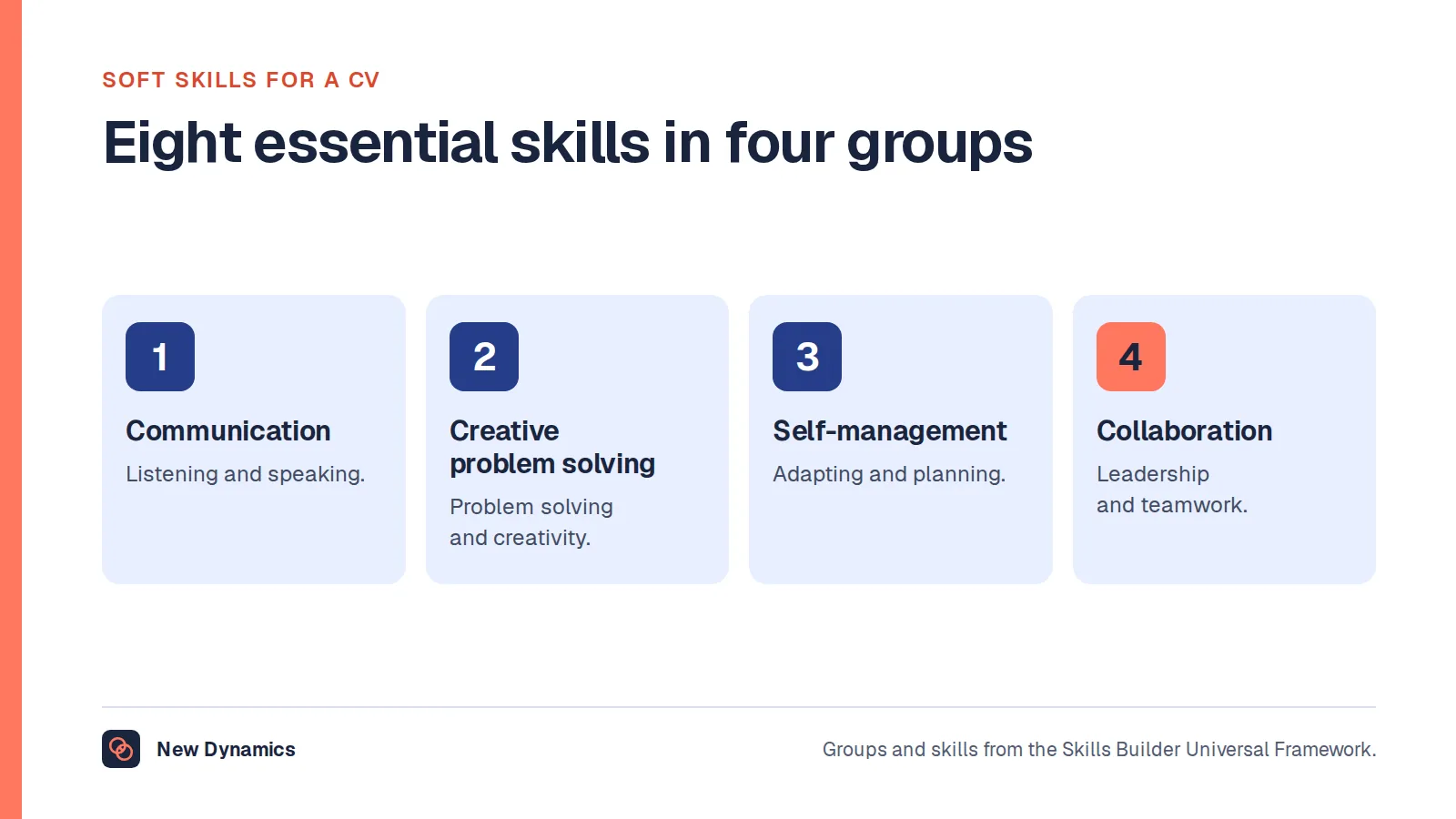
- Soft skills are transferable between jobs: teamwork, communication, problem solving, organising your time.
Underneath both lie abilities. The open textbook Organizational Behavior, published by OpenStax, says in its section on employee abilities and skills that abilities and skills “help determine an employee's capability to respond”, and that they “often bound an employee's ability to do the job”. Its list of mental abilities includes verbal comprehension, number aptitude, inductive reasoning and memory.
Three related words are often confused with skill.
| Word | Meaning | Example |
|---|---|---|
| Knowledge | What you know | Employment law, a product range |
| Skill | What you can do, learned through practice | Interviewing, negotiating, coding |
| Competency | A skill described as observable behaviour at work | “Explains decisions clearly to the team” |
Our guide to core competencies shows how employers turn skills into behaviours that can be assessed.
Skill set examples
These examples show what “range” means in practice. Each mixes hard and soft skills.
Customer service adviser: product knowledge, the ticketing system, clear writing, calm under pressure, listening, spotting patterns in complaints.
Project manager: planning and scheduling, budgeting, risk management, running meetings, negotiating, writing status reports, a project tool.
Nurse: clinical assessment, medication management, record keeping, communication with patients and families, teamwork across shifts, prioritising under pressure.
Data analyst: SQL, spreadsheets, statistics, data visualisation, questioning a brief, explaining findings to non-specialists.
First-time manager: setting goals, giving feedback, delegating, running one-to-ones, hiring, handling conflict. Our guide to management skills covers this set in depth.
How to map your own skill set in five steps
- List what you do. Write down the tasks of a typical month, including the ones that feel too obvious to mention.
- Name the skill behind each task. “Sorted out the rota clash” becomes negotiating and scheduling. One task often uses several skills.
- Attach evidence. For each skill, note a result, a piece of feedback or a qualification. A skill without evidence is a claim.
- Compare with your target role. Read three job descriptions for the role you want next, and mark which of their skills you have, partly have or lack.
- Choose two gaps to work on. Pick the ones that appear in every description. Put them in your development plan, with an action and a date. Our employee development plan template gives the structure.
Ask someone who knows your work to check the list. People often leave out their strongest skills because they find them easy.

How to describe your skill set
“Strong skill set” tells a reader nothing. Name the skills, and prove them.
On a CV. Group skills under two or three headings that match the advert, and show each in use: “Built the monthly forecast in SQL and Excel, which cut reporting time from three days to one.” That figure is an illustration. Our guide to soft skills for a CV has more wording.
In an interview. For “tell me about your skill set”, choose the three skills that matter most to the role, and give one short example of each.
In a review. Describe which skills you used, which you developed this year and which you want to build next. Our strengths and weaknesses examples can help with the honest part.
How employers use skill sets: five uses
- Hiring. A job description is a list of the skills the role needs. Separate the essential from the desirable, and test the essential ones.
- Development. Comparing a person's skills with their role, and their next role, produces a development plan.
- Performance reviews. Reviews should ask which skills someone applied and grew, as well as which goals they met.
- Succession. Knowing who has which skills shows who could step into a key role, and what they would need first.
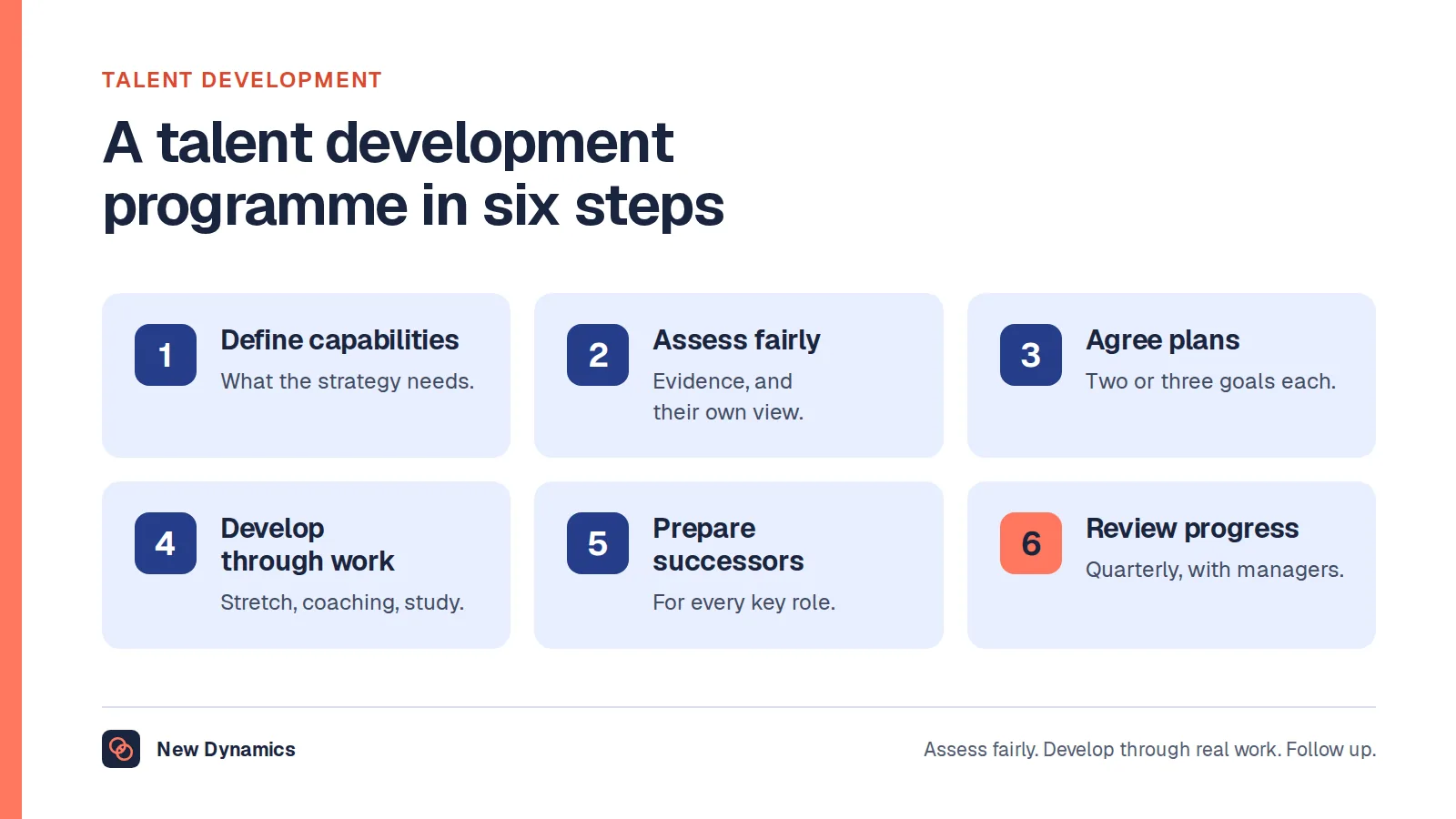
- Workforce planning. Comparing the skills you have with those the strategy needs shows where to train, hire or redeploy. Our article on talent development explains the process.
The common thread is a shared, specific vocabulary. “Good with data” means different things to different managers. “Can build and explain a forecast model” does not.

Frequently asked questions
What is the definition of skill set?
A skill set is the range of things that someone is good at, especially things that are useful in a particular job. The Oxford Learner's Dictionaries define it more briefly as a person's range of skills or abilities.
Is it skill set or skillset?
Both are accepted. Skill set, as two words, is the standard form and the headword in the Cambridge and Oxford dictionaries. Cambridge lists skillset, as one word, as an alternative. Use two words in formal writing, and be consistent.
Is “skills set” correct?
It is best avoided. Neither the Cambridge Dictionary nor the Oxford Learner's Dictionaries give “skills set”. The singular is skill set, and the plural is skill sets.
What is an example of a skill set?
A project manager's skill set might include planning, budgeting, risk management, running meetings, negotiating and using a project tool. A skill set usually mixes hard skills, which are specific and teachable, with soft skills, which transfer between jobs.
What is the difference between a skill and a skill set?
A skill is one thing that you can do well, such as negotiating. A skill set is the whole range of skills that you bring, usually described in relation to a particular job.
How do I identify my skill set?
List the tasks you do in a typical month, name the skill behind each one, attach evidence such as a result or feedback, compare the list with descriptions of the job you want, and ask someone who knows your work to check it.
Your next step: name ten skills
- Write down ten skills you have used in the past month, using verbs.
- Put a piece of evidence beside each one.
- Mark the three that matter most for the role you want next.
- Pick one missing skill, and agree a way to build it with your manager.
To do the same across a team, read and download our skills gap analysis guide. The guide is free to read, and the PDF uses our short download form.
Want development goals and skills conversations to be part of every review? Book a New Dynamics demo and bring a role you are trying to fill. You can also email contact@new-dynamics.com.