TL;DR
- There is no single staff coordinator role. The same title covers four different jobs: filling the rota, administering the people records, coordinating the work of a group of staff, and running a casual, bank or volunteer workforce. Deciding which one you mean is the whole task of writing the job description.
- The confusion is legal as well as editorial. Section 1 of the Employment Rights Act 1996 lets the written statement give either “the title of the job which the worker is employed to do or a brief description of the work for which he is employed”, so when the title explains nothing, the brief description is the part that has to do the work.
- Five boundaries decide whether the job is workable: spend, discipline and performance, hiring decisions, contractual change, and access to records. On the last one the Information Commissioner's Office expects organisations to ensure that “access to employment records systems is limited to HR staff only, and that managers only have access to the information they need to meet their obligations”.
Two employers advertise for a staff coordinator in the same week. One wants somebody to fill 140 care shifts a week from a bank list. The other wants somebody to chase probation reviews and keep the right-to-work file straight. Both adverts are honest. Neither title tells an applicant which job it is.
That is the real problem behind this search. "Coordinator" is a verb looking for an object, and "staff" is the raw material rather than the task. This article sets out what a staff coordinator actually does, the four distinct jobs that share the title, the duties in six groups, the five boundaries that make the job workable, who the role reports to, how it differs from the adjacent coordinator titles, and a template you can adapt. It is general information about the role, not legal advice.
Boundaries are easier to agree when the reporting lines are visible rather than remembered. New Dynamics org charts show who a coordinator reports to, who they coordinate and where the authority actually sits, which is the part most coordinator adverts leave blank.
Why "staff coordinator" is not one job
Most job titles name an output. A payroll administrator produces payroll. An event coordinator produces events. "Staff coordinator" names the people the work happens to, which leaves three questions open:
- Coordinate what, about staff? Their shifts, their paperwork, their training, their work, or their arrival and departure.
- Whose staff? A single department, a whole site, a bank or agency pool, or a volunteer list.
- With what authority? Permission to move somebody's shift is not permission to send them home, and neither is permission to discipline them.
Until those are answered the advert attracts two completely different candidates and disappoints one of them. Acas publishes job description templates and its own outline is built on exactly this point: the headings it asks for are "the main headings to use", "the role's main duties" and "who the employee will report to". Duties and a reporting line, not a title.
The law makes the same distinction. Section 1 of the Employment Rights Act 1996 sets out what must be in the written statement of employment particulars, and section 1(4)(f) requires "the title of the job which the worker is employed to do or a brief description of the work for which he is employed". That "or" is doing real work. Where a title is genuinely descriptive, the title is enough. Where it is not, and "staff coordinator" is not, the brief description is what the employee and the employer will actually rely on.
The four jobs that share the title

One: the rota and cover coordinator. The job is filling shifts. Build and publish the rota, find cover for sickness and leave, book bank or agency workers, check that whoever turns up is qualified to be there, and keep the hours that feed payroll accurate. Common in care, hospitality, logistics and NHS temporary staffing offices, where the title is often written "staffing coordinator".
Two: the people administration coordinator. The job is the paperwork of employment. Contracts out, checks back, induction booked, probation dates tracked, absence recorded, renewals chased, leavers processed. This overlaps most heavily with an HR coordinator, and if the post sits inside an HR team that is the title to use. Our post on the human resource coordinator job description covers that version, including where it stops short of HR advice.
Three: the service or team coordinator. The job is coordinating the work of a group of staff: allocating tasks, sequencing jobs, checking output against a standard, and acting as the point of contact for the team. This version is supervisory in substance even when it is not supervisory in title, which is the single most common way a coordinator advert misleads.
Four: the bank, casual or volunteer coordinator. The job is a workforce that is not on a standard rota. Recruit and induct a pool, keep availability current, match people to sessions, keep clearances in date, and keep the pool big enough to be useful. Charities, schools, festivals and NHS bank offices all run a version of this.
A real post can combine two of these. It should not combine all four, because the rhythms conflict: cover work is interrupt-driven and hourly, records work needs uninterrupted blocks, and supervising a team needs availability to the team.
Staff coordinator duties, in six groups

- Cover and scheduling. Build and publish the rota, hold cover arrangements, fill short-notice gaps, and record actual hours for payroll.
- Starters, leavers and movers. Prepare for arrivals, book induction, process changes of hours, role and manager, and close out leavers including system access.
- Records, compliance and renewals. Keep records, qualifications, background checks and mandatory training in date, and raise a renewal before it expires rather than after.
- Training logistics. Book places, chase attendance, record completion, and tell a manager when their team is behind.
- First-line queries. Answer what has a documented answer, and pass on what needs advice, authority or discretion.
- Reporting. Produce the recurring numbers somebody uses: shifts filled and unfilled, agency spend, absence, training completion, vacancies open.
Group six is the one most often missing from the advert and most often the reason the job grows unmanageable. Decide which reports the coordinator owns and which they only supply data to.
Where the role stops: five boundaries to write down

A coordinator job without written limits either stalls at every decision or quietly acquires a manager's responsibilities without a manager's grade. Settle these five before you advertise:
- Spend. What may the coordinator commit without approval? Agency bookings above a stated rate, overtime and training spend each need a figure or a named approver.
- Discipline and performance. A coordinator may record facts: a no-show, a late return, a missed training session. Deciding what happens next belongs to whoever holds the conversation. Say which role that is.
- Hiring decisions. Coordinating interviews is not selecting. Name who decides.
- Contractual change. Changing somebody's hours, pay or role is a contract change, not a rota change. Acas sets out the employer responsibilities in changing an employment contract, and a coordinator should route these rather than action them.
- Access to records. A staff coordinator sees absence reasons, checks and sometimes health information. The Information Commissioner's Office expects employers to ensure that "access to employment records systems is limited to HR staff only, and that managers only have access to the information they need to meet their obligations", in its guidance on collecting and keeping employment records. If this role needs wider access than a line manager, write down which fields and why.
Staff coordinator against the adjacent titles
The quickest way to settle the title is to ask what the post is accountable for and then pick the name that already means that.
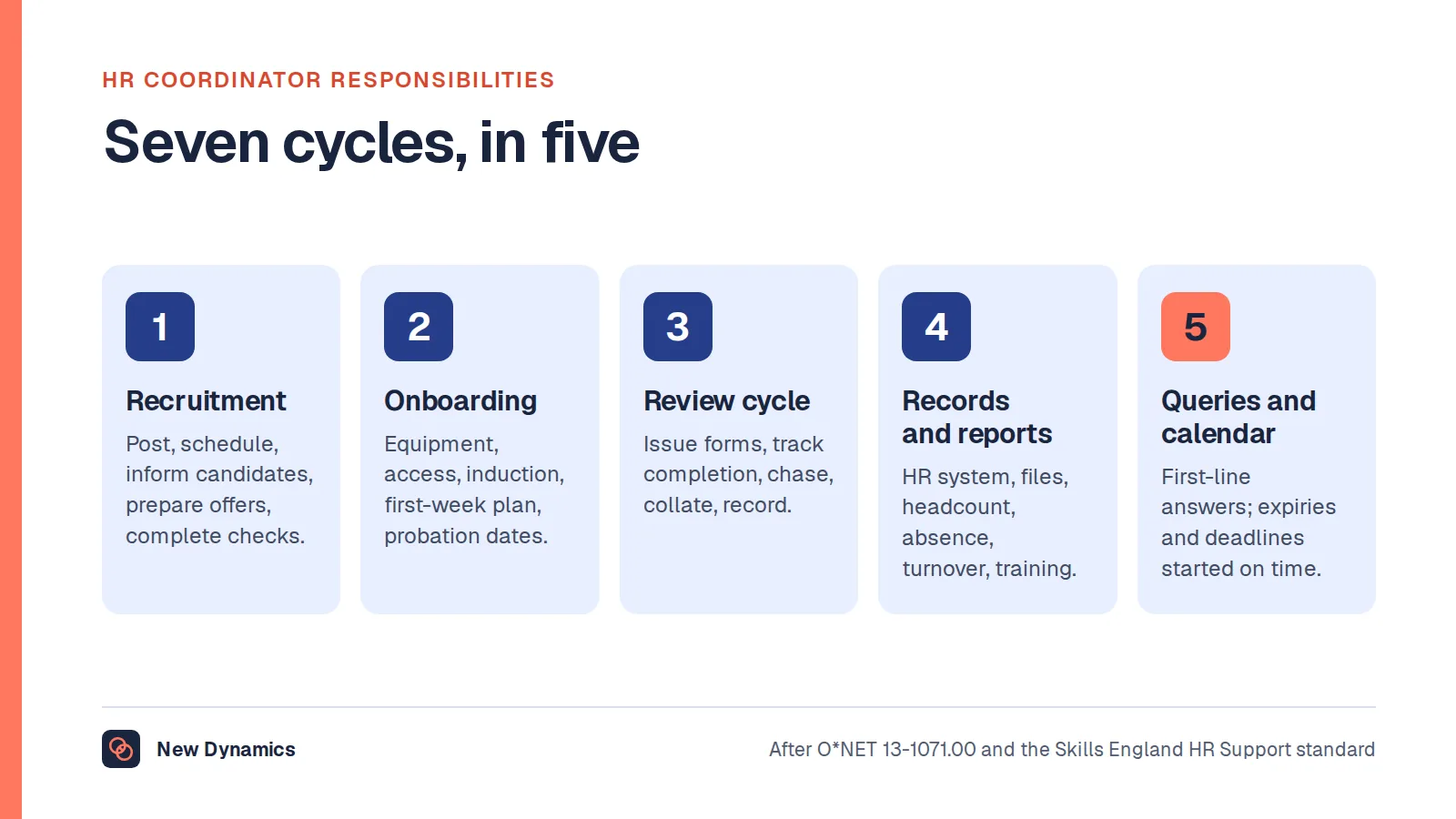
- HR coordinator. Owns HR process cycles inside an HR function and reports into HR. If that is the post, use it: see our human resource coordinator job description.
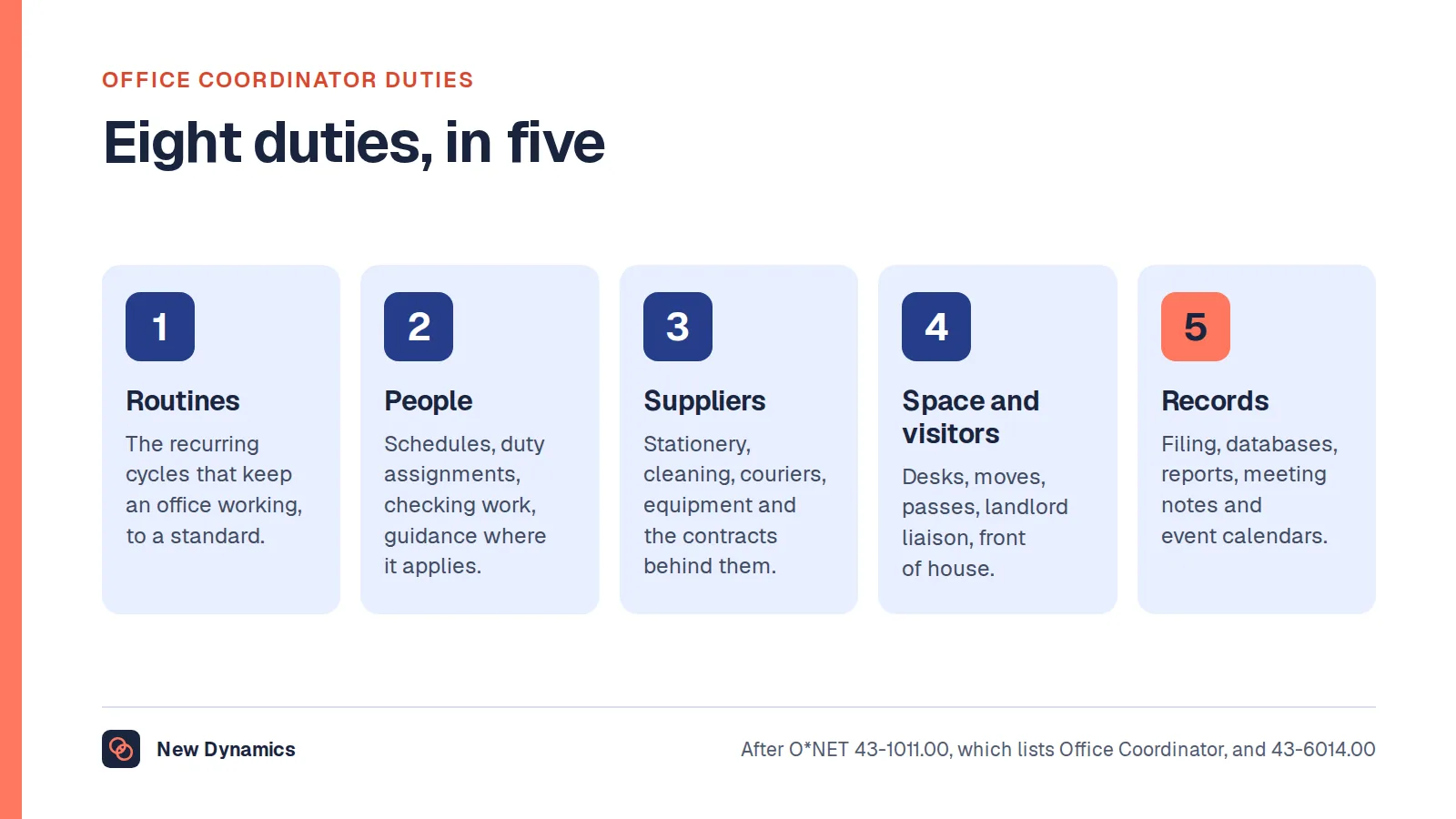
- Office coordinator. Owns an office: routines, suppliers, space, front of house. Staff work appears, but the office is the object. Compare the office coordinator job description.
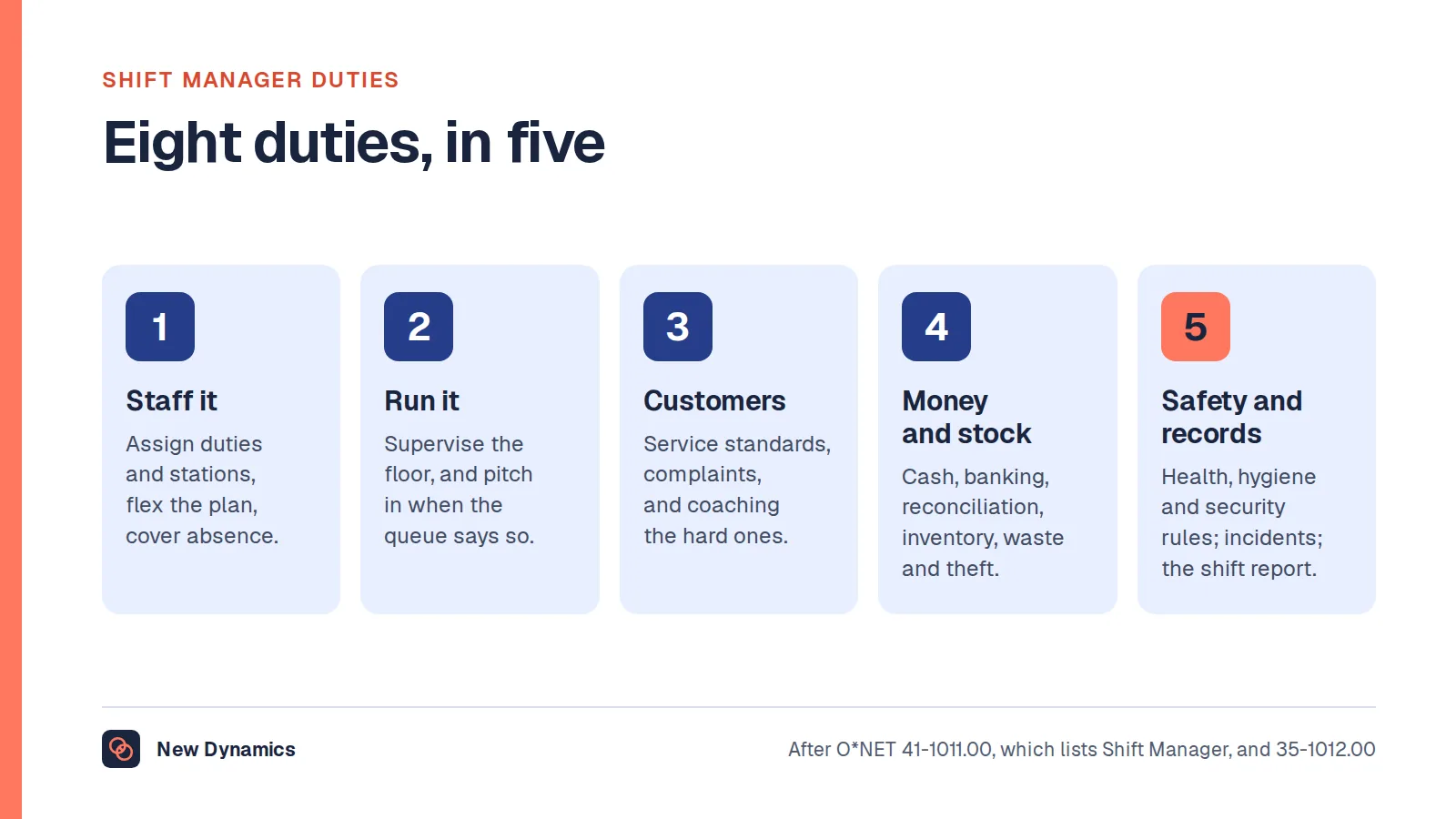
- Shift manager. Runs a site for the length of a shift, usually as the most senior person present, which is authority a coordinator does not have. See the shift manager job description.
- Team leader. Leads named people, including their objectives and development. A coordinator schedules and checks work; a team leader owns the people. See the team leader job description.
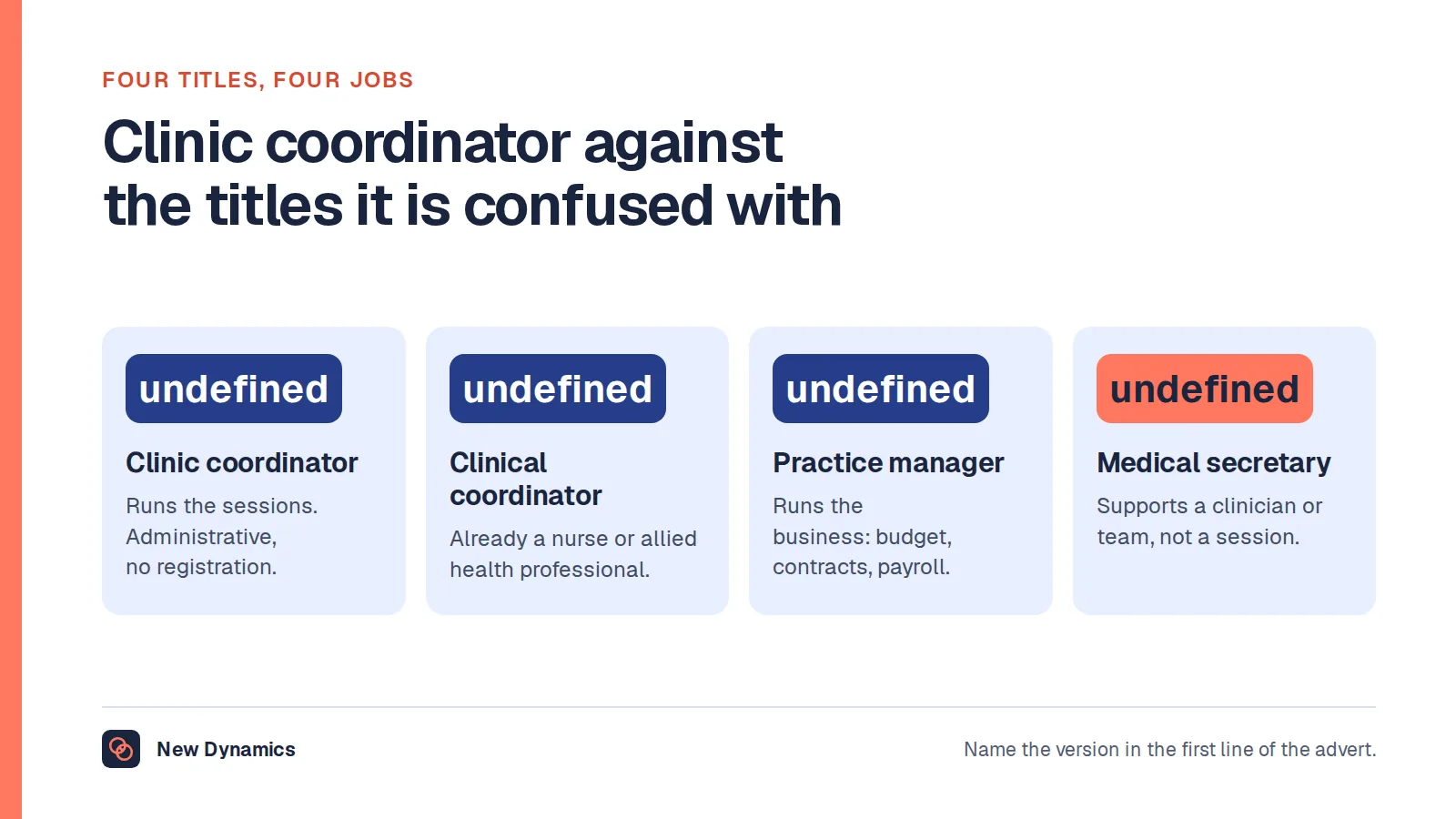
- Clinic coordinator. The same shape of job with patients and sessions as the object rather than staff. See what a clinic coordinator does.
- Event coordinator. Organised around a dated event rather than a continuing operation. See the event coordinator job description.
If two of these fit equally well, you are probably levelling the post wrong rather than naming it wrong. Our job evaluation guide sets out how to size a role before choosing the words, and our post on job titles covers why an invented title costs you applicants.
Who a staff coordinator reports to
There is no standard answer, and that is useful information rather than a gap. The reporting line follows whichever of the four jobs the post is:
- Rota and cover coordinators report to an operations, service or registered manager, because an unfilled shift is an operational consequence.
- People administration coordinators report to an HR manager or officer, or in a small employer to whoever holds HR alongside finance or the office.
- Service and team coordinators report to the manager of the function whose work they coordinate.
- Bank and volunteer coordinators report to whoever owns the pool, often a head of volunteering or a temporary staffing manager.
Many posts have a second, dotted line: operational day to day, HR for process and records. Write both down, and say which one settles a disagreement. Where a coordinator genuinely answers to two managers, reviewing them through one manager's eyes misses half the job, which is what multi-manager reviews exist to fix.
Skills and routes in
Employers ask for the same six things: administrative accuracy, confidence with a rota or HR system and with spreadsheets, calm handling of short-notice problems, clear written communication with busy people, discretion with confidential information, and the willingness to chase somebody politely for the fourth time.
The usual routes in are administration, reception, customer service or a team role in the operation being coordinated. No degree is required. In England the relevant level 3 apprenticeships are business administrator for the general version and HR support where the post sits inside HR. Knowing the sector's own rules, such as which clearances a care shift requires, often counts for more than a qualification, because it is what lets a coordinator spot a gap before it becomes an incident.
What is published about pay, and what is not
No official source publishes a salary for the job title "staff coordinator". The Office for National Statistics measures earnings by occupation through the Standard Occupational Classification, not by employer job title, and there is no SOC occupation of that name. Any figure quoted against the title comes from adverts or an aggregator rather than a publisher of pay data, and we do not repeat those.
What you can use is the economy-wide context. In Employee earnings in the UK: 2026, released on 22 October 2026, the ONS reports that "Median weekly earnings for full-time employees were £811.20 in April 2026, compared with £766.60 in April 2025. This was an increase of 5.8% on the year". All 2026 estimates are provisional and relate to the pay period that includes 22 April 2026. That is a national median for all full-time employees, not a rate for this job. More published workforce figures sit in our HR statistics hub.
One trap if you do go digging in the occupational tables. The same bulletin warns: "From 2021, we moved our occupation coding to Standard Occupation Classification 2020 (SOC 2020), from SOC 2010. This means that estimates for earnings in April 2021 on an SOC 2020 basis represent a break in the ASHE time series. Estimates will not be directly comparable with estimates for earnings on an SOC 2010 basis and, as such, should not be used in direct comparison with each other." A pay trend assembled across that break is not a trend. Benchmark against the administrative and supervisory grades you already pay instead.
A staff coordinator job description template
Fill every bracket before you advertise. An unfilled bracket is the part a new starter guesses at, usually wrongly.
Job title: Staff coordinator, [service, site or department]
Reports to: [named role]
Also accountable to: [second role, for which matters]
Coordinates: [number and type of staff, including bank, casual or agency]
Purpose: Keep [service or department] correctly staffed and its people records complete, so that [shifts are filled by qualified people / managers get starters ready on day one / the team's work is allocated and checked].
Responsibilities
- Build, publish and maintain the [rota or schedule], with [number] weeks of notice.
- Arrange cover for absence and leave, and escalate shortfalls to [role].
- Book and brief bank, casual or agency workers within the agreed rates.
- Check qualifications, clearances and mandatory training are in date before a shift is allocated.
- Record hours, absence and changes accurately for payroll by [deadline].
- Prepare for starters, process movers and close out leavers, including system access.
- Book training places, answer first-line queries, and route anything needing advice to [role].
- Produce the [weekly or monthly] staffing report covering [fill rate, agency spend, absence, training].
Decision rights: may commit [agency bookings up to the agreed rate, overtime up to X hours per week, training spend up to Y] without prior approval. Must refer [contractual change, disciplinary action, selection decisions, pay queries] to [role].
System access: [named systems and the fields the role may see], reviewed by [role].
Essential: administration experience, accurate record keeping, confidence with [system], GCSE English and maths or equivalent. Desirable: experience of [sector].
How the role is measured
Measure the things the coordinator controls, not the things the operation controls.
- Fill rate. Shifts filled against shifts required, split between substantive, bank and agency.
- Short-notice fill time. How long an absence takes to cover, in hours.
- Compliance currency. Clearances and mandatory training in date, sampled rather than self-reported.
- Day-one readiness. Starters with access, equipment and an induction booked before they arrive.
- Rota notice. Days of notice actually given, against the policy.
Do not make total agency spend a coordinator's personal target. Spend follows vacancies and absence, which they do not cause. Fill rate at the agreed rate is the fair version of that measure.
Frequently asked questions
What does a staff coordinator do?
A staff coordinator keeps a department or service correctly staffed and its people records complete. In practice that means building and publishing the rota, arranging cover for absence, booking bank or agency workers, checking that qualifications and clearances are in date, preparing for starters and processing leavers, booking training, answering first-line queries and producing the recurring staffing report.
Is a staff coordinator the same as an HR coordinator?
No, although they overlap. An HR coordinator sits inside an HR function and owns HR process cycles such as recruitment campaigns, onboarding and the review cycle. A staff coordinator is usually embedded in an operation and owns staffing it, with the records work as a consequence. If the post reports into HR, use the HR coordinator title, because applicants search for it.
What is the difference between a staff coordinator and a staffing coordinator?
Nothing reliable. The two titles are used interchangeably, although "staffing coordinator" is more common in care, healthcare and recruitment settings where the job is specifically filling shifts, and "staff coordinator" is used more loosely. Read the duties rather than the title.
Is a staff coordinator a management role?
Usually not. A coordinator schedules work, checks it against a standard and records what happened. A manager holds the budget, the appraisals and the disciplinary conversations. Where a coordinator is expected to do the second list, the post is a supervisory or team leader role with the wrong title and probably the wrong grade.
Who does a staff coordinator report to?
It depends which version of the role it is: an operations or service manager for rota and cover work, an HR manager or officer for people administration, the function's manager for team coordination, and a head of volunteering or temporary staffing manager for a bank or volunteer pool. Many posts have a dotted second line, and both should be written down.
Your next step: name the job before you name the role
- Decide which of the four jobs this post is, and write its purpose in one sentence.
- Write the reporting line, and the second line if there is one.
- Put figures on the five boundaries: spend, discipline, selection, contractual change, record access.
- Choose the title that already means that job, and keep "staff coordinator" only if none does.
- Agree the measures, and tell the first post-holder on day one rather than at their first review.
To size the post against the grades you already pay, rather than against a job board, read and download our job evaluation guide. The guide is free to read, and the PDF uses our short download form.
Want reporting lines, decision limits and coordinator objectives in one place instead of three documents? Book a New Dynamics demo and bring your current coordinator job description. You can also email contact@new-dynamics.com.