TL;DR
- Diagnose before you book. Unclear roles, unfair workload, a manager people do not trust and a decision nobody will make are the four usual causes, and none of them is cured by an activity.
- Twenty activities grouped by purpose: starting a new team, rebuilding after a difficult period, making better decisions and simply knowing each other better. All free or near-free, with timings and what each one needs.
- Run the inclusion test before you book anything, finish with one written commitment per person, and review those commitments in four weeks. Without the follow-up it was a day out, not a change.
Most searches for team building activities start with a feeling rather than a problem. Something is off in the team, nobody has named it, and an afternoon of activities feels like a reasonable thing to try.
It is worth being honest about what that afternoon can and cannot do. An activity cannot fix a team problem caused by unclear roles, an unfair split of the work, or a manager people have stopped trusting. Worse, a team day that pointedly ignores the real issue is worse than no team day at all, because everyone in the room can see what is being avoided. People come back more cynical than they left, and the next invitation gets a thinner response.
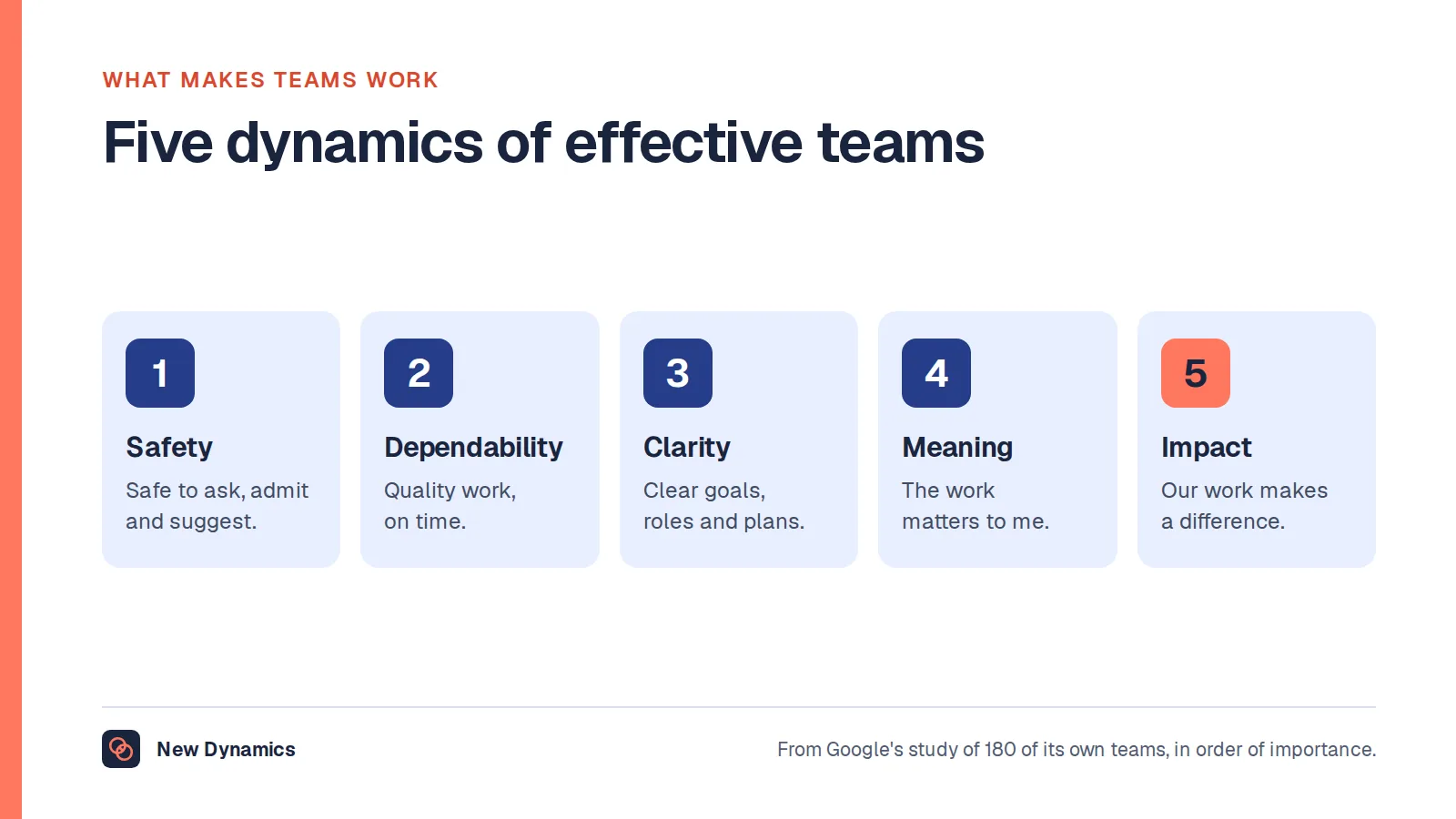
What activities do well is narrower and still useful. They give a team shared information, a shared language and a reason to talk about how it works rather than only what it is working on. That is worth a morning, as long as you have first worked out what is actually wrong.
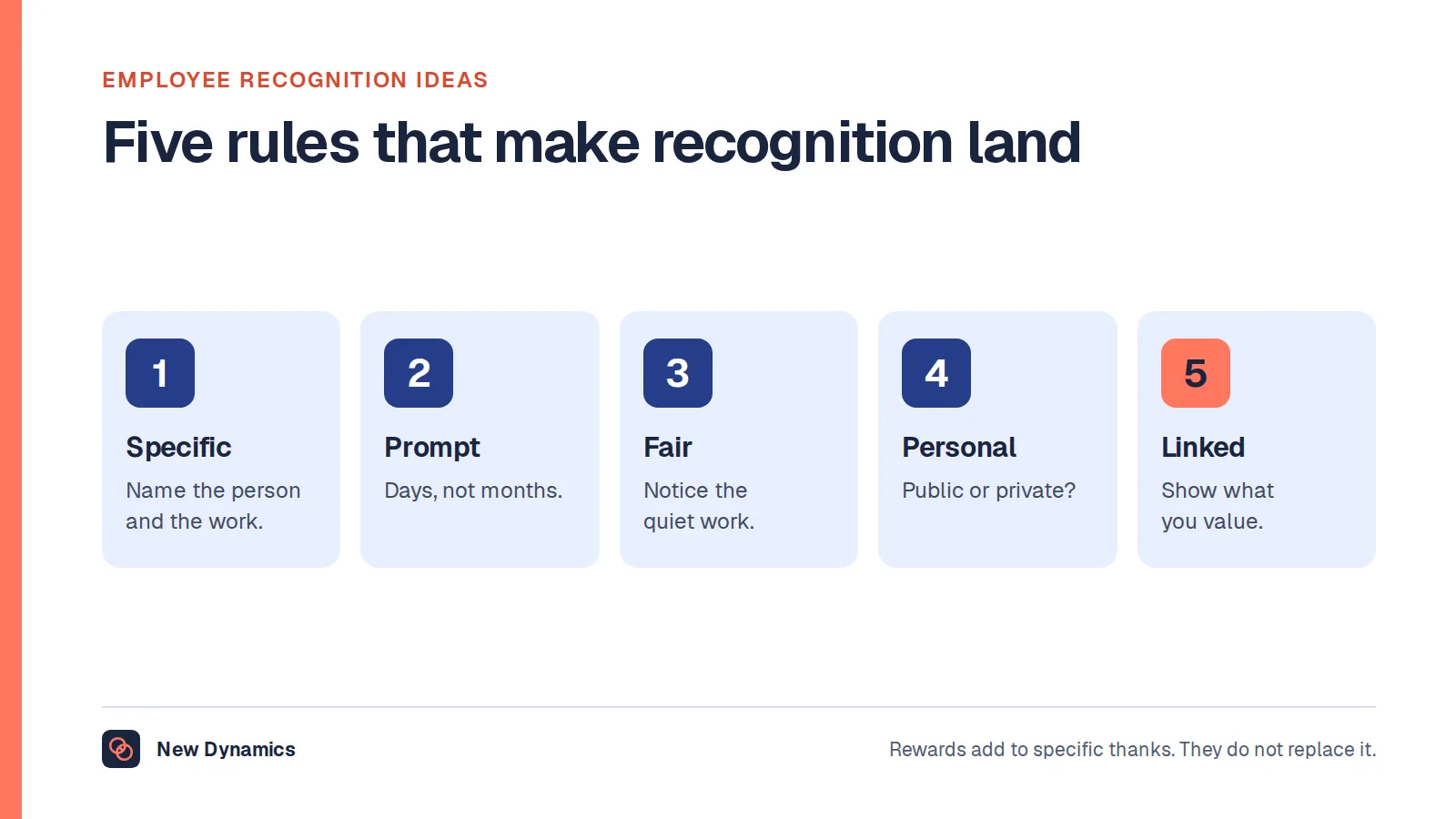
If what your team is short of is simply visible appreciation, that is a smaller job than a team day. New Dynamics employee recognition lets colleagues thank each other where the whole team can see it, which is a habit rather than an event.
Diagnose before you book anything
Spend half an hour on this before you spend a budget. Ask three or four people, separately, what they would change about how the team works. The answers usually point at one of four causes.

Unclear roles and ownership
The symptoms are duplicated work, things falling between people, and a question nobody can answer about who signs off what. It feels like poor communication, so it attracts communication exercises.
What it needs instead: a written list of the team's recurring decisions and deliverables, with one named owner for each. An hour with a whiteboard beats a day in a field. The role map in the next section does this job, which is the one case where an activity genuinely addresses the cause.
Unfair or unmanageable workload
The symptoms are the same two or three people carrying the rest, missed deadlines nobody is surprised by, and a pointed silence when someone says they are busy.
What it needs instead: a look at who is doing what, in writing, and then a decision about what stops. A team day on top of a workload problem reads as the employer spending money on anything except the thing people have asked for.
A manager people do not trust
The symptoms are nobody disagreeing in meetings, the real conversation happening afterwards in a smaller group, and feedback that stays carefully general.
What it needs instead: one-to-ones that are actually held, decisions explained rather than announced, and in some cases a conversation about the manager that someone senior has been avoiding. An activity in this situation is read as theatre, and often as a test of who will say something. Our manager one-to-one guide covers the mechanics of the conversations that do the work here.
A decision nobody will make
The symptoms are the same subject returning to every meeting, two plausible options neither of which is chosen, and a team that has stopped putting effort into either.
What it needs instead: the decision. Name who owns it and when they will make it. A team day held instead of making the decision wastes a day and confirms that the decision is not coming.
If your diagnosis is one of these four, deal with it first. Then come back to the activities, which will land very differently once people can see that the real thing has been addressed.
Twenty team building activities, grouped by purpose
These are free or close to it. Most need a room, some paper and someone willing to keep time. Timings assume a team of five to ten; add a few minutes per extra person. None of them requires a facilitator, a ropes course or a company credit card.
Getting a new team started
1. The working agreement hour. 60 minutes, whiteboard or shared document. Agree, in writing, how the team will work: response times, meeting rules, what gets decided in a meeting and what by one person, how you handle disagreement. This is the single most valuable hour on this list and nobody ever calls it team building.
2. User manual of me. 20 minutes of preparation, 45 minutes together. Everyone writes half a page: how I prefer to be contacted, when I do my best work, what I find difficult, how to give me feedback so that it lands. Read them out, ask questions, keep them somewhere findable for new starters.
3. Role map on the wall. 45 minutes, sticky notes. Write every recurring piece of work on a note. Stick them up. Then put one name on each. The arguments that happen during this exercise are the useful part.
4. Skills and interests grid. 30 minutes, one shared spreadsheet. Each person lists two things they are good at, one thing they would like to learn and one thing they would be happy to teach. Pair people up afterwards.
Rebuilding after a difficult period
5. The timeline on brown paper. 75 minutes, a roll of paper and marker pens. Draw the last year as a line on the wall. Everyone adds the events they remember, good and bad, where they fell. Then walk the line together and talk about it. It gives a team a shared version of a period people have been carrying separately.
6. Start, stop, continue, with owners. 45 minutes, sticky notes. Three columns. Everyone writes in silence first, then you group and discuss. The rule that makes it work: nothing leaves the room without a name and a date against it.
7. Blameless review of one real thing. 60 minutes. Pick one project or incident that went badly. Four questions: what did we expect, what actually happened, why, and what will we do differently. No names attached to failures. Our learning organization article has the longer version of this method.
8. What I need from you, in pairs. 30 minutes. Pairs swap two sentences each: one thing you need more of from me, one thing you need less of. Rotate pairs twice. Short, uncomfortable, effective.
9. The unsaid things, written first. 40 minutes, index cards. Everyone writes the thing they have not said, anonymously. Shuffle, read out, discuss. It gets a difficult subject into the room without requiring someone brave to go first, which is often the real blocker.
Improving how the team makes decisions
10. Decision log review. 45 minutes. List the last ten decisions the team made. For each, note who made it, how long it took and whether anyone was surprised. Patterns appear fast, usually around decisions that nobody owned.
11. Who decides, actually. 60 minutes. Take five real upcoming decisions. For each, agree who decides, who must be consulted first and who simply needs telling afterwards. Write it down. Most decision friction is this question left unanswered.
12. Silent brainstorm, then dot vote. 30 minutes, sticky notes and stickers. Everyone writes ideas alone for five minutes before anyone speaks, then you cluster them and each person spends three dots. It stops the loudest voice setting the agenda, which is the most common failure in a team's thinking.
13. Pre-mortem. 45 minutes. Before a project starts, imagine it is six months later and it has failed. Everyone writes why. You will surface risks that nobody would raise in an optimistic kick-off meeting.
14. Red team half hour. 30 minutes. Two people are formally asked to argue against the plan. Because the role is assigned, disagreeing stops being a social risk.
15. Meeting audit. 45 minutes. List every recurring meeting the team attends. For each, agree what it decides. Anything that decides nothing gets shortened, merged or cancelled. People remember this one fondly.
Knowing each other better
16. Walk and talk pairs. 30 minutes, a pavement. Pairs walk and talk with one light prompt. Side by side is easier than face to face for most people, and it costs nothing. Good in spring, when a team that has been indoors all winter will take any excuse to go outside.
17. Lunch and learn. 30 minutes, bring your own lunch. One person teaches the rest something for twenty minutes. Beekeeping counts. Pivot tables count.
18. Career timeline in threes. 30 minutes. Each person describes three turning points in their working life. You learn more about a colleague in five minutes of this than in a year of stand-ups.
19. The shared table. 45 minutes, everyone brings one thing. A proper break where people eat together and nobody presents anything. Mind the dietary and cost implications, and make clear that bringing nothing is fine.
20. Shadow an hour. 60 minutes, two people. One person sits with a colleague while they do their actual job, and asks questions. It kills more cross-team resentment than any game.
Check-in questions for the start of a meeting
A two-minute check-in is the cheapest team building there is, and it is the only item here that can be run every week without fatigue. The rules: one round, no commentary, "I will pass" is always an acceptable answer, and the person chairing goes last so they do not set the tone.
Keep a list and rotate. These are deliberately plain, because clever questions make people perform.
- One word for how your week is going.
- One thing that went well since we last met.
- One thing that is in your way right now.
- What are you working on that nobody else can see?
- What is the most useful thing you learned this week?
- On a scale of one to ten, how is your workload? No explanation needed.
- What is one thing you would like help with today?
- What is taking longer than you expected?
- What decision are you waiting on?
- What is one small thing that would make your week easier?
- Who should we thank this week, and for what?
- What is the thing you keep meaning to raise?
- What would you like to stop doing?
- What are you looking forward to, at work or outside it?
- What do you want to get out of this meeting?
- What is your energy level today, high, medium or low?
The last four are gentler, so they work for a team that is not used to being asked anything. The workload and decision questions are the ones that actually surface problems, which is why they belong in a weekly meeting rather than an annual survey. If you want the longer version of the conversation, see our workplace engagement survey questions.
Inclusion: the test to run before you book
This is the part most activity lists skip, and it is the part most likely to cause real harm. Activities that quietly exclude people include anything held in the evening or at a weekend, anything centred on alcohol, anything physical, anything requiring personal disclosure, anything that needs a car, and anything that only works if you are in the room.
Think about who that leaves out: parents and carers with fixed pick-up times, disabled colleagues, people who do not drink for religious or personal reasons, people managing a health condition, shift workers whose rota does not match the office, and remote attendees who end up watching a party through a laptop.
Run six questions over anything before you commit to it.
- Can someone with caring responsibilities attend without rearranging their life? If it is outside working hours, the answer is usually no.
- Can a disabled colleague take part fully, rather than watch? Ask about the venue, the activity and the travel, and ask the person rather than guessing.
- Does it work for someone who does not drink, and does that person still feel part of it?
- Does it require disclosing something personal? If so, make opting out invisible rather than conspicuous.
- Can shift workers and part-time colleagues get there, or is the date simply the one that suits full-time office staff?
- If anyone joins remotely, do they have a real part, or are they an audience? If it is the latter, change the activity.
There is a legal dimension, briefly. Acas, in its guidance on discrimination and the law, says discrimination "means treating someone 'less favourably' than someone else, because of" a protected characteristic, and lists those characteristics as age, disability, gender reassignment, marriage and civil partnership, pregnancy and maternity, race, religion or belief, sex, and sexual orientation. A work event is still work, so an activity that systematically shuts out one of those groups carries a risk beyond bad feeling. Acas also puts the positive case plainly in its guidance on improving equality, diversity and inclusion: an inclusive workplace "can help lower the risk of bullying, harassment and discrimination". This is general guidance rather than advice on your situation; take proper advice if a specific case arises.
The practical version of all this is short. Hold it in working hours, make the social parts optional and mean it, offer a way to take part that does not involve drinking, standing up or telling the room about your childhood, and ask the team what they would actually enjoy before you book anything.
Making it stick
The difference between a team day and a change is what happens in the fortnight afterwards. Three things make the difference.

One commitment per person, written down. At the end of the session, each person writes one sentence: one thing I will do differently, by when. Not a team value, not an aspiration, one specific action with their own name on it. Read them aloud. The reading aloud matters more than the writing, because a commitment nobody heard is easy to forget.
Three team changes, with owners. Out of everything discussed, pick no more than three things the team will change. Each gets one owner and a date. A list of twelve improvements is a list of nothing.
A twenty-minute review, four weeks later, already in the diary before you leave the room. Go through the commitments and the three changes. Mark each as done, in progress or abandoned, and say so honestly. Abandoning something openly is fine and teaches the team what is realistic. Letting it quietly fade teaches the team that sessions like this do not count.
One more thing: tell people what changed as a result. Managers routinely act on what they heard and never report back, so the team concludes nothing happened. Attach the change to the session out loud, even when it is small.
What goes wrong
Compulsory fun. Requiring attendance at something social turns a nice gesture into an obligation, and the people who most resent it are often the ones who already feel their time is not respected. Working sessions, such as agreeing how the team operates, are part of the job and can be expected. A quiz is not.
Activities that reward extroversion. Improvisation games, performing in front of the group, speaking without preparation: these measure comfort with attention, not contribution. The quiet half of your team will spend the day managing their discomfort. Use formats with silent thinking time first, written input and small pairs, which is why the silent brainstorm and the paired exercises appear above.
The team day as a substitute for a decision. If everyone knows which decision is overdue, an away day held in its place is not neutral. It is read as an answer, and the answer is that the decision is not being made.
No follow-through. The most common failure of all. A good session with no review is a pleasant afternoon that slightly lowers the team's belief that anything will change. If you cannot commit to the four-week review, run something shorter instead.
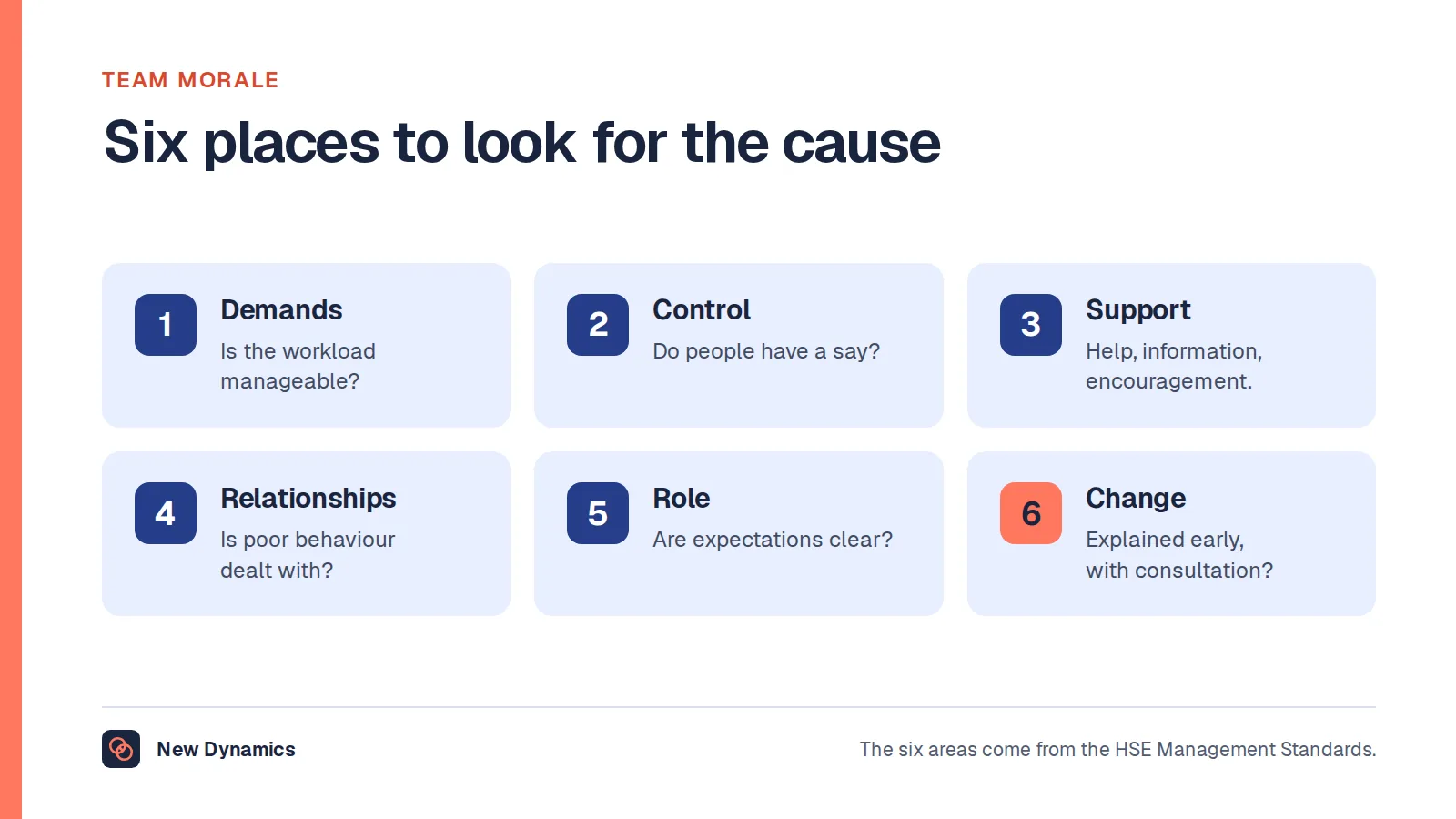
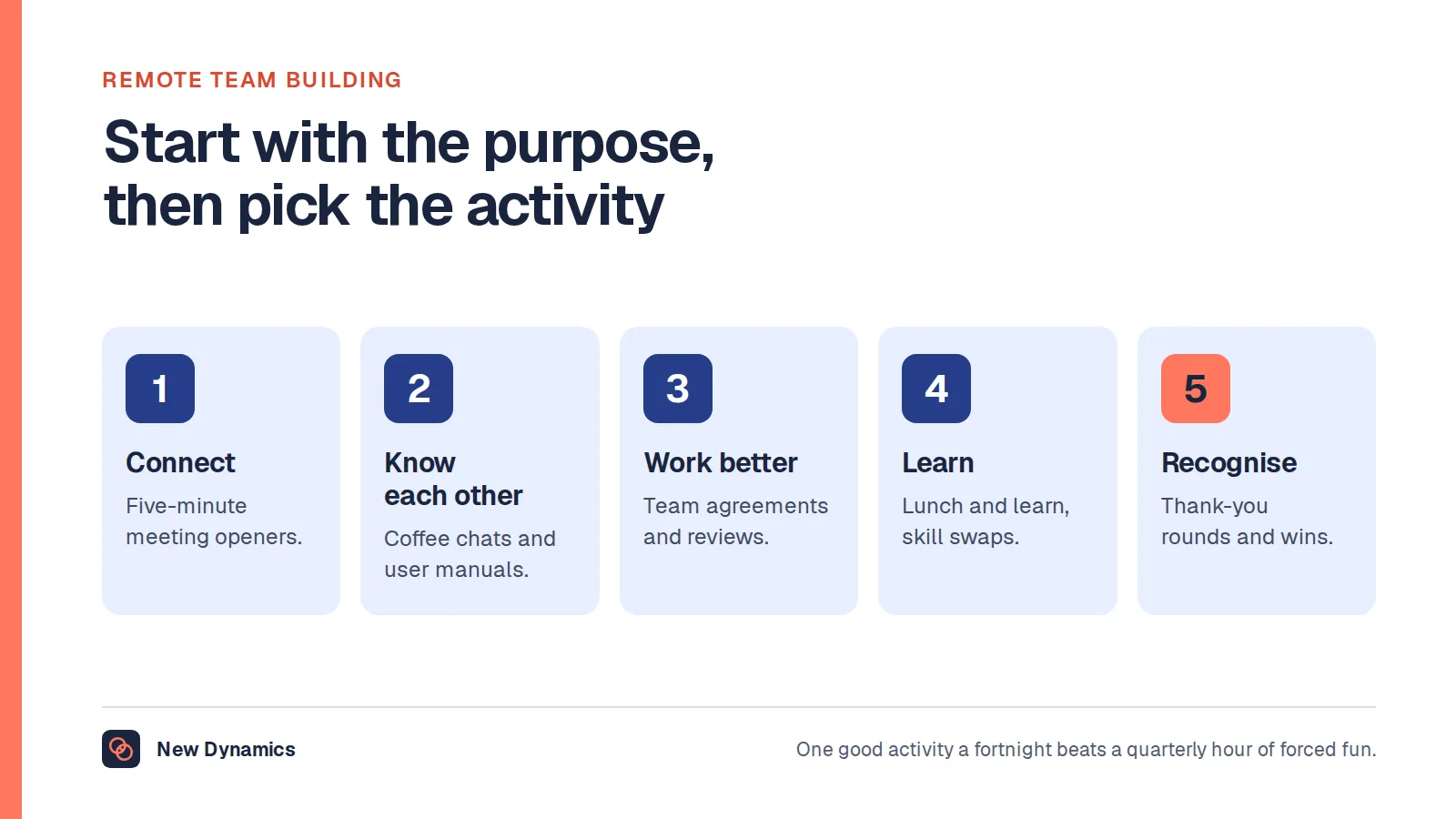
If the underlying issue is morale rather than connection, start with team morale and the causes it lists. If your team is distributed, our remote team building activities cover the virtual and hybrid versions, including asynchronous ideas for teams spread across time zones. And if you want the argument for why any of this is worth the time, see the importance of teamwork.
Frequently asked questions
What are good team building activities for work?
The best ones do a job the team actually needs. A working agreement hour, a role map on the wall, a blameless review of a real project, a silent brainstorm with dot voting and a weekly two-minute check-in all improve how the team works rather than only how it feels. Pick by purpose, not by novelty.
What are some simple, free team building activities?
A one-word check-in, a start-stop-continue round with owners, a walk and talk in pairs, a bring-your-own lunch and learn, a career timeline in threes and an hour shadowing a colleague all cost nothing beyond time, paper and sticky notes.
How long should a team building activity take?
Most of the activities here run between 30 and 75 minutes. Short and regular beats long and rare. A two-minute check-in every week will change more about a team than one afternoon a year, and it is far easier to sustain.
Should team building be compulsory?
Working sessions such as agreeing how the team communicates or reviewing a project are part of the job, so expecting attendance is reasonable. Purely social activities should be optional, with no penalty and no comment for the people who skip them.
What are good check-in questions for a meeting?
Plain ones work best: one word for your week, one thing that went well, one thing in your way, your workload out of ten, and what you would like help with today. Rotate the question, keep it to one round, and allow people to pass.
How do you make a team day inclusive?
Hold it inside working hours, check the venue and activity with disabled colleagues rather than guessing, make sure it works for people who do not drink, avoid required personal disclosure, pick a date that shift and part-time workers can make, and give remote attendees a real part rather than a view.
Your next steps
- Ask three people separately what they would change about how the team works.
- If the answer is roles, workload, trust or an unmade decision, fix that first and say so.
- Pick one activity from the purpose that matches, and book an hour.
- Finish with one written commitment per person, and put the four-week review in the diary before anyone leaves.
For the wider picture on what makes teams want to stay and contribute, read and download our employee engagement guide. The guide is free to read, and the PDF uses our short download form.
Want recognition, goals and one-to-one notes visible to the whole team, so that the follow-up is not a document nobody opens? Book a New Dynamics demo and bring the problem you are actually trying to solve. You can also email contact@new-dynamics.com.