TL;DR
- VTO usually means voluntary time off: unpaid hours a United States employer offers when demand is low, which staff may choose to take. No federal law creates it. The Department of Labor's position is that the Fair Labor Standards Act “does not require payment for time not worked”.
- The risk sits with salaried exempt staff. 29 CFR 541.602(a)(2) says an employee is not paid on a salary basis if deductions are made “for absences occasioned by the employer or by the operating requirements of the business”, and that “if the employee is ready, willing and able to work, deductions may not be made for time when work is not available”.
- The same three letters also mean volunteer time off, which is usually paid. The United Kingdom has no VTO concept at all: unpaid time away needs a contractual right, and lay-off under the Employment Rights Act 1996 carries a guarantee payment.
A warehouse is quiet on a Tuesday in January. A supervisor asks whether anyone wants to go home. Three people put their hands up, clock out, and lose four hours of pay each. That offer has a name in United States workplaces: VTO, or voluntary time off.
Two questions follow it around. What does VTO mean, and do you get paid for VTO? This article answers both, then covers the rules that do bite when VTO is used, even though no law requires the practice itself. It is general information about the position in the United States, with the United Kingdom position named separately, and it is not legal advice.
A request for unpaid hours needs the same approval trail as a request for paid leave. See how New Dynamics workflows let you shape the stages, forms and approvals around your own process, so an offer, an acceptance and a date sit on one record.
What VTO means at work
Voluntary time off is unpaid time away from work that an employer offers when there is less work than there are people to do it. Three features define it:
- The employer offers it. VTO appears because a shift is overstaffed, a line is down, a season has ended or a forecast was wrong.
- The employee chooses. Nobody has to accept. That is the difference between VTO and being sent home, and it is why the word voluntary is there.
- It is unpaid. The hours are not worked, so they are not paid. Accrued paid time off is a separate pot, and most policies let someone choose whether to use it to cover the gap.
VTO is an employer practice, not an entitlement. No federal statute creates it and no employer has to offer it. It exists because it is more popular than cutting everyone's hours.
Do you get paid for VTO?
No, not for the hours you take, and federal law does not step in. The Department of Labor states the position on its vacation leave topic page: "The Fair Labor Standards Act (FLSA) does not require payment for time not worked, such as vacations, sick leave or federal or other holidays. These benefits are matters of agreement between an employer and an employee (or the employee's representative)."
That sentence is the foundation of VTO. Pay for time not worked is a matter of agreement, so an employer may offer unpaid hours and an employee may take them. For an hourly, non-exempt worker the mechanics are simple: overtime is calculated on hours actually worked, so VTO hours just mean a smaller total for the week (our post on overtime pay covers how the week is counted), and whether accrued paid leave can cover the gap is a policy question, because policy is the agreement the Department of Labor is describing.

VTO also means volunteer time off, which is usually paid
Two different benefits share the abbreviation, and search results mix them freely.
| Term | Who starts it | Paid? | Why it exists |
|---|---|---|---|
| Voluntary time off | The employer offers it | Normally unpaid | Demand is lower than the staffing plan |
| Volunteer time off | The employee requests it | Normally paid | Time to volunteer for an approved cause |
Three tests separate them. Does pay continue that week? Volunteer time off keeps pay running and voluntary time off does not. Is the time capped as an annual allowance of hours? That points to volunteer time off. And who raised it? If a supervisor asked the shift whether anyone wanted to leave, it is voluntary time off. For the paid kind, see our post on volunteerism and employee volunteering. This article is about the unpaid kind, and a policy that uses the letters without defining them should be fixed before anyone relies on it.
The trap: offering VTO to salaried exempt staff
This is where an employer can do real damage without noticing. Exempt executive, administrative and professional employees must be paid on a salary basis, and the Department of Labor's Fact Sheet 17G, revised September 2019, puts it plainly: "Being paid on a 'salary basis' means an employee regularly receives a predetermined amount of compensation each pay period on a weekly, or less frequent, basis. The predetermined amount cannot be reduced because of variations in the quality or quantity of the employee's work."
The regulation behind it is blunter. 29 CFR 541.602(a), as Title 29 of the eCFR stood on 4 November 2026, says at (a)(1) that "an exempt employee must receive the full salary for any week in which the employee performs any work without regard to the number of days or hours worked", and then at (a)(2):
"An employee is not paid on a salary basis if deductions from the employee's predetermined compensation are made for absences occasioned by the employer or by the operating requirements of the business. If the employee is ready, willing and able to work, deductions may not be made for time when work is not available."
Read that against the warehouse. VTO exists precisely because work is not available. An exempt employee who accepts unpaid hours for that reason is ready, willing and able to work, and the deduction is occasioned by the operating requirements of the business. Docking the salary is the thing the regulation forbids.
Two details decide most real cases. Part days never work: section 541.602(b)(1) allows a deduction "when an exempt employee is absent from work for one or more full days for personal reasons, other than sickness or disability", and says that for an absence of one and a half days "the employer can deduct only for the one full-day absence". A whole empty workweek is the only clean route: the same section says "Exempt employees need not be paid for any workweek in which they perform no work", and any work in the week, including answering a message, brings the full salary back.
What happens if an employer gets it wrong
Fact Sheet 17G sets out the consequence: "The employer will lose the exemption if it has an 'actual practice' of making improper deductions from salary." The exemption is then lost "during the time period of the deductions for employees in the same job classification working for the same managers responsible for the improper deductions". One of the listed factors is "whether the employer has a clearly communicated policy permitting or prohibiting improper deductions".
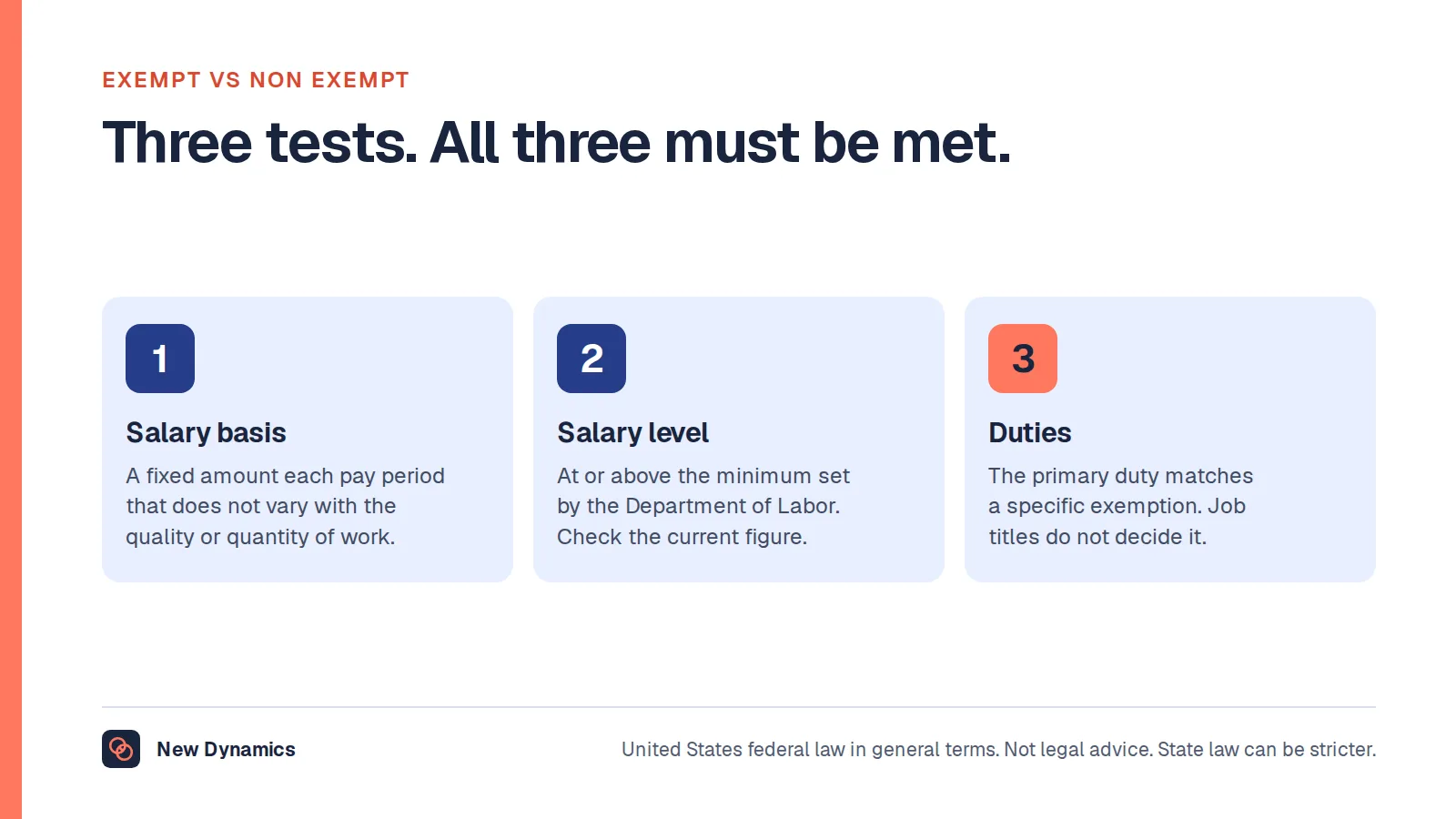
Two reliefs exist. Isolated or inadvertent improper deductions do not cost the exemption if the employer reimburses the employee. And an employer with a clearly communicated policy prohibiting improper deductions, including a complaint mechanism, which reimburses employees and commits in good faith to comply in future, keeps the exemption unless it carries on willfully after complaints. Both depend on having written something down first. Our post on exempt and non-exempt employees explains how the categories are set.
The safest approach is usually the simplest: offer VTO to non-exempt staff, and when an exempt employee wants a quiet day off, book it as paid leave from their allowance.

VTO, benefits eligibility and hours thresholds
Unpaid hours are hours that did not happen, and several federal thresholds count hours. Two bite often enough to check before a policy goes out.
Family and Medical Leave Act eligibility. The Department of Labor's Fact Sheet 28 states that employees are eligible if "they work for a covered employer for at least 12 months, have at least 1,250 hours of service with the employer during the 12 months before their FMLA leave starts, and work at a location where the employer has at least 50 employees within 75 miles". Someone who takes a lot of VTO across a year can drop under 1,250 hours and lose leave they expected to have.
Full-time status under the employer shared responsibility provisions. The IRS page on identifying full-time employees states that "a full-time employee is, for a calendar month, an employee employed on average at least 30 hours of service per week, or 130 hours of service per month". Unpaid VTO hours do not help anyone reach that. The definition in 26 CFR 54.4980H-1(a)(24)(i) counts "each hour for which an employee is paid, or entitled to payment, for the performance of duties for the employer", plus hours paid for time during which no duties are performed because of vacation, holiday, illness, incapacity, layoff, jury duty, military duty or leave of absence. VTO is neither worked nor paid, so it is in neither list.
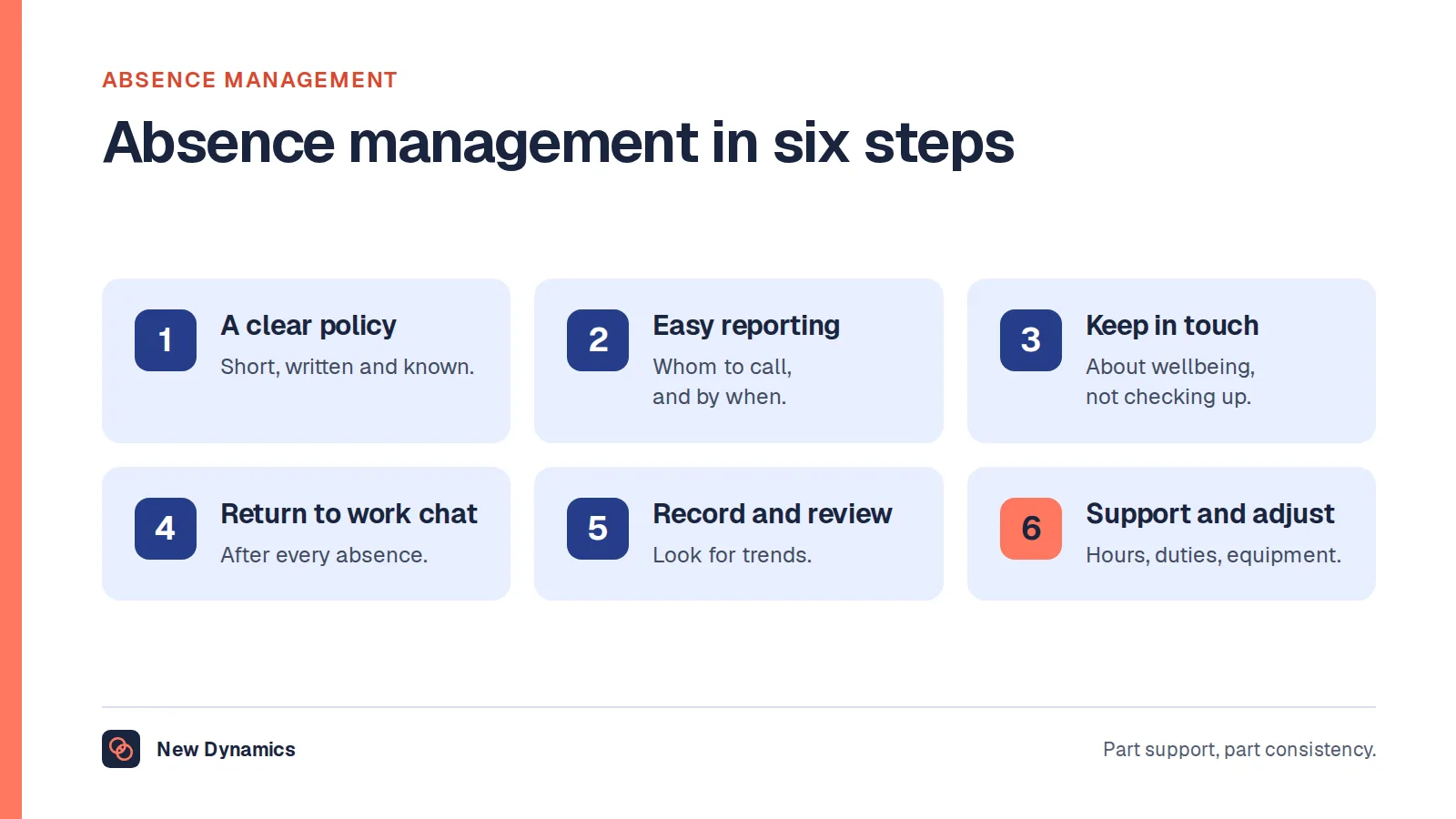
Internal thresholds matter too. Plan documents, accrual rules and bonus schemes are often written around a weekly hours figure, so a policy that is silent on accrual and eligibility leaves the answer to whoever runs payroll that month. Our posts on leave and absence and absence management cover keeping the categories and the record straight.
State law may differ, and often does
Federal law is a floor. 29 CFR 541.4, other laws and collective bargaining agreements, says: "The Fair Labor Standards Act provides minimum standards that may be exceeded, but cannot be waived or reduced. Employers must comply, for example, with any Federal, State or municipal laws, regulations or ordinances establishing a higher minimum wage or lower maximum workweek than those established under the Act."
A state or a city can therefore require more than the FLSA does, and some have rules on schedule changes, reporting to work and shifts cut short. This article does not list state rules, because a list that is wrong is worse than none. Check the rules in every state you employ people in, and check them again when a scheduling practice changes.
The United Kingdom has no VTO
There is no British equivalent, and importing the word into a UK policy causes problems. The default is the opposite of the American one: an employer cannot simply send someone home unpaid because work is short. GOV.UK says it in one line on lay-offs and short-time working: "You should get your full pay unless your contract allows unpaid or reduced pay lay-offs."
Where a contract does allow it, two statutory routes apply, and neither is voluntary.
- Lay-off and short-time working. Section 147 of the Employment Rights Act 1996 defines the terms. An employee is laid off for a week where pay depends on being provided with work and "he is not entitled to any remuneration under the contract in respect of the week because the employer does not provide such work for him". Short-time is where a diminution in work leaves remuneration for the week "less than half a week's pay". Sections 148 to 154 then give the route to a redundancy payment after four consecutive weeks, or six weeks in thirteen. The section is shown on legislation.gov.uk as up to date with all changes in force on or before 6 November 2026.
- Guarantee payments. Section 28 gives a right to a payment for a workless day where an employee is not provided with work because of "a diminution in the requirements of the employer's business for work of the kind which the employee is employed to do". GOV.UK states the cap: "The maximum you can get is £41 a day for 5 days in any 3-month period - so a maximum of £205." Below that daily figure the normal daily rate applies, and part-time entitlement is worked out proportionally.
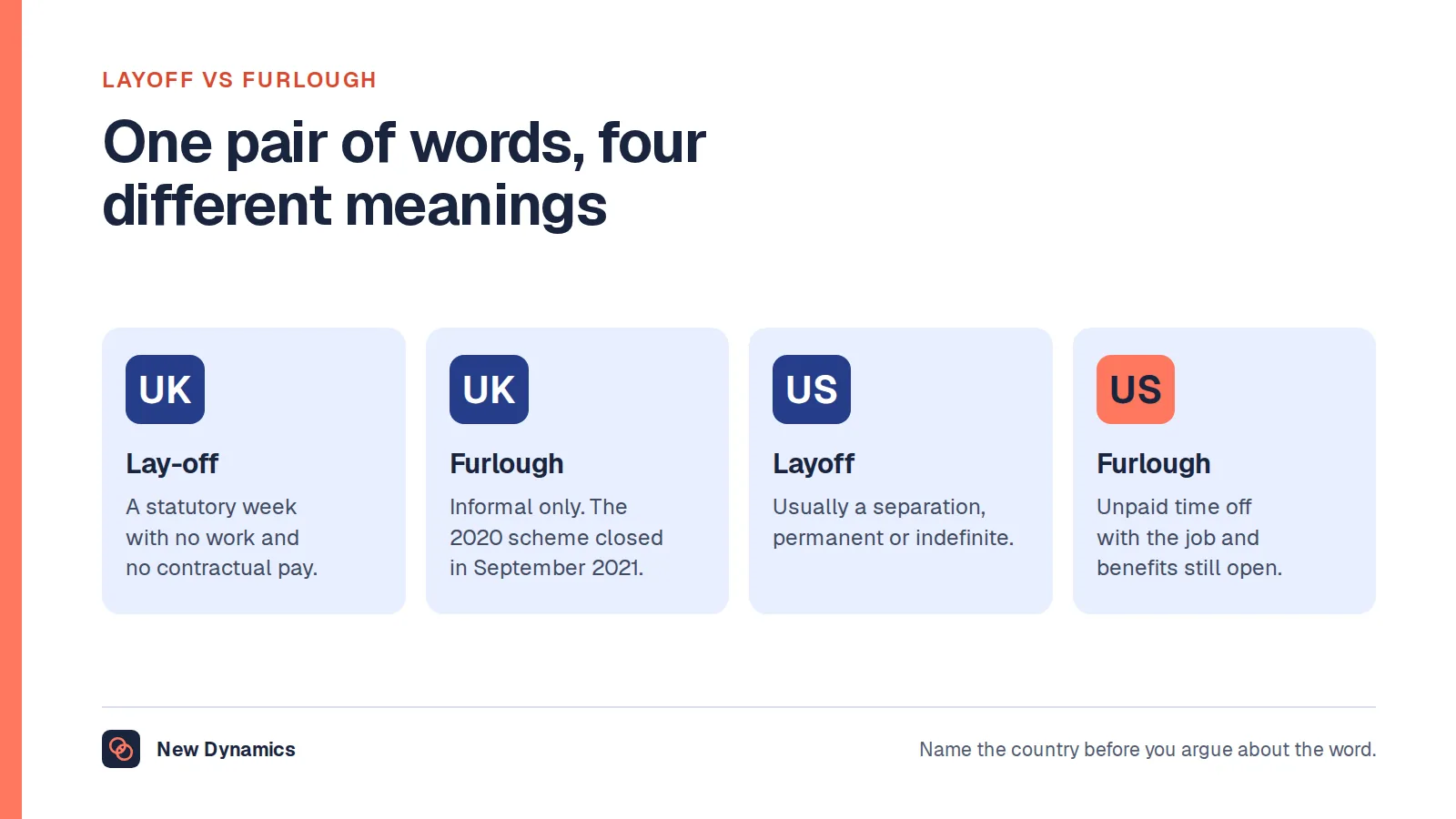
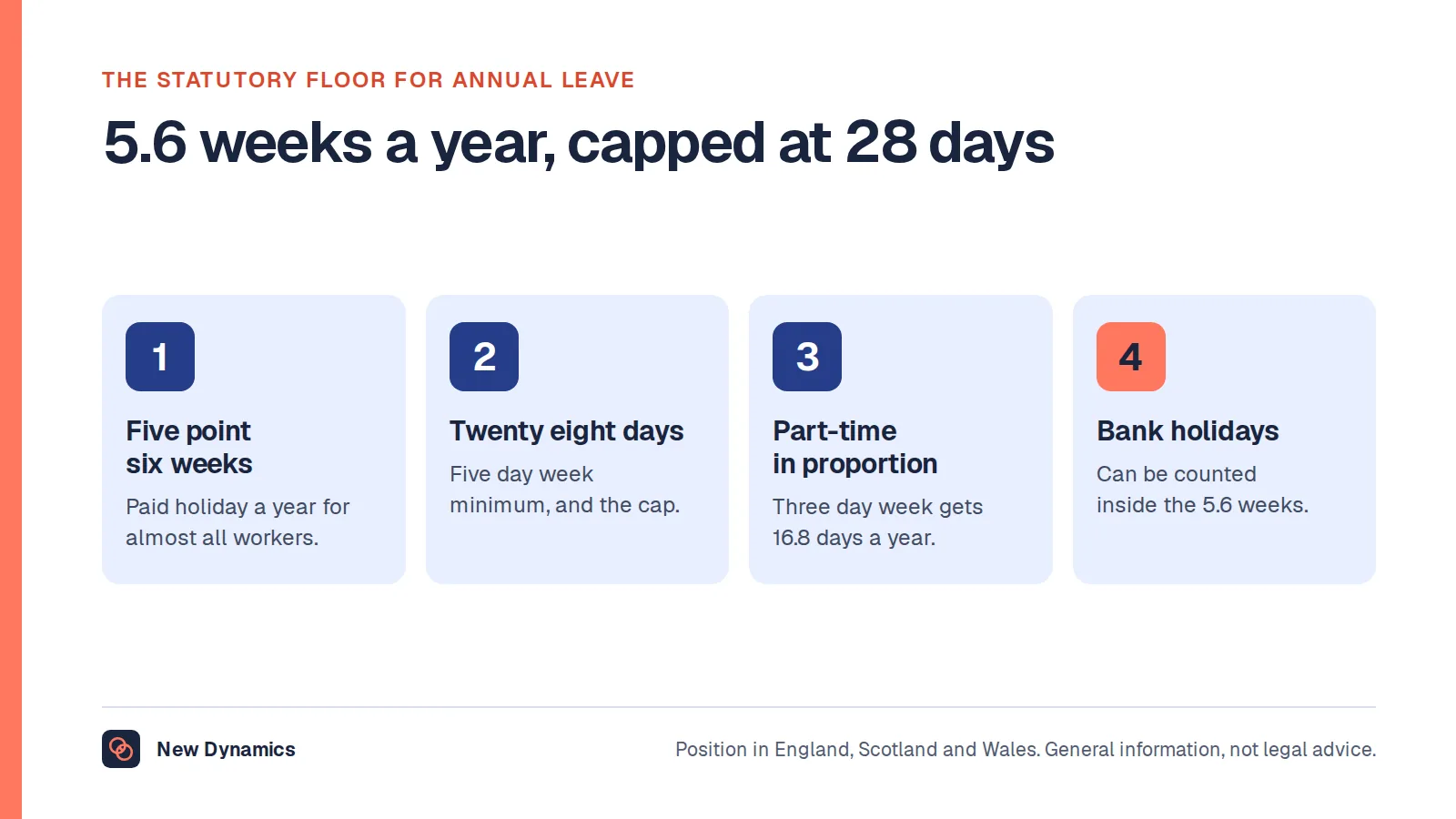
The nearest thing to genuine VTO here is agreed unpaid leave: the employee asks, the employer agrees, and both record it. That is a variation by agreement, not a management decision. For the full comparison, including why furlough means different things on each side of the Atlantic, see our post on layoff against furlough, and on how unpaid time meets statutory holiday, holiday entitlement.

Writing a VTO policy that does not break anything
- Name the meaning. State on the first line whether the policy covers unpaid voluntary time off or paid volunteer time off.
- Say who may take it. Limit it to non-exempt staff unless you have taken advice on the salary basis rules. If exempt staff are included, say that only full workweeks with no work at all are unpaid.
- Keep it genuinely optional. Record the offer, the acceptance and who asked. If a manager pressures a team into accepting, it stops being voluntary and the pay question changes.
- Set the unit. Whole shifts and whole days are easier to administer and far safer for salaried staff than part hours.
- Say what happens to accrual and eligibility. Spell out the effect on paid leave accrual, plan eligibility and any bonus scheme.
- Log the hours. Keep unpaid hours in the same record as paid absence, so the thresholds above can be checked.
Frequently asked questions
What does VTO mean?
VTO usually means voluntary time off: unpaid hours a United States employer offers when there is less work than people, which employees may choose to take. The same letters are also used for volunteer time off, which is normally paid time for approved volunteering.
Do you get paid for VTO?
No. Voluntary time off is unpaid for the hours taken. The Department of Labor states that the Fair Labor Standards Act "does not require payment for time not worked", and that pay for time not worked is a matter of agreement. Some policies let you cover the hours from accrued paid leave.
Is VTO the same as PTO?
No. Paid time off is a paid allowance the employee has earned and chooses when to use. Voluntary time off is unpaid, offered by the employer when demand is low, and usually taken as whole shifts. Many employers let staff use PTO to cover VTO hours, which is a policy choice, not a rule.
Can a salaried employee take VTO?
Carefully, and usually not for part of a week. Federal regulations say an exempt employee must receive the full salary for any week in which they perform any work, and that deductions cannot be made for absences occasioned by the employer or by the operating requirements of the business. Unpaid time is normally safe only for a whole workweek with no work at all.
Can taking VTO affect my benefits?
It can. Leave under the Family and Medical Leave Act needs at least 1,250 hours of service in the 12 months before it starts, and full-time status for the employer shared responsibility provisions means an average of at least 30 hours of service per week, or 130 hours a month. Unpaid hours count towards neither.
Is there VTO in the UK?
No. There is no UK concept of voluntary time off. GOV.UK says you should get full pay unless your contract allows unpaid or reduced pay lay-offs, and statutory lay-off or short-time working brings a guarantee payment. The nearest voluntary equivalent is unpaid leave agreed with the employer.
Your next step: find out what your policy actually says
- Search your time-off policy for the letters VTO. If they appear undefined, define them this week.
- Check which groups the policy covers, and whether any exempt employee has had pay reduced for part of a week.
- Pull the last twelve months of unpaid hours by person and compare the totals with the thresholds above.
- Record unpaid hours in the same place as every other absence.
For the wider set of policies this sits inside, read and download our employee handbook guide. The guide is free to read, and the PDF uses our short download form.
Want the offer, the acceptance and the approval on one record instead of in a supervisor's memory? Book a New Dynamics demo and bring your current policy. You can also email contact@new-dynamics.com.