TL;DR
- Health and safety law treats a work experience student as your employee. The Health and Safety Executive says so directly, and adds that there are very few work activities a student cannot do because of health and safety law.
- You usually do not need a new risk assessment. HSE: “You do not need to do a separate risk assessment for work experience students, as long as your existing assessment already considers the specific factors for young people.”
- Your existing employers' liability policy will normally cover the student if your insurer belongs to the Association of British Insurers or Lloyd's, so no extra policy is needed. The compulsory minimum cover is £5 million per occurrence.
An email arrives from a school asking whether you can take a Year 10 pupil for a week. It gets forwarded to HR, then to whoever handles health and safety, and comes back as a no, because nobody could work out what the law required.
The law asks for less new paperwork than that process assumes. This article sets out what a host employer has to do before a work experience placement starts: the risk assessment, who you must tell about the risks, whether your insurance already covers the student, what a young person may not be asked to do, the pay position, and how a T Level industry placement differs. It covers Great Britain, with England named where a rule is England only. It is general information about the position in Great Britain and not legal advice.
A placement goes wrong the same way a new starter's first week goes wrong: nobody wrote down who was responsible for what. See how New Dynamics onboarding gives a short arrival a named owner, a checklist and a record that the induction happened.

A work experience student is your employee for health and safety
This decides most of the rest. HSE's work experience page, in its "Young people at work" guide for employers (last updated 1 November 2024), states:
"Under health and safety law, work experience students are your employees, like any other young person you employ. There are very few work activities a student cannot do because of health and safety law."
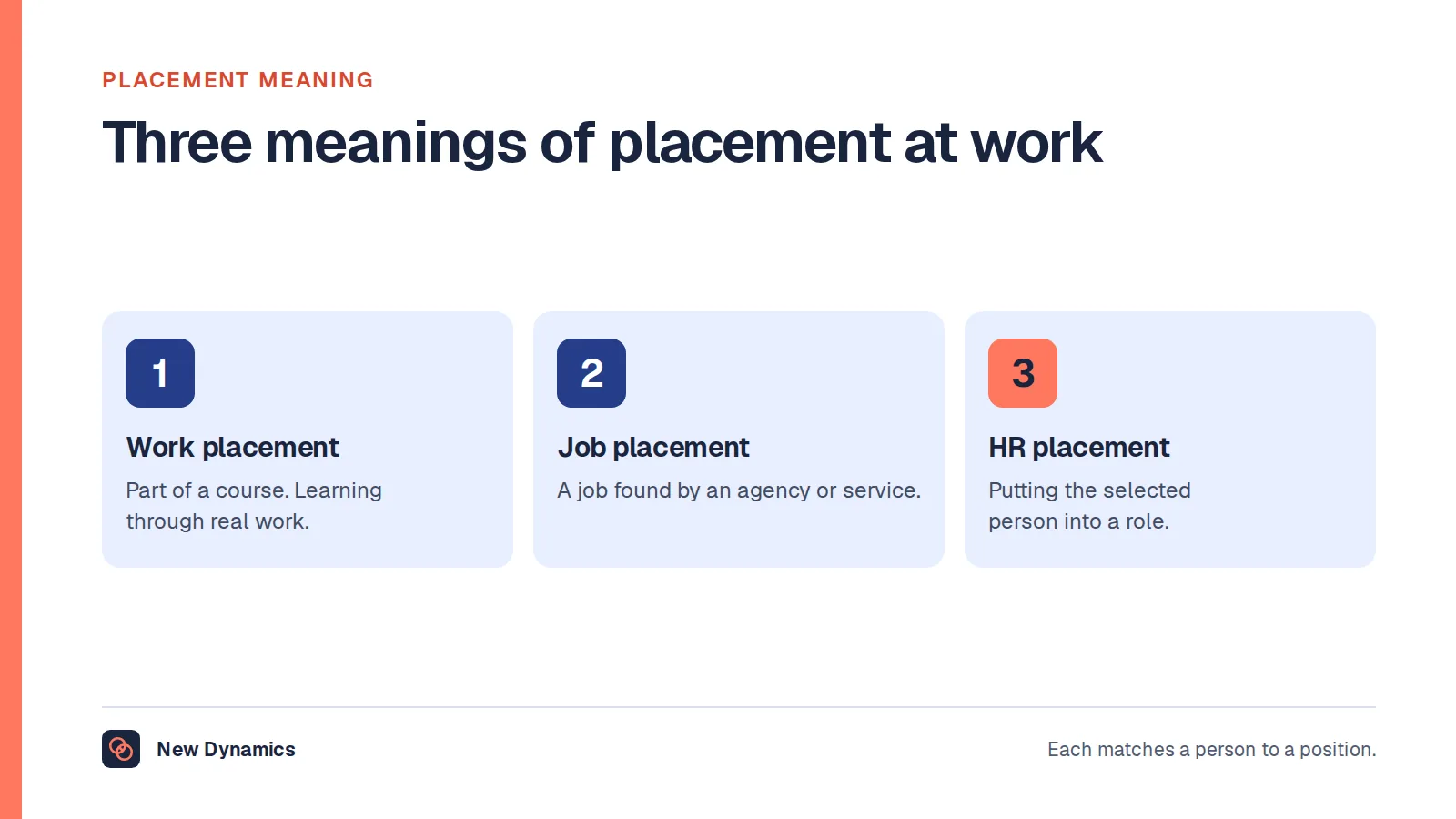
So the duties you owe your staff you now owe the student. The same page is blunt about where they sit: "As an employer taking on a young person for work experience, you have the main responsibility for their health and safety." The school keeps its duties as organiser, but it does not take yours. Our post on what placement means at work separates a school week from a year in industry and from an agency job placement.
Do you need a new risk assessment for a work experience placement?
This is the question employers get wrong most often, and HSE answers it directly on its risks to young people at work page:
"You do not need to do a separate risk assessment for work experience students, as long as your existing assessment already considers the specific factors for young people."
On the repeat case it goes further: if you already employ a young person, or have done recently, "your existing arrangements for assessment and management of the risks for new young people should be enough", provided the new starter is of a similar level of maturity and understanding and has no particular needs. The trigger is not the arrival of a student. It is whether your assessment has ever looked at young people, and HSE lists four situations where you should review it first.

HSE scales the effort to the setting. For "placements in low-risk environments, such as offices or shops", your existing arrangements for other workers should be enough. Where the risks are less familiar it expects "induction, supervision, site familiarisation, and any protective equipment needed". In construction, agriculture or manufacturing you must satisfy yourself that instruction, training and supervision "have been properly thought through and work in practice". One detail saves small employers an argument: "If you have fewer than 5 employees you do not need to do a written risk assessment. If a work experience student increases your staff to 5 you do not need to do a written risk assessment for this temporary period."
What a young person may not be asked to do
The specific duties come from the Management of Health and Safety at Work Regulations 1999 (SI 1999/3242), in force since 29 December 1999. A "young person" is "any person who has not attained the age of eighteen"; a "child", in England and Wales, is "a person who is not over compulsory school age".
Regulation 19 requires employers to ensure young persons "are protected at work from any risks to their health or safety which are a consequence of their lack of experience, or absence of awareness of existing or potential risks or the fact that young persons have not yet fully matured". Regulation 19(2) prohibits work beyond their physical or psychological capacity, harmful exposure to toxic or carcinogenic agents or to radiation, accident risks "which it may reasonably be assumed cannot be recognised or avoided by young persons", and risks from extreme cold or heat, noise or vibration.
Here is the part that matters for a school placement. Regulation 19(3) permits some of that work where it is necessary for training, the young person is supervised by a competent person, and the risk is reduced to the lowest level reasonably practicable. But it opens with the words "a young person who is no longer a child". A student still of compulsory school age does not get that exception, so the regulation 19(2) prohibitions apply without it. A 17 year old on a college placement and a 15 year old on a school week are not in the same position, even in the same workplace. HSE's the law page puts the minimum school leaving age in "the school year in which they turn 16"; GOV.UK's school leaving age guidance gives the exact date, which differs between England, Scotland, Wales and Northern Ireland. HSE adds the rule that makes school work experience possible at all: "Children below the MSLA must not be employed in industrial workplaces such as factories, construction sites, except on work experience." Age limits on some equipment, forklift trucks among them, apply separately.
Telling a parent or carer about the risks
Where the student is below school leaving age this duty is statutory, and it sits in regulation 10(2): "Every employer shall, before employing a child, provide a parent of the child with comprehensible and relevant information on (a) the risks to his health and safety identified by the assessment; (b) the preventive and protective measures" and the risks notified under regulation 11(1)(c). Regulation 10(3) extends "parent" to anyone with parental responsibility under the Children Act 1989 in England and Wales, or parental rights under the Law Reform (Parent and Child) (Scotland) Act 1986 in Scotland. Because health and safety law treats the student as your employee, the duty is yours as host, not the school's.
It is not a form-filling duty. HSE: "Explain to parents/carers of children what the significant risks are and what has been done to control them. You can do this in whatever way is simplest and suitable, including verbally, and is very often done via the school or college." Keep a note of what was sent and when.
It runs both ways. HSE asks you to take account of what the organiser and the parents or carers tell you about the student's capacity and any particular needs, "for example due to any health conditions or learning difficulties", then at induction to "explain the risks and how they are controlled, checking that they understand what they have been told", and to "always check they know how to raise health and safety concerns".
Does employers' liability insurance cover a placement student?
Almost certainly yes, and here two official sources have to be read together.
The duty comes from section 1 of the Employers' Liability (Compulsory Insurance) Act 1969: "every employer carrying on any business in Great Britain shall insure, and maintain insurance" against liability for bodily injury or disease "sustained by his employees". Regulation 3 of the Employers' Liability (Compulsory Insurance) Regulations 1998 (SI 1998/2573), in force from 1 January 1999, sets the amount at "not less than £5 million" for a claim "arising out of any one occurrence" plus costs.
Now the definition. Section 2(1) of the 1969 Act defines "employee" as "an individual who has entered into or works under a contract of service or apprenticeship with an employer". A school work experience student normally has no contract of service, so that statutory definition does not obviously reach them, even though HSE treats them as an employee for health and safety purposes. The same word is doing two different jobs, which is worth knowing before you ring your broker.
What closes the gap is the market, and HSE states it: "Your existing employers' liability insurance policy will cover work placements provided your insurer is a member of the Association of British Insurers (ABI), or Lloyds, so there is no need for you to get any additional employer's liability insurance if you take on work experience students." For many insurers, HSE adds, the definition of an employee includes "people on work experience schemes, for example students". Two cautions: check with your insurer if in doubt, and if you do not currently require employers' liability insurance at all, discuss the placement with them.

A longer placement adds a notification. GOV.UK's industry placements guidance tells employers: "Because your student will be working for you for more than 2 weeks, you will need to notify your insurer about their employment." A one week school placement does not reach that threshold. A T Level placement does.
Is a work experience placement paid?
Briefly, because the worker test deserves its own treatment. GOV.UK's guidance Minimum wage: work experience and internships, published 15 May 2013, says people "undertaking work experience for you who are of compulsory school age are not entitled to the minimum wage", and that students "working as a required part of a UK-based further or higher education course don't qualify for the minimum wage if their placement with you or your organisation does not exceed 1 year". That second exemption "does not apply to students performing work that is not related to their course, such as to help finance their studies or during a gap year".
The label decides nothing: "It is your responsibility to decide whether the person is a worker for minimum wage purposes." For an adult who is not on a required course you are outside those exemptions and into the worker test, which our post on the rules for unpaid internships covers in full.
T Level industry placements: hours and who arranges them
An industry placement is not a work experience week. GOV.UK's industry placements guidance, published 25 March 2019 and last updated 4 September 2020, applies to England and states that placements "must last for a minimum of 315 hours (approximately 45 days), not including lunch breaks", that most are expected to average 350 hours, and that they make up "around 20% of the course". If you cannot offer the full 315 hours you can ask the provider about sharing the placement with another employer.
The training provider arranges it and "will agree a structured work plan with you" before it begins. Your side is a safe environment, real technical work, "a line manager to support, supervise and mentor the student", an induction and formal feedback at the end. Placements "are part of a course and there is no legal requirement or expectation that students will be paid", though you may choose to. If the placement is really a route into an apprenticeship the contractual position changes entirely, and our post on the apprenticeship agreement sets out what that document must contain.
DBS checks and supervision
Eligibility for a Disclosure and Barring Service check depends on the position, not on whether it is paid. GOV.UK's DBS checks guidance for employers, last updated 5 October 2026, says "eligibility is the same whether you are applying for a paid role or a volunteer position", and that any reference to an employee in it "should be taken to include volunteers and individuals engaged in unpaid work". Standard and enhanced checks are limited to employers entitled by law to ask about spent convictions, and "knowingly requesting a higher-level check than the legislation allows is unlawful".
There is also an age floor: "The minimum age at which someone can be asked to apply for a criminal record check is 16 years old." You cannot DBS check a 15 year old coming on work experience, and that is not a reason to refuse the placement. It is a reason to rely on supervision, the control HSE keeps returning to. Young people "may be eager to impress or please people they work with, so you should supervise them effectively", and they "may be unaware of how to raise concerns, so make sure this is part of their training".
Frequently asked questions
Do I need a risk assessment for a work experience placement?
You need a suitable risk assessment, but usually not a new one. HSE says you do not need a separate risk assessment for work experience students as long as your existing assessment already considers the specific factors for young people. Review it first if you do not employ a young person now or recently, this is your first student, or the student has particular needs flagged by the organiser.
Is a work experience student covered by my employers' liability insurance?
HSE states that your existing employers' liability policy will cover work placements provided your insurer is a member of the Association of British Insurers or Lloyd's, so no additional cover is needed. Many insurers define an employee to include people on work experience schemes. Check with your insurer if unsure, and notify them for a placement longer than two weeks.
Do I have to tell a parent about the risks?
Yes, where the student is below compulsory school leaving age. Regulation 10(2) of the Management of Health and Safety at Work Regulations 1999 requires an employer, before employing a child, to give a parent comprehensible and relevant information on the risks identified by the assessment and the preventive and protective measures. HSE says this can be done in whatever way is simplest, including verbally, and is often done through the school.
Does a work experience student have to be paid?
Someone of compulsory school age is not entitled to the minimum wage, and a student on a placement of up to a year that is a required part of a UK further or higher education course is exempt. Outside those exemptions you must decide whether the person is a worker for minimum wage purposes. Our post on unpaid internship rules sets out that test.
How many hours is a T Level industry placement?
GOV.UK states that an industry placement must last a minimum of 315 hours, approximately 45 days, not including lunch breaks, and that most are expected to average around 350 hours. Placements make up around 20% of the T Level course. The training provider arranges it and agrees a structured work plan with you before it starts.
Can I DBS check a work experience student?
Not if they are under 16. GOV.UK's guidance for employers states that the minimum age at which someone can be asked to apply for a criminal record check is 16 years old. Above that age, eligibility depends on whether the position is one the law allows a check for, and it is the same for paid and unpaid work. Where no check is possible, supervision is the control.
Your next step: settle four things before the student arrives
- Open your current risk assessment and find the young-person factors. If they are not there, add them rather than writing a second assessment for the placement.
- Ask the school, college or training provider about the student's capacity and any particular needs, and write down what you were told.
- Confirm that your employers' liability insurer is an ABI or Lloyd's member, and notify them if the placement will run beyond two weeks.
- Name the supervisor, write the induction, and decide how the significant risks will be explained to a parent or carer where the student is below school leaving age.
For the structure behind a good first week, whether it lasts five days or a year, read and download our employee onboarding guide. The guide is free to read, and the PDF uses our short download form.
Want the induction, the supervisor and the sign-off to leave a record instead of living in one person's inbox? Book a New Dynamics demo and bring the last placement request you received. You can also email contact@new-dynamics.com.