TL;DR
- An internship interview cannot test experience, because the candidate has not had the chance to get any. Assess four things instead: trainability, curiosity, reliability and how the person behaves when they do not know the answer.
- Competency questions written for experienced hires quietly measure access. Ask for an occasion rather than a job, accept evidence from study, part-time work, caring responsibilities or voluntary work, and give no extra credit for unpaid experience that only money makes possible.
- Settle the pay question before you advertise. GOV.UK says that an intern "is entitled to the National Minimum Wage if they count as a worker", and that the term intern "has no legal status under minimum wage law". This is general information for the UK, not legal advice.
An internship interview has one structural problem, and everything else follows from it. The thing you normally assess, evidence of having done the work, is the thing the candidate has had no chance to acquire. That is why they are applying.
So most interviewers fall back on questions borrowed from a mid-career interview, get thin answers, and choose whoever was most comfortable in the room. Comfort is a product of practice and coaching, not a measure of how useful someone will be in eight weeks.
This article is written for the employer, because this is an HR site and the hiring decision is yours to defend. It covers what an internship interview is really assessing, internship interview questions that work without a CV to lean on, the ones that reward confidence or class rather than potential, how to score very different candidates fairly, and the pay question underneath it all. A short section at the end is for the candidate.
An internship is the shortest employment relationship you will run, so the handover from interview to first week matters more than usual. See how New Dynamics onboarding carries the expectations you agreed at interview into the first month, instead of starting again on day one.
What an internship interview is actually assessing
Write down what the internship is for before you write a question. Three honest answers exist: a pipeline, where you are assessing potential over two or three years; real work that needs doing, where you are assessing whether someone can be useful within a few weeks with support; or access and outreach, where you are opening a route into the sector and should expect less polish rather than less ability.
Whichever it is, four qualities do the predictive work, and every question below produces evidence of one of them.
Trainability. Can this person take a correction once and work differently afterwards? It is the most useful quality in someone who starts knowing nothing about your work, and it is easy to test: give a small piece of feedback during the interview and watch what happens next.
Curiosity. Do they ask about the work, or only about the organisation? Someone who went looking for information before the interview will go looking for it on the job.
Reliability. Do they turn up, warn you early when something has gone wrong, and finish small unglamorous things? A reliable intern is worth managing from day one. One who is brilliant and unpredictable costs more than they produce in a short placement.
How they handle not knowing. Interns spend most of their time at the edge of their competence. The behaviour you need is: say so, ask a specific question, write down the answer. The behaviour that hurts is a confident guess that hides the gap.

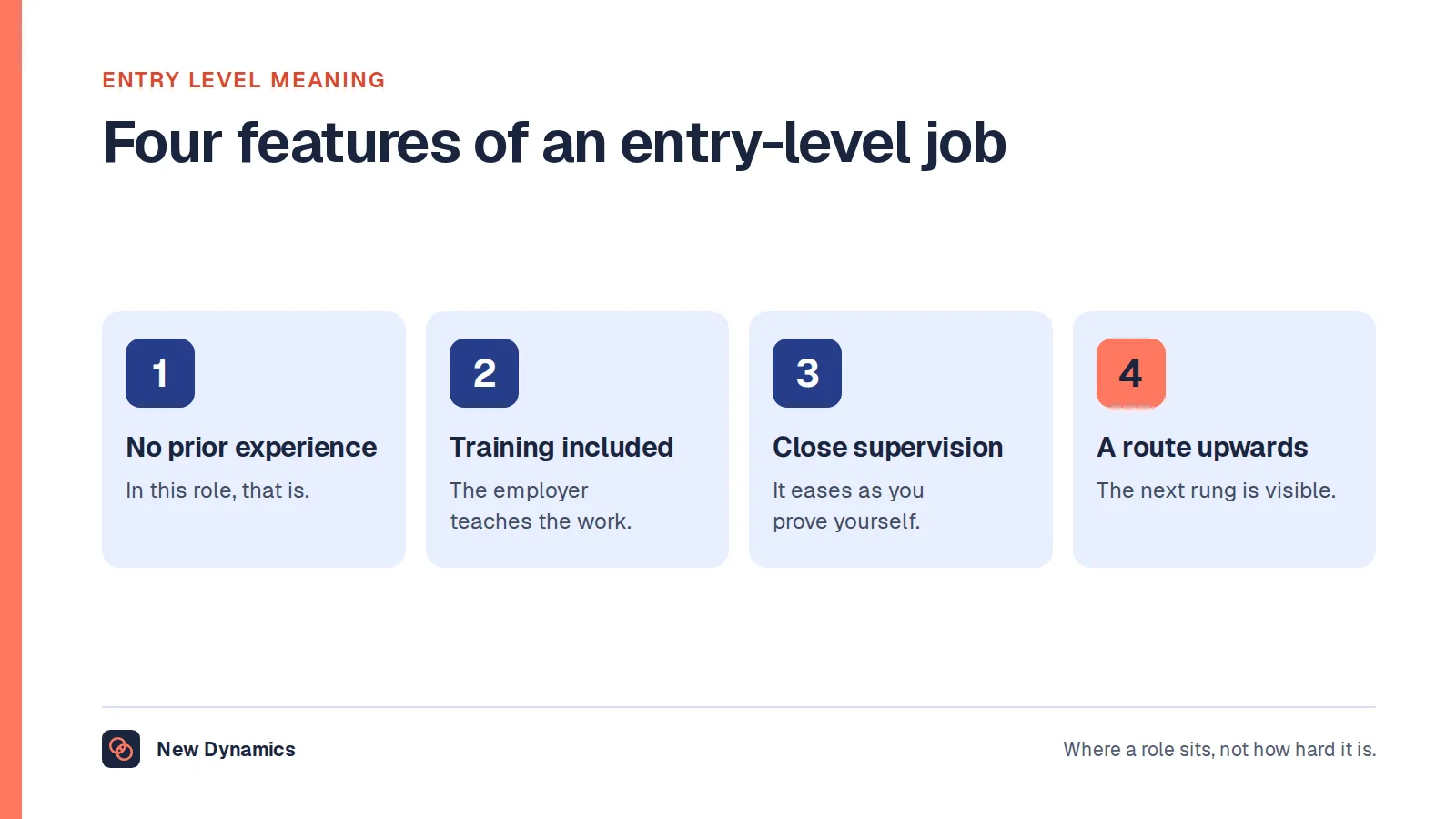
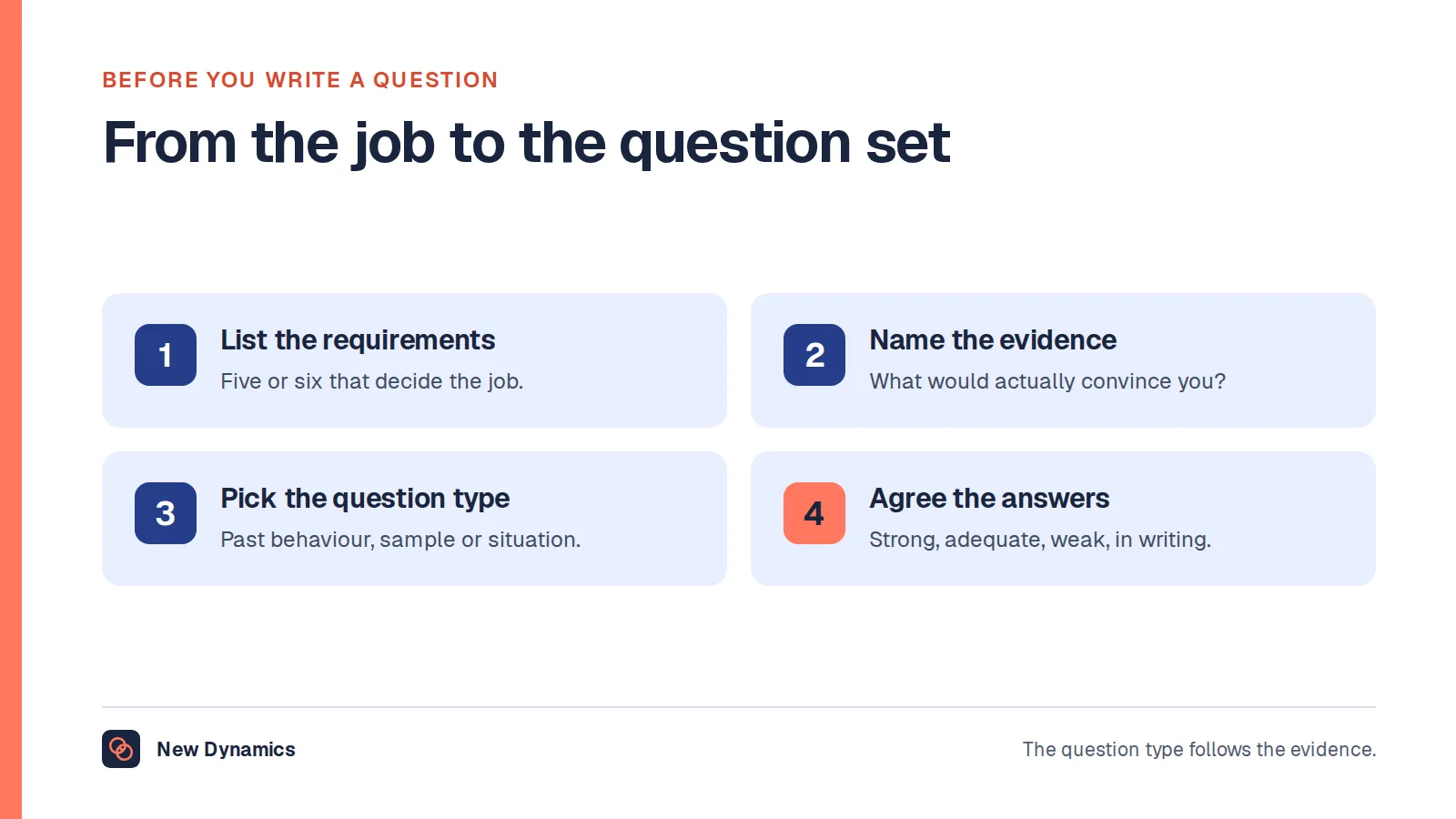
Four criteria is enough. Write them down, with a line each on what strong and weak evidence looks like, before anyone is invited in. Acas advises checking that your decisions "are based on how each applicant met each point in the job description and person specification", and an internship needs that specification as much as a senior role does. Our post on what entry level means sets out how an internship differs from an apprenticeship, a placement and a first permanent job.
Why competency questions built for experienced hires fail here
The standard behavioural question assumes a workplace. "Tell me about a time you managed a project to a deadline" assumes projects and deadlines handed down by an employer. "Describe a time you influenced a senior stakeholder" assumes senior stakeholders. Ask those of a twenty-year-old and you get a hesitant non-answer, a story stretched past what it can bear, or a polished answer from the candidate who did a paid internship last summer because somebody could afford to keep them in a city for two months.
The third is the dangerous one, because it looks like a good answer while mostly measuring a previous opportunity. Score it as ability and you spend the process rewarding whoever had the earliest access, which compounds into a team that all arrived by the same route. Three fixes, all small.
Ask for an occasion, not a job. Strip the workplace out and leave the behaviour in. "Tell me about a time you had to finish something by a date somebody else set" can be answered from a coursework deadline, a shift rota, a hospital appointment somebody depended on or a club fixture. The behaviour you want, planning, warning people, finishing, is identical in all four.
Name the settings you will accept, out loud. Most candidates assume only paid work counts, so they leave out three years of looking after a younger sibling, or the Saturday job they think is beneath mentioning. Say at the start: "Examples from your course, a part-time job, something you do at home, a club or anything you volunteer for are all equally useful here." That sentence improves the next forty minutes more than any question you could add.
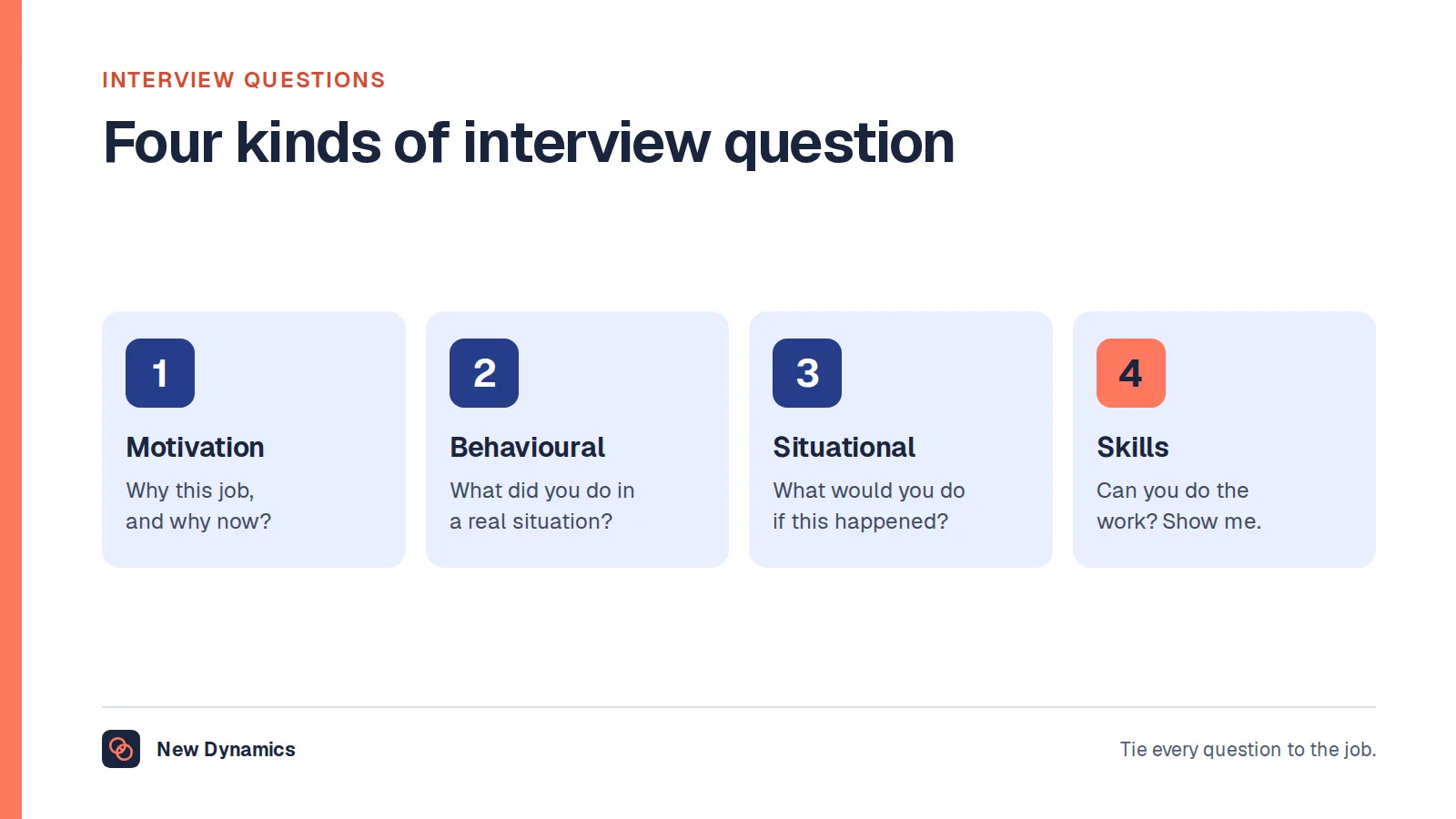
Use situational questions for anything you cannot reach. Where the role needs judgement the candidate has had no chance to exercise, describe a real situation from the team and ask what they would want to know first. With more than one defensible answer, it is the fairest question type available to someone with no work history. Our guide to interview questions to ask an interviewee covers the question types in more depth.

Decide whether the internship is paid before you advertise it
This is almost never discussed alongside interview questions, and it carries legal exposure. Your questions are a fairness problem. Pay is a compliance problem, settled before the advert goes out.
This section describes the United Kingdom, where minimum wage law applies across England, Scotland, Wales and Northern Ireland. It is general information rather than legal advice, and a borderline arrangement deserves proper advice before it starts.
GOV.UK's guidance on employment rights for interns opens with a test that has nothing to do with what you call the arrangement: "An intern's rights depend on their employment status. If an intern is classed as a worker, then they're normally due the National Minimum Wage." On the terminology: "Internships are sometimes called work placements or work experience. These terms have no legal status on their own." On entitlement: "An intern is entitled to the National Minimum Wage if they count as a worker."
GOV.UK's longer guidance for employers on the minimum wage, work experience and internships puts the duty on you: "It is your responsibility to decide whether the person is a worker for minimum wage purposes and, if they are, whether an exemption applies to them." And on getting it wrong: "Failure to pay the minimum wage to someone who is entitled to it is against the law." The label is irrelevant, because entitlement "does not depend on what someone is called, the type of work they do, how the work is described (such as 'unpaid' or 'expenses only') or the profession or sector they work in."
Three consequences catch employers out.
You cannot contract out of it. An employer cannot avoid paying the minimum wage where it is due by "saying or stating that it does not apply" or by "making a written agreement saying someone is not a worker or that they're a volunteer".
A promise of a job later is a reward now. GOV.UK: "An intern is classed as a worker and is due the National Minimum Wage if they're promised a contract of future work." That is the "do the summer unpaid and we will look at a role in September" arrangement.
The advert is visible. The employer guidance warns that "Adverts which suggest illegal unpaid positions inform HM Revenue and Customs' risk assessment process", and that employers considered "at risk" of not paying may be targeted for further investigation.
The narrow cases where the minimum wage is not due
The exemptions are specific. On course placements, GOV.UK says "students working as a required part of a UK-based further or higher education course don't qualify for the minimum wage if their placement with you or your organisation does not exceed 1 year", and adds that "The exemption does not apply to students performing work that is not related to their course, such as to help finance their studies or during a gap year." Work experience for people of compulsory school age is also outside the entitlement, as are genuine voluntary workers at a charity or similar body who receive no monetary payment beyond limited specified expenses. GOV.UK cautions that not every worker at such an organisation "is automatically a voluntary worker".
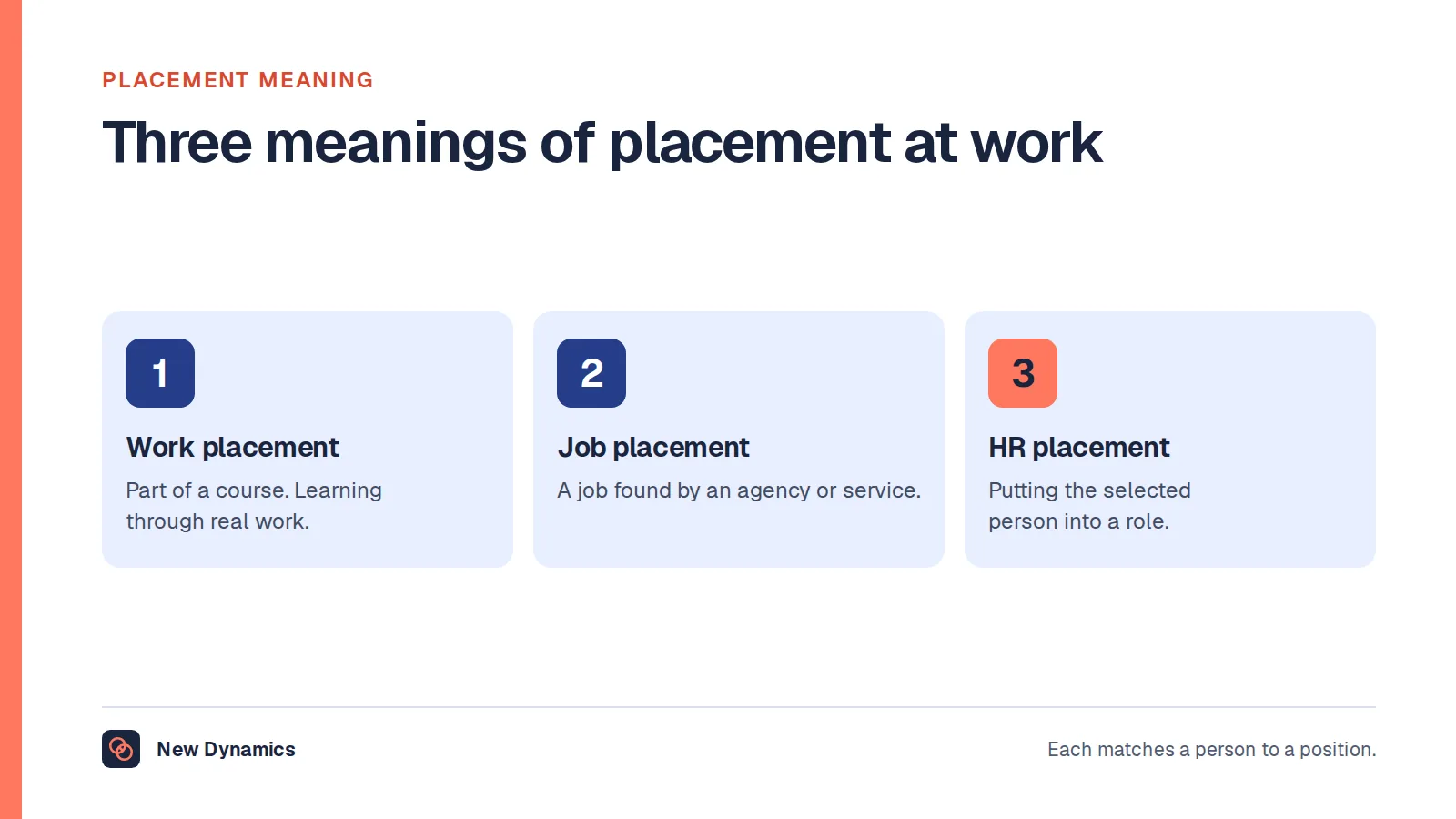
Pure observation sits outside the legislation: "Someone who is doing a placement that does not involve any work being performed, such as work shadowing, will not come within the National Minimum Wage legislation." If you are offering a few days of watching, that is job shadowing, and the advert should say so. Our posts on the meaning of placement and the definition of volunteerism cover those boundaries.
The rates, and the date they apply from
GOV.UK's page on National Minimum Wage and National Living Wage rates notes that "The rates change on 1 April every year." The rates it lists as current, applying from April 2026, are £12.71 an hour for workers aged 21 and over, £10.85 for 18 to 20, £8 for under 18 and £8 for apprentices. The same page already publishes the rates from April 2027: £13.21, £11.27, £8.31 and £8.31. Most interns are 18 or over, so the 18 to 20 or the 21 and over rate is usually the relevant one. The apprentice rate applies to apprentices, not interns.
One figure we will not give you is the share of UK internships that go unpaid. We have found no official source that publishes it, so we quote no number.
Unpaid work trials at the interview stage
A short practical task is one of the best things you can offer an intern candidate, because it tests the work rather than the talking. Keep it inside the lines Acas draws in its guidance on interviewing job applicants. It says a work trial "should be for a reasonable amount of time. For example, 2 hours or a shift", and that "An unpaid work trial should not usually last longer than one day." It adds that "An employer must pay an applicant the National Minimum Wage if the work trial is not genuinely for recruitment purposes", including where the tasks are not part of the role applied for or "the tasks have a 'value' to the employer beyond testing skills". So: thirty minutes, built from the job, observed, the same brief for everyone, and never work you were going to need anyway.
Twenty-four internship interview questions that do not need a CV
Pick six to eight, tied to your four criteria, and ask the same ones in the same order to everyone. These are ours; use and adapt them freely.
Study and how they learn
- "Tell me about a piece of work on your course that you found genuinely hard. What did you do when you got stuck?"
- "Which part of your course would you happily do more of, and which part do you put off?"
- "Describe something you have learned in the last year that nobody set you. How did you go about it?"
- "You are given instructions or reading you do not understand. What do you do first?"
Any paid work, however short
- "Tell me about a job you have had, even for a few weeks. What was the first thing you had to get right?"
- "Describe a time a customer or a manager was unhappy about something. What did you do?"
- "What did your shift manager rely on you for?"
- "Tell me about a rule at work you thought made no sense. What did you do about it?"
Responsibilities outside paid work: home, clubs, volunteering
- "Tell me about something you are responsible for that other people depend on."
- "Describe a time you had to organise other people, anywhere: at home, in a team, in a society, in a group of friends."
- "Tell me about a commitment you kept up for months. What made it hard to keep going?"
- "What have you done that nobody asked you to do?"
Question 9 most often surfaces the candidate who has been running a household or interpreting for a parent since they were fifteen. That is evidence of reliability under pressure, and it never appears on a CV. Do not ask why they have the responsibility or who is unwell. The responsibility is the evidence; the reason is none of your business.
How they handle not knowing
- "What is something about this field you do not understand yet?"
- "Here is a real problem from this team. Think out loud: what would you want to know first?"
- "Tell me about a time you were wrong about something. How did you find out?"
- "You are two days into a task and realise you misunderstood the brief. What happens next?"
Reliability and the practical side
- "This internship runs three days a week for ten weeks. Does that pattern work for you?"
- "What do you do when you realise you are going to be late, or miss a deadline?"
- "How do you keep track of what people have asked you to do?"
- "Tell me about a time you had two things due at once. How did you decide?"
Question 17 asks about a requirement of the job, not the candidate's circumstances. Ask about the pattern, not about childcare, health, religion or travel.
Motivation, and what they want out of it
- "Why this internship rather than another one? What do you want to be able to do by the end of it?"
- "What do you think this job is mostly made of, day to day?"
- "What support would you want in your first week?"
- "What would you like us to know that has not come up?"
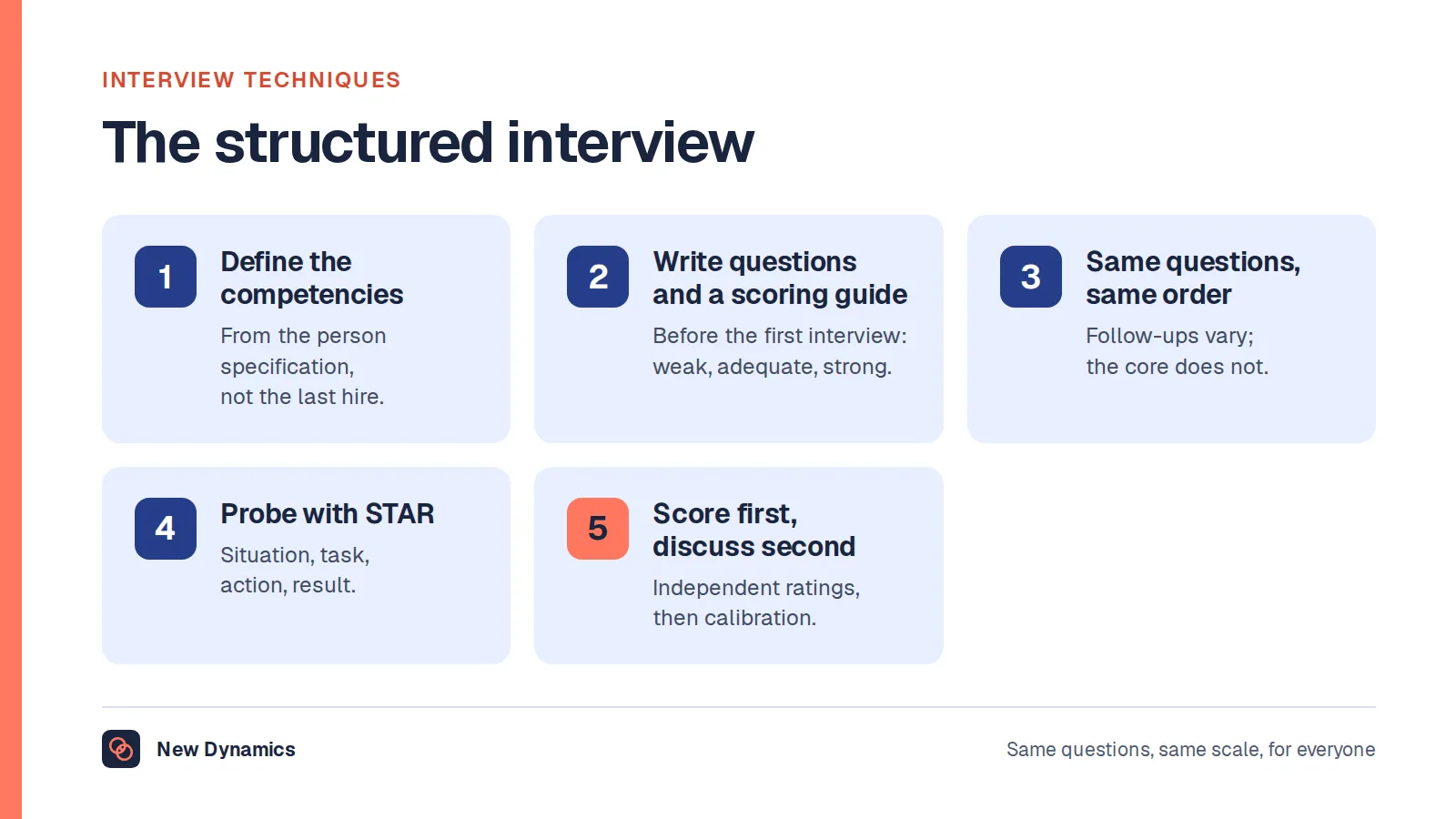
Follow every past-behaviour answer with the same probes: "What did you do, exactly?" and "What happened next?" An answer made of "we" and "generally" is not evidence yet. Our guide to interview techniques covers probing and anchored scoring.
Questions to avoid, because they test confidence or class
None of these are unlawful. They are bad instruments, because what they measure is not potential.
"Where do you see yourself in five years?" The coached candidate has an answer. The candidate who is first in their family to apply for a job like this has an honest shrug. The gap between them is coaching, not ambition.
"Sell yourself in thirty seconds." A test of performed confidence under artificial pressure. If the role involves pitching, test pitching as a task where everyone gets the same brief and preparation time.
"What have you done to show your commitment to this industry?" The most quietly exclusionary question in intern recruitment. The best answers to it are unpaid internships, unpaid festival work, expensive courses and family contacts. The candidate who spent two summers stacking shelves because the money was needed at home has no answer and the better work ethic. To test whether they understand the sector, ask question 22 instead.
Questions that reward travel, societies, school or family. "Tell me about your gap year", "What were you involved in at university?", "Which school did you go to?", "What do your parents do?" Each samples disposable income or class background. "When did you finish school?" carries a legal risk too, which the next section covers.
"Have you done an internship before?" As a scored criterion, this makes prior access a requirement for access. If a specific skill matters, ask about the skill.
Brainteasers, puzzles and market-sizing questions, unless the job is that. They measure familiarity with a genre that is coached unevenly. "What is your greatest weakness?" belongs here too: rehearsed, and answered with a disguised strength.
Small talk deserves a mention as well. The warm-up chat about hometowns, schools, families and holidays is where a panel builds the similarity bias it spends the next hour confirming. Open with the job instead.
The questions you must not ask
This section describes Great Britain, where the Equality Act 2010 applies. Northern Ireland has its own discrimination legislation. General information, not legal advice.
Acas's guidance on following discrimination law in recruitment lists nine protected characteristics: age, disability, gender reassignment, marriage and civil partnership, pregnancy and maternity, race, religion or belief, sex and sexual orientation. It notes that in recruitment, discrimination can happen through "the arrangements you make for deciding who to offer the job". Applicants are protected, not only employees. Two points bite harder here than anywhere else.
Age. Interns are young, and age is a protected characteristic. "How old are you?", "When did you finish school?" and "Are you not a bit young for this?" all point at it. It runs the other way too: a career-changer in their fifties applying for your internship is assessed on the same criteria as everyone else.
Health and disability. Acas is unambiguous: "You must not ask a job applicant about their health or any disability at any stage in the application or interview process, unless an exception applies." The exceptions are narrow, and include finding out whether a reasonable adjustment is needed for the assessment process. Acas also states the positive duty: "By law (Equality Act 2010), you must make reasonable adjustments for job applicants or interviewees if they are disabled", and that "By law you must ask anyone coming to an interview to tell you if they need reasonable adjustments so they can attend."
So the invitation asks everyone, in the same words, whether they need an adjustment, and says what is possible: extra time on a task, questions in advance, a quieter room, a break. An intern candidate is the least likely of your applicants to know they can ask.
Then avoid, of everyone: family and caring plans, who looks after whom, health conditions, where someone is "originally from", religious observance, anything about a partner. Where a fact affects the job, ask about the requirement, as question 17 does.
Scoring fairly when the candidates' lives look nothing alike
This is where an internship process is won or lost, because the raw material is so uneven. One candidate has two prior internships and a mock-interview session behind them; another has a Saturday job and three years of caring. Comparing overall impressions is then a vote on whose life has been more conventional.

Six habits make the scoring mean something.
- Score the criteria, not the candidate. Each criterion separately: strong evidence, some evidence, no evidence, with one line of what the person actually said. "Scored 3" is not a reason, and will not survive being read back to you in six months.
- Anchor the scale with examples first. Write down what strong evidence of trainability sounds like, or the scale drifts towards whoever interviewed most recently.
- Credit the behaviour, not the setting. A delivery shift, a committee, a household and a prior internship are equally valid sources of evidence. Discount nothing for gaps, and add nothing for brand names: a famous employer on a nineteen-year-old's history is usually a fact about their network.
- Do not score polish. Fluency and a tidy narrative arc are strongly trainable and weakly predictive. If presentation matters in the role, test it as a task with equal preparation time and score it openly as its own criterion.
- Score alone, immediately, before the panel talks, because discussion first produces one shared opinion wearing three hats. Acas advises that "If possible, each interview should be carried out by more than 1 person to reduce the risk of discriminating."
- Ask everyone the same questions. Acas: "When interviewing it's a good idea to ask each applicant the same questions where possible. This is to ensure you're treating applicants in the same way." Probes can differ. The set does not.
One test before the offer: could a colleague who was not in the room see from the quoted evidence why one candidate ranked above another? If the answer is "they came across better", the interview produced an impression, not a decision.
Then run the session so the evidence survives. Forty-five minutes is enough: say how long it will take, who is in the room and that there are no trick questions, give the sentence about which examples count, then two opening questions about the job, six to eight core questions, a task of up to thirty minutes and ten minutes for theirs. Acas advises telling applicants at the end of the interview when and how they will hear and what sort of feedback to expect. For an intern that feedback is worth more than the role: two specific things against the criteria, within a week. Write your notes as if the candidate will read them, because interview notes are personal data.
For the candidate: what a good answer looks like
Nobody expects you to have done the job. The National Careers Service puts it plainly in its interview tips: "A potential employer may not be expecting you to have done the job before, but they'll be looking for relevant experience or strengths." Four things separate a good answer from a thin one.
One occasion, not a general policy. "I am organised" is not an answer. "In April I had two essays and four shifts in the same week, so I wrote the order out on the Sunday and swapped one shift" is.
Say "I", and say what you did, even where the work was a team effort. Interviewers are trained to probe "we".
Use the life you actually have. A supermarket shift, a course deadline, looking after a grandparent, running a society's accounts: all of it is evidence of planning, reliability and dealing with other people. If the employer has not said such examples count, say it yourself: "This one is from my part-time job, if that is useful."
When you do not know, say so, then show the next step. "I have not come across that. I would look at how it was done last time, then ask which approach you prefer" beats a confident guess in any interview that is scored properly.
Prepare four or five occasions rather than twenty answers: planning, a mistake you fixed, learning something fast, working with someone difficult. Then ask about the work ("Who would I ask when I am stuck?"), ask for any adjustment you need, and check whether the internship is paid before accepting it. If you are doing real work and are not a student on a required course placement of up to a year, GOV.UK's position is that you are likely to be entitled to the minimum wage.
Frequently asked questions
What questions should you ask an intern candidate?
Ask six to eight questions tied to four criteria: trainability, curiosity, reliability and how the person handles not knowing. Good examples are "Tell me about a piece of work on your course you found hard, and what you did when you got stuck", "Tell me about something you are responsible for that other people depend on", and "What do you think this job is mostly made of, day to day?" Say at the start that study, part-time work, home and volunteering count equally.
Do interns have to be paid in the UK?
Usually yes, if they are doing real work. GOV.UK says an intern "is entitled to the National Minimum Wage if they count as a worker", that the term intern "has no legal status under minimum wage law", and that it is the employer's responsibility to decide whether the person is a worker. The main exemptions are students on a required UK course placement of no more than a year, people of compulsory school age, genuine voluntary workers at charities and similar bodies, and shadowing where no work is performed. General information for the UK, not legal advice.
How do you interview someone with no work experience?
Strip the workplace out of your questions and leave the behaviour in. Instead of "a project you managed", ask about "something you had to finish by a date somebody else set", which can be answered from coursework, a shift, a caring responsibility or a club. Add situational questions built from real problems in the role, plus a short observed task, and score the behaviour rather than the setting.
What questions should you avoid asking an intern?
Avoid questions that measure coaching, confidence or money: "Where do you see yourself in five years?", "Sell yourself in thirty seconds", "What have you done to show your commitment to this industry?", anything about gap years, societies, schools or parents' jobs, and brainteasers. In Great Britain you must also not ask about protected characteristics, and Acas says you must not ask about health or disability at any stage of the application or interview process unless an exception applies.
How do you score internship candidates fairly?
Agree four criteria and anchor each with examples of strong and weak evidence before you meet anyone. Ask the same questions in the same order, accept evidence from any setting, and credit the behaviour rather than the prestige of where it happened. Score alone and immediately, quoting one line of what the candidate said, and use more than one interviewer where possible. Acas advises checking that decisions are based on how each applicant met each point in the person specification.
Your next step: build an intern question set you can defend
- Write down why the internship exists, then four criteria, with a line each on what strong and weak evidence looks like.
- Settle the pay position against the GOV.UK guidance before the advert goes out, and put the rate in the advert.
- Choose six to eight questions from this article, add a situational question from a real problem in the team, and design a task of thirty minutes at most.
- Ask every candidate about reasonable adjustments in the invitation, in the same words.
- Open by saying which examples count, score alone against the criteria, and send specific feedback within a week.
For a fair process from the job description to the offer, read and download our recruitment and selection guide. The guide is free to read, and the PDF uses our short download form.
Want the expectations you set at interview to survive an intern's first week? Book a New Dynamics demo and bring the pack you use today. You can also email contact@new-dynamics.com.