TL;DR
- Onboarding is the whole process by which someone who has accepted a job becomes a working member of the organisation. It starts when the offer is accepted, not on the first morning, and it ends at a decision you can name, usually the probation decision.
- Induction and orientation are the same event in two dialects: the first day or days. Onboarding is the arc around them. Mixing the words up is how an employer buys a good first day and believes it has designed a first quarter.
- In the United Kingdom a new starter triggers duties with dates attached: the right to work check before you employ them, the principal statement of employment particulars on the first day, pension assessment, and data protection obligations for the records you now hold. General information, not legal advice.
Ask ten people in one organisation what the onboarding process is and you will get three answers. One describes the paperwork. One describes the first day. One describes a folder on a shared drive nobody has opened since the last reorganisation. Everyone agrees onboarding matters, and nobody can say where it begins or when it is finished.
This article gives you a definition to work from, the vocabulary that keeps HR and managers talking about the same thing, the shape of the process from accepted offer to probation decision, who owns which part, the United Kingdom duties a new starter sets off, and how to tell whether yours works.
If you want the process to live in one place rather than in an inbox, a spreadsheet and a manager's notebook, see how New Dynamics onboarding carries the tasks, the early goals and the first conversations on one path.
One clarification first. This article is about employees. "Onboarding customers" means something else, getting a new client live on a product, and nothing below applies to it.
What onboarding means
Onboarding is the process by which a person who has accepted a job becomes a working member of the organisation: legally employed, equipped, informed, connected to the people they need, and able to do the work to the standard the role expects.
That sentence does three jobs.
It is a process, not an event. A process has stages, owners and an end state. An event has a date and a room. Most complaints about onboarding are complaints about an event doing the work of a process.
It covers both sides. Half of onboarding is what the organisation needs: identity checks, bank details, acknowledgements, training records. The other half is what the person needs: what the job is for, what good looks like, who to ask, and permission to be new. Doing only the first half is administration with a welcome lunch attached.
It ends at a point you can name. Almost nobody writes this down, and it is the most useful thing to add to your own definition. If the end is undefined, the process stops when the last form is filed, usually in week one.
In short: onboarding means getting a new starter from a signature to a standard.
Induction, orientation and onboarding, and why the words matter
These three words get used as synonyms. They are not, and the confusion does real damage to budgets and job descriptions.
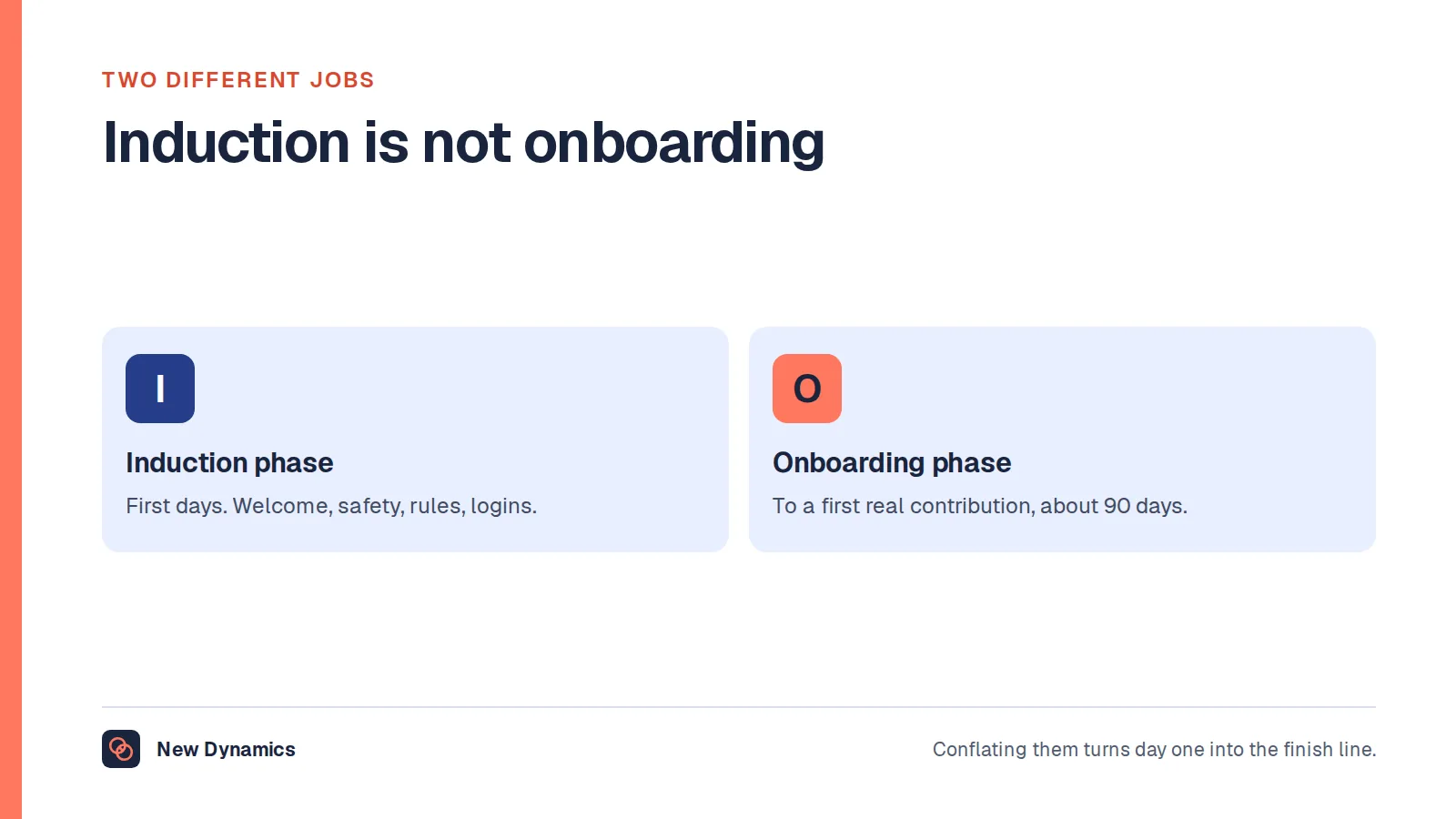
Induction is the British word for the first day or days. It is bounded, broadly the same for everyone, and mostly about safety and permission to operate: where things are, what the rules are, how to get into the systems, what happens when the alarm sounds.
Orientation is the same event in American English, which is why it turns up in so much HR software. If your policy says induction and your system says orientation, they describe one thing. Our post on employee orientation covers that vocabulary in more detail.
Onboarding is the arc around both, from the accepted offer to the point where the person is working to standard and a decision has been made.
Why be strict about it. Induction is cheap, visible and easy to run, so it gets designed, resourced and audited. Onboarding is long and hard to see, so it gets assumed. Use the words interchangeably and you end up with an excellent first day and an undesigned second month, then are surprised when somebody leaves in week nine. The new starter was safe, logged in and legally employed, and nobody had told them what the team was trying to achieve.
Where the process starts and where it ends

It starts when the offer is accepted. Not on the first morning, and not when the signed contract comes back. The gap between acceptance and the start date is the only part of the process where you have time, so every slow item, every queued access request and every piece of equipment with a lead time belongs here. It is also when a decision made in your favour can quietly be unmade: somebody who hears nothing for five weeks has been given five weeks to reconsider.
It ends at a decision, which for most employers is the end of a probation period.
Probation is worth being precise about, because it is not a legal requirement. Acas states: "There's no legal requirement to have a probation period. And they can be any length of time." Acas also notes that "'Day one' employment rights apply during probation periods", listing minimum wage, paid holiday, protection against discrimination, protection against detriment for whistleblowing and the right to join a trade union among them. On the law now coming into force, the same Acas page (last updated 7 October 2026) says: "From 1 January 2027, protection from unfair dismissal will become a right after 6 months of being in a job." Acas adds that employers might want probation to end before someone gets that protection, but that "this does not avoid legal risks". United Kingdom position, general information rather than legal advice.
If you do not run probation you still need an end point, and you have to choose it. Ninety days is the common choice: long enough for a first real contribution in most roles, short enough that people still remember what confused them. The number matters far less than the fact that somebody wrote it down and booked a conversation for it.
The onboarding journey, stage by stage

This is the shape of the onboarding journey and what each stage is for, not a task list. For the tasks, in four phases with an owner against every line, use our employee onboarding checklist.
Stage one: offer accepted to signed
Purpose: keep the decision made, and start everything slow. The person has said yes to a future they cannot see. Make it real: start date and arrival details in writing, the name of the human being who will meet them, and an answer within a day to anything they ask.
The test: has the person heard from somebody who is neither a recruiter nor an automated message?
Stage two: before day one
Purpose: remove every avoidable obstacle. Everything with a queue in front of it belongs here: equipment, accounts, a desk or a vehicle, induction training booked against the real hazards of the role, the first-week plan and the first month's expectations.
The test: can they log in on the first morning without asking for help?
Stage three: day one
Purpose: legally employed, safe, welcomed, clear about what the job is for. Day one is the induction, and induction is a smaller job than people make it. Clear the legal and safety floor, have the person prove their own logins, and hold the conversation about what the team is trying to achieve.
The test: can the new starter explain in their own words what their team is for?
Stage four: the first weeks
Purpose: context, relationships and the first real work. This is where onboarding either becomes a process or evaporates. Context arrives in pieces: who decides what, which meetings need preparation, how work gets approved, what the unwritten rules are. Relationships have to be arranged rather than hoped for.
The test: by the end of the first month, has the person completed something somebody else needed?
Stage five: to the decision
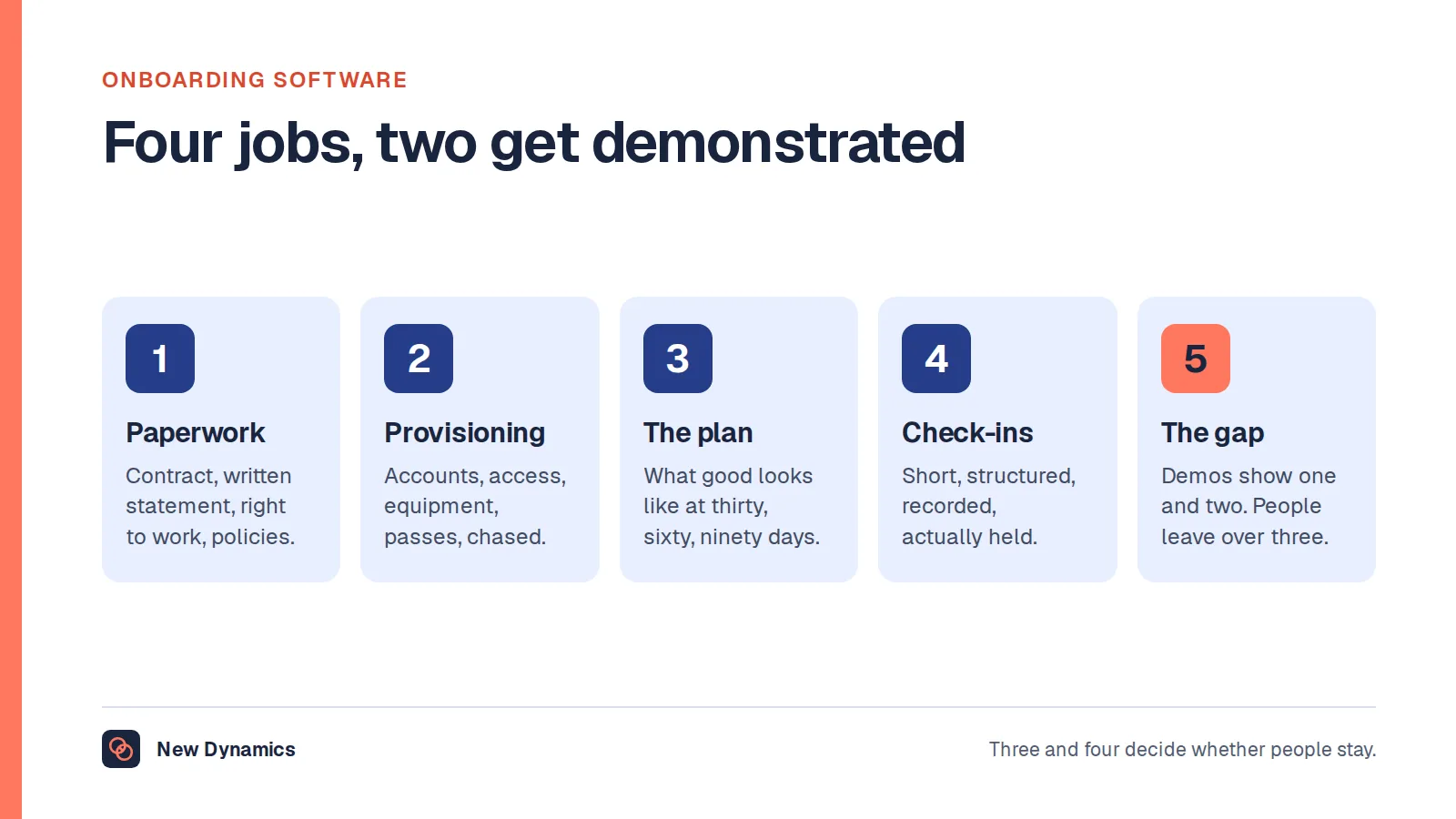
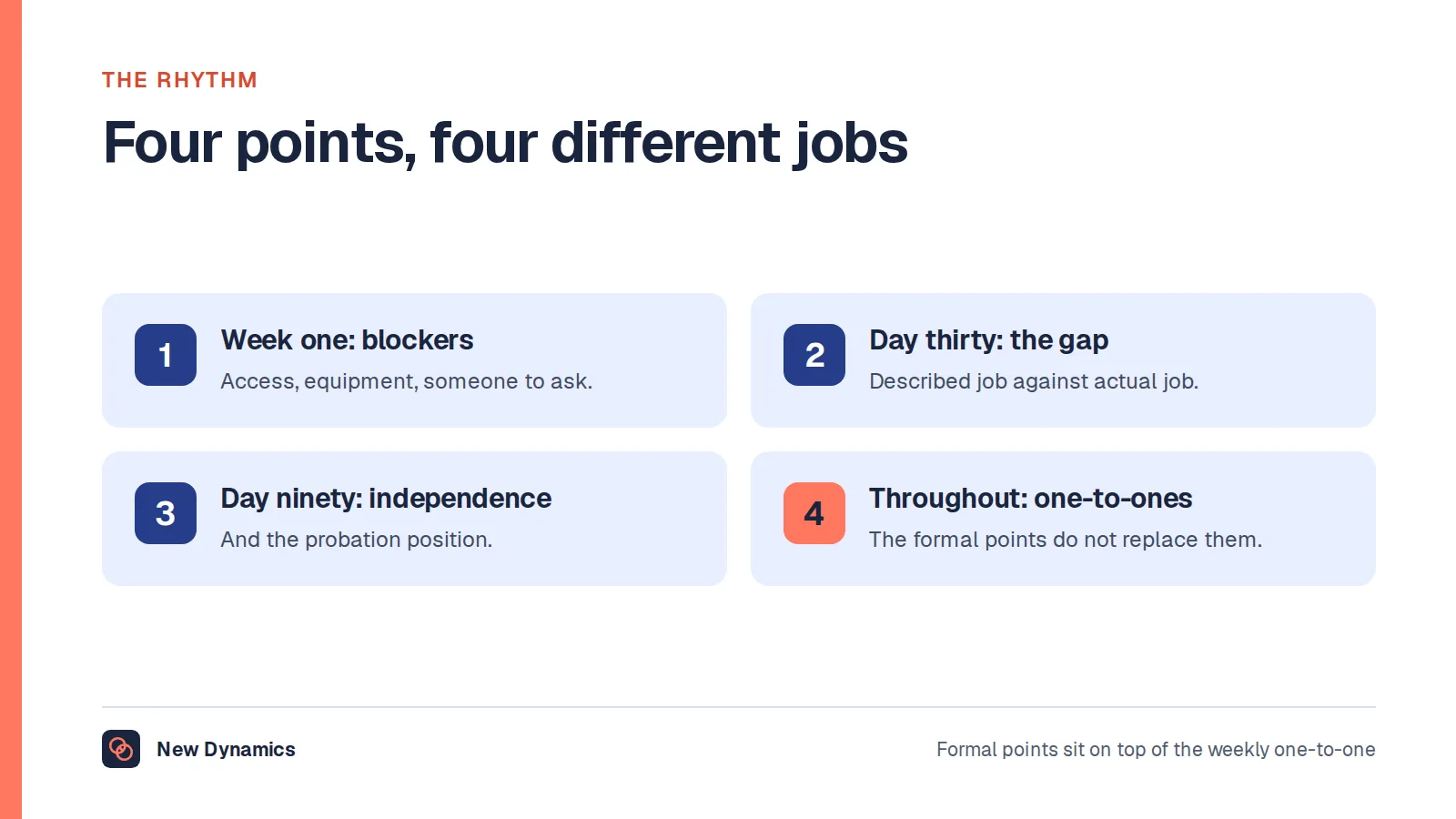
Purpose: performance against expectations, and an outcome said out loud. Most processes never reach this stage: a comparison between what was agreed and what happened, then an explicit result, confirmed, extended or ended. Our post on onboarding check-ins sets out the conversations that get you there, and why day 30 is the right moment to ask what the induction missed.
The test: was there anything in the final conversation the person had not heard before? If so, the earlier stages did not work.
Who owns the process: HR, the manager and three handovers

"Onboarding in HR" and "HR onboarding" ask a sensible question: which part belongs to the HR function and which does not. The split that works is not by task, but by whether the item is the same for everybody.
HR owns the spine. Anything identical for every joiner, defensible afterwards, or tied to a statutory duty: the right to work check, the written statement of employment particulars, payroll and pension, training records, the privacy information, the retention rules, and the data that says whether the process works. HR also owns the calendar, because a reminder is what makes a day 30 conversation happen when the manager is busy, which is always.
The hiring manager owns the content. What the job is for. What good looks like by the end of the first month and the end of probation. Who the person needs to know and why. The first piece of real work. The feedback. The decision. None of that is knowable outside the team.
The failure mode is mutual: the manager believes HR is running onboarding, HR believes the manager is, and the new starter reads the gap as indifference. Name the two halves, and put the manager's part in a diary before the start date.
Three other roles touch it, and the handover matters more than the task:
- Recruiter to manager. The recruiter owns the offer, the start date and the promises. Everything said at interview about the role, the progression and the flexibility is now an expectation somebody else has to meet. A recruiter who does not hand those over has handed over a disappointment with a start date.
- Manager to IT. Accounts, access and equipment should be triggered by the accepted offer, not the start date. The most common first-week complaint anywhere is not culture, it is not being able to get into the system you were hired to use.
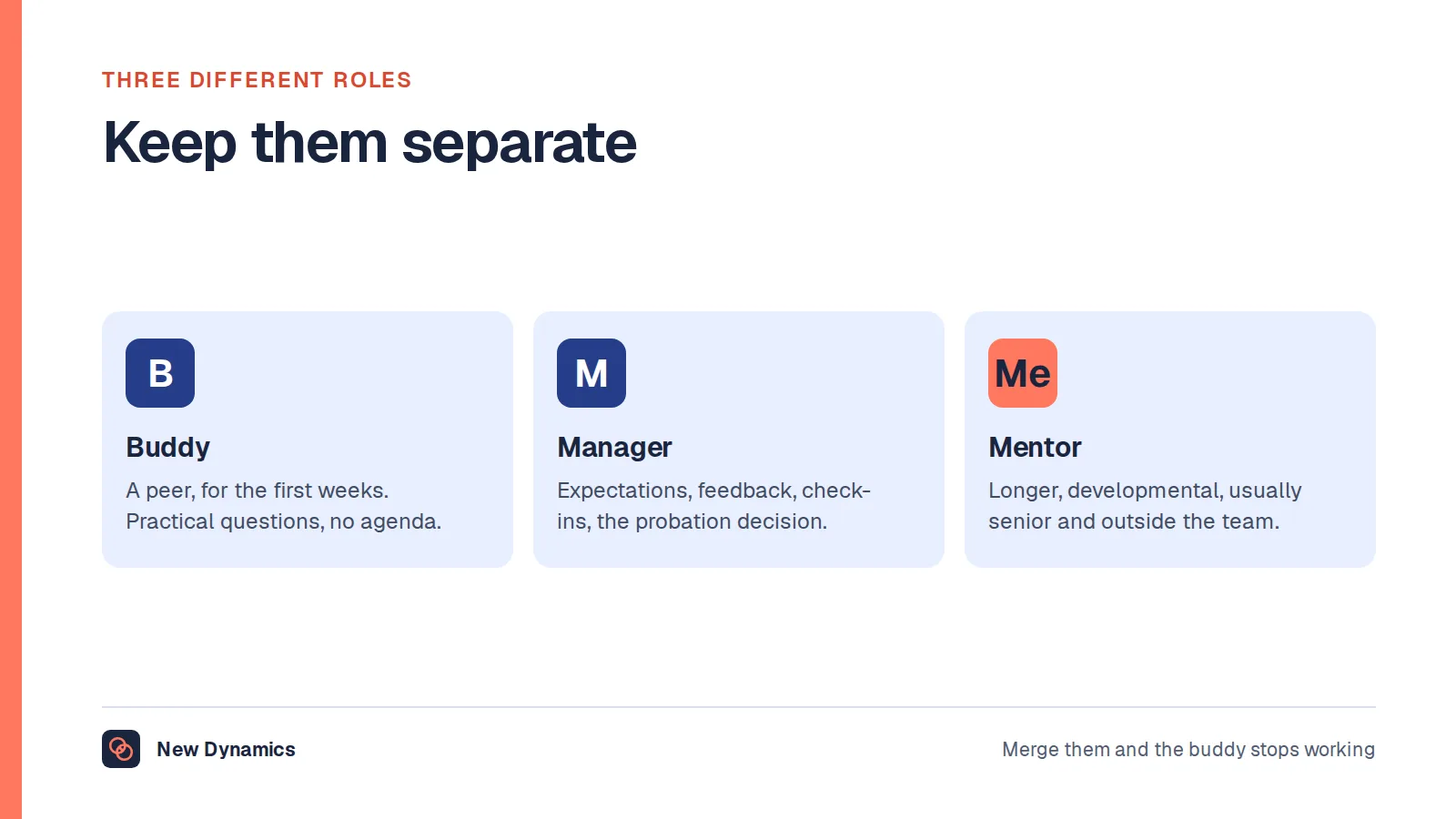
- The buddy, alongside both. A peer who answers what nobody else gets asked: is that meeting optional, what does that acronym mean, is it normal that nobody has replied. Ask rather than assign, and keep assessment away from the role. Our post on the onboarding buddy covers the selection test.
One point gets missed: onboarding is the first lap of performance management, not a separate system. Write a new starter's early objectives in the same form and place as everybody else's, so at the end of probation they continue rather than being replaced by the real ones. See goals and OKRs for the shape they take.
The United Kingdom floor: right to work and the written statement
Most of your process is a choice. Two items are duties with precise timing. United Kingdom position, general information rather than legal advice.
The right to work check, before employment begins. GOV.UK guidance on checking a job applicant's right to work states: "You must check that a job applicant is allowed to work for you in the UK before you employ them." The same guidance tells employers to "keep copies during the applicant's employment and for 2 years after they stop working for you", to "record the date the check was made", and to "Make sure you follow data protection law." It also warns that "You could face a civil penalty if you employ an illegal worker and have not carried out a correct right to work check."
The penalty is published separately. GOV.UK guidance on penalties for employing illegal workers states that you "might get a 'referral notice' to let you know your case is being considered and that you might have to pay a civil penalty (fine) of up to £60,000 for each illegal worker", and that "You will not have to pay the civil penalty if you can show you made the correct right to work checks." Those are the figures on that page as at 5 November 2026. The check is a gate before the start date, not an item on the day one agenda.
The written statement of employment particulars, on or before the first day. GOV.UK guidance states: "An employer must give employees and workers a document stating the main conditions of employment when they start work." On timing it is specific: "The employer must provide the principal statement on the first day of employment and the wider written statement within 2 months of the start of employment." Changes have their own clock: "Employers must tell employees or workers about any changes to the written statement. They must do this within one month of making the change."
The underlying law is tighter still. Section 1 of the Employment Rights Act 1996, "Statement of initial employment particulars", provides that "Where a worker begins employment with an employer, the employer shall give to the worker a written statement of particulars of employment", and that "the statement must be given not later than the beginning of the employment." Read that as on or before the first day, not during the first week.
Two details catch employers out. The principal statement must include the length and conditions of any probation period, so an undefined probation is a drafting problem as well as a management one. And GOV.UK lists further information due on day one, covering "sick pay and procedures", "other paid leave" and "notice periods".
Payroll, pension and the records you are now holding
Below those duties sits an administrative floor, less dramatic and just as easy to get wrong.
Payroll. The employer has to be registered with HMRC and set up for PAYE before it can pay anybody, which GOV.UK sets out as a step in getting ready to employ someone. The payroll record has to exist before the first pay run, not the first payslip query.
Pension assessment. GOV.UK guidance on setting up and managing a workplace pension scheme states that "Employers have to provide a workplace pension scheme for eligible staff as soon as their first member of staff starts working for them", and that you "must enrol and make an employer's contribution for all staff who" are "aged between 22 and the State Pension age", "earn at least £10,000 a year" and "normally work in the UK". Where somebody becomes eligible later through a change in age or earnings, the guidance says "you must put them into your pension scheme and write to them within 6 weeks of the day they meet the criteria". Those are the thresholds on that page as at 5 November 2026.
One timing point interacts with probation. Acas notes that during probation "an employee might not be automatically enrolled on a workplace pension scheme" because "an employer can delay enrolment for up to 3 months", adding that "an employer must enrol an employee if they ask them to". If you postpone, say so: an unexplained gap in contributions reads as a mistake.
Data protection for the records you have just created. By the end of day one you hold identity documents, bank details, a home address, an emergency contact, possibly health information, and a training record. Guidance on collecting and keeping employment records says you "must make sure the personal information you hold is adequate, relevant, and limited to what you need for your purposes", and that "you must identify the minimum amount of personal information you need to hold about your workers, and not hold more information than that".
The Information Commissioner's Office is as clear about telling people. The ICO says employers must tell workers "your purposes for collecting and using their personal information", "your lawful basis", "your retention periods for the information" and "their rights over their information". On timing: "If you are collecting personal information directly from your workers, you must give them the privacy information at the time you collect their information." The privacy information belongs with the form that collects the data, which usually means before day one, not in a handbook issued in week three. Write the retention period beside each record as you create it, including the two-year rule for right to work copies, so deletion is scheduled rather than decided years later. Our employee data protection guide goes further.
What makes someone stay, and what makes them leave early
Most articles about onboarding produce a percentage here. This one will not, because the percentages in circulation have no source you can check: the familiar claims about retention uplifts and productivity gains trace back to vendor surveys and to each other. No United Kingdom official source, ONS, GOV.UK or Acas, publishes a figure for the effect of onboarding quality on retention. Our post on onboarding statistics sets out which onboarding numbers are published and what you have to measure yourself, and the statistics hub holds the sourced figures we use.
Official data does describe the market you are hiring into. The ONS Labour market overview, UK: October 2026 bulletin, released on 20 October 2026, reports that "The estimated number of vacancies in the UK decreased in the latest quarter. Early estimates for July to September 2026 suggest a decrease of 21,000 (2.9%) to 691,000, compared with April to June 2026." The bulletin adds that "Feedback from our Vacancy Survey continues to suggest that smaller firms may not be recruiting because of increases in labour costs". A vacancy you have already paid to fill is expensive to have to fill again.
What can be said without inventing a number is what early leavers tell employers when anyone asks. The reasons cluster in four places.
- The job is not the job. The role described at interview and the role experienced in month two differ enough that the person feels misled. A recruitment handover problem showing up as an onboarding problem.
- Nobody said what good looks like. Without expectations a new starter cannot tell whether they are doing well, so they assume the worst. The cheapest to fix and the most often missed.
- No access and no progress. Weeks waiting for a system, a permission or a decision, which reads as an employer that does not care whether they contribute.
- Nobody to ask. The manager is busy, there is no peer in the role, and every question costs more than the answer is worth.
All four are discoverable by asking, and all four stop being discoverable after about six weeks, because by then the person has adjusted and no longer remembers what was strange. Hence a structured conversation at around 30 days.
Onboarding flows: remote, hybrid and the internal mover
Onboarding flows is a useful phrase, because most employers need more than one. The duties are identical for every joiner. The route through the process is not.
Remote and hybrid
Three things stop working when nobody shares a room, and each has to be replaced deliberately.
Overhearing. In an office a large share of induction is absorbed rather than taught: how people talk to each other, what is urgent, who is annoyed about what. None of it reaches a remote starter. Replace it by writing down the unwritten rules: core hours, what counts as urgent, which channel means what, and how to signal that you are stuck.
Incidental introductions. In a building they happen by accident. Remotely every one has to be a calendar invitation with its purpose stated in it, or the meeting becomes twenty awkward minutes.
Visible stuckness. A manager can see somebody struggling across a desk. Remotely the signal is absence, which looks like quiet competence. Replace it with short, frequent contact in week one rather than one long weekly meeting. For hybrid, add a fourth: an early first in-person day, with the floor populated.
Two administrative points are easy to drop when nobody hands over paper. The principal statement still has to be provided on or before the first day, issued electronically with a date you can show, and the privacy information still has to accompany the form that collects the data. Our guide to onboarding software covers the tooling.
Someone promoted or moved internally
The internal mover is the most reliably under-served person in any process, because the organisation reasons that they already know how things work. They know how the old job works, which is the problem.
Drop what is about the organisation rather than the role: the general induction, the policy tour, the bank details, the right to work check (unless their permission to work is time-limited and a follow-up check is due). A ten-year employee in a corporate welcome session learns that the process is not really about them.
Keep everything about the new role: what this job is for, what good looks like by the end of the first month, who they now need to know, what decisions are theirs, and what they have to stop doing. The last item causes the most damage when it is skipped: a promoted person still carrying the old job has been set up to do both badly.
Add three things an external joiner does not need. A clean handover of the previous role, with a date on it. A reset with people who knew them in the old role, especially where they now manage former peers. And a written variation of terms: GOV.UK guidance says employers must tell employees or workers about any changes to the written statement "within one month of making the change", and a promotion that changes pay, hours, place of work or job title is such a change. United Kingdom position, general information rather than legal advice.
Internal moves rarely carry probation, so the decision stage has to be invented: a conversation at about 90 days about whether the new role is working. Nobody books it, because the person is not new.
How to tell whether your onboarding process works
Most onboarding reporting measures whether the process ran, not whether it worked. A completion rate tells you tasks were closed by the people whose job it is to close tasks. Necessary, and not evidence.
Time to a first meaningful contribution. Define it per role before the start date, in one sentence somebody else would recognise as true, then record how long it took. The definition is the hard part: a role whose first contribution nobody can describe cannot have its onboarding designed.
Where people stall, not how much they complete. Look at the stage, not the percentage. If three consecutive joiners lost a week waiting for the same system access, you have found a fixable fault that a completion figure of 94% hides.
Decisions made on time, without surprises. Count two things at the end point: whether an explicit decision was recorded, and whether anything in it was new to the person. The second should be zero, and when it is not the fault is upstream.
Whether anything changed. Ask each joiner at around 30 days what was missing, change one thing, and tell the next joiner what changed because of the last one. A process that visibly improves is the strongest signal a new team can get, and the only honest proof the measurement is being used.
Then the benefits of effective onboarding stop being a claim: fewer weeks lost to waiting, no surprises at the probation decision, and objectives that survive into the normal cycle.
Frequently asked questions
What is onboarding?
Onboarding is the process by which a person who has accepted a job becomes a working member of the organisation: legally employed, equipped, informed, connected to the people they need, and able to work to the standard the role expects. It runs from the accepted offer to a named decision, usually the end of probation.
What does onboarding mean in HR?
In HR the word describes the whole process rather than the first day, and the function owns the part that must be the same for everyone: the right to work check, the written statement of employment particulars, payroll and pension, training records, privacy information and retention. The hiring manager owns the content of the job.
What is the difference between induction, orientation and onboarding?
Induction and orientation are the same event in two dialects, British and American: the first day or days, covering the welcome, health and safety, the rules of the place and system access. Onboarding is the arc around them, from accepted offer to working to standard. Induction is part of onboarding, not a shorter word for it.
How long does the onboarding process last?
From the accepted offer to the end point you set, which for most employers is the probation decision and commonly lands at about 90 days. Acas says there is no legal requirement to have a probation period and that they can be any length, so the duration is yours. What matters is writing the end point down before the start date.
What must a UK employer give a new starter on their first day?
GOV.UK guidance says the employer must provide the principal statement of employment particulars on the first day of employment, with the wider written statement following within two months. Section 1 of the Employment Rights Act 1996 puts it as not later than the beginning of the employment. Information about sick pay, other paid leave and notice periods is also due on day one. General information, not legal advice.
What are the benefits of effective onboarding?
The observable ones are practical: fewer first weeks lost waiting for access, a new starter who can say what good looks like, early objectives that carry into the normal cycle, and a probation decision with no surprises in it. Be sceptical of quoted retention and productivity percentages, because no official United Kingdom source publishes them.
Your next step: give the process a start, an end and named owners
- Write your definition in one sentence, with a start point (offer accepted) and an end point (the probation decision, or a date you choose).
- Name an owner for each part of your next joiner's process: HR, the hiring manager, the recruiter, IT and a buddy, plus the three handovers between them.
- Check the two duties with dates on them: the right to work check before employment begins, and the principal statement issued on or before the first day with the date recorded.
- Book the day 30 conversation and the end-point decision before the start date, because those are the two that get dropped.
- Ask your last three joiners what was missing, and change one thing.
For the task list inside this process, use our employee onboarding checklist or the editable 90-day onboarding checklist template. For the whole first ninety days in one document, read and download our employee onboarding guide. The guide is free to read, and the PDF uses our short download form.
Want the tasks, the early goals and the 30-day and probation conversations on one path, with an owner against each stage? Book a New Dynamics demo and bring the process you run today. You can also email contact@new-dynamics.com.