TL;DR
- Encouragement works when it is specific, sincere and timely. “You've got this” is kind. “You handled a harder client than this in March” is convincing.
- The 60 messages here are original and grouped by situation: a hard week, a mistake, a big moment, a new starter, self-doubt, a setback, a heavy workload, a return to work, a whole team and a manager.
- Do not cheer people past a real problem. Listen first, avoid “at least” and “cheer up”, offer practical help, and point a colleague who is struggling towards proper support.
A colleague has had a bruising week, made a visible mistake or is about to walk into the biggest presentation of their year. You want to say something, and every phrase that comes to mind sounds like a greetings card.
This article gives 60 encouraging words for coworkers, grouped by situation, that you can adapt in a message, a card or a conversation. It also explains what makes encouragement land, and what to avoid saying.
If you want appreciation to be part of everyday work, where the whole team can see it, explore New Dynamics employee recognition.
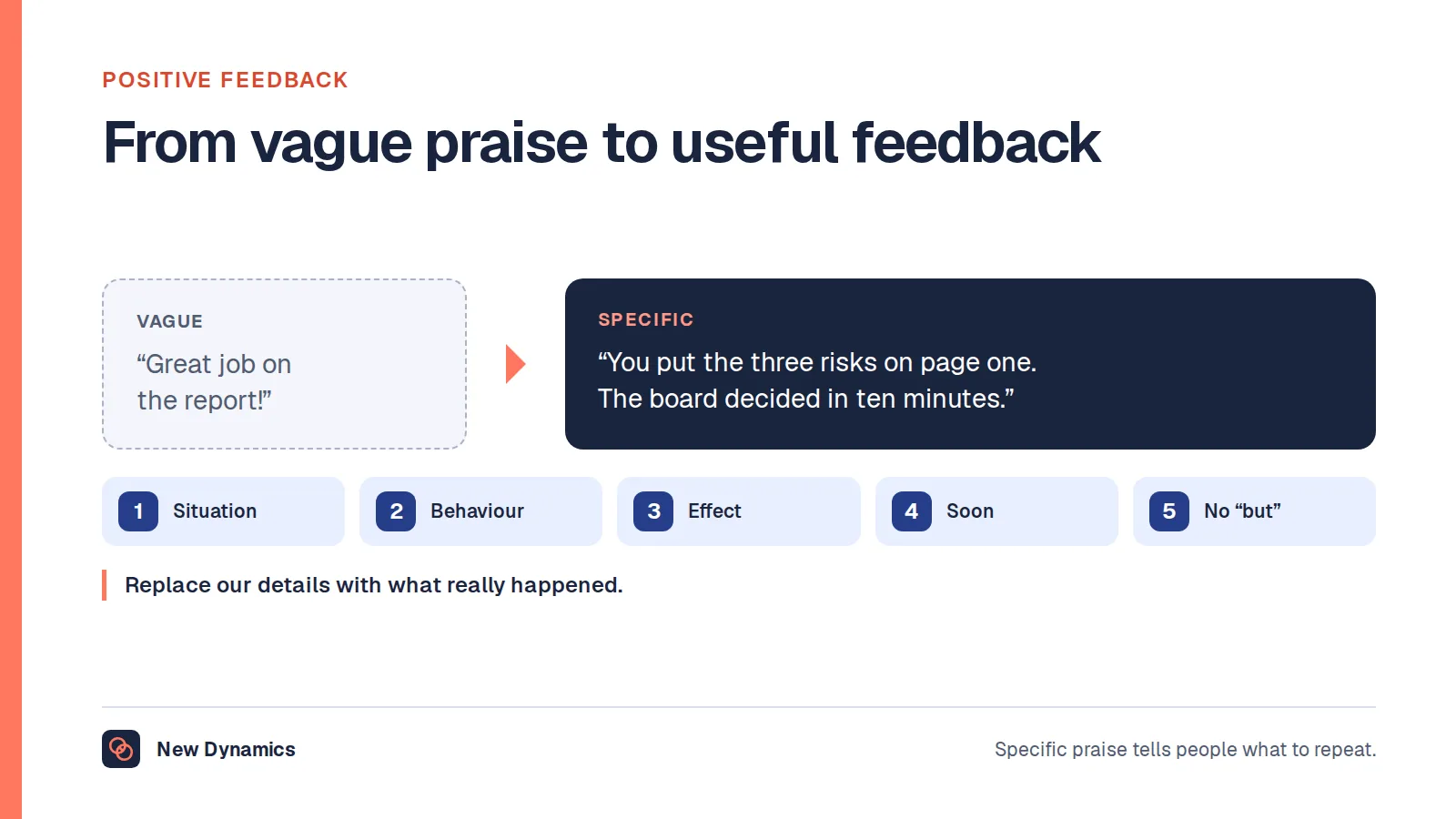
About these messages: all 60 were written by the New Dynamics editorial team. Use and adapt them freely. Replace our details with real ones, because the real detail is what makes encouragement believable.
Why a few words matter
Kindness helps the giver as well as the receiver. The NHS includes giving to others among its five steps to mental wellbeing. It says research suggests that acts of giving and kindness can help by “creating positive feelings and a sense of reward”. Its examples include “saying thank you to someone for something they have done for you” and asking colleagues how they are “and really listening to their answer”.
Support from colleagues is part of a healthy workplace. The UK Health and Safety Executive's Support standard for managing work-related stress expects that “systems are in place to enable and encourage employees to support their colleagues”.
It is quick. Most of the messages below take less than a minute to send. The person may remember them for years.
What makes encouragement land
Five qualities separate encouragement that helps from encouragement that slides past.
- Specific. Refer to something real that the person has done or can do.
- Sincere. Say only what you believe. People can tell.
- Timely. The night before the presentation is better than the week after.
- About them. Resist the urge to tell your own story.
- Followed by help. “What can I take off your plate?” is worth more than any adjective.

60 encouraging words for coworkers
After a hard week
- “That was a rough week, and you kept showing up. I noticed.”
- “You handled more this week than most people see in a month. Please rest this weekend.”
- “None of what went wrong this week was down to you. The way you dealt with it was.”
- “I know this week took a lot out of you. What can I pick up on Monday?”
- “You stayed calm when everything around you did not. It steadied the rest of us.”
- “A bad week is not a bad job, and it is certainly not a bad you.”
After a mistake
- “Everyone here has made that mistake, or a bigger one. What matters is that you flagged it quickly, and you did.”
- “You owned it straight away. That took courage, and it made it easy to fix.”
- “One error in a year of careful work is a very good record.”
- “I trust you just as much today as I did yesterday.”
- “You found it before the customer did. That is the system working.”
- “Tell me what you need to put it right, and then let it go. We have.”
If you are the person's manager, our negative feedback examples show how to discuss the mistake itself fairly.
Before a big moment
- “You know this material better than anyone who will be in that room.”
- “You have prepared properly. Now trust the preparation.”
- “Remember the March pitch? You were nervous then too, and you were excellent.”
- “They invited you because they want to hear what you think.”
- “Whatever happens in there, I am proud to work with you.”
- “Breathe, go slowly and look at the friendly faces. I will be one of them.”
For a new starter
- “Nobody expects you to know everything yet. Ask as many questions as you like.”
- “You are picking this up faster than I did.”
- “Your question in the meeting was a good one. We had stopped asking it.”
- “It takes months to feel at home in a new job. You are well ahead of schedule.”
- “We hired you because of what you bring. Do not feel you have to become a copy of us.”
- “If you are ever unsure who to ask, ask me.”
For someone doubting themselves
- “You see your own mistakes in close-up and everyone else's from a distance. The rest of us see how good your work is.”
- “Feeling out of your depth usually means you are learning. It does not mean you do not belong.”
- “You got this role because you earned it. Here is one example of why.”
- “I have watched you solve harder problems than this one.”
- “You do not need to be certain to be capable.”
- “Ask three colleagues what you do well. I think the answers will surprise you.”
See our growth mindset examples for more ways to reframe doubt.
After a setback or a disappointment
- “I am sorry. I know how much you wanted that, and I thought you deserved it.”
- “This decision does not change what you are capable of.”
- “Take the time you need to be disappointed. When you are ready, I would like to help you plan the next step.”
- “The work you put into that bid was excellent. The outcome does not take that away.”
- “A no today is not a no for ever. Let's find out what would make it a yes.”
- “You handled the news with more grace than I would have managed.”
For a heavy workload
- “You are carrying a lot. Which piece can I take?”
- “It is fine for some things to be good enough this month.”
- “You do not have to do it all today. What are the two things that matter most?”
- “Let's tell the team what you are dealing with, so that people stop adding to it.”
- “Working late every night is not sustainable. Would it help if we talked to your manager together?”
- “You have kept the quality up through all of this. I do not know how, and I am grateful.”
If the workload never eases, encouragement is not the answer. Our guide to team morale explains what managers should fix.
For someone returning to work
- “It is really good to have you back. Take it at your own pace.”
- “Nothing here is so urgent that it cannot wait for you to settle in.”
- “We missed you, and we managed. Both are true.”
- “You do not owe anyone an explanation. Tell us as much or as little as you like.”
- “I have kept notes on what you missed. Shall we go through them over a coffee?”
- “If a day feels too much, say so. We will sort it out.”
For a whole team
- “This quarter asked a lot of you, and you delivered it together. Thank you.”
- “I would not swap this team for any other in the building.”
- “We did not hit the number, and I saw how hard every one of you worked. We will learn from it and go again.”
- “The way you covered for each other this month is what a team is for.”
- “You are better at this than you were a year ago. I can show you the evidence.”
- “Look at what you have finished, as well as what is left to do.”
Our teamwork quotes and workplace quotes offer short lines for team messages.
For your manager
Managers hear little encouragement, and they need it too.
- “That was a hard decision, and you explained it honestly. It helped.”
- “Thank you for backing me in that meeting.”
- “I can see how much pressure you are under. The team notices that you shield us from it.”
- “The way you handled that difficult conversation taught me something.”
- “You do not have to have every answer. We trust you anyway.”
- “I like working for you. I thought you should know.”
See our manager feedback examples for more.
What not to say
Well-meant words can dismiss what the person is feeling. Avoid these.
| Avoid | Why | Try |
|---|---|---|
| “Cheer up, it could be worse.” | It tells them that their feelings are wrong | “That sounds hard. What would help?” |
| “At least you still have a job.” | “At least” shrinks the problem | “I am sorry. That is a real disappointment.” |
| “Everything happens for a reason.” | It explains away something that hurts | “I do not know why this happened. I am here.” |
| “I know exactly how you feel.” | You probably do not, and it turns the focus to you | “I can only imagine. Tell me about it, if you want to.” |
| “You'll be fine.” | It closes the conversation | “I believe in you, and I will help.” |
| “Just stay positive.” | It asks them to hide what they feel | “It is fine not to feel positive about this.” |

How to write an encouraging message in six steps
- Notice. Pay attention to who has gone quiet, who is stretched and who has a big moment coming.
- Name what you see, without judging it: “It looks as though this week has been heavy.”
- Say what you believe about them, with one piece of evidence.
- Offer something specific. A task you can take, a coffee or a practice run.
- Keep it short. Two or three sentences are enough.
- Follow up. Ask again next week. One message is kind. Two show that you meant it.

When encouragement is not enough
Kind words help with ordinary pressure. They are not a treatment for serious distress, and they do not fix a bad system.
- If a colleague seems to be struggling with their mental health, listen, and encourage them to use proper support: their GP, your employee assistance programme if you have one, or a trusted manager. You do not need to solve it yourself.
- If the cause is workload, bullying or unfair treatment, encouragement without action can feel like being told to cope. Help them raise it, or raise it yourself. See our guide to workplace relationships.
- If you are a manager, fix what you can control. Our article on the employee wellness program covers the organisation's part.
Frequently asked questions
What are some encouraging words for a coworker?
Try: “That was a rough week, and you kept showing up. I noticed.” Or: “You know this material better than anyone who will be in that room.” The best lines mention something real about the person and, where possible, come with an offer of help.
How do you encourage a coworker who is struggling?
Listen first, without rushing to fix things. Name what you see, say what you believe about them with a real example, and offer specific help, such as taking a task. If they seem seriously unwell, encourage them to use proper support.
What do you say to a colleague who made a mistake?
Reassure them about their standing, and recognise how they handled it: “You owned it straight away. That took courage, and it made it easy to fix.” Leave the discussion of what went wrong for a separate, calm conversation.
What should you not say to someone having a hard time at work?
Avoid phrases that dismiss the feeling, such as “cheer up”, “at least”, “everything happens for a reason”, “just stay positive” and “I know exactly how you feel”. Acknowledge that it is hard, and ask what would help.
How do you write a short encouraging note?
Keep it to two or three sentences. Say what you have noticed, say one specific thing that you admire or believe about the person, and offer help or good wishes. Handwritten notes and private messages both work well.
Can I use these messages freely?
Yes. All 60 were written by the New Dynamics editorial team. You can use and adapt them in cards, messages and conversations without asking permission or adding a credit.
Your next step: send one message today
- Think of one colleague who is stretched, doubting themselves or facing a big moment.
- Pick a message from the list, and change the details to fit.
- Add one specific offer of help.
- Send it before the end of the day.
For ways to make appreciation specific, timely and fair across a team, read and download our employee recognition guide. The guide is free to read, and the PDF uses our short download form.
Want recognition and feedback to be part of everyday work? Book a New Dynamics demo and bring your team's current habits. You can also email contact@new-dynamics.com.