TL;DR
- Most apprentices are not school leavers. The Department for Education and Department for Work and Pensions release of 16 July 2026 reports that for August 2025 to April 2026 in England, under 19s were 20.6% of starts, 19 to 24 year olds 27.1% and those aged 25 and over 52.4%. An existing employee can start one.
- The 20 per cent off the job training rule has gone, and one GOV.UK page has not caught up. For starts from 1 August 2025 each standard publishes its own minimum volume of hours, and the funding rules state that no programme must fall below 187 hours of evidenced delivery.
- Who pays depends on the apprentice's age at the start. For starts from 1 August 2026 the government funds all the training and assessment costs, up to the funding band maximum, for an apprentice aged 16 to 24 where the employer does not pay the levy or has run out of levy funds.
An apprenticeship is not a course you buy, and it is not an ordinary job with study bolted on. It is a job tied to a published occupational standard, with a legal minimum length, a floor under the training hours, and an assessment at the end that your own managers do not mark. Most of the duties sit with you rather than with the college.
The paperwork decides whether the funding survives an audit. See how New Dynamics onboarding keeps a new starter's checklist, owner and completion dates in one record, which is the evidence an apprenticeship needs for two or three years.
Apprenticeships are devolved, so everything below is the position in England. Scotland, Wales and Northern Ireland run separate systems with their own rules. This is general information and not legal advice.

What makes it an apprenticeship and not a job with training
Three sources draw the line.
A published standard. Section A1(3) of the Apprenticeships, Skills, Children and Learning Act 2009 requires an agreement for the apprentice to "work for another person for reward in an occupation for which a standard has been published", plus training to achieve that standard.
New learning, not getting up to speed. Regulation 3 of the Apprenticeships (Miscellaneous Provisions) Regulations 2017 defines off the job training as training received "for the purpose of achieving the published standard", against on the job training received "for the sole purpose of enabling the apprentice to perform the work". An induction teaching your systems is the second thing.
A gap to fill. Paragraph 63 of the apprenticeship funding rules for 2026 to 2027 makes the provider evidence "that the individual requires significant new knowledge, skills and behaviours in order to be occupationally competent in their job role".
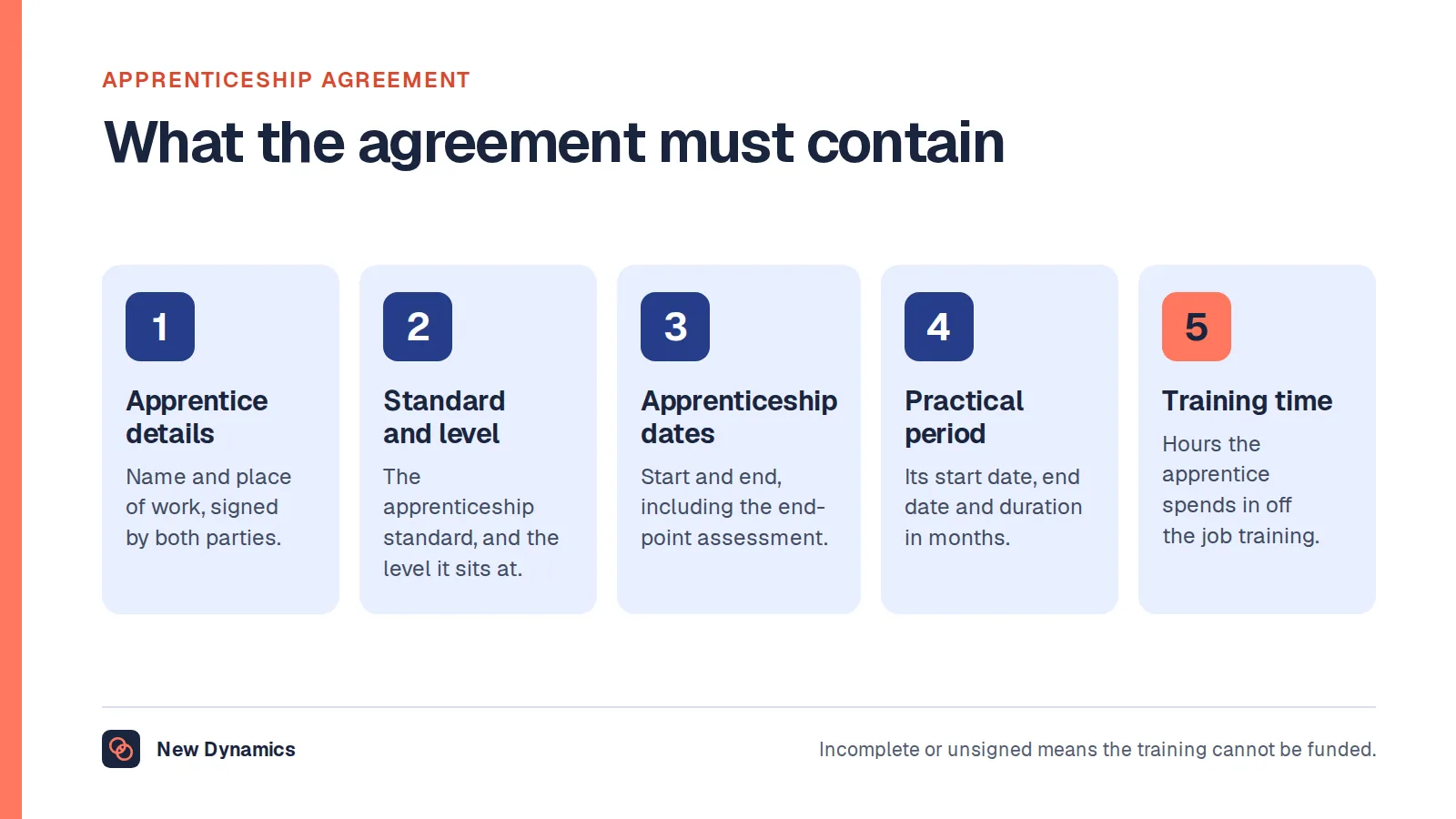
Our post on the apprenticeship agreement covers the employment relationship and the two documents that create it. You also need an ordinary employment contract.
Standards, levels and what they are equivalent to
GOV.UK's guidance on how to take on an apprentice, updated 8 October 2026, says "Apprenticeships are designed by groups of employers with the support of Skills England", and each one "relates to a specific occupation".
| Apprenticeship | Level | Equivalent educational level |
|---|---|---|
| Foundation and Intermediate | 2 | GCSE |
| Advanced | 3 | A level |
| Higher | 4, 5, 6 and 7 | Foundation degree and above |
| Degree | 6 and 7 | Bachelor's or master's degree |

An apprenticeship is not automatically a qualification. GOV.UK says only that "Some apprenticeships include a work-based qualification (from Level 2 up to degree level)", and any mandatory one must be finished before the final assessment.
Higher levels are where the growth is. The apprenticeships statistics release of 16 July 2026, from the Department for Education and the Department for Work and Pensions, reports that in England for August 2025 to April 2026 "Higher apprenticeship starts increased by 13.6% to 126,660", on provisional figures. See also the statistics hub.
Who can apply for an apprenticeship
There is a minimum age and no general maximum. GOV.UK says an apprentice should "be 16 years old or older by the end of the summer holidays" and "not be in full-time education". Paragraph 30.1 of the funding rules puts it as a date: the apprentice starts "after the last Friday in June of the school academic year (September to August) in which they have their 16th birthday."
The other funding conditions are the right to work in England, a relevant role, enough paid hours to finish, no student loan covering the same training, inclusion in the PAYE scheme on your apprenticeship service account, and paragraph 30.5, which requires "at least 50% of their working hours in England over the duration of the apprenticeship", a rule that "also applies to remote and hybrid workers".
Existing employees are eligible, and this is the most under-used part of the system. GOV.UK states it twice: "Apprentices can be new or current employees" on Employing an apprentice, and "Apprentices can be new employees or current employees already working for you" in the detailed guidance. Paragraph 68.2 will fund an apprenticeship "at the same or lower level than a qualification they already hold" where it delivers "significant new skills" and the content is "materially different".
The age mix makes the point. Of the 308,770 starts in England for August 2025 to April 2026, the same release reports that under 19s accounted for "20.6% of starts (63,530)", with "the share for 19-24 was 27.1% and for 25+ was 52.4%". Foundation apprenticeships are the exception to the no upper limit rule: paragraph 160 funds them only for apprentices aged 16 to 21 at the start, or 22 to 24 in defined circumstances.
How long it has to run
Regulation 5(1) of the 2017 Regulations now reads "the practical period must not be less than 8 months", substituted for 12 months on 1 August 2025. Paragraph 77 of the funding rules turns that into a dated test: an apprentice "who starts their training on 1 August 2026 must still be receiving training on 31 March 2027". Paragraph 77.2 makes it a gate: "The end-point assessment can only be taken after the minimum duration has been met."
Eight months is a floor, not a plan. GOV.UK's range is "from 8 months to 6 years to complete, depending on the type and level". Paragraph 77.3 adds the assumption behind it, that the minimum "is based on the apprentice working at least 30 hours per week, including any off-the-job training they undertake". Fewer hours or a zero hours contract "must not be a barrier", but part time apprentices take longer.
Off the job training: hours, not 20 per cent
This is the figure most likely to be wrong in anything you read, including some of what the government still has online.
The old rule was a percentage. The Department for Education's off the job training guidance, updated 4 August 2026 and aligned to the 2026 to 2027 funding rules, uses the past tense: "the minimum requirement was that an apprentice had to spend at least 20% of their normal working hours (capped at 30 hours per week for funding purposes only) ... on off-the-job training."
For starts from 1 August 2025, the same guidance sets out what replaced it:
- "a minimum volume of off-the-job training hours has been published for each apprenticeship standard, which replaces the need for the provider to calculate the minimum requirement based on a percentage of the apprentice's duration", and
- "the delivery link between off-the-job training and duration has been removed, giving providers the flexibility to deliver the required training hours over any duration, subject to meeting the minimum duration requirement of 8 months."
There is still a hard floor. Paragraph 86.2 of the funding rules is one line: "No programme must fall below 187 hours of evidenced delivery." Prior learning can cut the published figure for an individual but not below that. The guidance notes that 187 hours "is 20% of 8 months", so the floor is the old arithmetic kept as a backstop, not the new requirement.
What counts is a four part test: the activity must teach "new knowledge, skills, and behaviours", be "directly relevant to the apprenticeship standard", "take place in the apprentice's normal working hours", and "exclude ineligible activities (such as initial assessment and English and maths)". Lectures, shadowing, mentoring, learning support, assignments and revision all count. Compiling a portfolio does not, because "it doesn't deliver new skills", and nor does a generic induction. Where training happens outside working hours by exception, "the apprentice must agree to this and be compensated", and "The majority of the programme must not be delivered in this way".
Where two live GOV.UK pages disagree
GOV.UK's employer guidance says the minimum volume "will be published on the front of each apprenticeship standard". GOV.UK's citizen guide Become an apprentice, last updated 14 October 2024, still tells apprentices they will "get time for training and study related to your role (at least 20% of your normal working hours)".
Both are GOV.UK. For a funded apprenticeship in England the funding rules govern, because they are the conditions attached to the money and what a funding audit tests. Treat the 20 per cent as a rule of thumb about release time, and take the requirement from the published hours on your standard.
The end point assessment, and the gateway before it
Training and assessment are deliberately separated. GOV.UK describes the end point assessment as one "which confirms that they are occupationally competent", "conducted by independent assessment organisations". The provider, or you if you take the role on, must contract with an assessment organisation "at least 6 months before the apprenticeship reaches gateway", and its cost "should not exceed 20% of the funding band maximum".
Gateway is the readiness decision and the employer makes it. GOV.UK's gateway and resits guidance requires the apprentice to "display occupational competency", "have evidence of or pass functional skill levels in English and maths", "complete mandatory training", "take any qualifications set out in the standard" and "meet the minimum duration". Resits are your bill: they are "ineligible costs" and apprentices "are not responsible for resit costs".
The provider, the funding bands and how the money flows
You do not deliver the training. GOV.UK: "You and your training provider must agree a price for the total cost of each apprenticeship, including the cost of end-point assessment." That price sits inside a cap. Skills England's guidance on allocating apprenticeship funding bands, published 25 June 2026, states that "All apprenticeships are allocated to one of 30 funding bands, which range from £1,500 to £27,000", and that above the band "employers need to pay the difference with other funds".
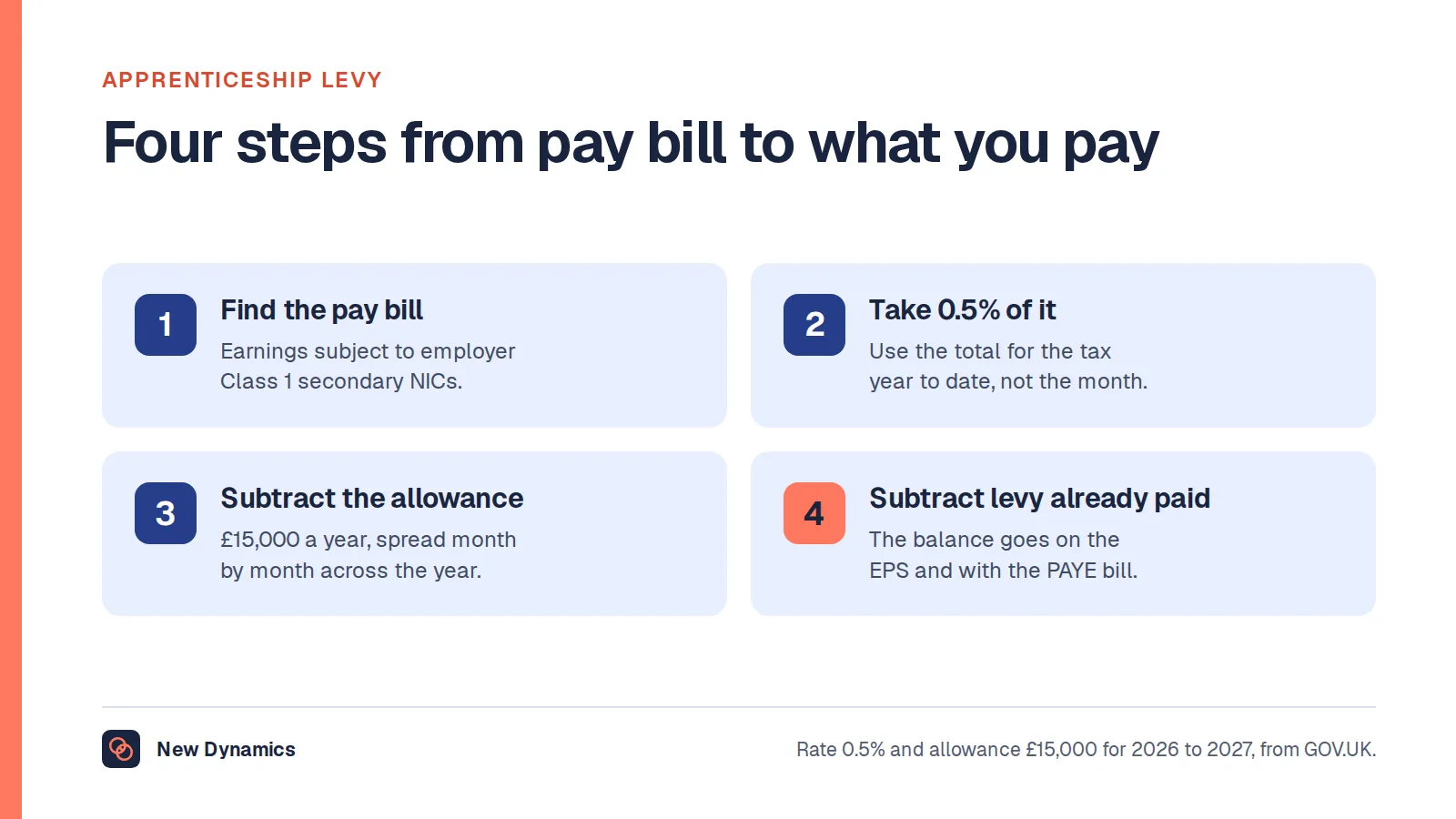
Everything runs through an apprenticeship service account, because "All employers must use the apprenticeship service to access apprenticeship training". Levy payers spend the account balance; employers below the threshold reserve funds instead, up to three months before the expected start. You pay the levy if your annual pay bill is more than £3 million, and our post on the apprenticeship levy covers the charge, the allowance and the expiry date on unspent funds.
Where you are not spending levy funds, paragraphs 213 to 215 set the split for starts on or after 1 August 2026, and it turns on the apprentice's age at the start of training:
- Levy payer with insufficient funds, apprentice 25 or over. "the government will fund 75% of the training and assessment costs (up to the funding band maximum)", so you co-invest 25 per cent.
- Non-levy employer, apprentice 25 or over. The government "will fund 95% of the training and assessment costs", so you pay 5 per cent.
- Either, apprentice aged 16 to 24 at the start. The government funds "all of the apprenticeship training and assessment costs, up to the funding band maximum", and the provider "must not request any employer contribution".

Paragraph 133 adds a hiring payment of £2,000 for employers who do not pay the levy, for an apprentice aged 16 to 24 whose practical period starts on or after 1 October 2026 and who "has not been employed by that employer for more than 90 days before their practical period start date". That condition rewards a new hire, not nominating someone who has been with you a year.
What you have to pay
Wages are yours in full, with no funding attached. Paragraph 75: "Every apprentice must be paid a lawful wage for the time they are in work and in training (active learning)." GOV.UK adds the duty to "pay them for the time they are in work and in off-the-job training".
GOV.UK's National Minimum Wage and National Living Wage rates publishes the apprentice rate alongside the age rates, and the rates change on 1 April every year:
| From | 21 and over | 18 to 20 | Under 18 | Apprentice |
|---|---|---|---|---|
| April 2026 | £12.71 | £10.85 | £8 | £8 |
| April 2027 | £13.21 | £11.27 | £8.31 | £8.31 |
The apprentice rate is narrower than most employers assume. It applies only to apprentices "aged under 19" or "aged 19 or over and in the first year of their apprenticeship", and they move to the rate for their age once they are both "aged 19 or over" and have "completed the first year". GOV.UK's example: an apprentice aged 21 in the first year is entitled to £8 an hour, and the same apprentice after the first year to £12.71.
Two timing rules come from the funding rules. Paragraph 75.1: the employer "must only use the apprentice rate of the national minimum wage from the apprenticeship start date and not before". Paragraph 75.2: where someone permanently withdraws, "the employer must not continue to use the apprentice rate", though a break in learning is different. Paragraph 76.1 requires the provider to withdraw a learner where it is told the apprentice is not being paid in line with the National Minimum Wage Regulations.
Paragraph 69 requires a contract of employment "that is long enough for the apprentice to complete the apprenticeship, including the end-point assessment". If you use a fixed term, see our post on fixed-term contracts. The apprenticeship agreement is separate from both the contract and the training plan, and all three must be in place.
Scotland, Wales and Northern Ireland
GOV.UK states the limit plainly: "This guidance is for employers in England. There's a different way to employ an apprentice in Scotland, Wales or Northern Ireland." Where an apprentice fails the 50 per cent rule, paragraph 30.5.1 says "The provider must make separate arrangements with the relevant devolved administration". The levy is collected across the United Kingdom, but the apprenticeship service, the standards, the funding bands and the rules above are the English system.
Frequently asked questions
How do apprenticeships work for an employer?
You pick an occupational standard matching a real job, agree the training, price and assessment organisation with a provider, check your funding, appoint a new or existing employee, then sign an apprenticeship agreement and a training plan. The apprentice works and trains for at least eight months, taking the off the job hours published on the standard inside normal working hours, before you pass them through gateway to an independent end point assessment. You pay their wages throughout. General information for England, not legal advice.
Who can apply for an apprenticeship?
Anyone aged 16 or over who is not in full-time education, with the right to work in England, in a relevant job, spending at least half their working hours in England. GOV.UK words the age test as being "16 years old or older by the end of the summer holidays". There is no upper age limit in general, and 52.4 per cent of starts in England for August 2025 to April 2026 were apprentices aged 25 and over.
Can an existing employee do an apprenticeship?
Yes. GOV.UK states that "Apprentices can be new or current employees". The test is not length of service but what the initial assessment shows: paragraph 63 of the 2026 to 2027 funding rules requires evidence that the person needs significant new knowledge, skills and behaviours to be occupationally competent in the role.
How much off the job training does an apprentice need?
For starts from 1 August 2025 it is a volume of hours published on each apprenticeship standard, not a percentage of working hours. Paragraph 86.2 of the 2026 to 2027 funding rules states that no programme must fall below 187 hours of evidenced delivery. Training must happen in normal working hours, and standalone English and maths are additional. GOV.UK's citizen guide still says 20 per cent, but that was the policy up to 31 July 2025.
Who pays for apprenticeship training?
For starts on or after 1 August 2026 in England, a levy-paying employer spends its apprenticeship service account balance. Where there is no levy or no balance, the government funds all training and assessment costs up to the funding band maximum for an apprentice aged 16 to 24 at the start. For an apprentice aged 25 or over it funds 95 per cent where the employer does not pay the levy and 75 per cent where a levy payer has run out. Anything above the band maximum is yours in full, and wages are never funded.
What is an example of an apprenticeship?
A level 3 advanced apprenticeship, which GOV.UK treats as A level equivalent, in an administrative or technical role: the apprentice is employed and paid by you, works in the role most of the week, spends the published off the job hours with a provider inside working hours, sits any qualification the standard makes mandatory, and is then put through gateway to an independent assessment before a certificate is issued. The same shape runs up to level 7, where a degree apprenticeship reaches master's equivalent.
Your next step: four checks before you commit
- Open the standard, not a summary of it. The level, the published off the job hours, any mandatory qualification and the assessment plan are all on that page.
- Settle the funding before you advertise. The band maximum, the apprentice's age at the start and the £2,000 hiring payment change the business case, and two of them depend on who you appoint.
- Count the release time in hours and put it in the rota. A manager who was never told is how a programme quietly fails a funding audit.
- Look at your own staff first. More than half of starts in England are apprentices aged 25 and over.
For the structure a programme like this belongs inside, read and download our skills gap analysis guide. The guide is free to read, and the PDF uses our short download form. Our posts on skills gap analysis and employee training and development programmes cover the method and the wider programme.
Want release time, review dates and signed documents to be a record you can produce rather than a search through inboxes? Book a New Dynamics demo and bring the standard you are considering. You can also email contact@new-dynamics.com.