TL;DR
- An HR administrator holds four things: the employee record, the paperwork, the payroll input and the HR system itself. That is a different job from an HR assistant on a career track and a different job again from an HR advisor who gives managers an answer. The job description should say which of the three you are hiring.
- The work is judged on accuracy, timeliness and confidentiality, in that order, because every later HR decision is made from the record this role keeps. A late contract change is a pay error. A wrong leaving date is a wrong final payment.
- It is also the data protection front line. The ICO says you "must make sure that the employment records you hold: can only be accessed, altered, disclosed or deleted by those who are authorised to do so", and on subject access requests that "any of your employees may receive a valid request". This article is general information about the United Kingdom and not legal advice.
Every HR decision is made from a record somebody keeps. Length of service, which contract applies, how much holiday is left, what was agreed at the last pay review, when probation ends. When those answers are wrong, the decision built on them is wrong, and nobody finds out until a payslip, a grievance or a tribunal bundle says so.
The person who keeps those records is usually called an HR administrator, or HR admin. The job is not junior HR advice with the advice removed. It is custody of the employee record and the processes that change it, a distinct discipline with its own standards. Most HR administrator job description documents miss that. They list verbs (maintain, assist, support, liaise) and leave the reader unable to tell whether the post is a filing job, a first rung on an HR career, or the whole HR function of a forty-person company.
The record and the process belong in a system, not in one person's inbox. See how New Dynamics configurable people workflows hold the owner, the approval and the due date for each starter, change and leaver, so a handover does not depend on somebody remembering to send an email.
Where law or official guidance is quoted here it describes the United Kingdom. This is general information rather than legal advice. Take advice on your own circumstances, and check the source pages, which change.
What an HR administrator actually does
Strip out the local variation and the role holds four things.
The employee record. Every person, every version of their terms, every absence, every change. It is the organisation's memory of its own employment decisions.
The paperwork that changes it. Offer letters, written statements of terms, variation letters, probation confirmations, references, leaver letters. Each is a legal artefact as well as an administrative one, and the version that counts is the filed one.
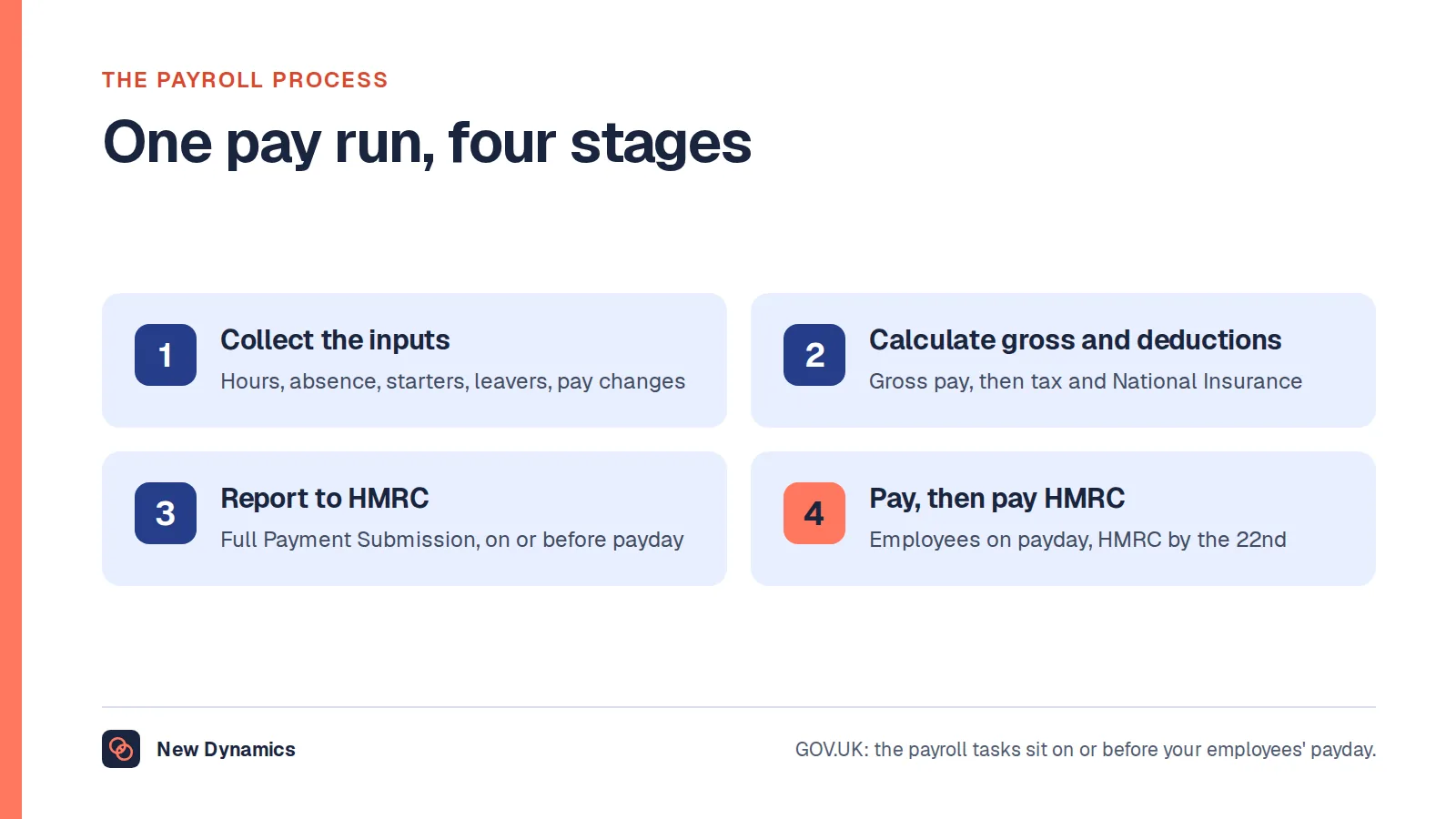
The payroll input. Not the calculation, usually a payroll specialist or an outsourced bureau, but the data that feeds it. Our post on the payroll process sets out the cycle this sits at the front of.
The HR system itself. Fields, permissions, workflow templates, reports, data quality. In a small organisation nobody else knows how it works, which quietly makes the administrator its owner whether or not the document says so.

Note what is not on the list: deciding anything. An administrator records decisions, prepares the documents that enact them and keeps the process moving. The decision belongs to a manager, advised where necessary.
HR administrator, HR assistant, HR advisor: three different jobs
These titles are used almost interchangeably in adverts, and they are not the same job. Getting it wrong produces a post that either bores a good candidate or exposes a junior one.
HR administrator is a custody role. The point of the job is that the record and the process are correct. It can be a long-term career in itself, and often the best administrator is somebody with ten years in the role.
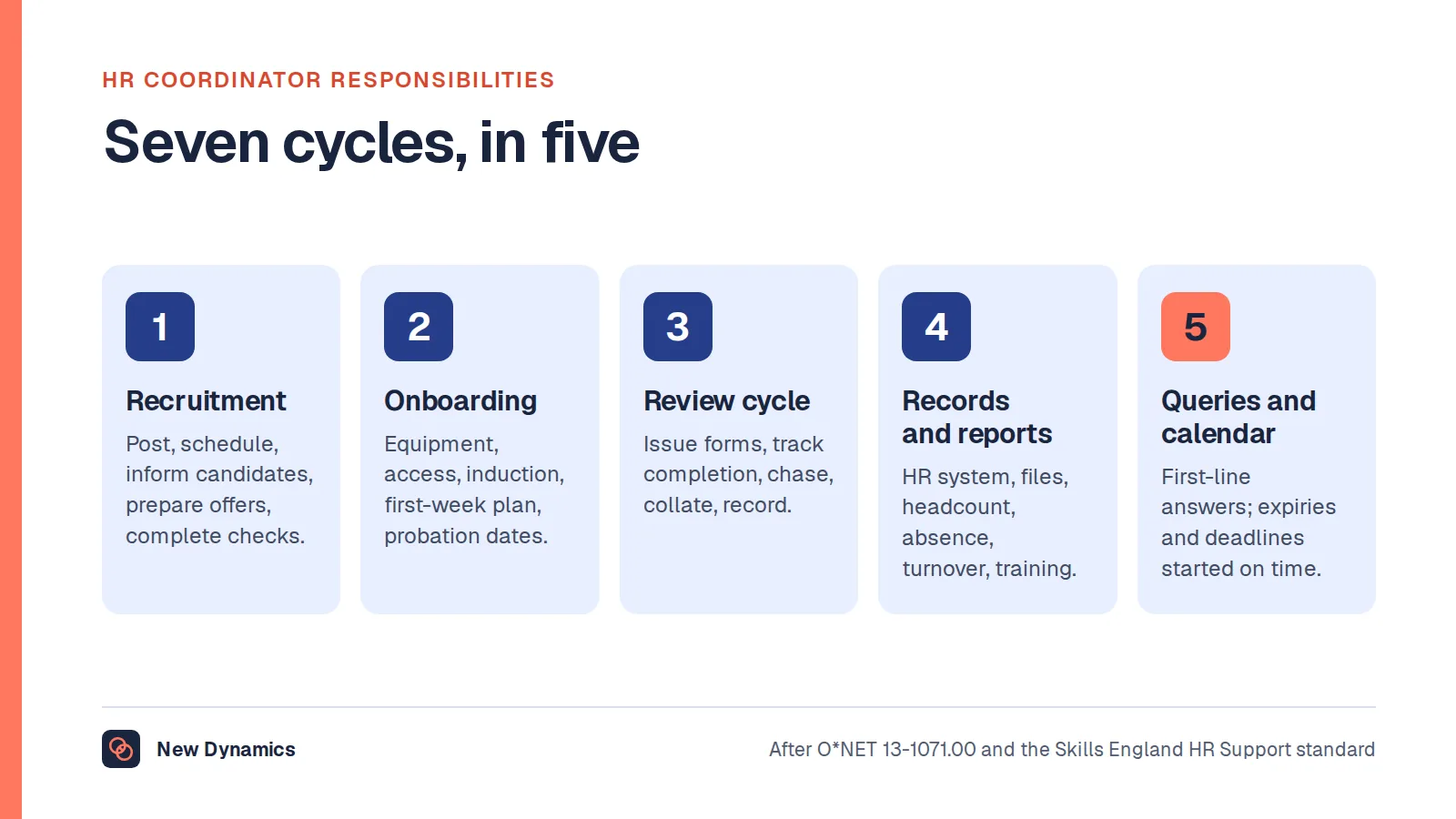
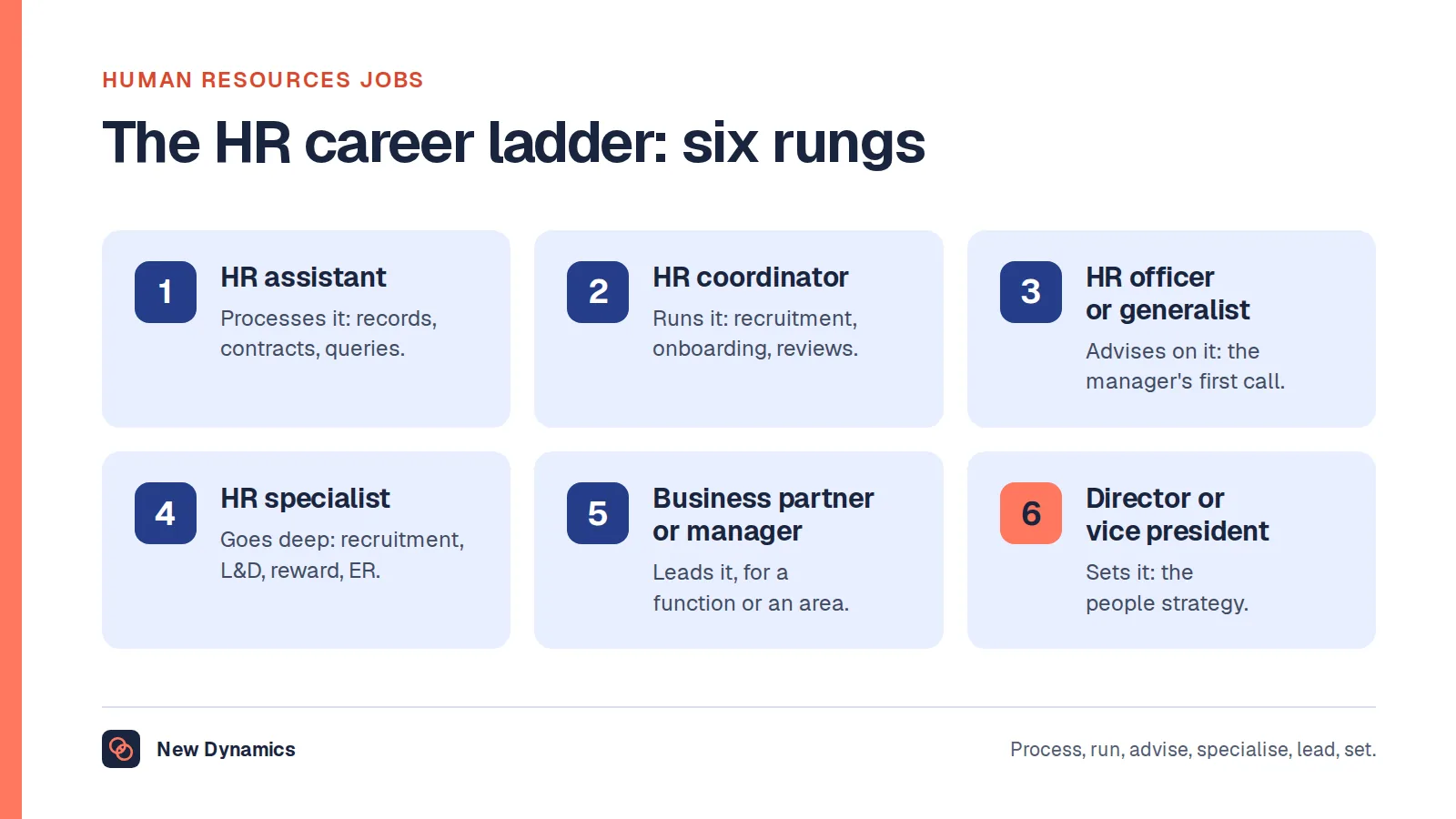
HR assistant is usually the same work with a career track attached: study, gradually more complex cases, promotion within two or three years. Our guide to human resources jobs and their duties places the assistant on the first rung of a six-rung ladder and gives an assistant duty list and template. If the person you want will leave the administration behind, use that document.
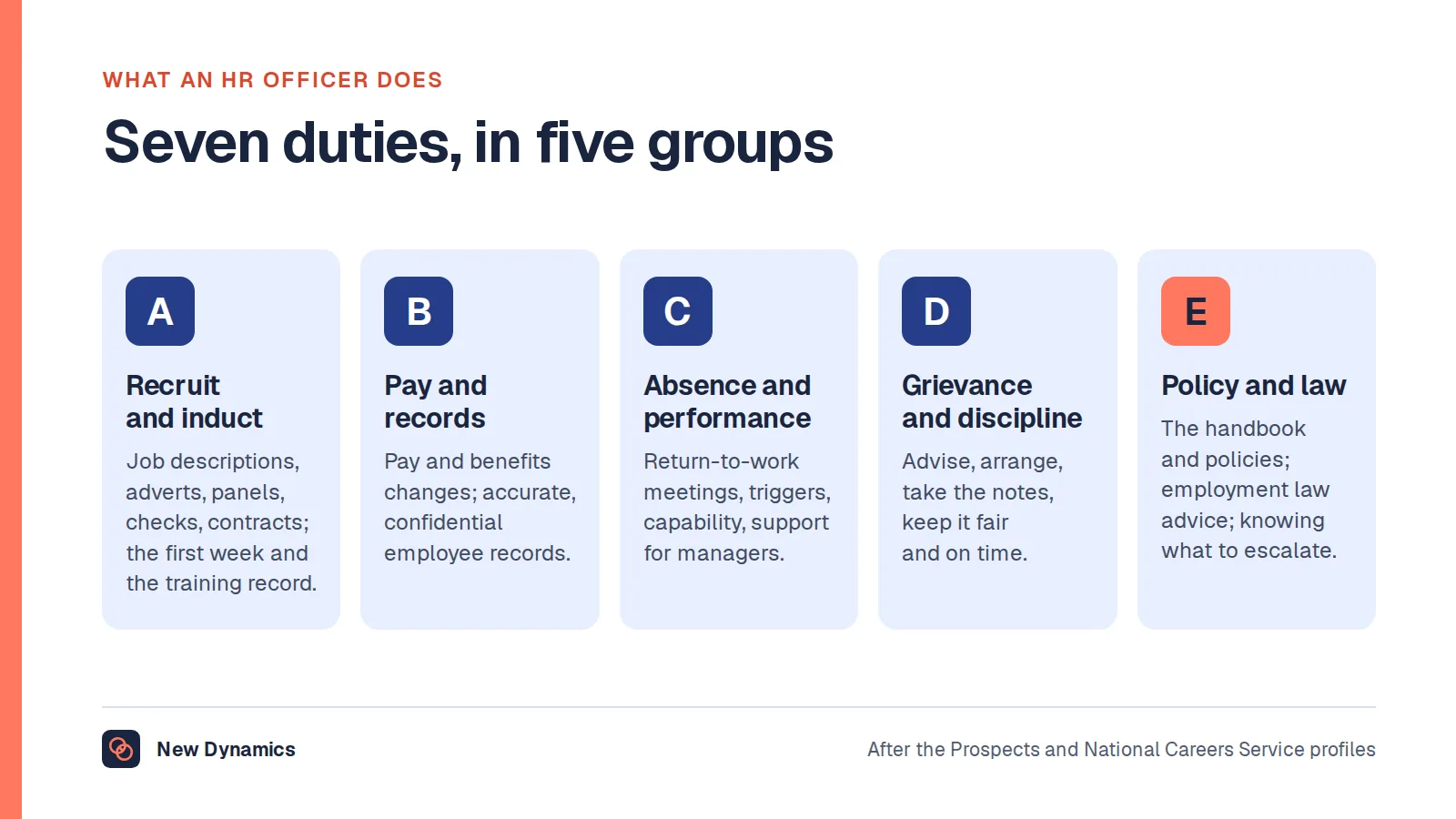
HR advisor or HR officer is an advice role. The point of the job is that a manager gets a defensible answer about a disciplinary, a grievance, a sickness case or a redundancy. The National Careers Service profile for the human resources officer lists tasks including "handle complaints and disciplinary procedures" and "advise on pay negotiations, redundancy and employment law", alongside "maintain confidential employee records". The advice is the job; the records are the context. Our post on what a human resources officer is covers it. A fourth title, HR coordinator, owns the timetable rather than the record; see the HR coordinator job description.
So answer one question first. Are you hiring somebody to keep the record right, somebody to grow into an HR career, or somebody to tell managers what to do? One advert cannot honestly offer all three.
A month in the role
The clearest way to describe this job, and the thing no template does, is to show the month. The work runs on two external clocks: the payroll cut-off, and the starter and leaver dates the business sets without asking.
New starters. For each one: the offer letter out, the written statement prepared, the right to work check completed and recorded, the file created, payroll and pension set up, the induction booked, the probation end date diarised. GOV.UK's guidance on the written statement of employment particulars states that "The employer must provide the principal statement on the first day of employment and the wider written statement within 2 months of the start of employment", as published at the time of writing (checked 5 November 2026). That first-day deadline is the administrator's in practice, and it arrives whether or not the hiring manager confirmed the start date in time.
Contract changes. Promotions, pay rises, hours changes, flexible working outcomes, fixed-term extensions. Each needs a letter, an effective date, an acknowledgement, a system update and, if it touches pay, a payroll instruction before the cut-off. The same page says employers "must tell employees or workers about any changes to the written statement" and "must do this within one month of making the change". Changes are where most record errors are made, because they arrive verbally and late.
Absence recording. Self-certified sickness, fit notes, long-term absence, holiday, family leave, unauthorised absence, lateness. Acas guidance on creating absence policies, last updated on 25 June 2026, says policies "should explain how you will deal with different types of absence", and suggests covering "how workers should book planned absences", "how workers should report unplanned absences" and "whether you use a trigger point system". The administrator turns that policy into the record, which means chasing managers for absences they forgot to report.
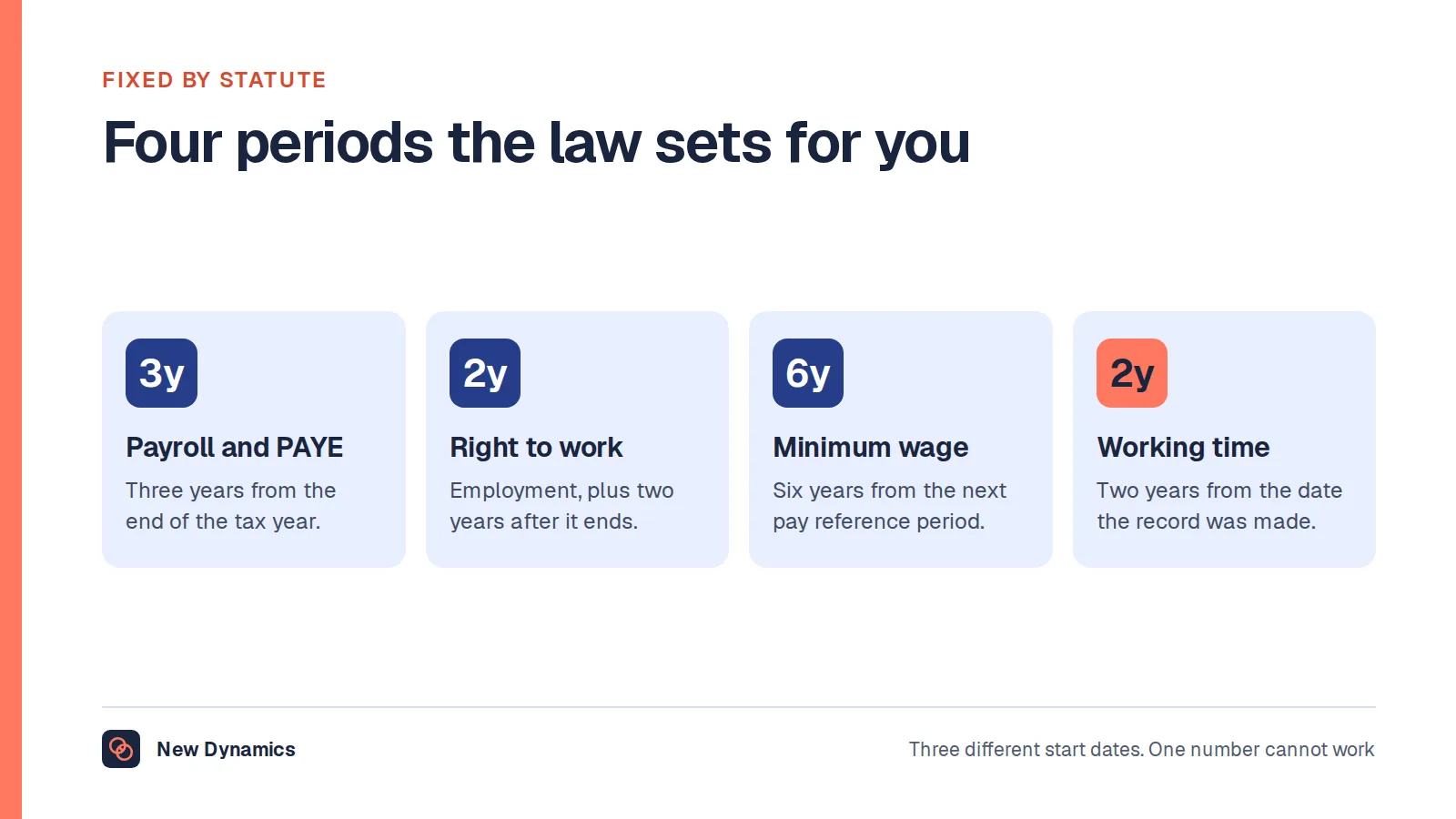
Payroll input. The monthly cut-off is the hardest deadline in the job: it cannot be moved, and a mistake is visible to the individual on their payslip. GOV.UK's guidance on PAYE record keeping says employers "must collect and keep records of: what you pay your employees and the deductions you make", along with "employee leave and sickness absences, tax code notices, taxable expenses or benefits", and that "you need to keep them for 3 years from the end of the tax year they relate to". It adds that "If you do not keep full records, HMRC may estimate what you have to pay and charge you a penalty of up to £3,000". Those figures are as published at the time of writing, checked 5 November 2026.
References. Acas guidance on when an employer must give a reference, last updated on 1 October 2026, says "An employer does not have to give a reference by law unless it's: in writing that the employer will provide one, for example, in an employment contract", or for certain regulated financial services roles. Its page on what employers can say in a reference opens with "If an employer gives a reference it must be accurate and fair", and says a detailed reference "should not include any absences related to: disability" or "parental rights". That is why references belong with an administrator working to a policy rather than with whichever manager is asked.
The HR system. Data quality checks, leaver records closed properly, duplicates merged, permissions reviewed when somebody moves, the leadership reports, and the retention schedule actually executed rather than filed.
The three standards the work is judged on
Volume is the wrong measure. Counting contracts issued tells you how busy the organisation made the post holder, not whether the job is being done. Three standards do.
Accuracy. Everything downstream is built on this record. A wrong start date is a wrong length of service, so a wrong notice period and a wrong redundancy payment. A change recorded with the wrong effective date is a pay error with an arrears calculation behind it. Measure corrections found after the fact: payroll queries traced to input, records amended after an audit, documents reissued.
Timeliness. The job has fixed dates that belong to other people: the first day, the payroll cut-off, the probation end, the fixed-term and right to work expiries. Measure the proportion that landed on time, not the average.
Confidentiality. A standard, not a personality trait, and assessable. Did anything leave the file that should not have? Was a reference given outside the policy? Was a manager given access they did not need? An administrator who asks "should I be sending this?" is meeting the standard.
A fourth, quieter standard belongs in the document: the process is documented well enough that somebody else could run it. In small teams this role is a single point of failure, and written procedure is the only cure.
Why this role is the data protection front line
This is the part templates leave out, and the most consequential part of the job. In most organisations the HR administrator touches more personal data, more often, than anybody outside the IT team. They do not set the policy. They are the point at which it either happens or does not. The ICO's guidance on collecting and keeping employment records is written for employers rather than lawyers. Four things in it land on this desk weekly.

The records you hold
The ICO lists what employers typically keep: "As an employer, there are many kinds of records you may need to keep about your workers. For example: personnel files; sickness and injury records; disciplinary and grievance records; training records; appraisal or performance review records; payroll information; pension information; interview notes; emails; references; and equality and diversity information."
Read that as an inventory of one desk. It also makes the special category point unavoidable: sickness and injury records reveal health, and equality and diversity information can reveal race, religion or disability. The ICO states that "You must apply at least one lawful basis whenever you are keeping records of your workers' personal information", and that "If you are keeping records of special category information about your workers, you must identify a special category condition, as well as identifying a lawful basis."
The administrator is not choosing the lawful basis. The administrator is the person who must not quietly start a new record that nobody chose a basis for, which is what happens when a spreadsheet of sickness reasons appears on a shared drive because a manager asked for it.
Who should be able to see them
The ICO is direct: "You must make sure that the employment records you hold: can only be accessed, altered, disclosed or deleted by those who are authorised to do so." Day to day, that means four habits.
- Managers see their own people, and only the fields they need. A line manager needs absence dates to manage attendance, rarely the fit note, the occupational health report or the grievance file.
- Permissions are reviewed when somebody moves. A manager who changes team keeps the old team's records unless somebody removes them, and that somebody is the administrator.
- Sensitive documents sit apart from the main file. Occupational health reports, grievance papers and interview notes about other candidates do not belong in a file a manager can browse.
- Email is the weakest link. Check the recipient before attaching a file, not after.
How long you keep them
The ICO says "You should set up a retention policy or schedule that lists: the types of record or information you hold; what you use it for; and how long you intend to keep it."
Note the division of labour. The organisation sets the schedule. The administrator executes it, the harder half, because deletion is the only HR task with no deadline and no complainant. One more GOV.UK anchor, checked on 5 November 2026: right to work copies are kept "during the applicant's employment and for 2 years after they stop working for you", from the guidance on checking a job applicant's right to work. Our post on employee records retention covers the wider schedule, and our HR statistics hub collects the workforce figures we use across the site.
When a subject access request lands on this desk
This usually arrives badly: an employee in a dispute asks for "everything you hold about me". The ICO's guidance on recognising a subject access request, last updated on 7 April 2026, removes most of the places an employer might hope to hide.
"There are no formal requirements for a valid request. A person can make a SAR verbally or in writing, including by social media. They can make it to any part of your organisation, and they do not have to direct it to a specific person or contact point." Nor does the person have to use the phrase "subject access request". And, decisively for this role: "Any of your employees may receive a valid request. You must identify and handle each request correctly. You should consider training your staff so that they can identify a request."
On the clock, the ICO's guidance on responding to a request, last updated on 8 December 2025, says "You must comply with a SAR without undue delay and at the latest within one month of receipt of the request". An extension is limited: "You can extend the time to respond by a further two months if: the request is complex; or you have received a number of requests from the same person", calculated "as three months from the original start date."
Two things follow for the job description. Say that the role will receive and help fulfil subject access requests, and name who owns the response. And say it is expected to recognise one phrased as "can I have a copy of my file", because that is how it arrives. The clock starts when the request was made, not when it reached HR.
Our employee data protection guide covers the wider picture for a people team.
Where an administrator should stop and escalate
A job description that does not draw this line is unfair to the person holding the job. Administrators are asked advice questions constantly, by managers who want a quick answer and do not care about role boundaries.

The test is simple. If the answer is written down, an administrator can give it. If it requires judgement about a person, it escalates.
Inside the boundary, with a policy to point to: holiday entitlement and how to book it; where to find a form and how a process runs; confirming facts from the record such as start date, job title and current terms; the steps in the sickness reporting procedure; reference requests answered to the reference policy.
Outside the boundary, every time:
- Whether somebody can be dismissed, including in a probation period.
- Whether conduct is gross misconduct.
- Whether a flexible working request can be refused, and on what ground.
- Anything about a disability, an adjustment or an occupational health report.
- Anything where a grievance, a protected characteristic or a tribunal has been mentioned.
- Any pay or term that differs from the written terms.
- A request to change or remove something already recorded.
The last deserves emphasis. "Can you take that off the file?" is the question an administrator must never answer alone, because an altered record is worse than an uncomfortable one.
Write the escalation route into the document with a name and a timescale, for example "pass to the HR advisor the same working day, and record what was passed on". An administrator who escalates ten questions a week is doing the job as designed.
What to put in the HR administrator advert
Six things, most of which are usually missing.
- Which of the three roles this is. Custody, career track, or advice. Say it in the first paragraph.
- The size and the systems. Employees covered, the HR system by category rather than by brand, whether payroll is in-house or outsourced, the cut-off date, starters and leavers a month. A candidate can judge the workload from those five facts and nothing else.
- Whether this is the whole HR function. In a company of thirty to eighty people the administrator is often the only HR person, reporting to a finance or managing director, with external advice bought in. That is a legitimate job, and a different one from administering records in a team of nine.
- The escalation route. Who an advice question gets passed to, internally or externally.
- What is not in the role. A short exclusion line is unusual and unusually useful. "This role does not advise on disciplinary or grievance cases" says more than a paragraph of values.
- The study support, honestly. If you will fund a level 3 apprenticeship or a CIPD qualification and give study time, say which and how much. If not, say so, and do not list a qualification as desirable.
On turning a duty list into accountabilities, our guide to how to write a job description works through the method, and our job description template covers the layout.
An HR administrator job description template
Adapt the wording and replace each prompt with your own facts.
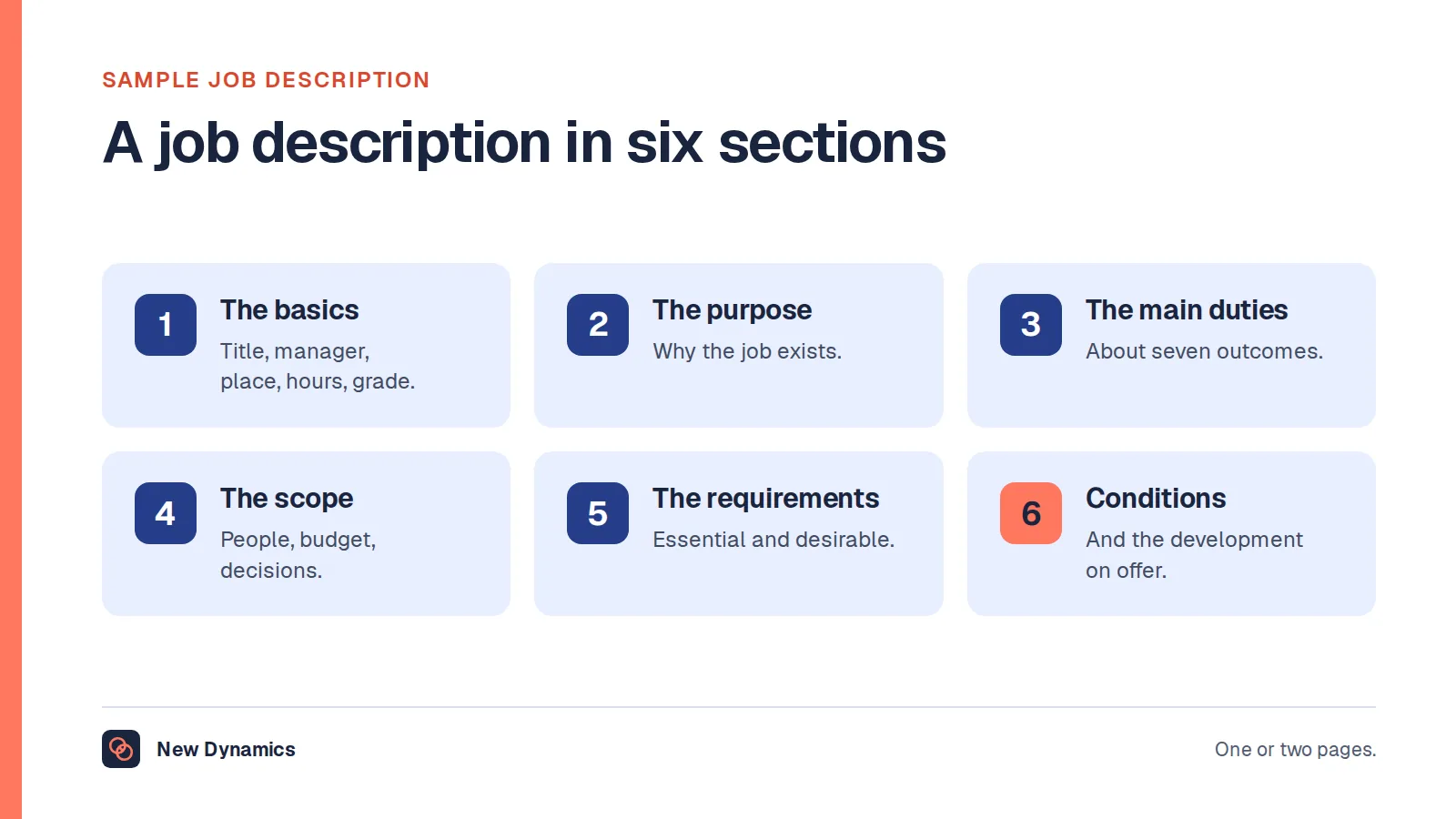
Job title: HR Administrator
Reports to: HR Manager, or in a standalone post the Finance or Managing Director
Scope: State the employees covered, the HR system, whether payroll is in-house or outsourced and the monthly cut-off, the starters and leavers a month, and whether this is the only HR post.
Purpose of the role: To hold the employee records and the processes that change them, so that every employment decision is made from accurate information, every document and payroll instruction is correct and on time, and personal information is handled lawfully.
Accountabilities. Written as outcomes, because outcomes can be assessed.
- The employee record is accurate and current, with every change evidenced, dated and traceable to an authorised instruction.
- New starters have their written statement on or before day one, a recorded right to work check, a personnel file, payroll and pension set up and a diarised probation end date.
- Contract changes are issued, acknowledged, recorded and sent to payroll before the cut-off for the month they take effect.
- Absence is recorded to policy for every type of leave, with fit notes chased rather than assumed, and payroll input is complete, checked and submitted by the cut-off, with errors found before the payslip.
- References follow the written reference policy, and nothing is said in one that the record does not support.
- Personal information is accessed, shared and retained to policy, access is reviewed when roles change, and the retention schedule is run on time.
- Subject access requests are recognised, logged on the day they arrive and passed to the named owner.
- Advice questions are escalated to the named adviser the same working day, with a written note of what was passed on.
- The processes in this role are documented well enough for a colleague to cover them.
Person specification.
Genuinely matters: accuracy under a fixed deadline; discretion with sensitive information, with an example; confidence with an HR system and a spreadsheet, including a simple report; clear written English for letters that may be read years later; the judgement to query an instruction that looks wrong.
Usually inflated: a degree, for a procedural role. Years of HR experience, when accuracy at a comparable volume is the real requirement. A named software package, when any comparable system plus a fortnight of training would do.
A reasonable middle: a level 3 HR or business administration qualification, or progress towards one, or equivalent experience. Say which you will accept and what study support you offer.
What good looks like after six months: every written statement issued on or before day one for three months running; no payroll query traced to input error in the last two cycles; the retention schedule run once, with a record of what was deleted; one process documented well enough for a colleague to cover.
Pay: what official UK sources actually publish
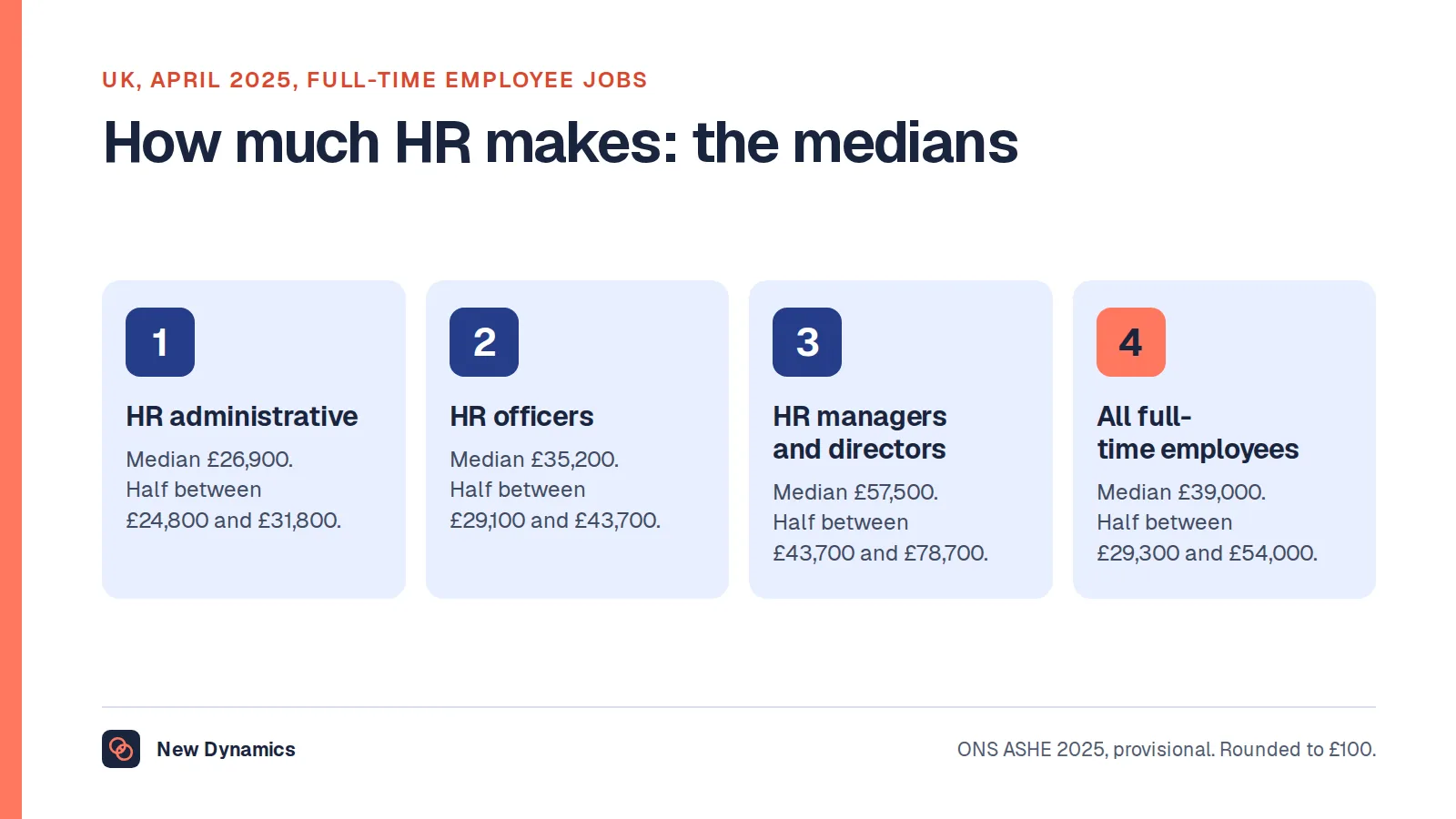
No official UK source publishes a pay range for the job title "HR administrator". The National Careers Service, the usual official source for UK occupational pay, has no profile for HR administrator, HR assistant or personnel officer. The nearest official figure is for the role above: its human resources officer profile shows an average salary of "£24,000 Starter" to "£40,000 Experienced" a year, as shown at the time of writing (checked 5 November 2026). That is an advisory role, so treat it as a ceiling to work down from. For what the profession pays by level, see our guide to how much human resources makes.
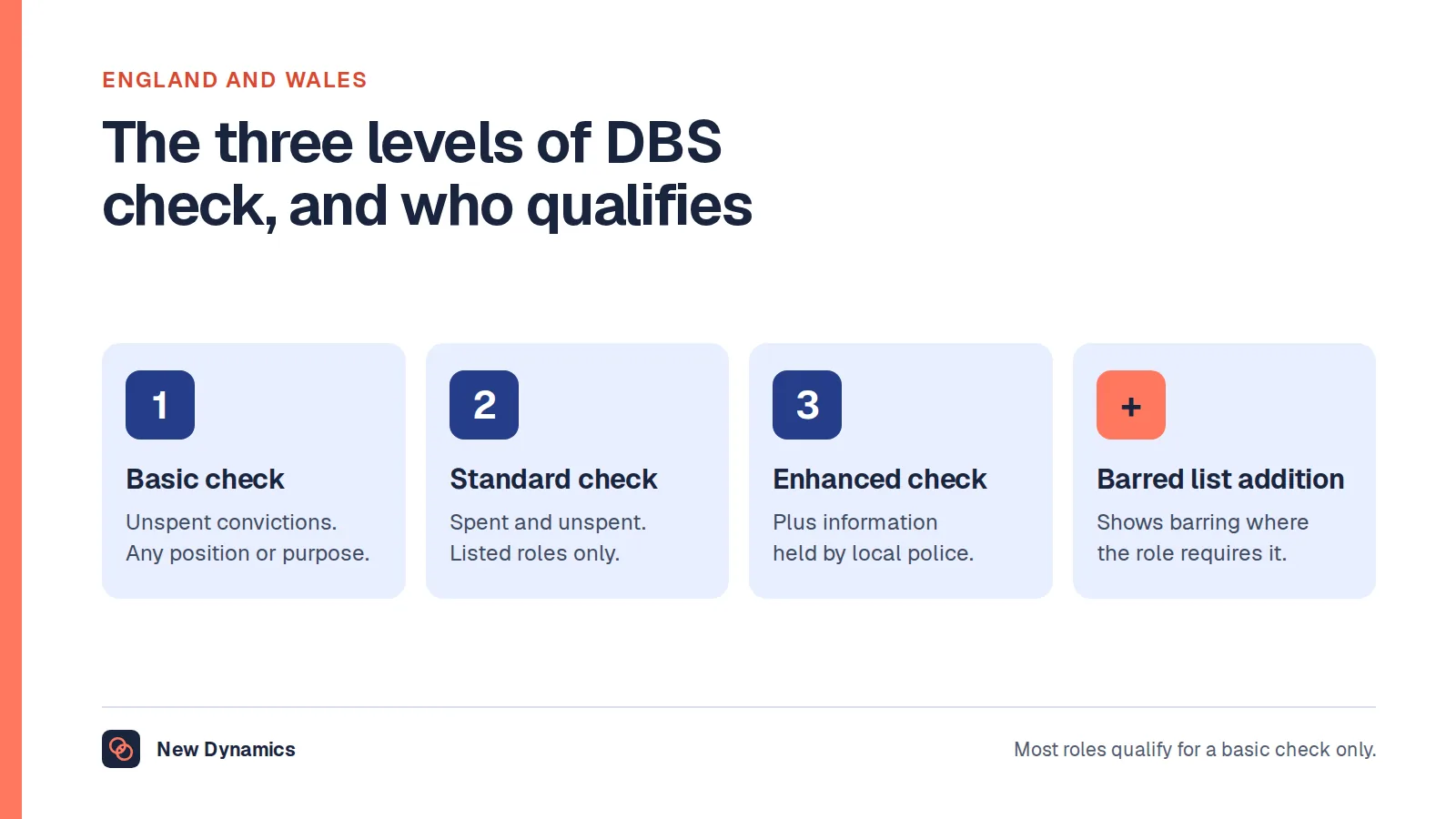
One figure does show what accuracy here is worth. GOV.UK's guidance on penalties for employing illegal workers, checked on 5 November 2026, says an employer who does not carry out correct checks "might have to pay a civil penalty (fine) of up to £60,000 for each illegal worker", and adds that "You will not have to pay the civil penalty if you can show you made the correct right to work checks". The record of having done the check is what protects the employer. Our post on background checks covers what is proportionate across pre-employment checks.
Progression out of the role, and the case for staying
Three routes out, and one good reason to stay.
Into advice. Administrator to HR advisor or officer is the most common move, and the hardest, because it is a change of discipline rather than a promotion. The administrator's instinct is to follow the process; the advisor decides what the process should be in a case that does not fit. The way through is case exposure: sit in as notetaker, draft the invite letters, write the outcome letter under supervision, then run a simple case with a safety net.
Into business partnering. The longer route, usually through advisor first. It needs commercial context administration does not teach, so ask for the leadership reports, the headcount budget and the workforce plan while still in the role.
Into specialism. Often the strongest route, and the most underrated. The administrator already owns the HR system and the data, which is the starting point for HR systems and analytics work. Reward and benefits is another natural step. Our guide to human resources jobs maps the specialist routes and the apprenticeship levels in England.
And the case for staying. An experienced administrator is often the only person who knows why a historic decision was made the way it was. Not everybody should be pushed up a ladder. If the post holder is excellent and content, pay for the expertise, widen the role into system ownership and reporting, and stop calling the job a stepping stone.
Onboarding is where most of the record is created, and where most errors start. See how New Dynamics onboarding gives every starter a checklist with owners and dates, so the first-day paperwork is not one person's memory.
Frequently asked questions
What does an HR administrator do?
An HR administrator holds the employee record and the processes that change it: new starter paperwork and right to work checks, written statements of terms, contract change letters, absence recording, payroll input, references, and the HR system itself. The role records decisions and keeps processes moving. It does not make them.
What is the difference between an HR administrator and an HR assistant?
Mostly the career track. Both do administrative HR work, but an HR assistant post usually carries the expectation of study, more complex cases and promotion within two or three years. An administrator post can be a long-term specialism in records, documents and systems. Decide which you are hiring before writing the advert.
Does an HR administrator give advice to managers?
Only where the answer is already written down, such as holiday entitlement, where to find a policy, or confirming facts from the record. Anything requiring judgement about a person goes to an advisor, officer or external adviser: dismissals and probation decisions, conduct, flexible working refusals, disability and adjustments, and anything where a grievance or tribunal is mentioned.
Why is an HR administrator a data protection role?
Because the role touches employee personal data constantly, including special category information such as sickness records. In the United Kingdom the ICO says employment records "can only be accessed, altered, disclosed or deleted by those who are authorised to do so", and that "any of your employees may receive a valid request" for a subject access request, which must normally be answered within one month. This is general information, not legal advice.
What qualifications does an HR administrator need?
None are required by law in the United Kingdom. A level 3 HR or business administration qualification, or progress towards one, is a reasonable requirement, and many people enter from general administration and qualify while working. Accuracy under deadline, discretion and confidence with an HR system matter more than a degree.
How much does an HR administrator earn in the UK?
No official UK source publishes a pay range for this job title. The National Careers Service has no HR administrator profile. Its nearest is the human resources officer profile, for the advisory role above this one, showing "£24,000 Starter" to "£40,000 Experienced" a year at the time of writing. Treat that as a ceiling to work down from, and be sceptical of precise medians quoted from job-board advert data.
Your next step: write the role around the record
- Decide which role you are hiring: custody, career track or advice. Put it in the first line of the advert.
- State the size, the systems, the payroll cut-off and whether this is the only HR post.
- Rewrite the duty list as the ten or so outcomes the role is accountable for.
- Draw the escalation boundary, with a name and a same-day timescale.
- Name the data protection accountabilities: access, retention and subject access requests.
- Strip out the requirements you cannot justify, and say what study support you offer.
For the wider picture on handling employee information lawfully, read and download our employee data protection guide. The guide is free to read, and the PDF uses our short download form.
Want starters, changes, leavers and approvals running on owners and due dates instead of one person's inbox? Book a New Dynamics demo and bring your current job description. You can also email contact@new-dynamics.com.