TL;DR
- An HR business partner is accountable for the people consequences of one business area's plan. An HR adviser is accountable for casework, an HR manager for an HR team, and a centre of expertise for the frameworks everyone else uses. The four are not seniority bands of the same job.
- The partnering model only works as three parts at once: strategic partners, a shared service and expertise centres. When the shared service is weak, the partner becomes the overflow route for transactional work and the strategic half of the job quietly disappears.
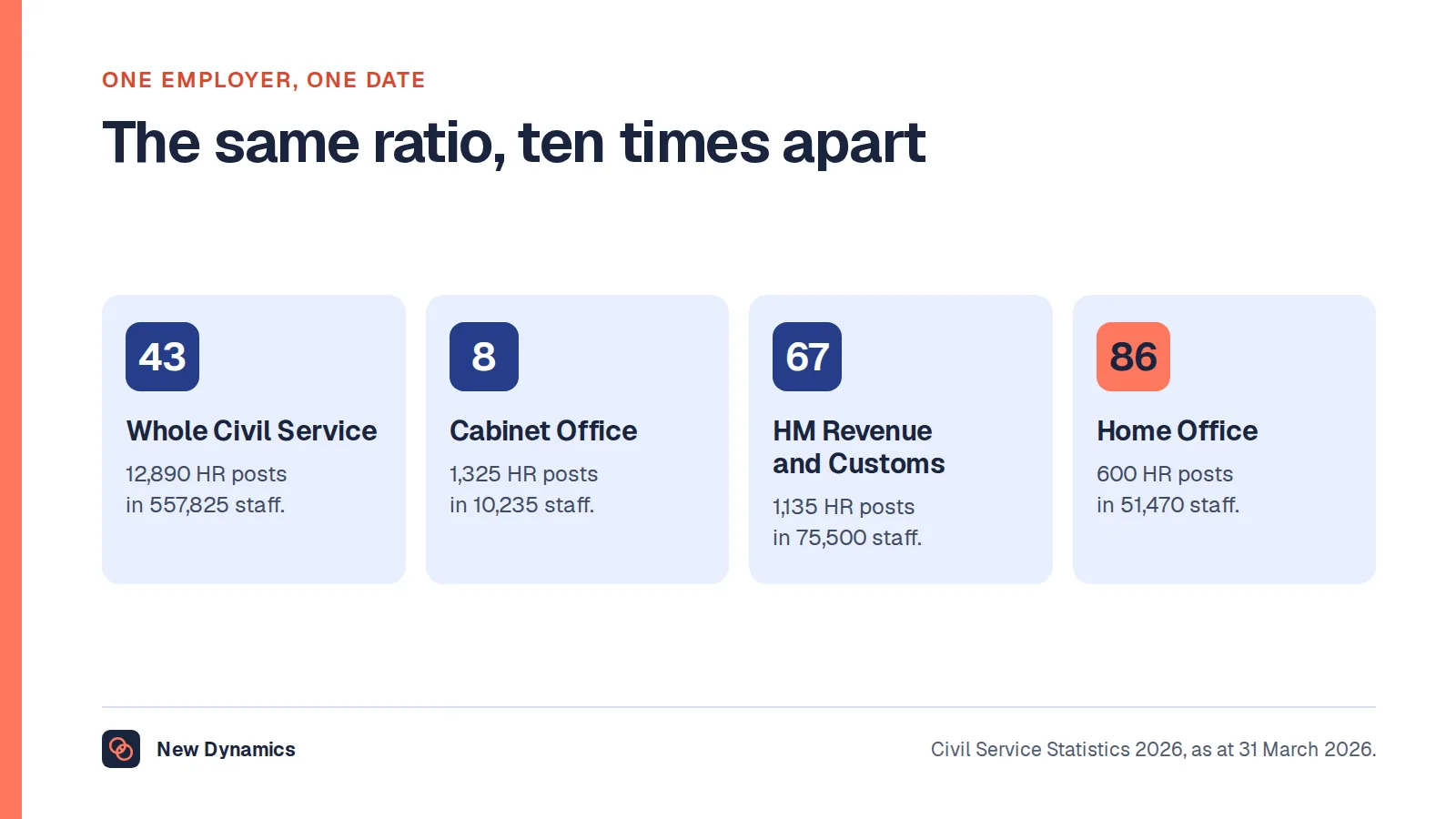
- HR is a small profession inside a large employer. Civil Service Statistics 2026 records a headcount of 557,825 as at 31 March 2026, of which the Human Resources profession accounts for 12,890 posts. Partner capacity is scarce, so how it is spent is the whole decision.
Four people in the same HR function can hold the titles HR adviser, HR business partner, HR manager and reward specialist, and nobody outside HR can tell you which of them to ring. The titles get used interchangeably, job adverts recycle each other's wording, and plenty of organisations have renamed advisers as business partners without changing a single thing any of them does.
So the real question behind "what is an HR business partner" is rarely a definition. It is a boundary question: what is this role for, what is it not for, and how is it different from the three roles it sits next to. This article answers that, writes out a full job description, and sets out the four ways the role fails in practice.
The honest precondition first. A partner only has strategic capacity if something else is absorbing the routine chasing, reminders and approvals. See how New Dynamics workflows take that work off a person's desk, because the partnering model is the part of HR design that fails fastest when they do not.
What an HR business partner actually does
An HR business partner, often shortened to HR BP, is accountable for the people consequences of one business area's plan. That is the whole job in a sentence, and every genuine responsibility follows from it.
In practice it means four things. The partner reads the plan for their client area and works out what it implies about people: how many, with what skills, at what cost, by when, and what has to change in the structure to get there. They then sit in the conversations where those decisions are actually made, rather than receiving them afterwards. They bring evidence to those conversations, usually turnover, absence, pay, capability, engagement and recruitment data for their own area, so the discussion is about the numbers rather than about whose anecdote is louder. And they hold a line when the plan and the organisation's obligations collide, which is the part of the role that cannot be delegated.
Notice what is absent. A partner does not own the policy library, the pay framework or the applicant tracking system. They do not run the grievance queue. They are not the HR function's manager. Those jobs belong to the other three roles, and a partner doing them is a symptom, not a job description.

HR business partner against an adviser, a manager and a centre of expertise
This is the distinction most readers are actually looking for, so it is worth being blunt about each one.
An HR adviser serves managers, case by case. The unit of work is an incident or a request: a disciplinary, a grievance, a sickness absence, a flexible working request, a probation that is not going well. The adviser knows the policy and the law, applies it consistently and keeps the organisation safe. Seniority here is depth of casework judgement. An adviser can be far more expert than a partner on employee relations and still not be doing the partner's job, because the unit of work is different.
An HR business partner serves a business area, plan by plan. The unit of work is a decision about the shape of a workforce. The partner may never touch an individual case, and in a well-run function they mostly should not, because casework is the adviser's and the shared service's work. What they own is the quality of people decisions inside their client group.
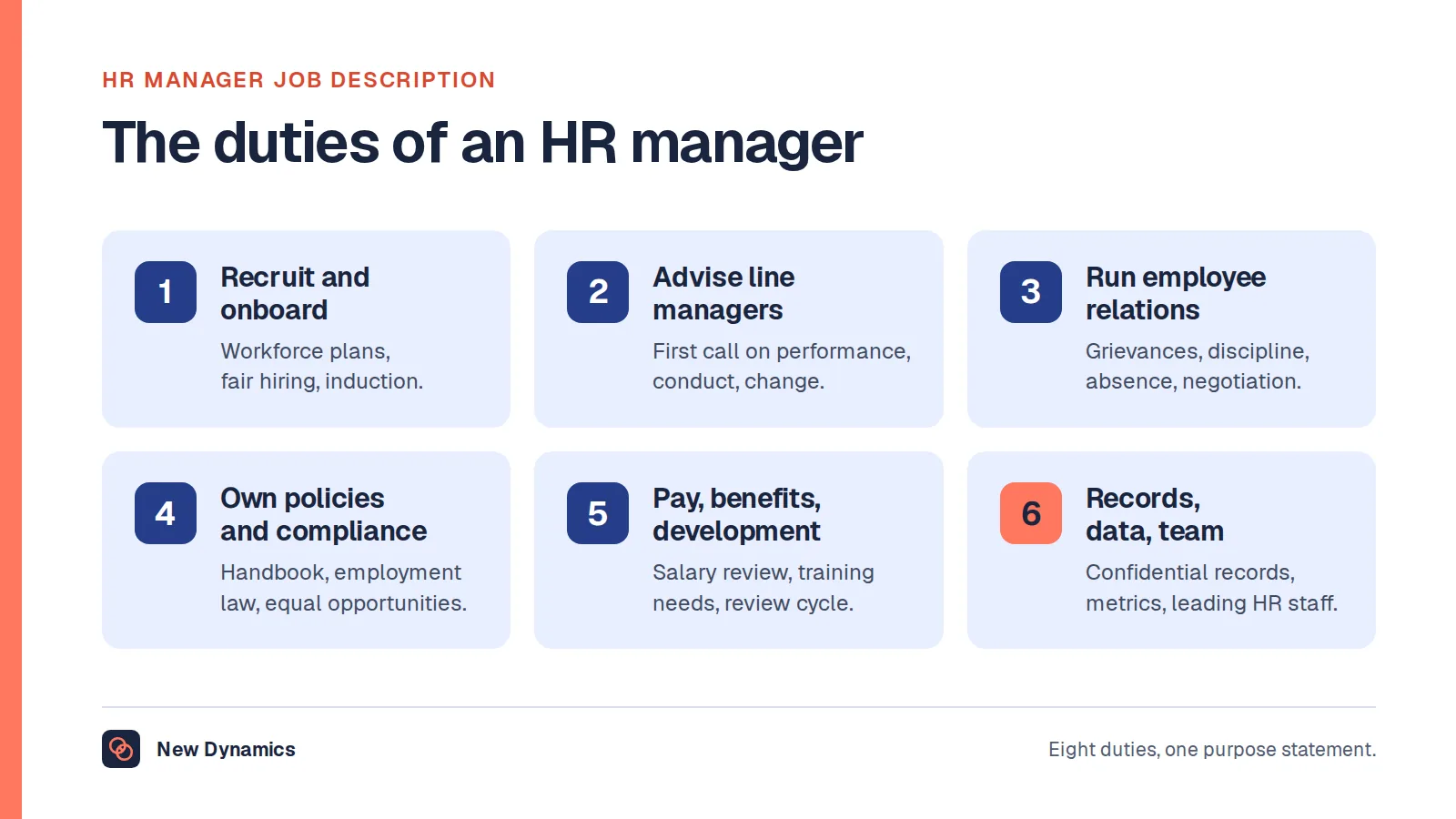
An HR manager serves the HR function itself. They run a team, own delivery, manage service standards, handle escalations and are accountable for the function's own performance. This is a management job, and in smaller organisations the same person is often doing all three roles under one of the three titles. Our post on the HR manager job description sets out that role in full.
A centre of expertise, sometimes written centre of excellence, serves everyone at once. It designs the frameworks the organisation runs on: the reward structure, the job architecture, the resourcing approach, the learning offer, the employee relations policy set. Its output is a framework, not an answer to today's question. Its customers include the partners, who deploy what it builds.
Four units of work, four customers, four accountabilities. Where these are confused, the usual symptom is that a partner spends their week doing adviser work for a manager who should have gone to the shared service, while the centre of expertise builds something nobody adopts because no partner was involved in designing it.
The model behind the title: partners, shared services and expertise centres
The business partner title did not arrive on its own. It came with a way of organising an HR function into three parts, each doing work the other two should not.

Shared services handle volume: contract changes, references, payroll queries, leave, onboarding administration, first-line policy questions. The point is standardisation. The same question gets the same answer, fast, at low cost per transaction, ideally without a person touching it at all.
Expertise centres handle design: reward, resourcing, employee relations policy, organisation design, learning, people analytics. The point is depth. Someone who does reward all year is better at reward than four generalists who touch it in March.
Strategic partners handle application: translating a business area's plan into people decisions, and translating what is actually happening in that area back into the frameworks and services the other two parts provide. The point is context. Someone embedded in a division understands its economics, its managers and its constraints in a way a central team cannot.
The logic is sound, and it is also fragile, because the three parts only work as a set. The partner's capacity to be strategic is created entirely by the other two. Take either away and the partner's week fills with whatever is left unhandled.
Why the model breaks when the shared service is weak
This is the single most common failure, and it is worth tracing precisely.
A weak shared service means routine work does not get resolved at first contact. Perhaps the self-service tools are poor, perhaps the knowledge base is out of date, perhaps the service sits behind a shared inbox with no routing, perhaps it was staffed from a headcount target rather than from measured demand. Whatever the cause, managers learn quickly that the fast route to an answer is the person they know personally, and the person they know personally is their business partner.
Now watch what happens. The partner answers, because it is one question and refusing looks unhelpful. Word spreads that the partner answers. The partner becomes the de facto escalation route, then the de facto first route. Their diary fills with casework and transactions. The strategic work has no deadline attached to it, so it is the work that slips. Within two quarters the partner is a senior HR adviser with a different job title, and the organisation concludes that business partnering does not work.
It is not that partnering does not work. It is that partnering is the part of the model with no queue and no service level, so it is always the part that gets eaten. A partner's strategic time is not protected by intent. It is protected by the shared service being good enough that nobody needs to go round it, and by automation absorbing the steps that never needed a person. That is why the sequencing matters: fix the transactional layer first, then appoint partners. Done the other way round, the title arrives and the job never does. Our post on HR structure covers how the three parts fit together as an operating model.
HR business partner job description
Here is a realistic HR business partner JD, written as it would appear for a mid-sized UK employer. Adapt the client group and the reporting line; keep the shape.
Purpose
To be accountable for the people consequences of the plan in one defined business area, so that its leadership team makes workforce decisions that are commercially sound, legally safe and deliverable. The role exists to improve the quality of those decisions, not to process the work that follows them.
The work
- Read, challenge and contribute to the business area's annual plan, and produce the workforce implications of it: headcount, skills, structure, cost and timing.
- Own the people elements of change in the area: restructures, new teams, role design, consultation planning and the transition itself, working with the employee relations specialists on process.
- Bring a standing evidence pack to the leadership team: turnover and its reasons, absence, vacancy and time to hire, pay position against the framework, capability and succession risk, engagement movement.
- Identify the two or three people risks that would actually derail the plan, and secure decisions on them rather than reporting them repeatedly.
- Coach the area's senior managers on people decisions, and improve their self-sufficiency so that routine conversations happen without HR in the room.
- Deploy what the expertise centres design, feed real constraints back to them, and resist local workarounds that fragment a framework.
- Route transactional and casework demand to the shared service and the advisory team, and escalate systematically where that route is failing rather than absorbing the work.
- Contribute to pay review, performance calibration and succession planning for the area as the annual cycle requires.
The relationships
The partner reports to the HR director or a senior partner, and sits on the leadership team of the client area. Internally in HR, they work daily with the advisory and employee relations team, the shared service, and reward, resourcing and learning colleagues. Externally in the business, the key relationships are the area director, their direct reports, and finance, because almost every workforce decision is also a budget decision. Where a decision touches process or fairness, Acas is the reference point: "Employers must follow the Acas Code of Practice. It says how they should follow fair procedures."
What good looks like after a year
- The partner is in the room when the plan is set, not briefed after it.
- The area's leadership team can state its top three people risks without prompting, and each has a named owner and a date.
- Workforce numbers in the area's plan reconcile with HR's data and with finance's budget, from one source.
- Routine queries from the area reach the shared service first, and the partner's casework load is lower than it was at month three.
- Managers in the area run probation, absence and performance conversations themselves, with the partner consulted on the difficult ones rather than running them.
- At least one framework from an expertise centre has been adopted in the area without a local variant.
The skills that actually distinguish the role
Most HR skills are common to all four roles. Three are not, and they are what selection panels should actually test. Our post on HR skills covers the wider set.
Reading a business plan
A partner has to be able to open their area's plan, understand the commercial logic, and say what it means for people without being told. That means reading a profit and loss account, understanding what drives cost and revenue in that specific business, and spotting the gap between what the plan assumes about people and what is actually true. A partner who waits for the business to translate its plan into an HR brief is not partnering. They are taking orders.
Holding a line with a senior manager
The role is defined by the moments when the fastest commercial route is not an acceptable one, and the partner has to say so to someone more senior than themselves, with a workable alternative attached. That is a specific skill: evidence, calm, a clear statement of consequence, and a proposal. It matters most where process and fairness are at stake. Acas is clear that "The procedure an employer follows and an employee's actions will be taken into account if the case reaches an employment tribunal." A partner who cannot hold that line turns into a very well informed bystander.
Using evidence rather than opinion
"People are leaving because of pay" is an opinion until exit data, pay position and leaver destinations say so. The distinguishing habit is arriving with a number, naming its source and reference period, and being honest about what it does not cover. That also means knowing where a figure does not exist. There is no official HR to employee ratio in the UK, for instance, which our post on the HR to employee ratio sets out in detail, so a partner arguing team size from a borrowed benchmark is arguing from nothing.
How much partner capacity actually exists
Partner time is scarcer than most plans assume, and the scale is worth seeing in real numbers rather than in theory.
Civil Service Statistics 2026, published on 29 July 2026 and measured as at 31 March 2026, reports that "Civil Service headcount stands at 557,825 as at 31 March 2026." The accompanying statistical tables break that headcount down by profession, and record 12,890 posts in the Human Resources profession. That is about 2.3% of the whole workforce, or roughly one HR post for every 43 people. The bulletin notes that "The reporting rate for professions data is 98.0%, up from 97.4% in 2025", so the share is close to complete but not total.
Two cautions. That is one very large public sector employer on one date, not a UK norm, and it counts the whole HR profession rather than business partners specifically. No official statistic publishes how many of those posts are partner roles, and we are not going to estimate one. What the figure does establish is the scale of the constraint: HR is a thin layer across a large population, partners are a minority of that thin layer, and the number of client groups one partner covers is therefore a real design decision rather than an administrative detail. For the wider set of sourced figures, see our HR statistics hub.
The career path into the role and beyond it

The usual route in runs through delivery. An HR coordinator or administrator learns the transactions, the data and the systems. An HR adviser then builds casework judgement, policy knowledge and the ability to coach a manager through something difficult. A partner role follows, normally for a smaller client group first.
That third step is the one people underestimate, because it is a change of job rather than a promotion. The adviser's reputation is built on handling what arrives. The partner's is built on deciding what matters before anything arrives, and on influencing people who do not report to them. Advisers who struggle with the move are usually excellent at the work they are asked to do and reluctant to set their own agenda.
Two other routes in are common and both work. A business manager with strong people instincts moves into partnering and learns the technical HR, which is a real gap but a closable one. Or a specialist from an expertise centre moves across, bringing depth in reward or resourcing and having to broaden quickly.
Beyond the role, the two common directions are a senior or group partner covering a larger client group with partners reporting in, or a functional leadership role: head of HR, HR director, then chief people officer. Our post on the chief human resources officer role covers the top of that path. The partner route is also the most common path to HR manager and HR director positions, because it is the one that teaches commercial context, and our career progression framework post covers how to map those steps formally.
A frequent question is whether a partner must have worked in advisory first. Not strictly, but they need somewhere to stand when they hold a line, and casework experience is the cheapest way to get it.
What goes wrong
Four failure patterns account for most disappointing partnering models.
A partner with no seat at the planning table. If the partner finds out about the restructure when consultation is due to start, they are implementing decisions, not partnering on them. The test is simple: are they in the meeting where next year's plan is set? If not, the model is a title.
A partner used as an escalation route for casework. Discussed above, and the most insidious failure, because it looks like helpfulness and consumes exactly the time that was supposed to be strategic. Watch for partners whose calendars are reactive and whose casework volume rises over their first year.
Too many clients per partner. A partner covering six leadership teams cannot read six plans, build six evidence packs and sit on six leadership teams. They will attend, listen and add nothing, and everyone will conclude that partnering adds nothing. Size the patch from the number of leadership teams and the pace of change in each, not from a headcount ratio.
A title change with no change in the work. Renaming the advisory team as business partners costs nothing on the day and poisons the term for years. If nothing moved into a shared service, no expertise centre was built, no partner joined a leadership team and no casework left anyone's desk, then nothing changed except the signature block.
Frequently asked questions
What is an HR business partner?
An HR business partner is a senior HR professional accountable for the people consequences of one business area's plan. They sit with that area's leadership team, translate its plan into workforce decisions about headcount, skills, structure and cost, and bring evidence to those decisions. They are not the area's casework handler or policy desk.
What does an HR business partner do day to day?
A good week is mostly conversations and analysis: leadership team meetings, one to ones with senior managers, preparing an evidence pack, working through the people implications of a change, and coaching managers so that routine conversations happen without HR present. Casework and transactions should be routed to the advisory team and shared service, not absorbed.
What is the difference between an HR business partner and an HR manager?
They serve different customers. An HR business partner serves a business area and is accountable for the quality of its people decisions. An HR manager serves the HR function, running an HR team and owning its delivery and service standards. In a small organisation one person often does both, which is where the confusion starts.
Is an HR business partner the same as an HR adviser?
No. An HR adviser's unit of work is a case or a request, such as a grievance, an absence or a flexible working request, and seniority comes from depth of casework judgement. A partner's unit of work is a workforce decision. Many organisations have renamed advisers as partners without changing the work, which is why the titles now blur.
What does a centre of expertise do that a business partner does not?
A centre of expertise, sometimes called a centre of excellence, designs the frameworks the whole organisation runs on, such as the reward structure, job architecture, resourcing approach and employee relations policy set. Its output is a framework. A partner deploys those frameworks in one business area and feeds real constraints back to the designers.
What is the career path to HR manager or HR business partner?
The common route runs HR coordinator, then HR adviser, then HR business partner, then head of HR or HR director. Business partnering is the most common path to HR manager and director roles because it builds commercial context. Moves in from line management or from a reward or resourcing specialism also work, with a technical or breadth gap to close.
Your next step: test the model before you test the people
- Write down which of the four roles each person in your function actually performs this week, and compare it with their job title.
- Count how many queries reached a business partner that the shared service could have closed, over one month.
- List the leadership teams each partner covers, and the number of plans they are expected to read.
- Check whether each partner is in the meeting where their area's plan is set, by name, in the calendar.
- Mark every step in your top five people processes that needs a person only because nothing is automating it. That list is the partner capacity you can recover without hiring.
For the wider framework this sits inside, read and download our human resources management guide. The guide is free to read, and the PDF uses our short download form.
Want to see how much of the transactional layer can be absorbed before you appoint partners? Book a New Dynamics demo and bring one partner's diary from last month. You can also email contact@new-dynamics.com.