TL;DR
- A podcast is worth the hour when you can name where a claim came from, repeat one specific practice and say what it would cost you. Most episodes fail at least two of those tests.
- There are five useful categories: practitioner interviews, research led shows, leadership craft, organisational psychology and employment law updates. Pick two, not five.
- This page does not rank podcasts. A ranking goes stale, and what suits a first time manager in a ten person company is wrong for an HR director in a thousand person one.
A podcast is the only form of professional learning you can do while driving to a site visit or walking back from the station. That is why so many people managers end up with a queue of forty unplayed episodes and almost no record of what any of them changed.
This article is about the habit, not the queue. It covers what makes an hour of audio worth the hour, the five kinds of HR podcast worth knowing about, a listening routine that survives a busy week, how to turn an episode into something you actually do with your team, and how to run a listening habit across a team without it becoming homework.
Almost everything useful you hear will land in a one-to-one, if it lands anywhere at all. See how New Dynamics continuous feedback keeps those conversations, and the follow-ups, in one place.
Why audio earns a place in a people manager's week
Reading time is the first thing a busy week takes away. Listening time is harder to lose, because it is attached to something you were going to do anyway: the commute, the dog, the gym.
The habit is also no longer unusual. Ofcom's Media Nations 2026 report, published on 29 July 2026, says that “Over a quarter of adults (27%) now listen to a podcast each week, according to RAJAR figures”, and sets that against a figure of 7% a decade earlier. Podcast listening is now ordinary behaviour rather than an early adopter habit, which is why so many professional bodies and business publishers run one. For wider workforce figures we keep in one place, see our HR statistics hub.
Two things make audio genuinely useful when you run people, and one thing makes it dangerous.
It is good for judgement, not procedure. Hearing an HR director explain how they handled a restructure teaches you how to think about sequencing, communication and fairness. It is a poor way to learn a procedure, because you cannot see the document and you cannot check the date.
It is good for vocabulary. Much of the work of managing people is naming things accurately: this is a capability issue, not a conduct one; this is a workload problem, not a motivation problem. Hearing other practitioners be precise improves your own precision.
The danger is that it feels like work. An hour of listening produces the pleasant sensation of having developed, with no evidence that anything changed. That is the problem the rest of this article is written to solve.
Why this page is not a ranked list of HR podcasts
We do not publish ranked lists of podcasts on this site, and it is worth saying why plainly.
A ranking goes stale faster than the page gets updated. Shows pause, hosts move on, a series runs out of funding, a weekly show becomes occasional. A list that confidently says “number three” will be wrong within a year and will keep being wrong, because nobody rewrites a list like that until the traffic drops.
A ranking pretends there is one reader. What suits a first time manager with four direct reports in a ten person company is actively wrong for an HR director running a review cycle across a thousand people in three countries. The first needs the craft of a one-to-one. The second needs calibration and how other directors handled a bad engagement result. No single ordering serves both.
A ranking hides the thing that matters. The useful skill is not knowing which show other people like. It is being able to tell, inside ten minutes of an episode, whether the next fifty are worth your time. That skill transfers to every show, including the ones that do not exist yet.
So the rest of this page gives you the tests, the categories and the routine, plus a short list of shows we opened and checked while writing, in no order. If you want a ranking, every podcast directory will give you a chart based on downloads, which measures popularity rather than usefulness.
What separates an hour worth listening to from an hour of nothing
Most episodes in this field fail for the same few reasons. Here are the tests we apply.
Does anyone name a source?
The weakest kind of people podcast is two confident people agreeing with each other about what “the data says” without once naming the data. Listen for the moment where someone says which study, which survey, which year and how many people. A host who says “that was a 2026 survey of around a thousand UK employers, published in March” is giving you something you can check. A host who says “research shows” is giving you nothing.
Could you repeat one specific thing on Monday?
The test is not whether the episode was interesting. It is whether you could describe, in one sentence, something a named person actually did, in enough detail that you could try it. “They moved the development conversation out of the appraisal and into a separate meeting in March” passes. “They built a culture of continuous growth” does not.
Is the organisation anything like yours?
An hour on how a technology company with unlimited headcount redesigned its progression framework is entertaining if you run appraisals for a 60 person construction firm, and that is all it is. Listen for size, sector and whether the speaker had a budget. Advice that assumed eight people in HR does not survive a team of one.
Are they honest about what it cost?
Every change in people management costs something: manager time, a worse number somewhere else, a group of people who liked the old way. An episode that describes only the upside is marketing, whoever is speaking. The guests worth hearing say what broke, who objected and what they would not do again.
Is the show selling you something?
A great many podcasts in this space are a software company's marketing channel with a presenter. That is not dishonest in itself, but it changes what you will hear: the problem will always turn out to be one their product solves. Check who publishes the show before you take its diagnosis seriously. We have left vendor shows out of the list below for exactly this reason.
Judge it in the first ten minutes
You do not need to finish an episode to decide. Check what is happening at minute five: a good show has started on the substance, while a weak one is still doing introductions. Listen for whether the host ever asks “what went wrong with that?”, because an interviewer who never pushes back is producing a press release. Look for a transcript, which makes a show easier to quote accurately and search a year later. If a show fails most of this, stop. The sunk cost of fourteen minutes is not a reason to spend forty more.

The five kinds of people podcast, and what each is good for
Treating “HR podcasts” as one category is why people end up with an unplayable queue. They are five different products that happen to share a file format.
Practitioner interviews. HR and people directors describing what they ran. Best for judgement, sequencing and politics. Worst for accuracy, because it is one person's memory of their own project.
Research led shows. Academics, editors and researchers explaining evidence and, if the show is any good, its limits. Best for correcting things you believe that are not true. Worst for immediate application, because a finding averaged across thousands of people does not tell you what to do about Dave.
Leadership and management craft. The everyday mechanics: giving feedback, delegating, running a one-to-one, having a difficult conversation. Best for new and stretched managers. Worst for anyone who has heard the same three models eleven times.
Organisational psychology. Why people and groups behave as they do at work: status, fairness, motivation, group decisions. Best for understanding why a sensible process keeps failing. Worst for anyone who wants a template.
Employment law and policy updates. Changes to rights, process and case law. Best for staying current. Essential caveat: audio goes out of date and does not state your jurisdiction unless the host does. Treat it as a prompt to go and read the current guidance, never as the guidance itself.

A reasonable diet is two of these five, chosen deliberately: one for craft, and one for either research or law depending on your role. Five at once is how the queue becomes unplayable.
If you searched for podcast management
Two different things get typed into a search box. If you meant running a listening habit across a team, that is the section further down this page. If you meant producing an internal podcast for your own organisation, that is a communications project with a hosting bill, a consent question about recording colleagues, and a real risk of three episodes and silence. This article does not cover it.
Shows we opened and checked
These are not ranked, scored or called the best of anything. Each is here because we opened its official page while writing and confirmed what it is. Where we could not confirm a show was still publishing, we say so rather than guess.
Practitioner interviews
HR People Pod, from the CIPD, the professional body for people professionals. Its page describes it as a fortnightly series featuring “expert insights from HR leaders discussing the topical issues impacting the world of work”, hosted by CIPD team members with guests. When we checked, the most recent listed episode was number 61, dated 04 November 2026. The CIPD also runs a longer standing numbered podcast series alongside it on the same feed.
Research led
If/Then, from Stanford Graduate School of Business. The school's page describes it as a podcast that “examines research findings that can help us navigate the complex issues we face in business, leadership, and society”, drawing on its own faculty research. Its most recent listed episode when we checked was dated 4 November 2026. It is a business school show rather than an HR one, which is the point: it is a corrective to reading only people management sources.
Leadership and management craft
HBR IdeaCast, from Harvard Business Review. HBR's podcast page describes IdeaCast as “A weekly podcast featuring the leaders in business and management”. The same page lists several other HBR series, including one of curated leadership segments and one of recorded coaching sessions, so there are alternatives from the same publisher if the interview format does not suit you.
Organisational and psychological research
PsychCrunch, from the British Psychological Society's Research Digest. The page describes a show exploring “whether the findings from psychological science can make a difference in real life”. It is general psychology rather than workplace psychology, so the hit rate for people managers is lower, and its listing did not carry dates we could use, so we cannot tell you how recently it published. Treat it as an archive to search by topic.
Employment law and workplace practice
The Acas Podcast, from Acas. The page describes a show exploring “work, ways to prevent and deal with problems, and how we can make working life better”, with listed episodes including “How employee voice improves engagement”, dated 6 October 2025. Note that date: when we checked, the most recent listed episode was over a year old, so this is an archive worth searching rather than a current affairs feed. Acas publishes transcripts, which makes it unusually easy to check what was actually said.
On jurisdiction: Acas describes its services as covering England, Scotland and Wales. Northern Ireland has separate arrangements, so guidance aimed at Great Britain will not always apply there. Nothing in this article, or in any podcast, is legal advice. It is general information, and employment law questions about a specific person or process need current written guidance or a qualified adviser.
We deliberately left out shows published by performance management and HR software companies, including our own sector. If a podcast exists to generate demand for a product, it is a sales channel, and you should read it as one.
Build a listening routine that survives a busy week
A routine fails for predictable reasons. Here is one built around them.
Attach it to something that already happens. Not “Tuesday evenings”, which disappears the moment the week goes wrong. The drive to the office, the walk from the station, the first twenty minutes of the gym. The trigger has to be an existing event, not a slot in a calendar.
Cap the subscriptions. Three shows, maximum. A queue you cannot clear produces guilt, and guilt kills the habit. Unsubscribing from a show you admire but never play is maintenance, not failure.
Be ruthless about the back catalogue. You are not obliged to listen in order or to catch up. Treat a podcast as a library, not a series, and search the episode list for the problem you have this month.
Decide in advance what you will do with a good idea. This is the step everybody skips, and it is the only one that makes the difference. The next section is about it.
Expect to skip weeks. A habit that tolerates gaps survives. One that requires a streak ends the first time you have a bad fortnight, and stays ended.

Turn what you hear into something you do with your team
Here is the discipline that separates a habit from a hobby. One idea per episode. Written down. Tried within a week.
Capture one sentence, not notes. While you are still walking, type a single sentence in the form “I am going to try X in Y”. For example: “I am going to try asking what is getting in your way at the start of each one-to-one, not the end.” If you cannot compress the episode into a sentence like that, it did not contain an action.
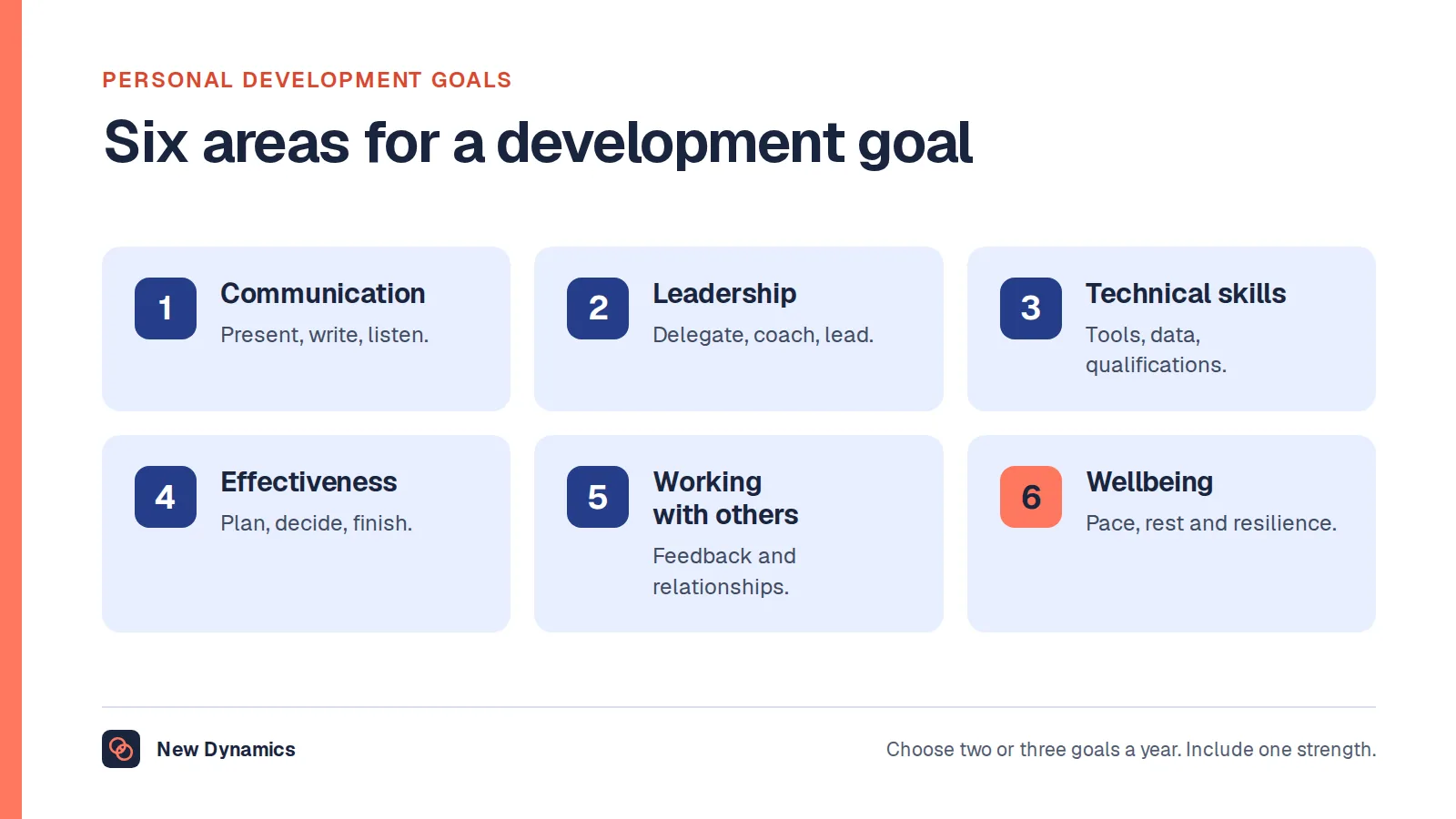
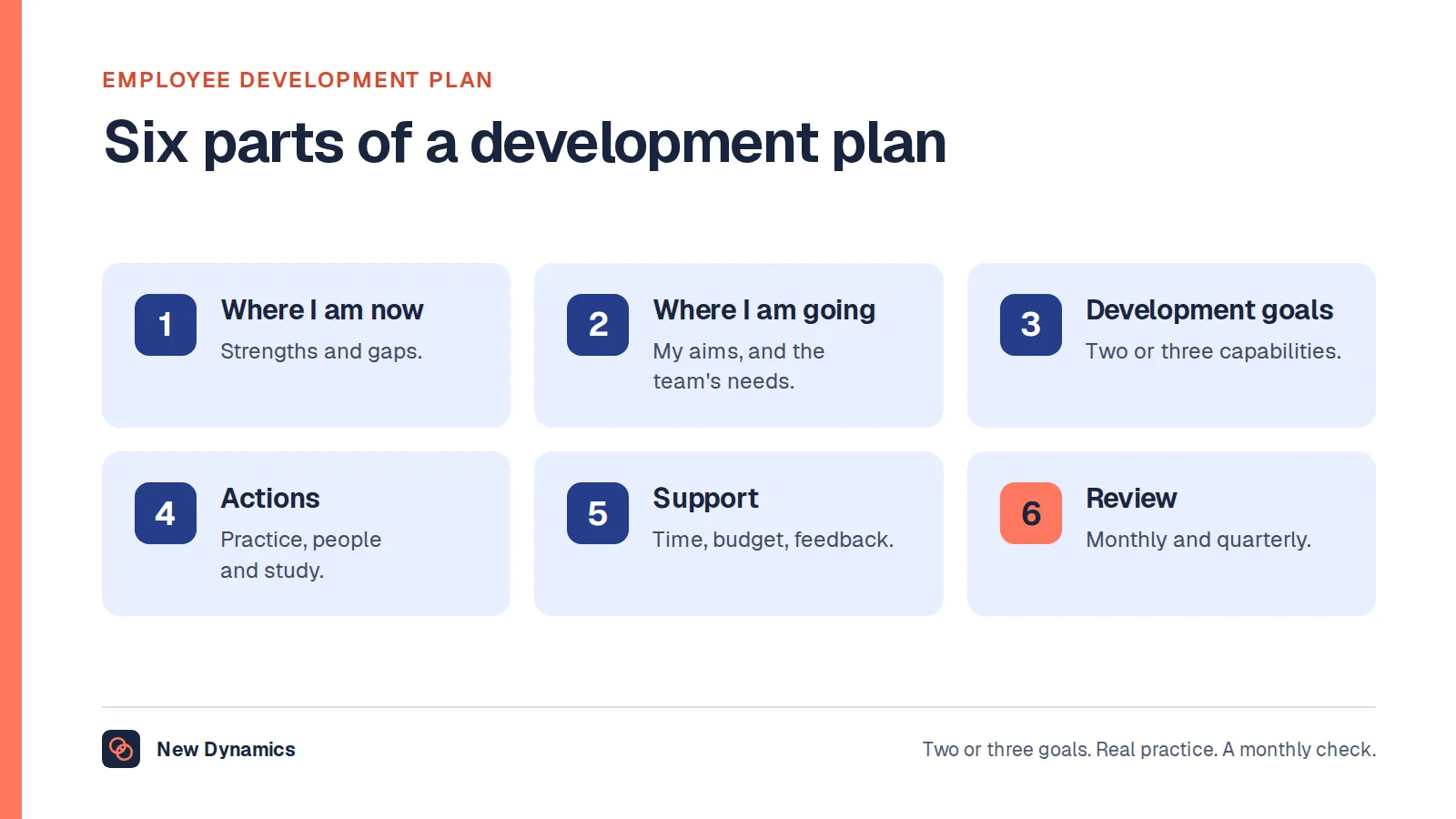
Attach it to a conversation you already have. The one-to-one is the natural home for most of what you will hear. Our one-to-one meeting questions and career conversations guides give you places to slot a new question in. For bigger ideas, use a development plan or your own personal development goals.
Tell the person what you are doing. “I am going to try something different in these meetings for a month, and I would like to know whether it helps” is better than silently changing your behaviour and confusing someone.
Set a date to decide. Two weeks, or two one-to-ones. Then keep it or drop it, explicitly. Most ideas get dropped, and that is the correct outcome. The failure mode is accumulating twelve half-tried techniques and no judgement about any of them.
Keep a one line record. A running note with the date, the idea, where you got it and what happened. After a year it is the most useful document you own about your own management, and it makes a review conversation about your development concrete rather than vague.
Do not experiment on a fragile team. If your team is mid-restructure or already distrustful, this is not the month to try something you heard on a podcast. Our guide to difficult conversations is a better starting point than a new framework.
Run a listening habit across a team without it becoming homework
The moment a manager sends a link with “have a listen before Thursday”, listening becomes an unpaid task that people will resent and most will not do. If you want this to work across a team of managers, change the unit from the episode to the conversation.
Make the discussion the commitment, not the listening. Hold a standing thirty minute slot, monthly. Anyone who listened to anything brings one sentence, and anyone who listened to nothing comes anyway. Attendance is the habit; listening is optional input.
Rotate who chooses, and let people choose badly. One person a month picks something and says in two sentences why. The quality of the pick matters far less than the fact that choosing is distributed. A compulsory curriculum set by HR is training, and training has a different budget and a different consent.
Never set listening as homework in work time nobody has. If you want people to spend an hour, give them the hour, in the open, and say so. Expecting unpaid commuting time to carry a development programme is a quiet imposition, and people notice. Be careful here if your team includes part time staff or people whose working patterns involve no commute at all.
Capture the one thing the group will try. The output of the session is not a summary. It is one practice that two or three managers will try before the next one, and a quick check at the start of the next session on whether it worked. That single loop is the difference between a book club and a learning organisation.
Keep it away from assessment. The second this appears in a review as “engagement with development opportunities”, it becomes performative. If you want it in a review, review what people changed, not what they consumed. The same principle applies to the whole of training and development: count behaviour, not attendance.
Accept a small core. In most teams three or four people will carry this and the rest will dip in. That is a working habit, not a failed one.
Where podcasts fit in CPD and your own development record
If you are a member of a professional body, listening can count towards your continuing professional development, but only in the form the body asks for.
The CIPD defines continuing professional development as “learning experiences which help you develop and improve your professional practice”, and is explicit that the mechanism is reflection: “The key to making and truly embedding that change is reflecting on your learning”. Its CPD records tool exists, in its words, “to record and reflect on your learning”.
That is a useful standard whether or not you are a member of anything. The record is not “listened to 40 episodes”. It is “changed how I open a one-to-one, in March, after an episode on employee voice, and here is what happened”. Check your own body's current requirements directly, because they change and they differ.
Our career development guide covers how to set and review development aims, and our guide to running one-to-ones covers the conversation where most of this will land.
Personal development and self help podcasts: a word of caution
The same search that turns up HR podcasts turns up personal development and self help shows, and they are a different proposition. Some are genuinely useful on habits, attention and recovering from a bad week. Many are a confident voice with a book to sell.
Two filters help. First, the same source test as above: a show that tells you what a study found, how big it was and what it did not show is operating differently from one that tells you what the brain “is wired” to do. Second, be suspicious of anything that explains your workload as a mindset problem. If your week is unmanageable because you have eleven direct reports and no admin support, that is a structure problem, and no morning routine will fix it.
So the honest answer to “what are the best self help podcasts” is that it depends on what is wrong, and that if what is wrong is the job rather than you, the answer is not a podcast. It is a conversation with your manager, and our guide to career conversations is a better place to start.
What audio cannot do
Expect too much of audio and it quietly replaces things that work better.
It cannot teach you a procedure. Disciplinary process, redundancy consultation, right to work checks. Read the current written guidance. Audio has no version number.
It cannot give you feedback. The single fastest way to improve as a manager is to find out how your people experience you, which requires asking them, or a structured 360 feedback process. No amount of listening substitutes for that.
It cannot tell you what is happening in your own organisation. That comes from your own data, your own exit conversations and your own managers. A podcast can suggest the question. It cannot answer it.
Frequently asked questions
What is the best HR podcast?
There is no useful answer to that question, which is why this page does not rank them. The right show depends on your role, the size of your organisation and what is broken this quarter. A better question is what you want to be able to do differently in a month, and which category of show, practitioner interviews, research, craft, psychology or law, is most likely to help with that.
How do I choose a human resources podcast worth my time?
Check who publishes it first, because a professional body, a university, a broadcaster and a software vendor are producing very different things. Then give it ten minutes and ask four questions: does anyone name a source, could you repeat one specific practice on Monday, is the organisation anything like yours in size and sector, and is anyone honest about what the change cost. If it fails three, stop listening.
Do podcasts count towards CPD?
That depends on your professional body, so check its current requirements directly. The CIPD defines continuing professional development as learning experiences that help you develop and improve your professional practice, and is clear that reflection is the mechanism that embeds the change. On that standard, an hour of listening on its own is not development. An hour of listening, one recorded change to your practice and a note on what happened is.
Are personal development or self help podcasts useful for a manager?
Some are, on habits, attention and recovering from a hard week. Apply the same source test you would to any other show, and be sceptical of anything that reframes a structural problem as a mindset one. If your week is unmanageable because of workload, span of control or missing support, that is a conversation with your own manager rather than something a morning routine will solve.
How do I get my team listening without making it homework?
Change the unit from the episode to the conversation. Hold a standing thirty minute monthly slot where anyone who listened to something brings one sentence, and anyone who listened to nothing comes anyway. Rotate who picks. Keep it out of performance assessment. If you genuinely want people to spend an hour on it, give them the hour openly rather than relying on their commute.
Can I trust employment law advice from a podcast?
Treat it as a prompt, never as the answer. Audio does not carry a version number, and a host rarely states which jurisdiction they are describing. Acas describes its services as covering England, Scotland and Wales, and Northern Ireland has separate arrangements. Use an episode to find out that something has changed, then read the current written guidance or take advice. This article is general information and not legal advice.
Your next step: one episode, one change
- Pick one show from a publisher you can name, and one episode on a problem you have this month.
- Listen once, at normal speed, and capture a single sentence in the form “I am going to try X in Y”.
- Try it in your next one-to-one, and tell the person you are trying something.
- Two weeks later, decide to keep it or drop it, and write one line about why.
For a structured way to connect this to your own development aims and your team's, read our career development guide. It is free to read, and the PDF uses our short download form.
Want one-to-ones, feedback and development plans in one place, so that the change you tried is visible at review time rather than forgotten? Book a New Dynamics demo and bring the review form you use today. You can also email contact@new-dynamics.com.