TL;DR
- Occupational health advises, it does not decide. Acas is explicit that after an assessment "It's up to the employer to decide whether to put in place the recommendations from the occupational health assessment."
- A referral generates special category data. The ICO says an employer must identify a lawful basis under Article 6 and "must also identify a special category condition for processing under Article 9 of the UK GDPR", and warns that worker consent is often not freely given.
- A diagnosis is usually the wrong thing to ask for. The ICO's worked example has the employer asking only about fitness for continued employment and not asking "the medical report author to provide details of the worker's condition".
A manager has someone who has been off for six weeks, or who is at work and visibly struggling. Someone says "refer them to occupational health", and the referral goes off with one line on it: please advise. Weeks later a report arrives answering a question nobody asked.
The referral is not the hard part. The hard parts are knowing which decision the advice is meant to inform, asking for that and nothing more, and handling the health information lawfully. This article covers what occupational health is and is not, when a referral is appropriate, what to ask, consent and data protection, how the report feeds into adjustments or a capability process, and what to do if the employee refuses. The guidance quoted describes Great Britain. This is general information, not legal or medical advice.
A referral is a process with stages, participants and a record, which is why it usually lives in somebody's inbox. See how New Dynamics workflows let you shape the stages, participants and approvals around how your organisation works.
What occupational health is, and what it is not
Acas puts it in one sentence in its guidance on using occupational health at work, last updated on 17 December 2025: "Occupational health is a type of medical service." It may be in house or an outside agency. Three distinctions matter more than the definition, and they are the ones managers get wrong.
It advises. It does not decide. Acas is unambiguous on the companion page about occupational health assessments: "It's up to the employer to decide whether to put in place the recommendations." So "occupational health said we had to" is not a defence, and neither is "occupational health did not mention it".
It is not the employee's treating doctor. The Access to Medical Reports Act 1988, at section 2, defines a medical report as one "prepared by a medical practitioner who is or has been responsible for the clinical care of the individual". An adviser seeing someone once for a work assessment is usually not that person. Acas calls the assessment "a useful addition to a fit note or a doctor's medical report", not a replacement for either.
It looks at the job, not only the condition. Acas says the assessment is "more focused on" two things: "how someone does their job" and "how the job might affect someone's health". A fit note speaks to fitness for work in general. An occupational health report can speak to these duties and this shift pattern. It is not an employee assistance programme, which helps the employee directly rather than advising the employer.

When an occupational health referral is appropriate
Acas lists the decisions it can help with: someone struggling with their physical or mental health, the right reasonable adjustments for a disabled worker, "someone who has been off sick for a long time or is returning to work after sickness absence", reducing sick leave, health and safety compliance, and "managing risks to mental health, such as too much pressure at work or bullying".
The Health and Safety Executive's guidance on managing sick leave and return to work tells employers to "get professional advice on issues such as fitness to work or workplace adjustments", naming occupational health providers alongside nurses, occupational therapists, pharmacists, physiotherapists and doctors. A physiotherapy or ergonomics opinion sometimes answers the question faster.
The Department for Work and Pensions guidance Getting the most out of the fit note, last updated on 6 October 2023, is narrower. At paragraph 3.5: "You may need to make a referral to occupational health specialists, for work that may be affecting your employee's health condition, this can be useful when dealing with complex cases." Where a fit note suggests seeking that advice, it adds: "It is your decision whether to act on this advice."
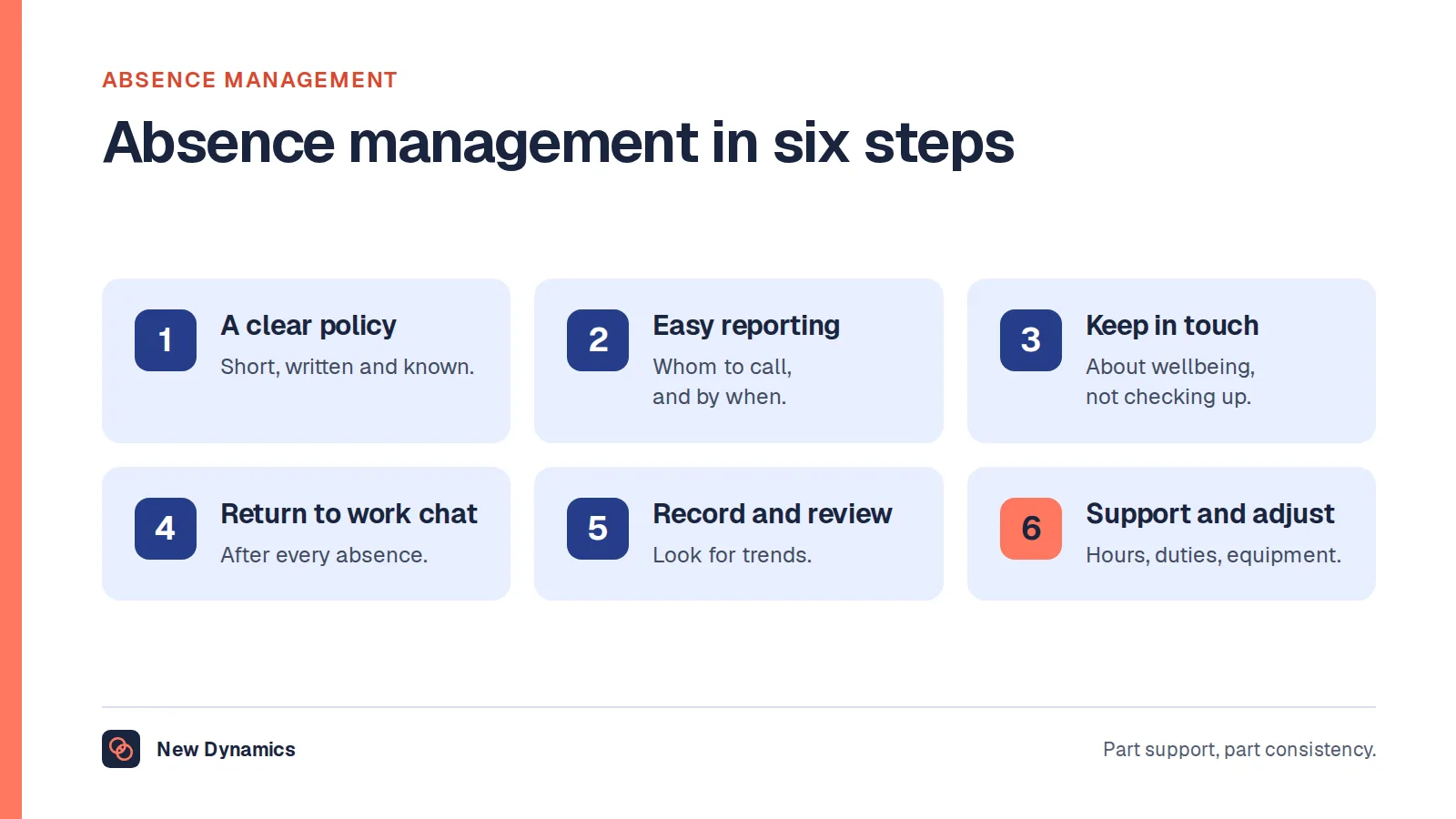
So the test is not the length of the absence. It is whether you face a decision you cannot make responsibly on what you already know. If the employee has told you what helps and you can do it, a referral only adds delay. Our post on absence management covers the policy and conversations a referral sits inside.
Acas says an occupational health policy should set out "when an occupational health referral or assessment can be made", how the assessment is carried out, what each side does and what happens next. Where there is no scheme, the employer "must get permission before contacting the worker's doctor". For scale, the HSE's key figures for Great Britain 2024 to 2025 report "1.9 million working people suffering from a work-related illness" and "40.1 million working days lost due to work-related illness and workplace injury". Wider figures sit in our HR statistics hub.
What to ask for, and what not to ask for
No official UK source publishes a model occupational health referral letter, so treat any template you are handed as convention rather than rule. What the sources do settle is the shape of the questions.
Acas's guidance on getting a doctor's report about a worker's health, last updated on 20 May 2025, says an employer "should only request the information they need", and gives three examples: "how long a worker is likely to be off sick", "whether the worker is disabled", and "what support might help a worker return to work".
The Information Commissioner's Office rules the diagnosis out in a worked example, in its guidance on data protection and workers' health information: "The employer only asks for information on the worker's fitness for continued employment in their role. They don't ask the medical report author to provide details of the worker's condition." You "should not normally ask workers to consent to the disclosure of their entire medical record", and "as far as possible, leave it to medical professionals to access and interpret detailed medical information for you".
So write the referral as a short list of decision questions, attach the real duties, say what you have already tried, and show the employee the questions first. A diagnosis is usually neither needed nor appropriate, and asking for one collects information you then have to justify holding.

Consent and health data, the legally serious part
A lawful basis and an Article 9 condition
Article 4(15) of the UK GDPR, as the ICO quotes it, defines "data concerning health" as "personal data related to the physical or mental health of a natural person". Article 9 prohibits processing it as a starting point unless a condition in Article 9(2) applies.
The ICO's test has two steps: "you must first identify a lawful basis under Article 6 of the UK GDPR", and "you must also identify a special category condition for processing under Article 9". For a referral it names the condition most employers reach for as "Employment, social security and social protection law", which is Article 9(2)(b), relevant where the employer is "ensuring the health, safety and welfare of workers". Two strings are attached: you "must meet the associated condition set out in part 1 of schedule 1 of the DPA 2018", and "you must have an appropriate policy document in place". If you have no appropriate policy document, close that gap before the next referral. Article 9(2)(h) covers "the assessment of the working capacity of the employee", but Article 9(3) lifts the prohibition there only for data processed under the responsibility of a professional bound by secrecy, which is a condition for the clinician rather than for HR.
Consent, which most referral forms lean on, is the weakest basis. The ICO: "as an employer, you will generally be in a position of power over your workers. They may fear adverse consequences and might feel they have no choice but to agree." It tells employers to "avoid relying on consent unless you are confident you can demonstrate it is freely given". Consent to the assessment itself is still needed as a matter of medical practice and Acas guidance. It is simply not a sturdy data protection basis on its own.
What the employee must be told
The ICO's guidance on occupational health schemes is specific. You "must clearly set out to workers, preferably in writing, how you intend to use information they supply", who you might make it available to and why, and "the circumstances, if any, when their line manager can access" what they tell a health professional. The baseline behind that: "Unless told otherwise, workers are entitled to assume that information they give to a doctor, nurse or other health professional will be treated in confidence and not passed to others."
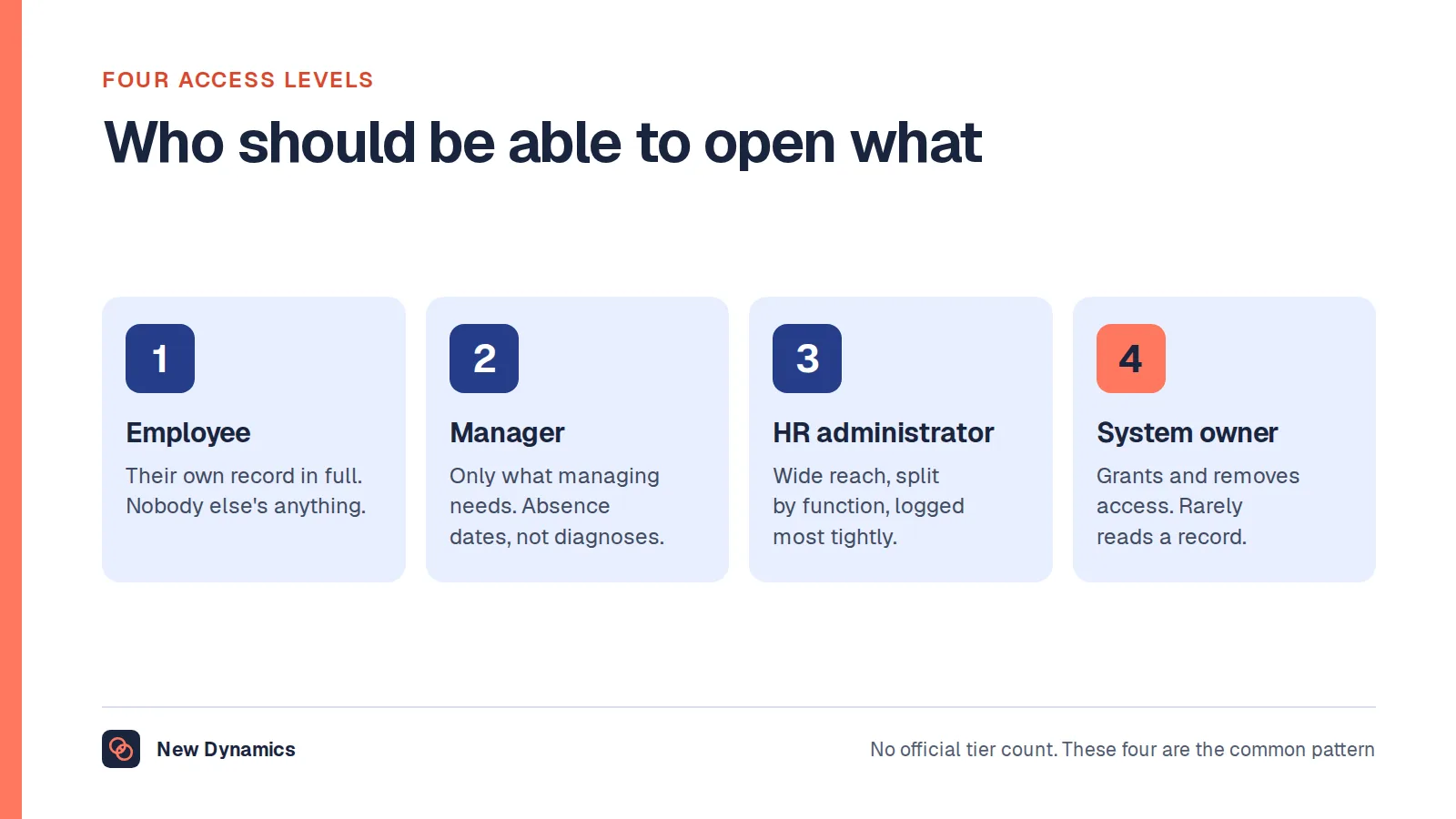
Who holds what also surprises people. A provider processing information "in their professional capacity, with their own medical professional obligations" is "likely" to be "acting as the controller, rather than as a processor", so it answers subject access requests about its own records, while the employer is controller for what it obtains "for your own purposes". You "must tell your workers who is in control of what health information". Medical details should reach managers only "where necessary to allow them to discharge their management responsibilities", kept "to a minimum". Our post on access levels for HR data covers setting that up in a system rather than by good intentions.
Can the employee see the report first?
Take this in two parts, because it is answered too confidently.
For a report from the employee's own doctor, yes, and it is statutory. Section 3 of the 1988 Act bars an application unless the individual "has notified the applicant that he consents to the making of the application". Under section 4 they may state, when giving consent, that they wish to have access "before it is so supplied", and the practitioner "shall not supply the report" until access has been given or 21 days have elapsed. Section 5 lets them ask for amendment of anything "incorrect or misleading". Acas adds the right to "ask to see a copy of the report at any time within 6 months of it being completed".
For the occupational health report itself the sources are softer. Acas says "the occupational health adviser must ask for the worker's permission before sharing it with their employer", and that where "a doctor carries out the occupational health assessment the employer must inform the worker in writing of their rights" under the Act. The Act's own definition turns on a practitioner responsible for the individual's clinical care, which an occupational health doctor seeing someone once generally has not been. Whether the Act strictly bites there is not settled by the guidance we can quote, and Acas advises informing the worker in writing anyway. The safe reading: set out the rights in writing, and do not expect a report the employee has not agreed to release.
Two points belong in the policy rather than in an argument later. Acas says whether appointments are paid "should be written in the organisation's policy", and that if a disabled worker is disadvantaged because their time is unpaid, "this could be disability discrimination". Tell the worker "from the start how to withdraw their consent to a report". In Northern Ireland the ICO points to the Access to Health Records (Northern Ireland) Order 1993 instead of the 1988 Act.

From report to adjustments, or to a capability process
Acas sets out what the two sides might agree afterwards: "more time off work", a referral for therapy such as physiotherapy or counselling, adjustments to the workspace, or "a phased return to work, for example reduced working hours or lighter duties".
Where adjustments are recommended, Acas restates the duty: "By law, employers must make reasonable adjustments when they know, or could reasonably be expected to know, someone is disabled." An employer need not make unreasonable ones, but "they should still find other ways to support someone". That duty, including the knowledge test, is in our post on workplace adaptations and reasonable adjustments.
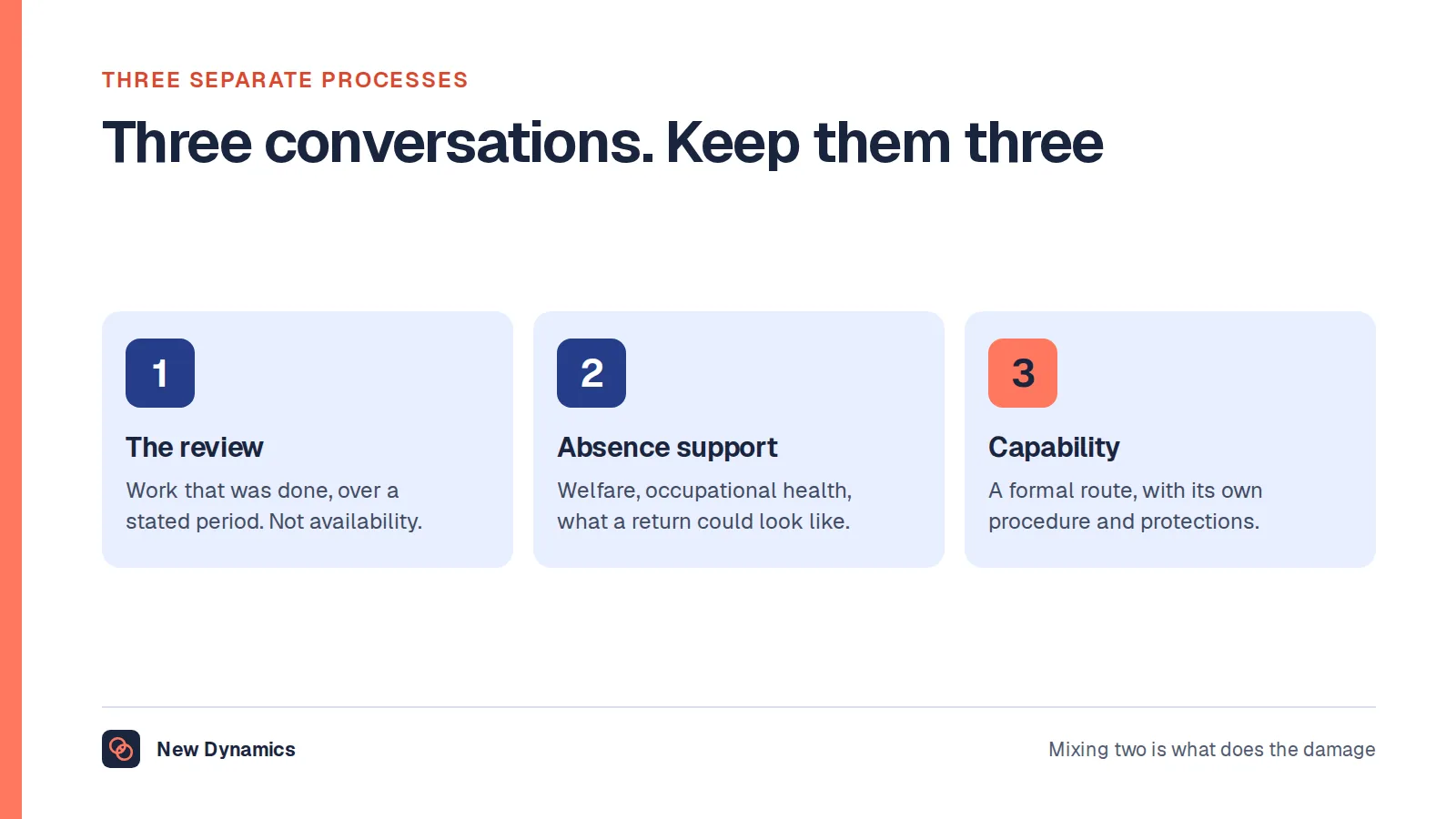
Where no reasonable return is supported, the route is a capability process rather than a disciplinary one, and the report is one piece of evidence in it. Our post on the capability procedure sets out that sequence, and reviewing an employee on long-term sick leave covers the review cycle alongside it. Where the assessment and a doctor's report disagree, Acas says employers "should talk with their worker and come to an agreement on the best course of action".
If the employee refuses the referral
They are allowed to. Acas: "The worker does not have to agree to an occupational health assessment." The guidance gives reasons to agree rather than penalties for declining, and they are the employee's reasons: to get support they need "to feel better and be able to do their job", to "return to work safely and more quickly", and to "avoid their employer making big decisions without important information".
Then proceed on what you have. For a refused medical report, Acas lists what is left: "anything the worker has told them", "information in the worker's fit note", and "an occupational health report, if they have one". Record that the referral was offered and declined, and that the decision rests on partial information. Do not treat refusal as misconduct, and ask why first: the answer is often fear about who will read the report, which the transparency the ICO already requires will fix.
Frequently asked questions
What does occupational health do?
Acas describes it as a type of medical service. It assesses how someone does their job and how the job might affect their health, then advises the employer on fitness for work, timescales and adjustments. It does not treat the person and does not make the employer's decision.
Can an employee refuse an occupational health referral?
Yes. Acas states that a worker does not have to agree to an occupational health assessment. The employer then decides on what it has: anything the worker has told them, the fit note, and an earlier report if one exists. Record that the referral was offered and declined.
Does the employee have to consent to the report being shared?
Acas says the occupational health adviser must ask for the worker's permission before sharing the report with their employer. The employer should also tell the worker from the start how to withdraw consent later.
Can an employee see the occupational health report before the employer?
For a report from a doctor responsible for their clinical care, yes. Section 4 of the Access to Medical Reports Act 1988 lets the individual say, when giving consent, that they want access first, and the report cannot be supplied until they have had it or 21 days have passed. For a report from an adviser who has not provided their clinical care, the guidance does not settle the point, and Acas advises setting out these rights in writing anyway.
What lawful basis applies to an occupational health referral?
The ICO says an employer must identify a lawful basis under Article 6 and, because health data is special category data, also a condition under Article 9. For employment purposes it names the employment, social security and social protection law condition, which also requires part 1 of schedule 1 of the Data Protection Act 2018 and an appropriate policy document.
Should a referral ask for a diagnosis?
Usually not. The ICO's worked example has the employer asking only about fitness for continued employment, redeployment and adjustments, and not for details of the worker's condition. It also says employers should not normally ask for disclosure of an entire medical record.
Your next step: fix the paperwork before the next referral
- Find your occupational health policy. If there is not one, write the four things Acas lists: when a referral can be made, how the assessment works, what each side does, what happens next.
- Check you have an appropriate policy document for special category data, as the ICO requires for the employment condition.
- Rewrite the referral form as decision questions about fitness, timescales and adjustments. Delete any request for a diagnosis or full records.
- Write down who may read a report, and set system access to match.
- Add a line to the staff privacy information covering referrals, who controls what, and how to withdraw consent.
For the data protection side of all of this, read and download our employee data protection guide. The guide is free to read, and the PDF uses our short download form.
Want the referral, the consent record, the adjustments and the review dates held in one sequence instead of five inboxes? Book a New Dynamics demo and bring your current referral form. You can also email contact@new-dynamics.com.