TL;DR
- Research assistant is four different jobs sharing one title: a grant-funded university post, a contract role in a commercial research company, fieldwork in a market research agency, and a study-support role in a clinical setting. Name the setting in the first line of the advert, because the duties and the governance differ in each.
- The duties that fill the week are literature searching, data collection, data entry and cleaning, running participants, analysis support, writing up and reference checking. The employment realities are usually missing from the advert: a fixed-term contract tied to a grant, what happens when the grant ends, and part-time study alongside the job.
- Research data about people is personal data, and in a clinical context it is often special category data. The ICO says there is "no specific lawful basis for research" and that "in most cases, consent is not the most appropriate lawful basis", which is the most misunderstood point in research administration. This article is general information about the United Kingdom and not legal advice.
Two people answer an advert for a research assistant. One spends three years screening abstracts and running models on a dataset nobody else has opened. The other spends it phoning participants, checking consent forms and typing numbers off paper. Same advert.
That is the problem with the research assistant job description: it describes a position in a hierarchy rather than a body of work. It says somebody supports a more senior researcher, and nothing about the setting, the data, the governance or the contract. Those four are the job.
The role runs on dates somebody has to hold: an ethics approval, a grant end, a notice period that starts before anyone says anything out loud. See how New Dynamics configurable workflows keep owners, steps and due dates in one place, so a contract end is a scheduled step rather than something remembered in the wrong week.
Where law or figures are quoted they describe the United Kingdom. This is general information, not legal advice.
What does a research assistant do?
A research assistant carries out defined parts of a research project under the direction of a more senior researcher, and is accountable for the quality and documentation of that work rather than the study's design.
That names the direction, which is why "under the supervision of" appears in almost every genuine advert, and the accountability, which adverts miss. A research assistant rarely chooses the question or the method, but is the only person who can say whether participant 47's second measurement was taken before or after the room was moved.
The American occupational database O*NET files the nearest equivalent under social science research assistants, defined as "Assist social scientists in laboratory, survey, and other social science research. May help prepare findings for publication and assist in laboratory analysis, quality control, or data management." That is an American occupation on an American classification, quoted because its task list is honest about the clerical content of the work.
Research assistant job description: the title means four different jobs

Before you write a duty, name the setting.
A university research assistant
A post attached to one funded project, reporting to a principal investigator, usually fixed term for the length of the award. The work is the project's: literature, data, analysis, drafting and whatever administration the grant generates. There is often a teaching element, and often an expectation of studying for a doctorate alongside the job.
The National Careers Service research scientist profile describes that route plainly: "It may be possible to start as a research assistant or graduate industrial scientist. You would usually need to study part time for a PhD while you work." It adds that "UK Research and Innovation and industrial companies sometimes offer studentships", as published when we checked the page on 5 November 2026.
A research assistant in a commercial research company
Here the research is the product: projects are scoped, costed and billed, and deadlines are contractual. The work looks similar on paper, but accountability runs to a project manager and an invoice rather than a publication, and confidentiality runs to the client too.
A research assistant in a market research agency
A commercial insight role, more operational than analytical. The National Careers Service market researcher profile lists tasks including "set up and send out online polls, surveys and questionnaires to gather information" and "write survey reports and store information securely". Our post on what a questionnaire is covers the instrument design.
A research assistant in a clinical setting
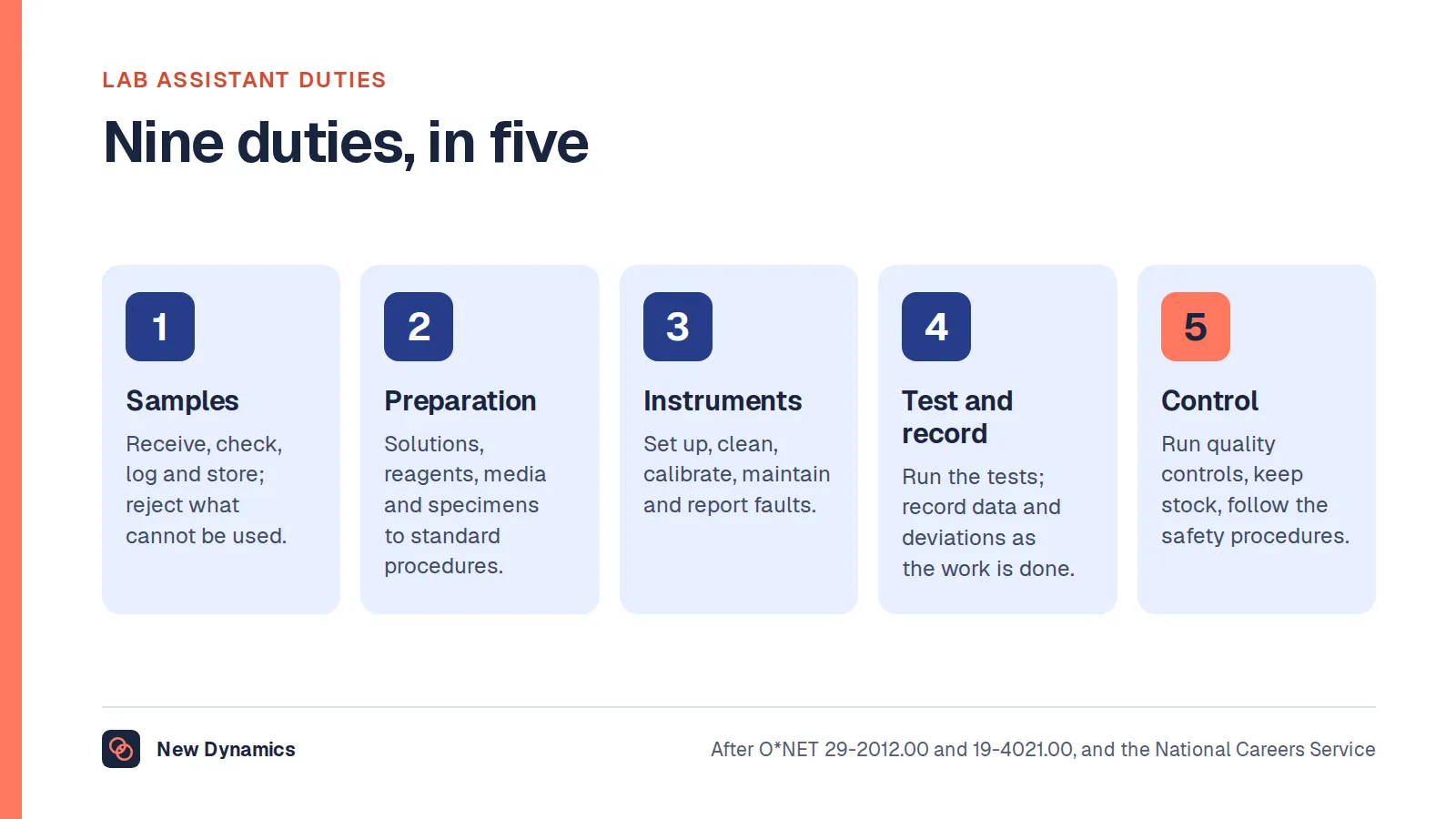
The most governed version: study visits, screening, consent, source data and case report forms, sample handling and the paperwork a regulated study generates. Protocol compliance is the standard, not a preference, and the data is health data, so special category data from the moment it exists. Our lab assistant job description covers the neighbouring bench role.
An advert that does not say which of the four it is has described nothing.
Research assistant duties and responsibilities

Literature searching. Running a strategy rather than typing a phrase into a box: the databases, the terms and Boolean logic, screening against inclusion criteria, and a log that lets somebody else reproduce the result set. Without the log nobody can say whether a gap in the evidence is real or an artefact of the search.
Data collection and running participants. Recruiting, screening and scheduling, then running the session or visit to the protocol. O*NET's task list for that American occupation includes "Recruit and schedule research participants", "Screen potential subjects to determine their suitability as study participants" and "Obtain informed consent of research subjects or their guardians". This duty cannot move around a deadline: the participant has already taken an afternoon off.
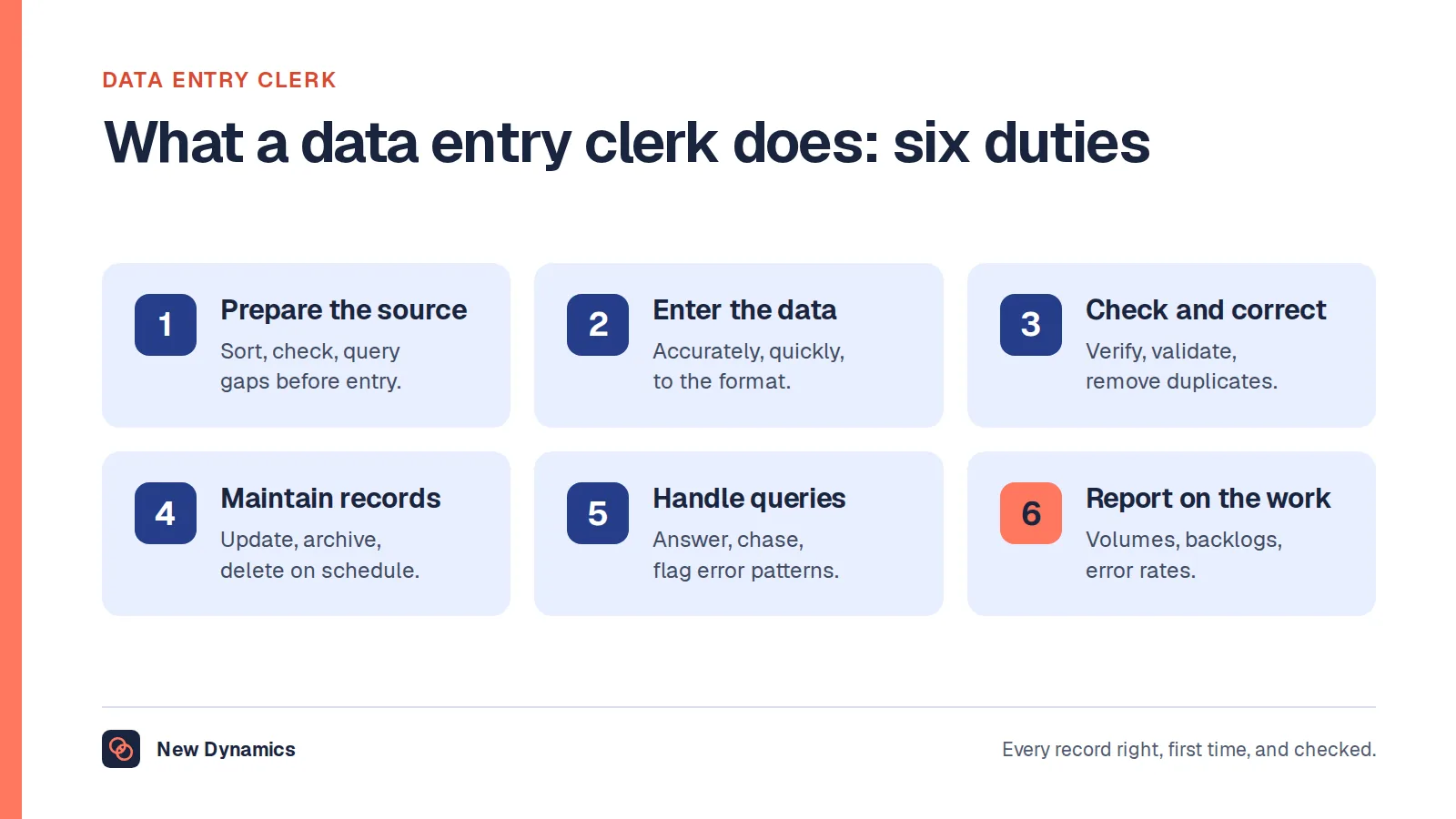
Data entry and cleaning. The least glamorous duty and the one most likely to decide whether the study is any good: entering from paper or exporting from an instrument, checking ranges and logic, resolving impossible values against the source. O*NET lists "Verify the accuracy and validity of data entered in databases, correcting any errors". Our data entry clerk job description covers the keying.
One rule carries the rest: raw data is read-only. Cleaning happens in a script or logged process that can be re-run from the raw file. A spreadsheet edited by hand over eighteen months cannot be.
Analysis support. Running the agreed tests and checking the output against the analysis plan rather than the hoped-for result. Keep the code, the output and the data version together, because the first question a reviewer asks is which dataset produced a figure.
Writing up. Drafting methods and results, assembling tables, preparing figures. The methods section is usually the research assistant's, because they remember what happened.
References and citation discipline. A duty, not a habit. Every reference exists, matches its claim, and was read rather than inherited from somebody else's bibliography. Citation errors propagate: one misattributed finding gets cited forty times by people who never opened it.
Fixed-term contracts, grant funding and the four year rule
Most research assistant posts in the United Kingdom are fixed term because the money is. GOV.UK's guidance on fixed-term employment contracts says employees are on a fixed-term contract if "they have an employment contract with the organisation they work for" and "their contract ends on a particular date, or on completion of a specific task, like a project". A grant-funded post is the second limb exactly.
Fixed term does not mean second class. The Fixed-term Employees (Prevention of Less Favourable Treatment) Regulations 2002 give "the right not to be treated by his employer less favourably than the employer treats a comparable permanent employee", including as regards "the opportunity to receive training" and "the opportunity to secure any permanent position in the establishment". Those two are where research employers trip: excluding a fixed-term research assistant from the training budget, or from the internal pool for a permanent post.
What happens when the grant ends
GOV.UK's guidance on renewing or ending a fixed-term contract says such contracts "will normally end automatically when they reach the agreed end date. The employer does not have to give any notice." But non-renewal is not neutral: "This is considered to be a dismissal. If the employee has 2 years' service, the employer needs to show that there's a 'fair' reason for not renewing the contract." Employees "may be entitled to statutory redundancy payments after 2 years' service" where that reason is redundancy.
Working past the end date without a formal renewal creates, in GOV.UK's words, "an 'implied agreement' by the employer that the end date has changed", so drifting past a grant end on goodwill creates a position nobody intended. And a grant end date is known years ahead, so there is no excuse for raising redeployment three weeks out. Our posts on the redundancy process and the employment contract cover it.
Successive fixed-term contracts and the four year rule
Research careers are often built from a chain of one and two year contracts, which is what regulation 8 addresses. Headed "Successive fixed-term contracts", it provides that where a fixed-term contract has previously been renewed, or the employee was previously on one, "the provision of the contract mentioned in paragraph (1)(a) that restricts the duration of the contract shall be of no effect, and the employee shall be a permanent employee" if two things are true: "the employee has been continuously employed under the contract mentioned in paragraph 1(a), or under that contract taken with a previous fixed-term contract, for a period of four years or more", and "the employment of the employee under a fixed-term contract was not justified on objective grounds".
GOV.UK states the same rule plainly: "Any employee on fixed-term contracts for 4 or more years will automatically become a permanent employee, unless the employer can show there is a good business reason not to do so."
Three details decide real cases. The clock runs on continuous employment with the same employer, and regulation 8(4) disregards "any period of continuous employment falling before the 10th July 2002". The effect takes hold on the later of the date the contract was last renewed and "the date on which the employee acquired four years' continuous employment", so it bites at a renewal. And regulation 8(5) lets a collective or workforce agreement substitute different provisions, which GOV.UK summarises as an agreement that "removes the automatic right to become a permanent employee". Many research employers have one, so check yours. This describes the United Kingdom and is general information, not legal advice.
Part-time study alongside the role
Many university research assistants are registered students at the same time, usually part time for a doctorate. An employer who ignores that is managing a fiction. Write it into the arrangement: hours protected for study, whether the study uses the project's data, who supervises the thesis and who supervises the job, what happens to the thesis when the grant ends, and whether fee support exists. Agree it at the start, because the conflict surfaces when a deadline and a thesis chapter land together.
Research integrity and ethics: approval, consent and conduct
This separates a research assistant from an administrator who works in a research building. UK Research and Innovation's research integrity page, last updated on 16 September 2026, sets the standard: "High integrity in research is the result of upholding the values of honesty, rigour, transparency and open communication, care and respect for those involved in research."
Ethical approval is a boundary, not a form. A study involving people runs within the scope of its approval, and the research assistant is the person at that boundary: in the room when a participant asks something the protocol did not anticipate, or when it would be convenient to collect one extra variable. Anything outside the approved protocol needs an amendment before it happens, not a note afterwards. In the clinical context the ICO gives the recognised meaning: approved medical research is "medical research approved by a research committee recognised or established by the Health Research Authority".
Consent duties. Use the current approved information sheet and consent form, give the participant time, check understanding rather than a box, record the version and date, store the signed form where it can be found, and act on a withdrawal at once. Consent to take part is an ethical requirement, not a lawful basis under data protection law.
What counts as misconduct. The UKRI policy on the governance of good research practice, last updated on 1 April 2026, reads as a list of things a junior researcher can be pressured into. Fabrication "includes making up results, other outputs (for example, artefacts) or aspects of research, including documentation and participant consent, and presenting or recording them as if they were real". Falsification is "inappropriately manipulating or selecting research processes, materials, equipment, data, imagery or consents". Failure to meet legal and ethical obligations includes "misuse of personal data, including inappropriate disclosures of the identity of research participants".
The policy separates that from "poor research practices" such as "inadequate documentation or record-keeping", which "might only require further training or development rather than formal disciplinary action". That distinction belongs in an induction: a research assistant who cannot tell the two apart will panic about a transcription slip or stay quiet about something serious. Name in the job description the person a concern is raised with, and a second in case the first is the problem.
Data protection for research data: the part that defines the role

Research data about people is personal data. In a clinical or health context it is special category data, and a research assistant often has more direct access to it than anybody else on the project. The ICO's special category list includes "data concerning health", alongside racial or ethnic origin, political opinions, religious beliefs, trade union membership, genetic and biometric data, and sex life or sexual orientation. Research touching those needs a lawful basis and an Article 9 condition.
The research provisions, as the ICO words them
The ICO's guidance on the research provisions explains that the UK GDPR and the Data Protection Act 2018 contain provisions for processing personal data for research, covering three purposes: "archiving purposes in the public interest", "scientific or historical research purposes" and "statistical purposes". They reach the data protection principles, a condition for special category and criminal offence data, and exemptions from individuals' rights. Every page notes that the guidance "is under review and may be subject to change" following the Data (Use and Access) Act, so check it live.
Two principles carry built-in provisions. The ICO's page on principles and grounds for processing says you "can reuse existing personal data for research-related purposes, as long as you have appropriate safeguards in place", and that "you can keep personal data indefinitely, if you are processing it for research-related purposes", qualified at once: "this must be your only purpose."
On the lawful basis the ICO is blunt: "There is no specific lawful basis for research. Depending on your status and context, you are likely to rely on either legitimate interests or public task." For "a private or third sector organisation conducting research, legitimate interests is the most likely lawful basis"; for "a public authority, such as a university or an NHS organisation, public task".
And on the point everybody gets wrong: "consent to participate in a research study is distinct from consent as a UK GDPR lawful basis to process personal data". Why: "Consent is only valid if the person can withdraw it at any time." Where a withdrawal cannot be fully actioned, because that would undermine the research and effective anonymisation is not possible, then in the ICO's words "you cannot rely on consent as your lawful basis (or condition for processing special category data)". Consent is also inappropriate "where there is a power imbalance between you and the person whose personal data you are processing", and the ICO concludes that "in most cases, consent is not the most appropriate lawful basis".
For special category research data the ICO sets out the Schedule 1 paragraph 4 requirements: the processing must be "necessary for that purpose", "subject to appropriate safeguards for people's rights and freedoms, as set out in Article 89(1) of the UK GDPR", "not likely to cause someone substantial damage or substantial distress", "not used for measures or decisions about particular people, except for approved medical research", and "in the public interest". The fourth has teeth: "you cannot use the findings of your research to provide specific, individualised services or decisions to any subject of your research".
Anonymisation and pseudonymisation are not the same word
The ICO's guidance on appropriate safeguards sets a preference order: "Where possible, you should carry out your research using anonymous information. This information is not personal data and data protection law does not apply." Where that is impossible, "you should consider whether it is possible to pseudonymise the data. Pseudonymous data is still personal data and data protection law applies." And "you should ensure that you do anonymisation or pseudonymisation at the earliest possible opportunity".
The ICO's introduction to anonymisation names the common research error: "It is common to refer to datasets as 'anonymised' when in fact they still contain personal data, just in pseudonymised form." The instruction belongs on the wall of every project office: "if you can still identify people using additional information you hold separately, the data is not anonymised. It is pseudonymised and is still personal data."
A participant ID with the linking key two folders away is pseudonymised, not anonymous. Removing names may not be enough either. In the ICO's example a health authority strips names and addresses from a dataset derived from medical records, and "there may still be enough details about the people to potentially re-identify them". Small-sample qualitative work has the same problem: a quotation attributed to "a part-time technician in a small team" identifies one person to colleagues.
Who should have access
Start from the minimum. Article 89 safeguards, the ICO says, "take the form of technical and organisational measures to ensure respect for the principle of data minimisation": "you should identify the minimum amount of personal data you need to fulfil your purpose. You should hold that much information, but no more." Other named safeguards include DPIAs where necessary, staff training and "privacy enhancing technologies eg trusted research environments".
Then separate the layers and name who sees each. Identifiers and contact details, for recruitment and scheduling. Signed consent forms, for whoever owns consent. The linking key, which almost nobody needs. The pseudonymised dataset, for the analysis team. The published output, which is anonymous or it is not publishable.
Access is a list, and a list has to be reviewed. The research assistant whose contract ended last quarter is still in the folder permissions unless somebody removed them, and on a grant-funded project somebody's contract is always ending. Our post on employee records retention covers the schedule. This describes the United Kingdom and is general information, not advice.
Authorship: who goes on the paper, and who decides
Authorship is pay in academic research, and a research assistant is most exposed to somebody else getting it wrong. UKRI's policy puts it inside the definition of misconduct: under misrepresentation it lists "involvement, including inappropriate claims to authorship or attribution of work and denial of authorship or attribution to persons who have made an appropriate contribution". Both halves matter, adding a name that did not earn one and leaving off a name that did.
Settle it at the start. Name the convention the project follows and where the post holder can read it. Say what contribution earns authorship and what earns an acknowledgement, who decides author order and when, and what happens if the research assistant leaves before submission, which on a fixed-term contract is normal. Record contributions as the project runs: reconstructing who did what two years later is how disputes start.
A research assistant job description template you can paste
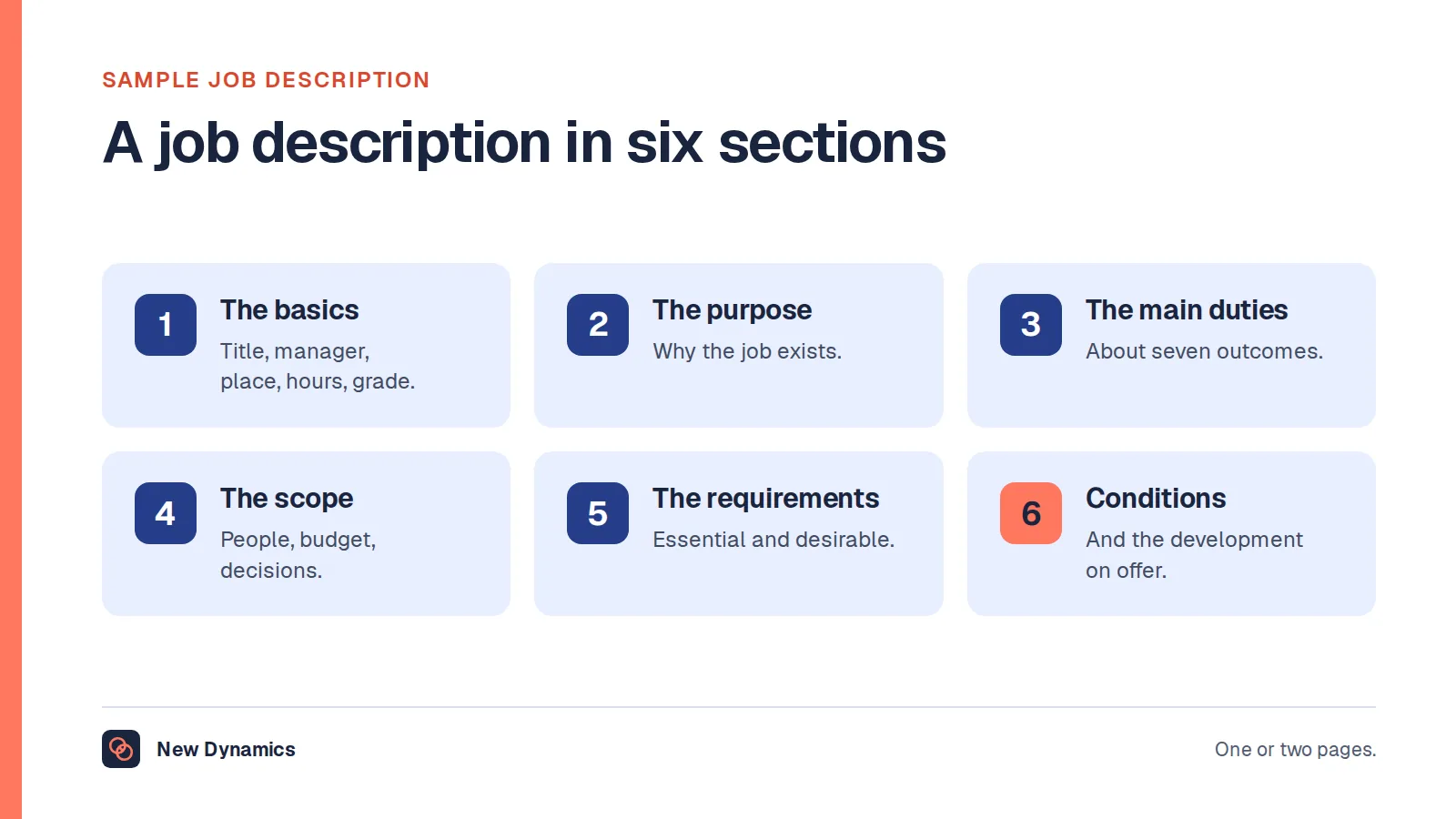
Replace every bracketed prompt with your own facts. For the whole document's structure see our job description template, and for turning duties into accountabilities our guide to writing a job description.
Job title: Research Assistant ([project or programme name])
Setting: [University department] / [commercial research company] / [market research agency] / [clinical research setting].
Reports to: [Principal investigator or study lead]. Supervised day to day by [name].
Basis: Fixed term for [x] months to [date], funded by [award]. [Full time or part time, x hours.] [x hours a week protected for part-time doctoral study.]
Purpose of the role: To carry out defined elements of [project] to the approved protocol and analysis plan, to document that work so another researcher could reproduce it, and to handle research data in line with our data protection and ethics rules.
The work: Participants [who, how many, recruited how]. Data [type, volume, whether special category]. Tools [database, software].
Accountabilities:
- Literature searches run to a recorded strategy, with a reproducible search log
- Participants run within the approved protocol, and anything outside it raised before it happens
- Consent taken on the current approved documents, recorded with version and date, and withdrawals acted on at once
- Raw data never altered; cleaning scripted or logged so the dataset can be rebuilt from source
- Analysis follows the agreed plan, with code, output and data version kept together, and every reference checked against its claim
- Research data held with identifiers separated, pseudonymised early, and accessible only to named people
- Concerns about data, conduct or participant welfare raised with [named contact]
Skills and experience: [Degree or equivalent] in [subject]; search and data-handling skills tested on an exercise using our own material; [named software] at a level you can evidence; understanding of research ethics, consent and data protection.
Authorship: This project follows [named convention]. [Who decides author order, and when.]
End of contract: The post is funded to [date]. We will discuss redeployment with you no later than [x months] before that date.
What good looks like after six months: The search log reproducible by a colleague, the dataset rebuildable from raw files, no protocol deviation unreported, and no research data outside approved storage.
Two prompts do most of the work: the setting line stops the wrong candidates applying, and the end-of-contract line is the one candidates remember.
Pay, and what no official source publishes
No official United Kingdom source publishes a pay figure for "research assistant" as a title, and none publishes a pay spine point for one. University research posts sit on a grade of a local structure, published by individual employers rather than by government, so we will not borrow a number and call it national. Take the figure from your own structure.
What is published officially is pay for adjacent occupations. The National Careers Service research scientist profile gives, under "Average salary (a year)", "£27,000 Starter" to "£48,000 Experienced", and typical hours of "39 to 41 a week", checked on 5 November 2026. That is a research scientist, the role a research assistant post is often a route into. The market researcher profile gives "£24,000 Starter" to "£28,000 Experienced", checked the same day. For wider figures see the HR statistics hub.
Progression from research assistant
The usual academic route is research assistant to research associate or research fellow, which normally requires a completed doctorate, then senior research fellow and independent funding. The National Careers Service research scientist profile puts it as: "In an academic post, once you've gained experience and published original research, you could progress to senior research fellow or professor and lead your own research team." In a research organisation it describes moving "into a senior research or laboratory management position".
A library is the other place this work lives, and the job has changed more than most people assume. Our post on the librarian job description covers the four settings and the professional ethics that come with them.
Outside academia the routes are wider and often better paid: data analysis, clinical research coordination, research management, policy and evaluation, and commercial insight. Each values a different part of the skill set, so make development explicit rather than assume everybody wants a chair. Attach that conversation to a fixed date rather than to a vacancy. New Dynamics goals and OKRs holds the objective, the evidence and the check-in dates in one place, so a twelve-month contract leaves a record of what the post holder did. Our post on a career progression framework covers the levels.
Frequently asked questions
What does a research assistant do?
A research assistant carries out defined parts of a research project under the direction of a more senior researcher. The usual duties are literature searching to a recorded strategy, recruiting and running participants, collecting and cleaning data, supporting the agreed analysis, drafting methods and results, and checking every reference.
What is a research assistant job profile, compared with a research associate?
A research assistant works to a protocol and an analysis plan set by someone else. A research associate or fellow post normally requires a completed doctorate and more responsibility for design, interpretation and publication. Titles vary, so read the duties rather than the label.
Are research assistant jobs always fixed term?
Most are, because the funding is. GOV.UK says an employee is on a fixed-term contract where it "ends on a particular date, or on completion of a specific task, like a project", which describes a grant-funded research post. Fixed-term employees must not be treated less favourably than comparable permanent employees without objective justification.
What happens to a research assistant when the grant runs out?
Non-renewal counts as a dismissal. GOV.UK says that if a contract is not renewed and the employee has two years' service, the employer "needs to show that there's a 'fair' reason for not renewing the contract", and statutory redundancy pay may be due where the reason is redundancy. A grant end date is known years ahead, so discuss redeployment months before it.
Does a research assistant become permanent after four years?
Often, but not in every case. Regulation 8 of the Fixed-term Employees (Prevention of Less Favourable Treatment) Regulations 2002 makes the duration restriction "of no effect" once there has been four or more years' continuous employment on fixed-term contracts and the fixed term "was not justified on objective grounds". GOV.UK adds that a collective agreement can remove that right. This is general information about the United Kingdom, not legal advice.
Is consent enough to use research data about people?
No, and the two are different. The ICO says that "consent to participate in a research study is distinct from consent as a UK GDPR lawful basis to process personal data", that there is "no specific lawful basis for research", and that public task or legitimate interests is usually more appropriate, because consent must be withdrawable at any time.
Your next step: write the contract and the consent into the document
- Name the setting in the first line: university, commercial research company, market research agency or clinical.
- Write the duties as accountabilities, including the two nobody writes down: a reproducible search log and a rebuildable dataset.
- State the funding end date, and a date by which redeployment is discussed.
- Set out the study arrangement in writing if the post holder is registered part time.
- State the authorship convention, who decides order, and what happens if they leave before submission.
- Identify the lawful basis and the Article 9 condition before the first participant is approached, and pseudonymise early.
Research data about identifiable people is a data protection obligation before it is an administrative one. Read and download our employee data protection guide for the lawful basis, access and retention decisions.
Want objectives, evidence and check-in dates for a fixed-term research post in one place? Book a New Dynamics demo and bring the review form you use today, or email contact@new-dynamics.com.