TL;DR
- The exemption in section 264 ITEPA 2003 covers an annual party or similar annual function that is available to employees generally, or generally to those at one location, where the cost per head does not exceed £150.
- It is an exemption, not an allowance. HMRC's manual is explicit: for a function outside the exemption, employees are chargeable "on the full cost per head, not just the excess over £150", for themselves and for family or household guests.
- Cost per head is the total cost of the function plus any transport or accommodation, including VAT, divided by everyone who attends, employees and non-employees alike.
Someone books the Christmas party. The invoice arrives at £158 a head, and the assumption in the room is that £8 per person is now taxable. It is not. The whole £158 is.
That misunderstanding is the most expensive thing about staff parties in the United Kingdom, and it is avoidable. This article sets out what the staff party exemption requires, how cost per head is worked out, how the limit behaves across two events in a year, and what to do when it is missed. It is general information about the position in the United Kingdom and not tax advice.
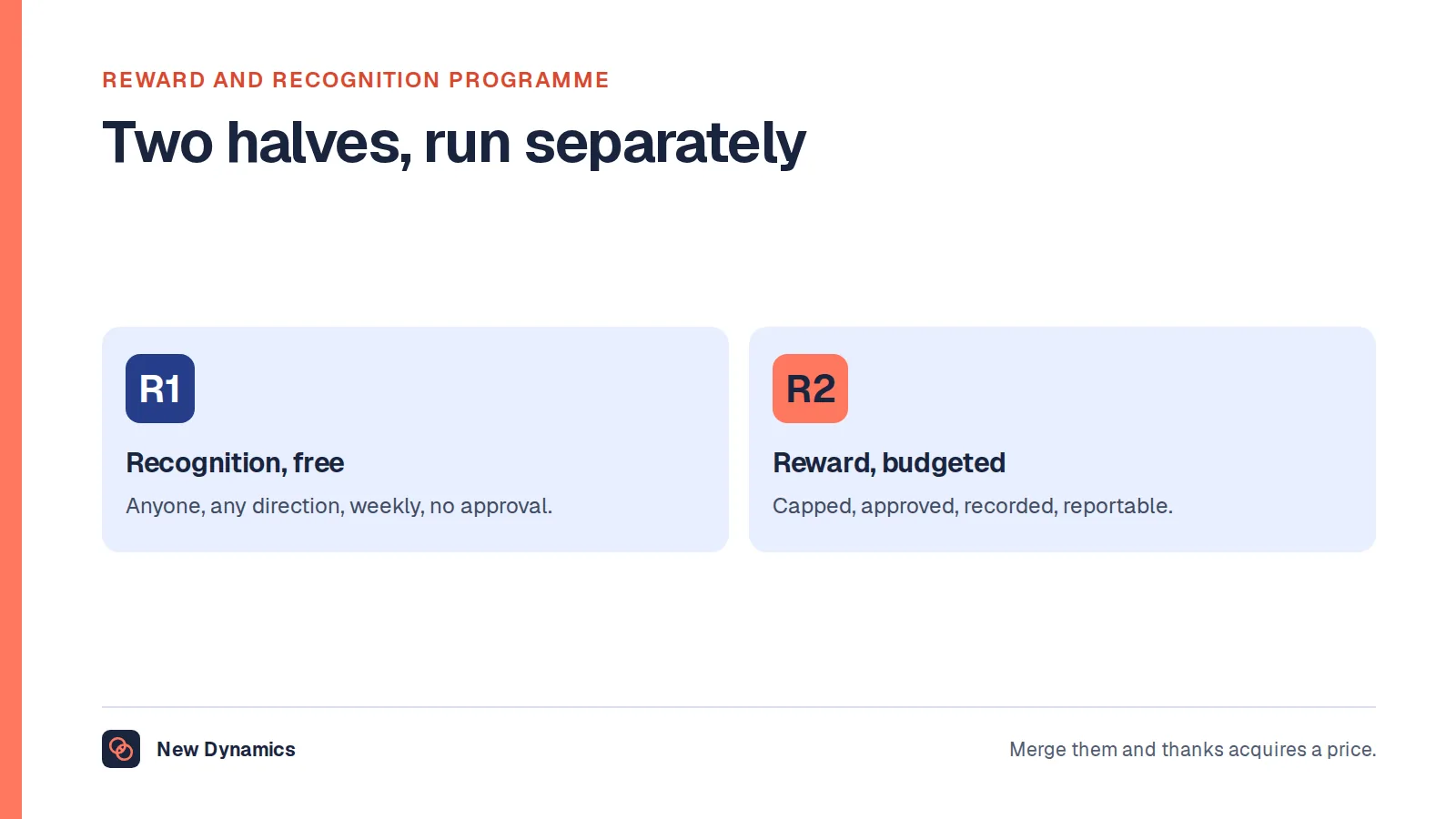
Appreciation people remember rarely depends on one night in December. See how New Dynamics recognition keeps specific contributions visible through the year, so the party is the celebration rather than the whole reward.
What the staff party exemption covers
The rule is section 264 of the Income Tax (Earnings and Pensions) Act 2003. It applies to "an annual party or similar annual function provided for an employer's employees and available to them generally or available generally to those at a particular location." Subsection (2) sets the limit: where only one such function is provided in the tax year, "no liability to income tax arises in respect of its provision if the cost per head of the party or function does not exceed £150."

GOV.UK's guidance on social functions and parties puts the conditions plainly. To be exempt, the function must "be open to all your employees", "be annual, such as a Christmas party or summer barbecue" and "cost £150 or less per person". It adds that "This also applies to online or virtual parties."
Three details decide most real cases.
Annual means recurring. HMRC's Employment Income Manual at EIM21690 states that annual here "is something that happens once a year on a recurring basis", so "a one-off event, for example a party to celebrate a 25th anniversary, cannot be an annual party or function."
Generally available, not selectively. In HMRC's first example an all-staff Christmas party at £50 a head is exempt, while a separate directors-only party at £75 a head "is not covered by the exemption because it is not available to staff generally."
Locations and departments are allowed. A function open to everyone at one site still qualifies where there is more than one site, and GOV.UK adds that you "can also put on separate parties for different departments, as long as all of your employees can attend one of them."
The figure is not indexed. EIM21690 notes that "until 5 April 2003 the figure was £75 per head", and legislation.gov.uk shows £150 substituted from 13 June 2003 by S.I. 2003/1361. Read on 7 November 2026, inside the tax year from 6 April 2026 to 5 April 2027, it is still £150.
Exemption, not allowance: the part employers get wrong
This is the centre of the subject, and HMRC gives it its own heading. Under "Exemption not allowance", EIM21690 says: "The figure of £150 is not an allowance. For functions that are outside the scope of the exemption ... directors and employees ... are chargeable on the full cost per head, not just the excess over £150", in respect of "themselves and any members of their family and household who attend as guests."

HMRC's booklet 480 says it again at chapter 5, paragraph 5.1: the £150 "is not an annual allowance and the criteria set out at Section 264 ITEPA 2003 must be satisfied to meet the exemption."
So this is a cliff edge, not a slope. At £150.00 per head there is nothing to report. At £150.01 nothing is exempt, and an employee who brought a partner has a taxable benefit of the full cost for two people. Trimming a party from £158 to £149 a head saves far more than £9 a person, which makes the planning question not "how far over are we" but "can we get under".
How cost per head is calculated
Section 264(4) defines it as the total cost of the function plus "any transport or accommodation incidentally provided for persons attending it (whether or not they are the employer's employees), divided by the number of those persons". Subsection (5) adds that the total "includes any value added tax on the expenses incurred".
EIM21690 turns that into an instruction: "Divide the total cost of each function by the total number of people (including non-employees) who attend in order to arrive at the cost per head."
So VAT counts, and a quote shown excluding it is not the figure to compare with £150. Coaches and hotel rooms count where the employer lays them on. Guests count twice over: everyone attending goes into the divisor, which is why inviting partners pushes the cost per head down, but if the exemption fails the employee is taxed on their own share and on that of any family or household member who came with them.
HMRC's figures are in EIM21691. Its second example takes a dinner dance costing "£10,000 including VAT", including transport and accommodation for certain guests, with 100 people attending, and arrives at £100 per head. What is divided is attendance, not invitations, so a half empty room raises the cost per head above the budgeted figure.
Two or more annual functions in the same tax year
Section 264(3) covers this. Where two or more qualifying functions are provided, the exemption covers "one or more of them" so long as the cost per head of the exempt party or parties "does not exceed £150 or £150 in aggregate". GOV.UK's version: "As long as the combined cost of the events is no more than £150 per head, they're still exempt."
Go over in aggregate and you choose. EIM21690 says that where the total goes over £150, "whichever functions best utilise the £150 are exempt, the others taxable". It also says HMRC does "not expect employers to keep a cumulative record, employee by employee, of functions attended", but "for each function the cost per head should be calculated."
Its example runs two dinner dances open to all staff, at £100 and £80 per head. Either could be exempt alone, "but it is more beneficial overall for the first to be exempted", so the £100 event is exempt and anyone who attended the second is chargeable on £80. GOV.UK's reporting page adds the warning: "you'll have to report and pay on the full costs of any additional events that go over this limit, even if they cost less than £150 per head on their own."
If the exemption is not met: P11D, or a PAYE Settlement Agreement
GOV.UK sets out the default. Where an event is not exempt you must "report on each employee's form P11D" and "pay Class 1A National Insurance on the full cost of the event". Expenses and benefits are reported by 6 July after the tax year ends, and Class 1A on work benefits is due "by 22 July each year for the previous tax year", or 19 July by post. The Class 1A rate for the 2026 to 2027 tax year is 15%, per rates and thresholds for employers. Our post on the P11D deadline covers that return in full.

That route puts a taxable benefit on the record of an employee who assumed the party was a gift. The practical alternative is a PAYE Settlement Agreement, which GOV.UK describes as letting you "make one annual payment to cover all the tax and National Insurance due on minor, irregular or impracticable expenses or benefits for your employees". Get a PSA and you will not need to "include them in your end-of-year P11D forms" or "pay Class 1A National Insurance on them at the end of the tax year (you pay Class 1B National Insurance as part of your PSA instead)".
Staff entertaining is on GOV.UK's list of what a PSA can include, under impracticable items: "staff entertainment that is not exempt from tax or National Insurance Contributions". The dates matter. The application deadline "is 5 July following the first tax year it applies to", and payment is due "by 22 October after the tax year the PSA applies to (19 October if you pay by post)". The Class 1B rate for 2026 to 2027 is also 15%. Separately, GOV.UK states that you "do have to report how much social functions and parties are worth to each employee if they are a part of a salary sacrifice arrangement".
A gift handed out at the party
Small gifts have their own exemption, and the two rules interact rather than stack. We cover the four conditions of the trivial benefits exemption in our post on fringe benefits, so this is only the interaction.
HMRC's guidance at EIM21871 says that where a benefit is covered by the trivial benefits exemption and another exemption, "you should apply the outcome that is most favourable to the employee". Its example has two functions at £140 and £40 per head: the first is exempt under section 264, and the second, which fails on the aggregate, is covered by the trivial benefits exemption because it cost no more than £50.
The limit is the next sentence: "If an existing exemption exempts only part of a benefit, even if the excess cost is less than the trivial benefit monetary limit, that excess is not exempt." A single £180 function is exempt under neither rule, so you cannot use a £50 exemption to shave £30 off a party that has already failed. Costs inside the event belong to the event too: HMRC's virtual party example counts a hamper sent to each attendee inside the £100 cost per head. For the wider package these sit in, see our employee benefits guide.
A company whose only employee is a director
This comes up constantly and the honest answer is that no official source answers it directly. Section 264(1) requires a function "provided for an employer's employees and available to them generally", and neither GOV.UK's guidance nor EIM21690 and EIM21691 addresses a company whose only employee or office holder is its director. HMRC publishes no example of that case.
What HMRC does publish is the opposite case: the exemption is denied to a directors-only party at a company that also employs other staff, because it "is not available to staff generally". The condition is about excluding some employees, not about how many there are. A one-person company should take its own advice before relying on the exemption, and keep the invoice, the attendance and the cost per head on file either way.
Frequently asked questions
What is the staff party exemption?
It is the exemption in section 264 of the Income Tax (Earnings and Pensions) Act 2003. No income tax arises on an annual party or similar annual function provided for employees and available to them generally, or to all those at one location, where the cost per head does not exceed £150.
Is the £150 limit an allowance?
No, and this is the point employers most often get wrong. HMRC's manual at EIM21690 states that "The figure of £150 is not an allowance", and that for a function outside the exemption employees are chargeable "on the full cost per head, not just the excess over £150". Booklet 480 repeats that it "is not an annual allowance".
What counts towards the cost per head?
Section 264(4) and (5) include the cost of the function plus any transport or accommodation incidentally provided for people attending, and any VAT on those expenses. HMRC's instruction is to divide that total by the number of people who attend, including non-employees, so guests and partners go into the divisor.
Can we hold two staff parties and still be exempt?
Yes, if the cost per head of the exempt functions does not exceed £150 in aggregate. Where the total goes over, HMRC says whichever functions best use the £150 are exempt and the others taxable. In its example, events at £100 and £80 per head leave the first exempt and employees charged on £80 for the second.
Does a virtual Christmas party qualify?
Yes. GOV.UK states that the exemption "also applies to online or virtual parties", and EIM21690 says a function provided virtually using IT can meet the exemption provided all the other conditions are satisfied.
What do we do if the party is not exempt?
Report it on each employee's form P11D and pay Class 1A National Insurance on the full cost of the event, by 6 July and 22 July respectively after the tax year ends. Alternatively apply for a PAYE Settlement Agreement by 5 July following that tax year, which keeps it off employees' P11D forms and replaces Class 1A with Class 1B.
Your next step: check the per head figure before you book
- Add up the whole cost including VAT, plus any coaches or hotel rooms you are providing so people can attend.
- Divide by the number of people you expect to attend, employees and guests together, and compare with £150.
- Check the structural conditions separately. Is the event annual and recurring, and can every employee at the site attend?
- Add in any other annual function already held in the same tax year, and test the aggregate per head figure.
- If the total goes over, choose now between the P11D route and a PAYE Settlement Agreement, and diarise 5 July.
To put recognition on a footing that does not rest on one evening a year, read and download our employee recognition guide. The guide is free to read, and the PDF uses our short download form.
Want appreciation and performance evidence to sit in one place instead of being reconstructed at review time? Book a New Dynamics demo and bring your current recognition process. You can also email contact@new-dynamics.com.