TL;DR
- Job performance is how well someone does the work their role exists to do: the results they achieve and the way they achieve them, judged against what was expected.
- Four things drive it: ability, a clear understanding of the role, the working environment and motivation. When performance dips, it is tempting to blame the last of these and overlook the first three.
- Measure it with more than one lens. Combine results, quality, behaviour, feedback from others and growth, and compare them with expectations that were agreed in advance.
“She's a strong performer.” “His performance has dropped.” Managers say these things every week, often without stopping to ask what they mean. Performance at what? Compared with what? And caused by what?
This article gives a plain definition of job performance, explains the four factors that drive it, sets out five fair ways to measure it and shows what to check first when it dips.
If you want goals, feedback and evidence in one place when you assess performance, see how New Dynamics performance reviews bring them together.
What is job performance?
Job performance is how well someone does the work their role exists to do. It covers the results they achieve and the way they achieve them, judged against what was expected.
Three parts of that definition matter.
- Results and behaviour. A salesperson who hits the target by misleading customers has not performed well. Nor has a kind colleague who delivers nothing. Performance is the what and the how together.
- Against expectations. Performance is always relative to a standard. If the standard was never agreed, any judgement is a matter of opinion.
- The role's purpose. Being busy is not the same as performing. The test is whether the work the role exists for is getting done.
Performance is different from effort, potential and results alone
| Term | What it means | Why it differs |
|---|---|---|
| Effort | How hard someone tries | Effort aimed at the wrong thing produces little |
| Results | What was achieved | Results also depend on luck, markets and other people |
| Potential | What someone could do in a bigger or different role | A strong performer today may or may not suit the next level |
| Job performance | How well the person did what the role required | It takes account of results, behaviour and what was within their control |
For the difference between performance and potential, see what talent means at work.
The parts of job performance
In practice, most roles ask for four kinds of contribution. This is our working breakdown. It is a practical aid, and we do not claim it as a formal model.
- Core tasks: the duties in the job description, done to the standard required.
- Contribution to the team: helping colleagues, sharing information and making the place better to work in.
- Adapting: learning new tools, coping with change and handling the unexpected.
- Conduct: following the rules that matter, such as safety, honesty and respect for others.
A review that looks only at the first of these will overrate the brilliant individual who damages the team, and underrate the person who quietly holds it together.
The four factors that drive job performance
Why does one person perform well and another struggle? The open textbook Organizational Behavior, published by OpenStax, identifies four factors in its section on motivation, direction and intensity.
1. Ability
OpenStax describes ability as “the knowledge, skills, and receptiveness to learning that a person brings to a task or job”. Can the person do what is being asked? If they cannot yet, training, coaching or practice is the answer. Encouragement alone will not supply a missing skill.
2. Role clarity
“Accurate role perceptions refer to how well an individual understands their organizational role.” That includes the outcomes expected and the way they are to be achieved. OpenStax adds that incomplete or inaccurate role perceptions “limit employees' capacity to meet expectations, regardless of their abilities and motivation”.
This is the cheapest factor to fix and one of the most often neglected. Many people who appear to be underperforming are doing a good job of something nobody wanted. Our performance goals examples show how to write expectations down.
3. The performance environment
“The performance environment refers to those factors that impact employees' performance but are essentially out of their control.” OpenStax gives the example of a word processor working with a defective computer, who “is certainly not going to perform at peak levels, regardless of ability or desire”.
Tools, systems, workload, staffing, conflicting priorities and the quality of management all belong here. So does health. If several people in the same team are struggling, look at the environment before you look at the individuals.
4. Motivation
OpenStax calls motivation “the fourth major factor that determines whether a person will perform a task well”, and defines it as a force that “energizes, directs, and sustains human behavior”. Direction matters as much as intensity: energy pointed at the wrong goal does not help.
Motivation depends heavily on the other three. People lose heart when they lack the skills, the clarity or the tools to succeed. Our plain guide to expectancy theory explains why.

How to measure job performance
No single measure captures performance. Use several, and agree them in advance.
- Results against goals. Did the person achieve what was agreed? This is the clearest measure, provided the goals were good ones. See our SMART goal examples.
- Quality. Accuracy, rework, complaints and whether the work can be relied on without checking.
- Behaviour. How the person works with others, measured against a short list of described behaviours. See core competencies.
- Feedback from others. Colleagues, customers and other managers see parts of the work that the line manager does not.
- Growth. What the person can do now that they could not do a year ago.
Keep the set small. The GOV.UK Service Manual gives the same advice for services: choose three or four metrics that show whether the thing is working. Our KPI tracker guide and success indicator examples can help you pick them.
Two cautions apply.
- Any single number can be gamed. Calls per hour rise when agents cut customers short. Pair each quantity measure with a quality safeguard.
- Measure what the person controls. A sales target missed because the product was withdrawn says nothing about the salesperson.
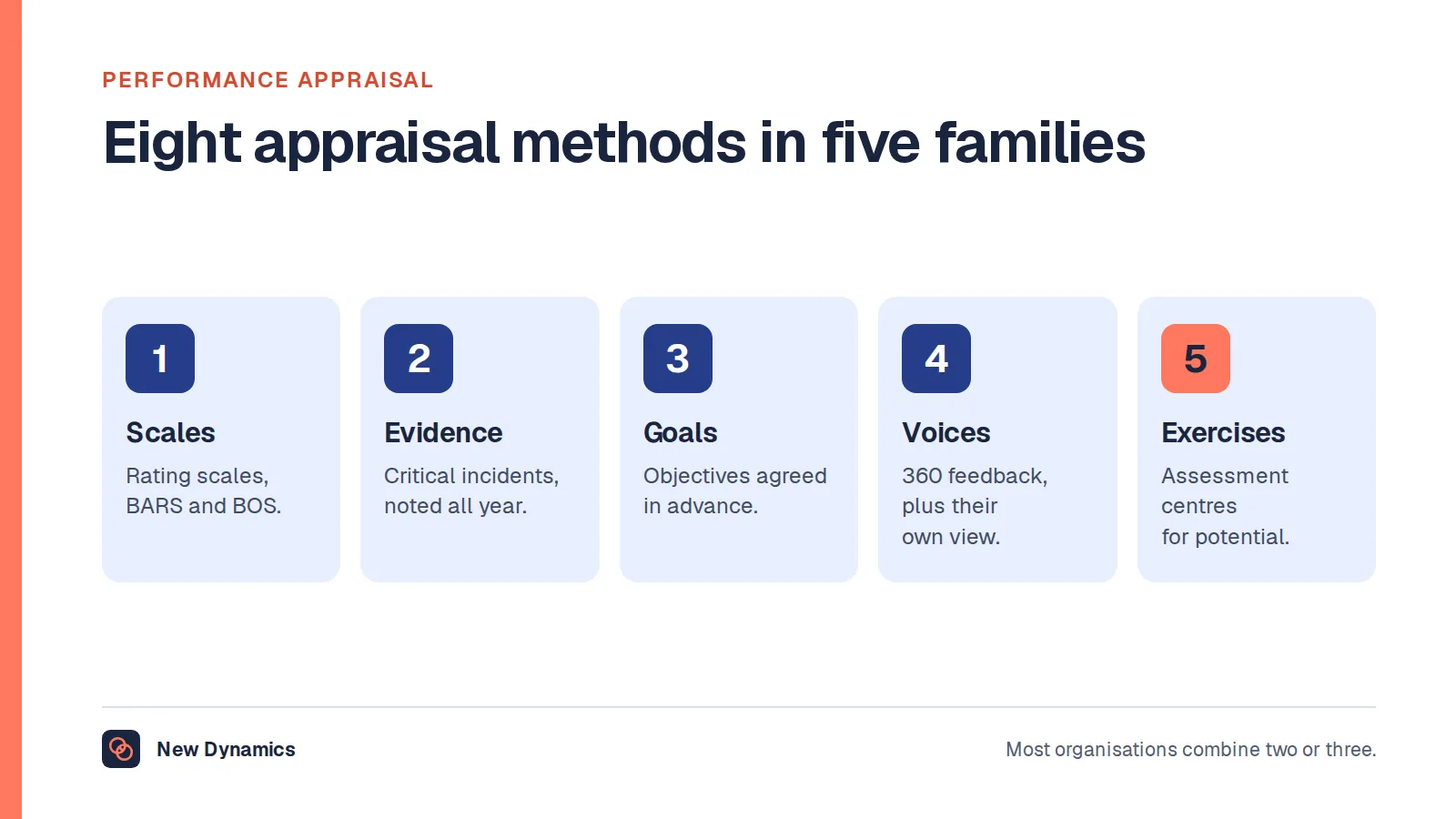
For the formal methods, from rating scales to 360-degree feedback, see our guide to performance appraisal.

When job performance dips: check four things first
The instinct is to conclude that the person has stopped trying. Work through the four factors in order, because the cheapest fixes come first.
- Do they know what is expected? Ask them to describe their priorities and what good looks like. If their answer differs from yours, you have found the problem.
- Can they do it? Has the job changed, or the tools? Do they have the skills this work now needs?
- Is something in the way? Workload, systems, unclear decisions, conflict in the team, health or trouble at home.
- Do they want to? If the first three are sound, talk about motivation: what has changed, and what they value.
Acas takes a similar line in its guidance on problems with an employee's performance. It says that “employers should try to understand why”, and it separates capability, “someone's ability to do their job”, from conduct, “someone's behaviour at work”. For a capability issue, it suggests support such as coaching, mentoring and training. It also warns that a problem that looks like conduct may really be capability, for example where lateness is linked to a health condition. This is general information, not legal advice.

If you are the one who wants to improve, see our practical ways to improve work performance.
How managers can raise job performance
Each factor suggests its own actions.
Ability
- Hire for the skills the work really needs.
- Give training at the point of need, and time to practise.
- Pair people with someone who does the task well.
Role clarity
- Agree a handful of goals and the standards that go with them.
- Say what matters most when priorities conflict.
- Check understanding by asking, not by assuming.
Environment
- Ask, “What is getting in your way?” in every one-to-one, and act on the answers.
- Fix the tools and the processes that waste people's time.
- Keep workloads realistic. Our one-to-one meeting questions include prompts for this.
Motivation
- Notice good work and say so, specifically. See our positive feedback examples.
- Keep promises about pay, promotion and development.
- Give people a say in how they do their work.
Common mistakes in judging job performance
Judging effort or hours. Presence is easy to see, and it says little about contribution.
Judging only the recent past. A strong year can be forgotten after one poor month. Keep notes through the year.
Confusing confidence with competence. The person who talks most about their work is not always the one doing the most.
Ignoring the environment. Comparing two people fairly means comparing their territories, tools and workloads as well.
Moving the goalposts. If expectations change, say so at the time. Do not reveal it at the review.
Treating performance as fixed. Performance varies with the role, the manager and the moment. A struggling person in one team is sometimes a star in another.
Frequently asked questions
What is job performance?
Job performance is how well someone does the work their role exists to do. It covers both the results they achieve and the way they achieve them, judged against expectations that should have been agreed in advance.
What factors affect job performance?
OpenStax identifies four: ability, which includes knowledge and skill; accurate role perceptions, meaning a clear understanding of what is expected; the performance environment, such as tools and workload; and motivation. Weakness in any one of them limits performance.
How do you measure job performance?
Use several measures together: results against agreed goals, quality of work, behaviour against described standards, feedback from colleagues and customers, and growth over time. Agree the measures in advance and pair each number with a quality safeguard.
What is the difference between job performance and productivity?
Productivity is output for a given input, such as cases closed per day. Job performance is broader. It includes quality, behaviour, contribution to the team and adaptability, as well as the quantity of work done.
What causes poor job performance?
Common causes are unclear expectations, missing skills, poor tools or systems, excessive workload, health or personal problems, and low motivation. It is tempting to assume low motivation. Checking clarity, ability and obstacles first is usually more productive.
How can managers improve job performance?
Agree clear goals and standards, provide training and coaching, remove obstacles such as poor tools and conflicting priorities, give regular and specific feedback, and recognise good work. Find the cause of a dip before choosing the remedy.
Your next step: run the four-factor check
- Think of one person whose performance concerns you, or your own.
- Score each factor from 1 to 5: ability, role clarity, environment and motivation.
- Start a conversation about the lowest score.
- Agree one change, and review it in a month.
For a fair, supportive process when someone is struggling, read and download our performance improvement guide. The guide is free to read, and the PDF uses our short download form.
Want goals, feedback and reviews connected, so that performance is judged on evidence? Book a New Dynamics demo and bring your current approach. You can also email contact@new-dynamics.com.