TL;DR
- Employers hire HR consultants for four recurring reasons: a risk nobody in house has handled, a restructure, a rebuild of pay or policy, and an investigation that needs independence. The fifth is cover while a post is vacant.
- An advisory retainer, a project and an interim placement are three different purchases. A consultant is the wrong answer when the real need is permanent capacity or an absent system, and the brief decides which you are buying.
- Responsibility for employee data does not move. The ICO states that controllers are primarily responsible for overall compliance with the UK GDPR, and that a written contract needs to be in place whenever a controller uses a processor.
Two quite different people search for HR consulting. One is an employer with a problem that has outgrown the people available to solve it. The other is an HR professional wondering whether the job they do for one employer could be done for several.
This article serves both, in two marked halves: the first for the employer buying, the second for the person thinking of becoming a consultant. Both are about the United Kingdom, and both are general information rather than legal advice.
A consultant leaves you a design. Someone then has to run it every year after they have gone. See how New Dynamics performance reviews take a review process agreed on paper and actually run the cycle.
New Dynamics is not a consultancy. We make a performance management platform for goals, feedback, recognition, reviews and onboarding, so we have no engagement to sell you here and no firm to recommend.
What HR consulting is, and what it is not
HR consulting is paid advice, or paid delivery, on the people side of an organisation, from someone who is not your employee. "Human resource consulting", "HR consultancy services" and "HR advisory" describe the same market, and tell you nothing about what a supplier actually does.
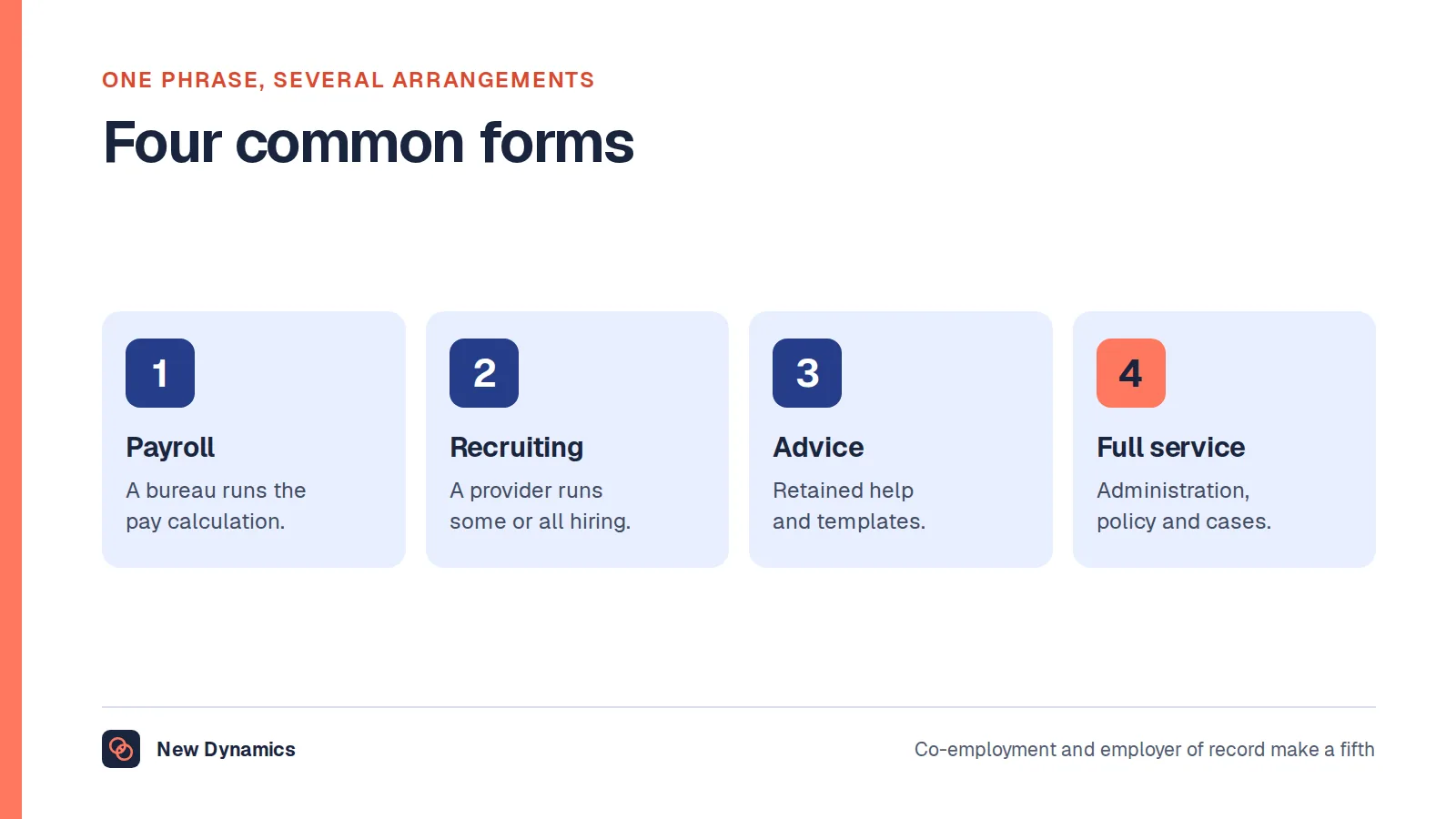
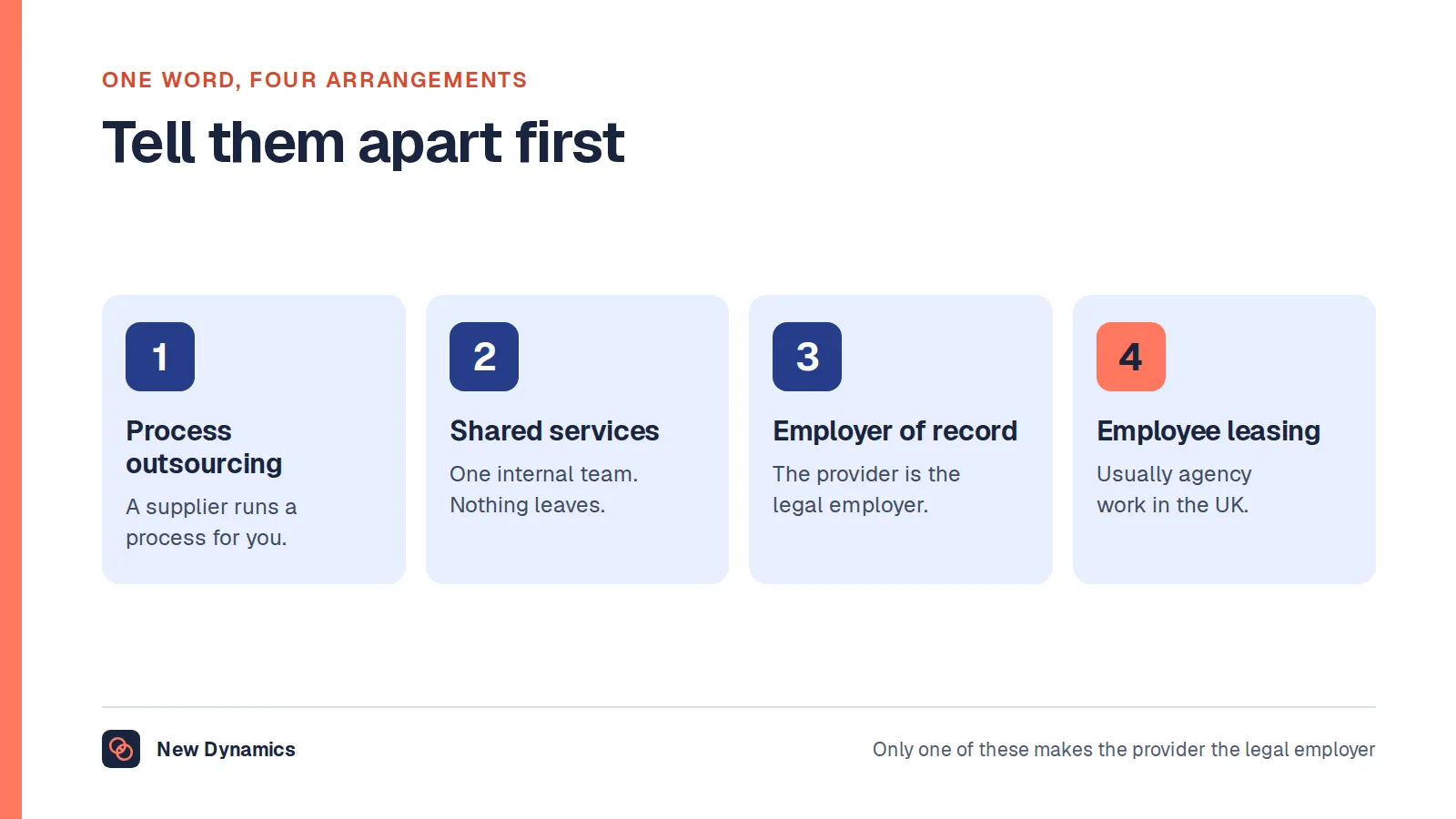
It is not outsourcing, which hands a whole process over to run continuously and brings different duties. Our guide to HR outsourcing sets out the five arrangements and what never moves, and BPO outsourcing covers the contractual shape.
And it is not a substitute for a decision. A consultant can investigate, draft, model, advise, train and recommend. The employer dismisses, promotes, pays and signs. Every arrangement that goes wrong has, near the start, a confusion about which of those two lists an activity belongs on.
For employers: what HR consultants actually get hired for

Strip out the brochure language and the same briefs recur.
A risk nobody in house has handled. A long term sickness case tangled up with a disability discrimination allegation. A dismissal where the process has already gone wrong twice. A grievance against a director. GOV.UK states that "Before you make a claim to an employment tribunal, you must tell Acas (Advisory, Conciliation and Arbitration Service)", and on the time limit for employment tribunal claims says you usually have "6 months if the problem happened on or after 1 October 2026" and "3 months if the problem happened before 1 October 2026". Acas reports that in the year from 1 April 2025 to 31 March 2026 it "dealt with over 150,000 notifications for early conciliation", in its annual report coverage. An HR officer who has run twenty capability cases has not necessarily run one of these.
A restructure. GOV.UK states that "You must follow 'collective consultation' rules if you're making 20 or more employees redundant within any 90-day period at a single establishment", and sets the minimum period before the first dismissal at 30 days where 20 to 99 roles are affected and 45 days where 100 or more are, in its guidance on redundancy consultations. Those figures shape the project plan, not the paperwork.
A pay structure. Grading, job evaluation and pay ranges need someone to compare roles that colleagues cannot compare dispassionately, because they know the people in them. Our job evaluation guide covers the method; a consultant applies it without a stake in the result.
A policy rebuild. A handbook written in 2016, a sickness policy copied from a previous employer, a disciplinary procedure that no longer matches the Acas Code. This suits a fixed fee project, because the output is countable.
An investigation that needs independence. Its own section follows.
Interim cover. The least glamorous and most common reason. The HR manager has resigned or is signed off, the review cycle starts in six weeks, and the post has to be held. That is not advisory consulting.
Retainer, project or interim: three different purchases

Employers usually ask what HR consulting costs before asking what shape they are buying. The shape matters more: it decides who carries the risk of the work taking longer than expected.
An advisory retainer is access. A monthly or quarterly fee for being able to ring someone when a case starts. It suits an employer with no HR specialist, or a lone HR officer who needs a more senior judgement to test against. Retainers fail in two directions: unused, they feel like insurance nobody claims on; overused, the consultant starts rationing. Ask what the fee includes, what falls outside it, and what happens to unused time.
A project is an output. Six policies redrafted. A grading structure built and signed off. It should carry a fixed fee, because the supplier knows better than you how long the work takes. A supplier who will only quote a day rate for work with a defined output is asking you to carry their estimating risk.
An interim placement is a person in a seat, at a day rate, for a period. The useful question is not the rate but the handover: what will exist at the end that did not exist at the start, and who will own it.
A fourth shape is often right: a single paid diagnostic, one or two days to establish what the problem actually is, with no commitment to buy the fix from the same supplier.
On fees we publish no figures. No official United Kingdom source publishes a day rate, a retainer price or an earnings figure for HR consultants: the Office for National Statistics earnings series are organised by occupation and do not isolate independent HR consultancy, and neither GOV.UK nor Acas publishes consultancy rates. Any number quoted as a market rate is somebody's sample, not a statistic.
When a consultant is the wrong answer
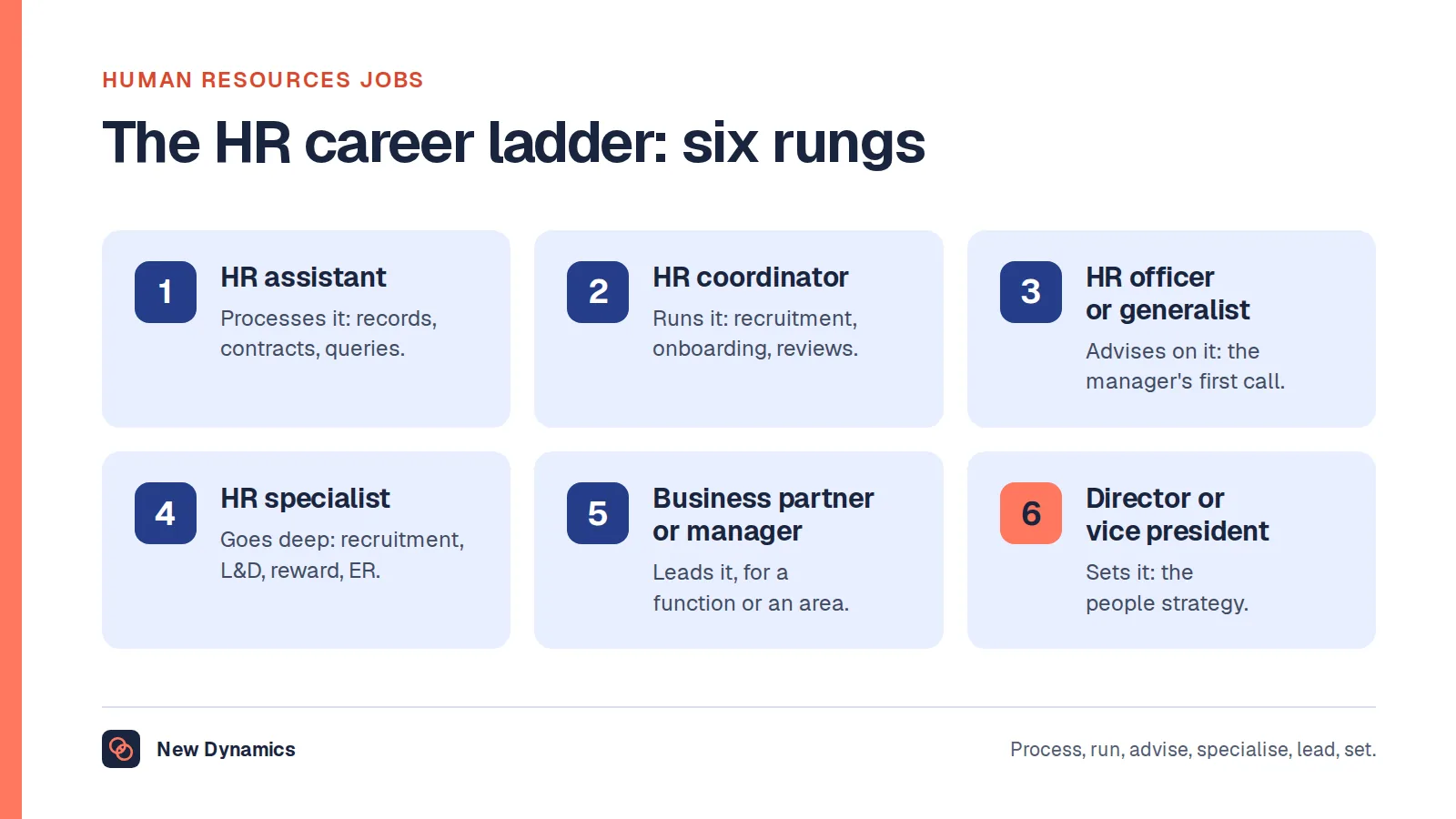
When the need is permanent capacity. If the honest description is "there is more HR work here than one person can do, every week, indefinitely", a consultant is an expensive way of postponing a hire. Write down what the consultant will be doing in month nine. If it matches month one, you are describing a job, and our HR careers ladder sets out which rung it is.
When the need is a system. Much of what gets diagnosed as an HR capacity problem is administration that should not be done by a person at all: chasing managers for review forms, tracking probation dates, keeping count of who has had a one to one. A consultant will chase for you at a day rate, for exactly as long as you pay them, and then nothing has changed. See New Dynamics workflows for what that work looks like when a system owns it. If what you are buying is somebody else's diligence, buy the system.
When the real need is a decision nobody wants to make. A report commissioned because an external document makes an unpopular decision easier to announce can be legitimate, but it is not advice.
How to brief a consultant, and what a good proposal looks like

Most disappointing HR consulting is traceable to the brief. "Help us sort out our HR" produces a proposal written to sell, because there is nothing in the brief to quote against.
A brief that works has five parts.
- The problem, in one sentence, in your own words. Not the solution. "Our six core policies have not been reviewed since 2016 and two contradict the contract" is a brief. "We need to overhaul HR" is not.
- The output. A document, a structure, a trained group of managers, a decision supported by evidence. Name the artefact.
- The deadline, and what it is tied to. A review cycle, a board meeting, a tribunal date. Deadlines tied to something real survive.
- Who decides. Name the person who signs off the output. Unclear at briefing becomes a dispute at invoicing.
- The handover. What has to be true after the consultant leaves, and who maintains it. Most briefs omit this, and it decides whether the money was well spent.
A good proposal answers all five back to you, in your words, before it says anything about the supplier. Beyond that, look for exclusions in writing ("representation at tribunal is not included" is better read in a proposal than discovered later); the named people who will do the work rather than the person who sold it; written assumptions about what data you supply by when; a mechanism for pricing a variation; a defined end date; and a stated position on your data. A proposal that restates your brief as a larger problem than the one you described is positioning for a bigger sale, and one with no exclusions has not been read carefully.
Independence when a consultant investigates
Hiring an outsider here can be procedurally better, not merely convenient.
In the United Kingdom the Acas Code of Practice on disciplinary and grievance procedures sets the expectation tribunals work from. The Code states that "A failure to follow the Code does not, in itself, make a person or organisation liable to proceedings. However, employment tribunals will take the Code into account when considering relevant cases." On separation of roles: "In misconduct cases, where practicable, different people should carry out the investigation and disciplinary hearing."
Acas is more specific in its guidance on preparing for an investigation. On choosing an investigator it says "The employer should get somebody who's not involved in the case to carry out the investigation", and that "If this is not possible, they should try and make the procedure as impartial as they can." On external help: "In exceptional circumstances, it might be appropriate to appoint an external consultant. They can be more detached from the matter and bring an independent view."
That is the whole case for an external investigator, in Acas's own words, and it is narrower than some suppliers suggest. "Exceptional circumstances" means something: a grievance against the person who would normally investigate, an allegation where everybody senior is a witness. Four things to settle before one starts.
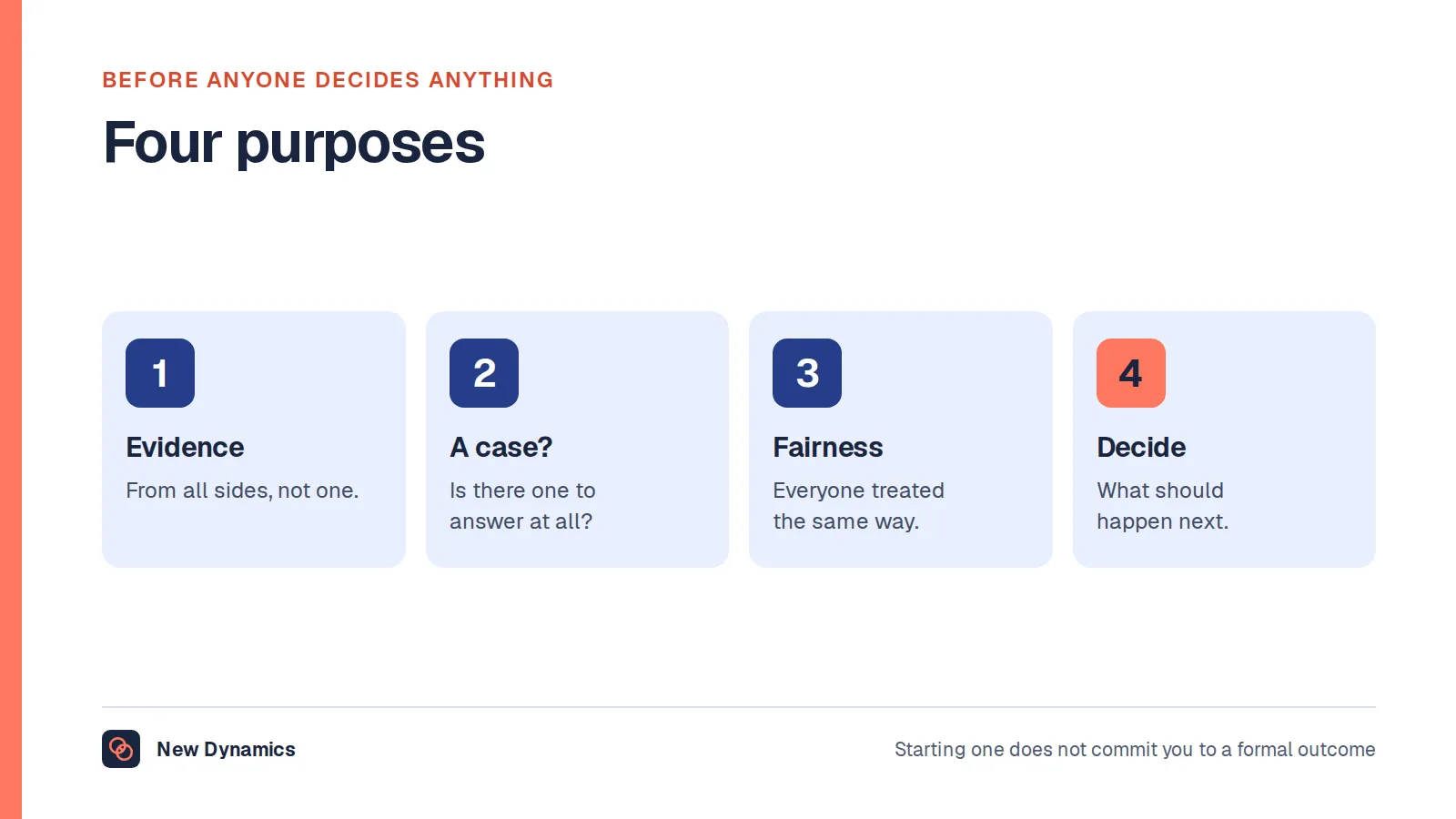
What they decide, which is nothing. Acas describes the purpose of an investigation as to "gather evidence from all sides", "find out if there is a case to answer" and "make sure everyone is treated fairly". If one supplier investigates and recommends the sanction, you have collapsed two roles the Code expects to keep apart.
Terms of reference, in writing. The allegations, the scope, who may be interviewed, and that the scope may widen if something material emerges.
Independence from the outcome. A supplier whose next engagement depends on your satisfaction with the finding is not fully detached. A fixed fee agreed before the finding helps, and so does declining to tell them the answer you expect.
What the employee is told. That the investigator is external, who commissioned them, and what happens to the information gathered. Our guide to workplace investigations covers the procedure itself.
Employee records in an outsider's hands
A consultant who investigates a grievance or reviews a sickness case handles personal information about identifiable employees, sometimes including health information. In the United Kingdom this is governed by the UK GDPR and the Data Protection Act 2018, and the Information Commissioner's Office is the regulator. This is general information and not legal advice.
Responsibility does not travel with the data. On contracts between controllers and processors the ICO states that "Controllers are primarily responsible for overall compliance with the UK GDPR, and for demonstrating that compliance." Its guidance on collecting and keeping employment records puts it bluntly: "Ultimately, your organisation, as the controller, has responsibility for data protection compliance."
So what is the consultant? If they process employee data on your instructions, for your purposes, they are normally your processor, and the ICO is unambiguous about what follows: "Whenever a controller uses a processor to process personal data on their behalf, a written contract needs to be in place between the parties", because "Contracts between controllers and processors ensure they both understand their obligations, responsibilities and liabilities." The employment records guidance repeats it for workers' information: "If you use any processors that are processing workers' personal information on your behalf, you must have a written contract in place with them."
The contract is not a formality with free wording. The ICO sets out what needs to be included in the contract, saying "Article 28(3) also sets out the following specific terms or clauses that must be included in the contract", and listing:
- processing only on the documented instructions of the controller
- duty of confidence
- appropriate security measures
- using sub-processors
- data subjects' rights
- assisting the controller
- end-of-contract provisions
- audits and inspections
Two matter most here. Using sub-processors matters because a consultant may use a transcription service, a cloud drive or an associate. End-of-contract provisions matter because a consultant who has finished an investigation is holding interview notes about your employees.
Where a consultant is not acting on your instructions the picture changes: one exercising independent professional judgement for their own purposes may be a controller in their own right for part of what they hold, which brings different duties. That turns on the facts, and it is a question for the supplier and your own adviser.
So: settle controller and processor status in the engagement letter, give the consultant the minimum they need rather than a copy of the personnel system, because the minimisation duty still binds you ("you must make sure the personal information you hold is adequate, relevant, and limited to what you need for your purposes"), and agree the return or deletion of material.
For the duties that stay with you whoever touches the records, read and download our employee data protection guide. The guide is free to read, and the PDF uses our short download form.
Why this site does not rank HR consulting firms
People search for the best human resource consulting firms and the top HR consulting companies. We will not publish that list, and the reason is not modesty.
A ranking would rank suppliers we have not worked with, against a brief we do not know, for employers whose problems differ. Lists of this kind are generally built from paid placement, commercial relationships, or a size proxy such as headcount, which measures a firm's success rather than its fit for your problem.
What does tell you something, in rough order of usefulness:
- Two references for work of the same shape and size as yours. Not a logo wall. A named employer of comparable size who bought the same kind of engagement, and a conversation with the person who managed it.
- The named individual's own record. In HR consulting the firm is often a brand on top of one to three practitioners. Ask who will do the work, how many of these they have done, and when they last did one.
- Professional indemnity insurance, and the amount. Ask to see the certificate, not a statement that cover exists.
- Their position on who decides. A supplier comfortable saying "we advise, you decide" has understood the engagement. One who promises to "handle it" has not.
- The proposal itself. Three suppliers quoting against one written brief is the only comparison tailored to your problem.
Two checks cost nothing: ask what would make them tell you the project should stop, and ask about two engagements that went badly.
For the career searcher: routes into HR consulting
The rest of this article is for the second reader: the HR professional considering going independent or joining a consultancy. "HR consultant" is a career search as often as a buying one.
Start with an unwelcome fact. HR consultancy is not a regulated profession in the United Kingdom. There is no licence to practise, no protected title and no register you must be on. Anyone may call themselves an HR consultant tomorrow, which is why the buying checklist above leans on references and insurance.
Out of an in house role. The commonest route. An HR manager or business partner with ten or more years across employee relations, restructures and policy goes independent, usually with a first client they already know. The advantage is real case experience. The limitation is that one employer's way of doing things can look like the only way, and part of the first year goes on finding out which instincts were company specific.
Through a consultancy. Joining an established firm trades autonomy for a pipeline, supervision and fast exposure to many organisations, which is the quickest way to broaden out of one sector.
From a specialism. Reward and job evaluation, employee relations and investigations, learning design, HR systems implementation, and TUPE and restructuring each support independent practice alone, because each is a problem employers meet occasionally and cannot staff for permanently. A narrow, well evidenced specialism is easier to sell than general HR advice, and our HR skills article covers what sits under each.
From the adjacent professions. Employment lawyers, occupational psychologists and organisational development practitioners move in. Each brings a strength and a matching gap: the lawyer who has never had to make a grading structure work operationally, the psychologist who has not run a redundancy consultation.
Whichever route, what is sold is judgement about situations the client meets rarely and you meet often. Volume of cases, not years served, is the real qualification.
CIPD membership and chartered status: what they are and are not
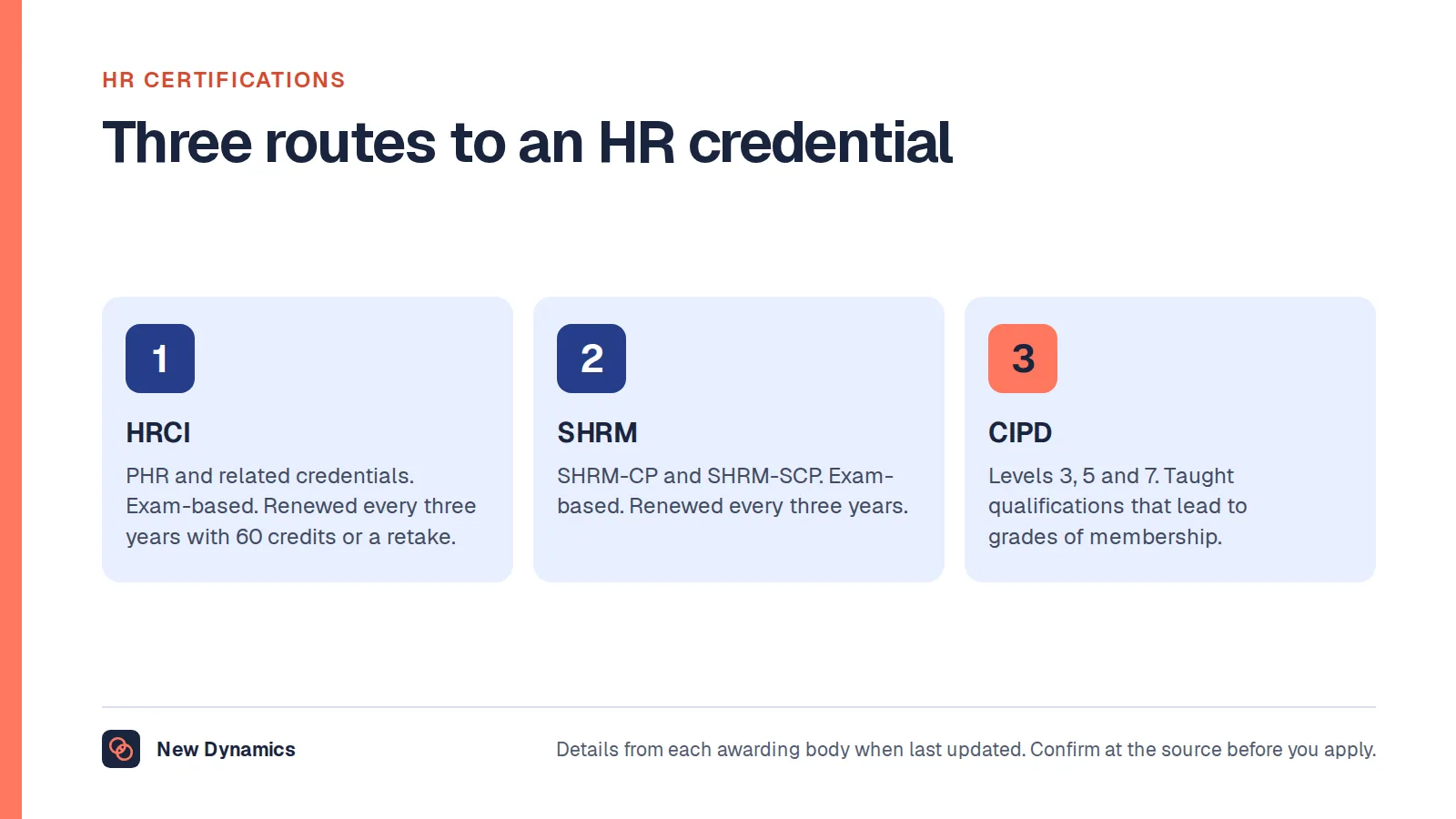
The Chartered Institute of Personnel and Development is the professional body for the people profession in the United Kingdom. It is a professional body rather than a regulator, and one route among several, but its grades are the shorthand the market uses.
Its membership grades run from Student and Foundation, for people studying or early in their experience, through Associate, for "People professionals experienced in HR operational work", to Chartered Membership, for "Experienced people professionals with strategic and operational expertise", and Chartered Fellow, for professionals "influencing at senior levels".
On Chartered Membership the CIPD says it "recognises your strategic and operational expertise, professional achievements and experience within the people profession", that "You can apply for Chartered Membership if you have at least one year of experience working at Chartered Member level", and that "When you're a Chartered Member, you can use the designation Chartered MCIPD after your name." There are two routes to it: an upgrade assessment for holders of a CIPD Advanced diploma or accredited postgraduate qualification, and an experience assessment with no further study.
Now what chartered status is not.
It is not a licence. You may practise as an HR consultant in the United Kingdom without it, and without any CIPD membership at all.
It is not a guarantee of competence in your specific problem. It recognises breadth and level, not whether the holder has run a collective consultation, investigated a grievance against a director, or built a pay structure.
It is not the only credential that counts. Legal qualifications, occupational psychology registration, specialist reward accreditations and sector experience all carry weight, and in some briefs more. Our article on HR certifications sets the options out side by side.
And it is not a substitute for insurance. Membership of a professional body does not indemnify a client against your mistake.
Setting up on your own, and the realistic first year
The legal and tax basics
Most people start as a sole trader. GOV.UK's guidance on how to set up as a sole trader states that "You can start trading straight away without registering", and that "You must register for Self Assessment as a sole trader if you earn more than £1,000 in a tax year (from 6 April to 5 April)." On when to register for VAT it states that you must register if "your total taxable turnover for the last 12 months goes over £90,000 (the VAT threshold)". Whether a limited company suits you is an accountant's question.
A second status question catches consultants out, and it is the one they advise clients on for a living. Acas sets out, on employment status, that "There are 3 main types of employment status: employee, worker, self-employed", that status rests on the contract, "what was agreed when they were offered the job" and "the way the organisation and the individual work together", and warns that "If someone is considered self-employed for tax purposes, this does not necessarily mean their employment status is self-employed." An interim sitting in one client's office five days a week for two years, under their direction, with no other clients, is in the arrangement they would flag if a client described it. Our article on independent contractor status covers the tests.
Insurance
Professional indemnity is the cover serious clients ask about: your product is advice, and the risk is that it is wrong. Public liability matters if you work on client premises, and employers' liability from the moment you employ anyone. Check the level your clients expect, because larger clients and public bodies often specify a minimum, and make sure the cover outlasts the engagement.
What to charge, in shape rather than numbers
We publish no rates, for the reason given above. Price the output where you can estimate it, and the time where you cannot. Policy rebuilds, handbooks, grading structures and training design can be fixed fee, which rewards you for getting faster. Live cases and interim cover are time based, because the scope is not knowable in advance.
Build the capacity assumption honestly. Proposals, invoicing, reading, marketing and the days a client postpones all come out of the same calendar, and the gap between a day rate and an annual income is mostly made of those. Get a written engagement letter for everything, invoice on a stated schedule, and decide in advance what you will not do.
The first year, honestly
The first year is usually a marketing year wearing a consulting year's clothes. Work arrives from people who already know you, which is a real asset and also a ceiling, because it runs out at a size you can predict. The work is lumpy: a restructure for six weeks, two quiet weeks, then three small policy jobs at once, with income following that shape plus a lag from payment terms.
The hardest adjustment is not technical. Nobody else will decide what you work on, chase your invoice, tell you your advice was wrong, or notice that you have not developed a new specialism in eighteen months. What separates the practices still going in year three: a specialism narrow enough to be remembered, a repeatable piece of work that sells more than once, and a referral source outside the first employer.
Frequently asked questions
What does an HR consultant do?
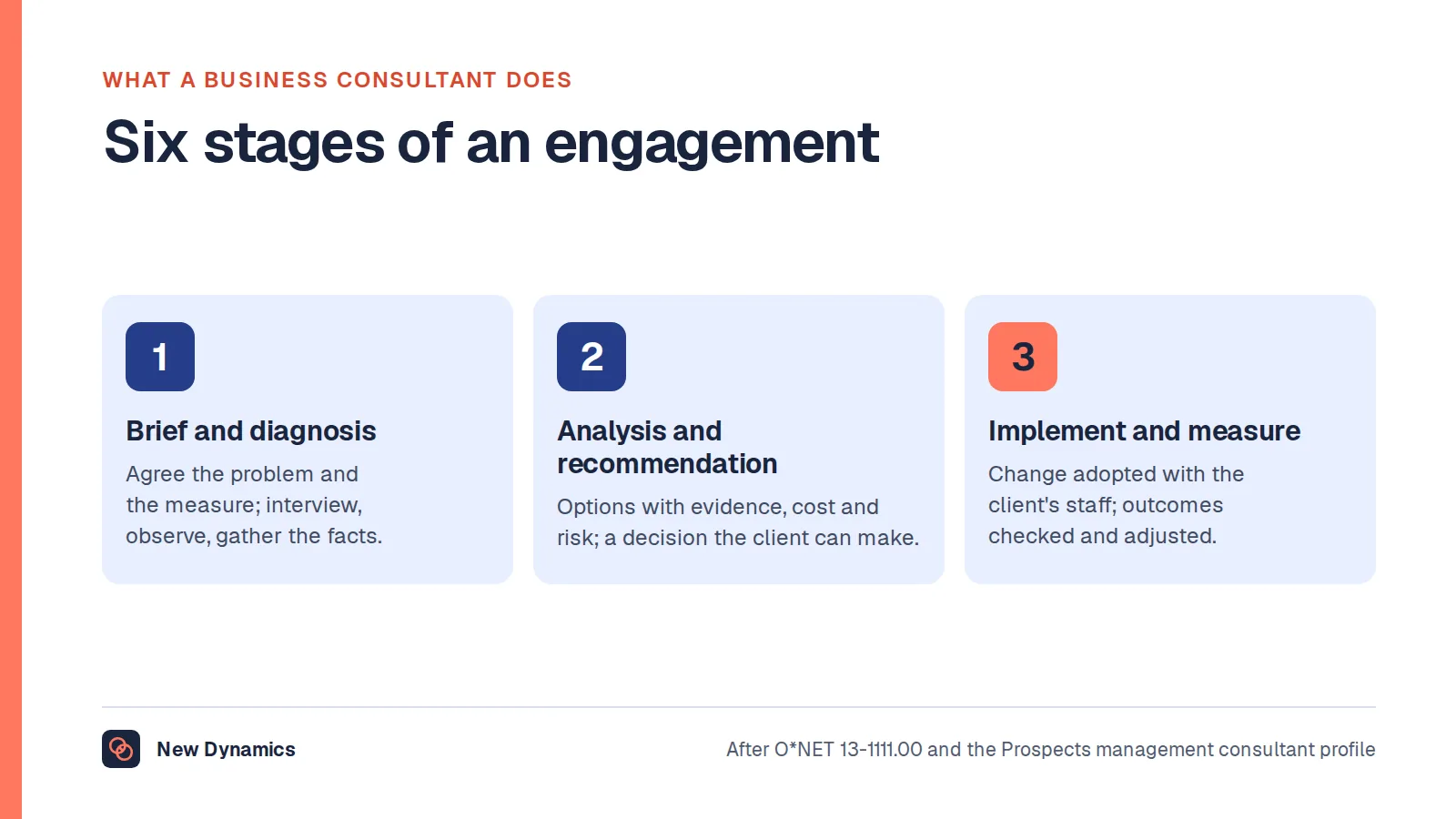
An HR consultant gives paid advice, or delivers defined pieces of work, on the people side of an organisation without being its employee. Typical briefs are a live employee relations case, a restructure, a pay or grading structure, a policy rebuild, an independent investigation, manager training, and interim cover. The consultant advises and prepares; the employer makes and signs the decisions.
Which are the best HR consulting firms?
This site does not publish rankings of consultancies, because any such list would reflect paid placement, the publisher's commercial relationships or firm size rather than fit for your problem. Compare suppliers instead: ask three of them to quote against one written brief, then check two references for work of the same shape and size, the named individual's record of that specific work, and the professional indemnity insurance certificate.
How much does HR consulting cost?
No official United Kingdom source publishes a day rate, retainer price or fee benchmark for HR consulting, so we quote none. What you can control is the shape. Work with a definable output, such as a policy rebuild or a grading structure, should carry a fixed fee, because the supplier can estimate it better than you can. Work of unknown length, such as a live case, is normally a day rate.
Do I need to be CIPD qualified to be an HR consultant?
No. HR consultancy is not a regulated profession in the United Kingdom, so there is no licence, protected title or compulsory register. CIPD membership grades are widely recognised, and the CIPD describes Chartered Membership as recognising "your strategic and operational expertise, professional achievements and experience within the people profession", requiring at least one year of experience at that level. It is one credential among several, and no substitute for professional indemnity cover or for a record of having done the specific work.
Can an HR consultant investigate a grievance against us?
Yes, and sometimes they should. Acas guidance says the employer "should get somebody who's not involved in the case to carry out the investigation" and that "In exceptional circumstances, it might be appropriate to appoint an external consultant", who "can be more detached from the matter and bring an independent view". Keep the roles separate, agree written terms of reference and a fixed fee set before any finding, and say what happens to the notes. This is general information about the United Kingdom and not legal advice.
Does an HR consultant become responsible for our employee data?
Not instead of you. The ICO states that "Controllers are primarily responsible for overall compliance with the UK GDPR, and for demonstrating that compliance", and that where a consultant processes employee data on your instructions as your processor, "a written contract needs to be in place between the parties", covering the terms Article 28(3) requires, including sub-processors and end-of-contract provisions. Give the consultant the minimum the work needs, and agree its return or deletion in the same document.
Your next step
If you are the employer:
- Write the problem in one sentence, in your own words, before you contact anybody.
- Decide which shape you are buying: a retainer, a project, an interim placement or a single paid diagnostic.
- Apply the two wrong answer tests. Describe what the consultant will be doing in month nine, and ask whether the work is really administration a system should own.
- Send the same written brief to three suppliers and compare the proposals, not the day rates.
- Settle controller and processor status and the Article 28(3) contract terms before the first day of work.
- Name the person who owns the output after the consultant leaves.
If you are thinking of becoming one:
- Count your cases by type, not your years. That list is your actual offer.
- Pick a specialism narrow enough that somebody could remember to recommend you for it.
- Register with HMRC as GOV.UK describes, get professional indemnity cover at the level your clients specify, and write your engagement terms once.
- Apply your own employment status advice to your own interim arrangements.
- Build one referral source outside your last employer.
For the wider picture on the profession and the numbers behind it, see our HR statistics hub.
Once a consultant has designed your review process, somebody has to run it every year. Book a New Dynamics demo and bring the process they left you. You can also email contact@new-dynamics.com.