TL;DR
- When a review form asks for three ways to improve your work performance, choose one from each of three areas: how you focus, what you learn and how you work with others. Make each specific, with an action and a way to tell that it worked.
- The most reliable improvements come from clarity about priorities, protected time for important work, feedback sought often and one skill practised deliberately.
- Performance is never only the individual's doing. Managers improve it by making expectations clear, providing resources and training, and understanding the cause before judging.
“List three ways you can improve your work performance.” The question appears on countless review forms, and it produces the same answers every year: better time management, better communication, more training. They are not wrong. They are just too vague to change anything.
This article shows you how to answer the question well, with sample answers. It then gives 20 practical ways to improve work performance, and a section for managers on what to do when someone's performance dips.
Improvement sticks when it is written down and reviewed. See how New Dynamics Goals & OKRs keeps goals, progress and check-ins in one shared place.
How to answer “What are three ways you can improve your work performance?”
Choose one improvement from each of three areas. Together they cover most of what makes someone effective.
- Focus: how you choose and protect your most important work.
- Learning: one skill or area of knowledge that would make the biggest difference.
- Working with others: how you communicate, collaborate or ask for help.
For each, write three things: what you will do differently, why it matters, and how you and your manager will know that it worked.
Sample answer
1. Protect time for priority work. I will agree my top three priorities with my manager each Monday, and block two 90-minute sessions a day for them. At the moment, urgent requests crowd out the quarterly analysis. We will know it is working if the analysis is delivered by the 10th of each month.
2. Build my data skills. I will complete the SQL course by June, and build the monthly report myself from July. It will remove my dependence on the data team and cut the turnaround from five days to one.
3. Give earlier warning of delays. Twice this year I flagged a slipping deadline too late. I will raise any risk at least three days ahead, with options. We can check this in our one-to-ones.
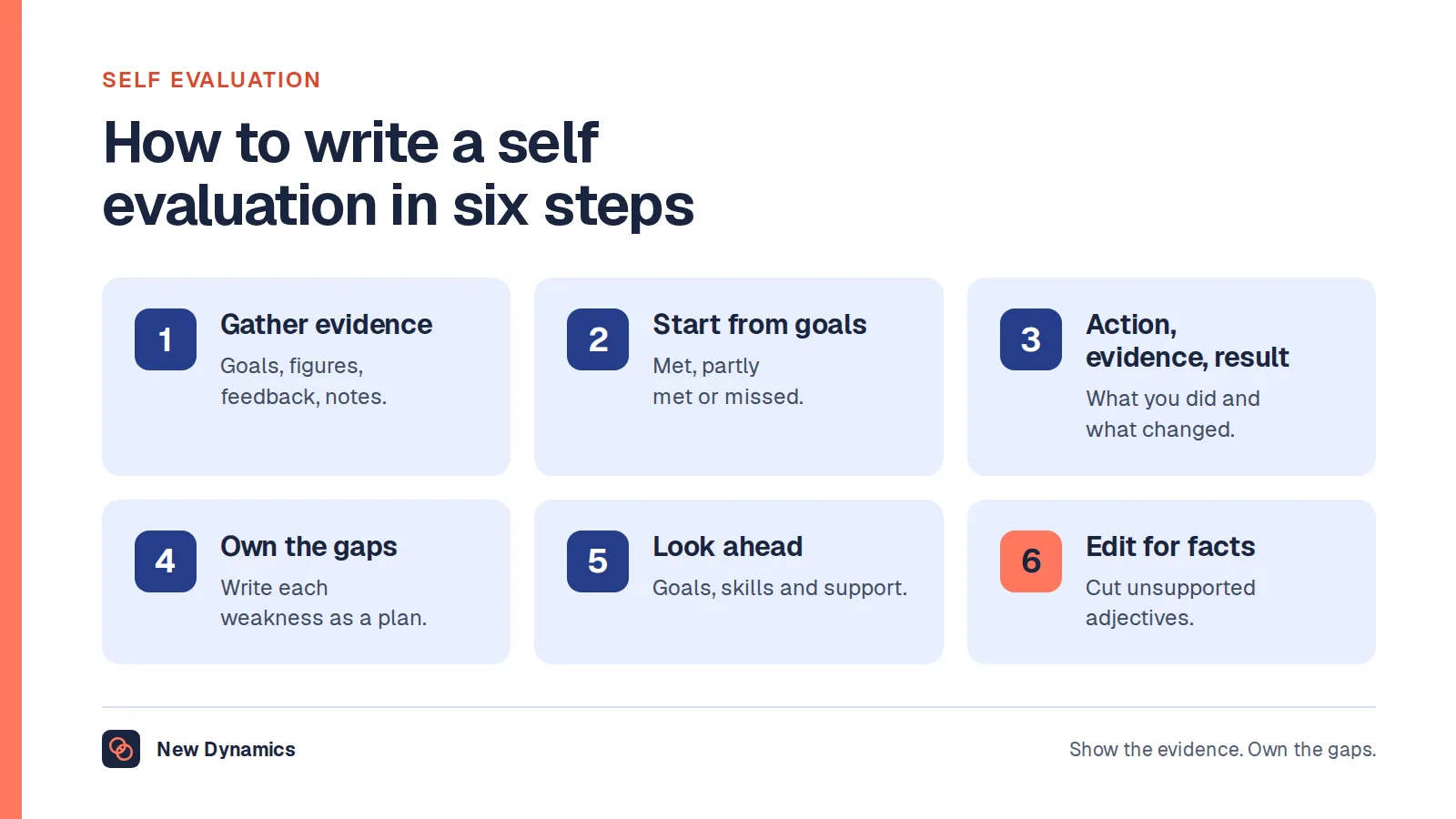
Notice what makes it work. Each point is specific, honest about the current position, tied to a result and easy to review. Our self evaluation examples give more wording.
Shorter sample answers
- Focus: “Say no, with reasons, to requests outside my three agreed priorities, so that the supplier project finishes on time.”
- Learning: “Shadow the finance partner at two month-end closes, so that I can explain our budget variances myself.”
- Working with others: “Send a written summary after every client meeting, so that actions are not lost.”

20 practical ways to improve work performance
Focus and priorities
- Agree your top three priorities with your manager, and review them weekly.
- Do the most important task first, before email.
- Protect focus time. Two blocks a day with notifications off.
- Say no, or “not now”, with reasons. Every yes has a cost.
- Finish before starting. Reduce the number of things you have in progress.
- Plan tomorrow before you leave.
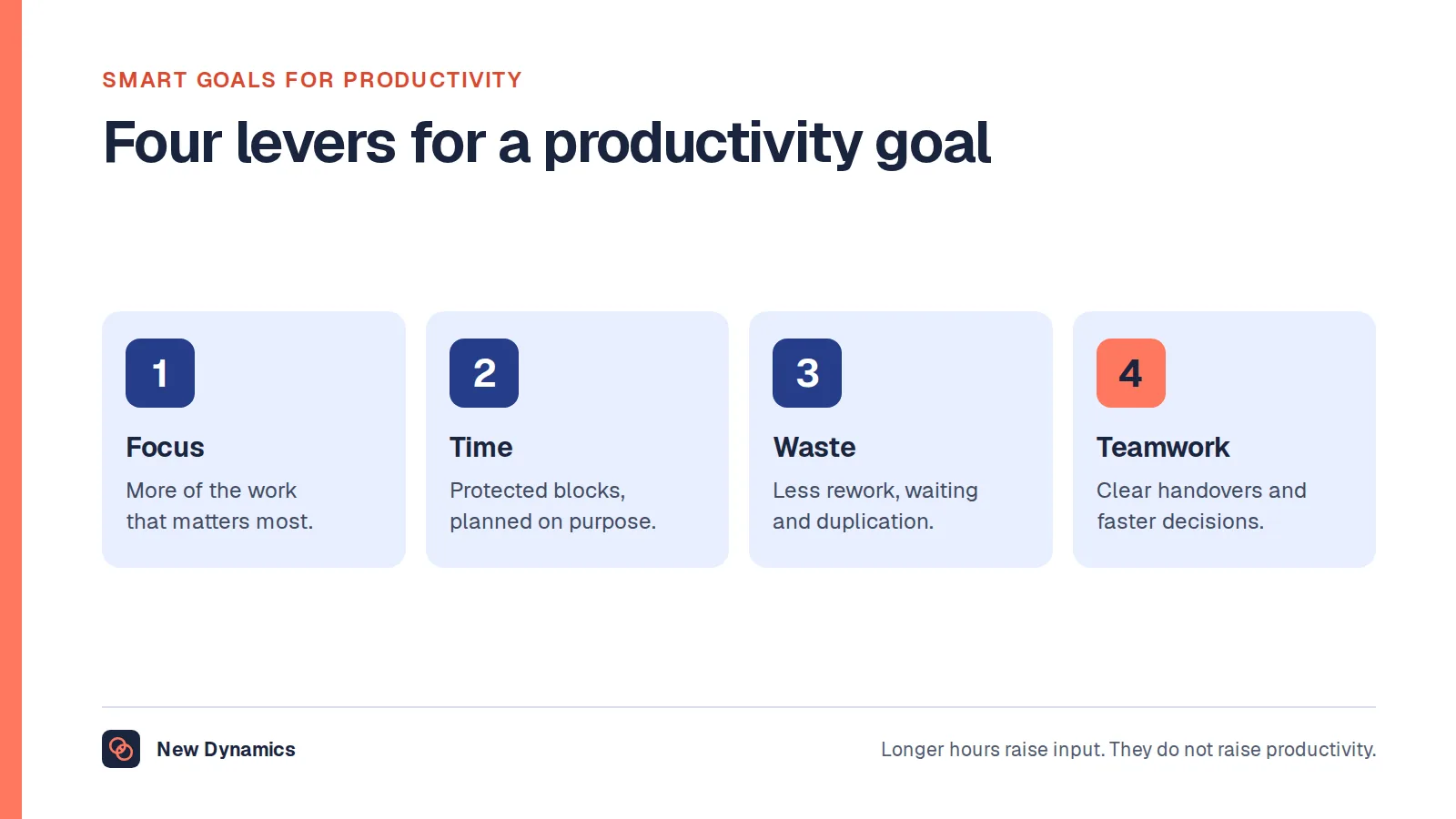
Our SMART goals for productivity turn these into measurable goals.
Quality
- Check your work against the brief before you hand it over.
- Use a checklist for tasks that you repeat.
- Find the cause of recurring mistakes, and fix that.
- Ask what good looks like at the start, so that you do not have to guess.
Learning
- Pick one skill that would make the biggest difference this year, and practise it deliberately. See our personal development goals examples.
- Ask for feedback often. “What is one thing I could do better?” after each significant piece of work. Our colleague feedback examples list 20 questions.
- Watch someone who is excellent at it, and ask how they learned.
- Reflect for ten minutes every Friday: what went well, what did not, and what will I try next week?
Working with others
- Keep people informed without being chased. A short weekly update prevents most surprises.
- Flag risks early, with options.
- Ask for help sooner. An hour of struggling alone is usually enough.
- Build relationships before you need them, especially with other teams.
Energy
- Take real breaks, and your full holiday. Tired people tend to work more slowly and make more mistakes.
- Raise workload problems early. If the work does not fit the hours, no technique will fix it. See our article on working 8 hours a day.
Do not try all twenty. Pick three, one from each of the areas above, and work on them for a quarter.
Turn the three into goals
An intention becomes an improvement when it has a measure and a date. Acas recommends that objectives are specific, measurable, achievable, relevant and time-bound.
| Intention | Goal |
|---|---|
| “Manage my time better” | By 30 June, deliver at least 90% of agreed tasks on the agreed date, up from about 75% |
| “Communicate better” | From next month, send a written summary within one working day of every client meeting |
| “Learn more about finance” | By September, present the department's budget review myself, after shadowing two month-end closes |
Our performance goals examples offer 60 more.

For managers: how to help someone improve
Performance is the product of the person and the situation. Before you decide that someone needs to try harder, check what you have given them to work with. Our guide to job performance explains the four factors behind it.
Understand the cause first
Acas, in its guidance on problems with an employee's performance, says that “employers should try to understand why”. It distinguishes two kinds of issue.
- Capability: “someone's ability to do their job”. Here the employer could help through support, such as coaching or mentoring, and through training. Acas adds that employers must provide “adequate resources” to enable an employee to do their job.
- Conduct: “someone's behaviour at work”, such as regular lateness or refusing to do work. Acas advises talking to employees informally first, unless the issue is more serious.
It also warns that the two can overlap. Something that looks like a conduct issue, such as regular lateness, could be linked to an impairment or a condition. If that amounts to a disability, the employer needs to consider reasonable adjustments before taking any disciplinary action.
This is general information based on guidance for Great Britain. It is not legal advice.
Six things that managers control
- Clarity. Does the person know their priorities, and what good looks like?
- Resources. Do they have the tools, information, time and authority?
- Skills. Have they been trained, and have they had a chance to practise?
- Feedback. Do they hear, promptly and specifically, how they are doing?
- Workload. Is what you are asking achievable in the hours available?
- Obstacles. What is in their way that only you can remove?
If the answer to any of these is no, fix that first. If all six are in place and performance is still short, have a direct, supportive conversation, agree specific goals and review them often. Acas says that employers “should take steps to try and help someone to improve” before starting a formal procedure. Our performance improvement guide sets out a fair process.
Common mistakes
Vague intentions. “Improve communication” cannot be reviewed.
Too many at once. Three is plenty.
Only weaknesses. Using a strength more is often the quickest improvement. See our strengths and weaknesses examples.
Working longer. More hours is rarely the answer, and it is never sustainable.
No follow-up. If nobody looks at the three items until next year's form, nothing will change. Put them in your one-to-ones.
Blaming the person for the system. If five people in the same role are struggling, the problem is probably the role.

Frequently asked questions
What are three ways to improve work performance?
Choose one from each of three areas. Focus: agree your top three priorities and protect time for them. Learning: pick one skill and practise it deliberately. Working with others: keep people informed and flag risks early. Make each specific and measurable.
How do I answer “How can you improve your work performance?” on a review?
Name three specific improvements. For each, say what you will do differently, why it matters and how you and your manager will know that it worked. Be honest about where you are now, and link each one to a result.
How can I improve my performance at work quickly?
Clarify your priorities with your manager, do the most important task first each day, ask for feedback on your last piece of work and fix the single most common cause of your mistakes. These four often show results within weeks.
What are examples of areas of improvement at work?
Common areas include prioritising, meeting deadlines, attention to detail, written communication, speaking up in meetings, delegating, asking for help sooner, technical skills, giving feedback and keeping others informed.
How can a manager improve an employee's performance?
Start by understanding the cause. Check that expectations are clear, that the person has the resources, skills and time to do the job, and that they get regular feedback. Offer coaching or training. Agree specific goals, and review them often.
How do you improve team performance?
Agree a few shared goals, make roles and priorities clear, remove obstacles, make it safe to raise problems, review progress every week or fortnight and recognise good work. Look at workload and processes before looking at individuals.
Your next step: write your three
- Choose one improvement for focus, one for learning and one for working with others.
- Write each with an action, a reason and a measure.
- Share them with your manager, and ask what they would add.
- Review them in your one-to-ones for a quarter.
For a fair, structured process when performance falls short, read and download our performance improvement guide. The guide is free to read, and the PDF uses our short download form.
Want goals, feedback and check-ins in one place, so that improvement is visible? Book a New Dynamics demo and bring your current goals. You can also email contact@new-dynamics.com.