TL;DR
- No law in Great Britain prohibits colleagues from forming a relationship, and a blanket ban is both unenforceable and risky. Marriage and civil partnership is a protected characteristic under section 8 of the Equality Act 2010, so a rule that treats married couples differently from unmarried ones is exposed on its face.
- A relationship becomes the employer's business at identifiable points: line management, a recruitment or promotion decision, access to someone's pay or performance record, procurement, and safeguarding duties in regulated sectors. Outside those points the employer is asking about private life, which Article 8 of the Convention rights protects.
- Consent at one moment does not settle the harassment question. Section 26(1) of the Equality Act 2010 makes conduct harassment where it has the "purpose or effect" of violating dignity, and section 26(3) covers less favourable treatment because of rejection of, or submission to, conduct of a sexual nature.
Most published advice about romantic relationships at work is either prurient or evasive. Neither helps the person who has to write the policy, or apply it on a Tuesday morning when two people have just told their manager they are together and nobody knows what happens next.
Treat it as what it is. This is a conflict of interest question, a record-keeping question and, in some sectors, a safeguarding question. It is not a morality question, and a policy written as though it were will not survive contact with either a tribunal or your own staff. This article sets out where the employer's legitimate interest begins, what a disclosure rule can reasonably require, what to do once something is disclosed, and where the line between a relationship and harassment actually sits. It is general information about the law of Great Britain and not legal advice. The Equality Act 2010 applies in England, Wales and Scotland; Northern Ireland has its own separate discrimination legislation.
Almost every practical answer in this article comes down to one thing: knowing who really decides about whom. New Dynamics org charts show the formal reporting line alongside the project and review relationships that sit beside it, which is what you need before you can re-route a decision away from someone.
There is no general prohibition, and a blanket ban is the wrong tool
Nothing in the law of Great Britain prohibits two colleagues from forming a relationship. There is also no cross-sector official guidance on the subject: a search of GOV.UK for workplace romantic relationships returns little beyond first-instance employment tribunal decisions, which are not authority. If you are looking for a government rule to copy, there is not one. What exists instead is a set of general obligations that a relationship can engage.
A blanket ban fails for three separate reasons, and it is worth keeping them apart.
It is unenforceable in practice. The only evidence an employer normally has is a disclosure. A rule that punishes the disclosure guarantees you stop receiving them, which removes the one thing that lets you manage the conflict.
It is exposed on discrimination grounds. Marriage and civil partnership is a protected characteristic. Section 8 of the Equality Act 2010 states that "A person has the protected characteristic of marriage and civil partnership if the person is married or is a civil partner." A policy that permits married couples to work together but not unmarried ones, or the reverse, treats people differently because of that characteristic. Direct discrimination is defined in section 13(1) as where "because of a protected characteristic, A treats B less favourably than A treats or would treat others", and section 13(4) confirms that for marriage and civil partnership this applies to a contravention of Part 5, which is the work Part, "only if the treatment is because it is B who is married or a civil partner".
It invites an indirect discrimination claim. Marriage and civil partnership is also one of the relevant characteristics for indirect discrimination under section 19 of the Equality Act 2010, which bites where a "provision, criterion or practice" puts people sharing a characteristic at a particular disadvantage and the employer "cannot show it to be a proportionate means of achieving a legitimate aim". A ban on relationships is a provision, criterion or practice. Proportionality is where it will be tested, and a blanket rule has no proportionality argument available to it, because it makes no distinction between a relationship that creates a conflict and one that does not.

Article 8 and what an employer can reasonably demand
The private life point is real, and it is usually stated badly, so here it is precisely. Article 8 of the Convention rights, as set out in Schedule 1 to the Human Rights Act 1998, reads: "Everyone has the right to respect for his private and family life, his home and his correspondence." Paragraph 2 permits interference only where it "is in accordance with the law and is necessary in a democratic society" for one of the listed aims, including "for the protection of the rights and freedoms of others".
How that reaches your organisation depends on what your organisation is. Section 6(1) of the Human Rights Act 1998 provides that "It is unlawful for a public authority to act in a way which is incompatible with a Convention right", and section 6(3)(b) extends "public authority" to "any person certain of whose functions are functions of a public nature". A public body is therefore directly bound. A private employer is not, but section 3(1) requires that "So far as it is possible to do so, primary legislation and subordinate legislation must be read and given effect in a way which is compatible with the Convention rights", so Article 8 shapes how the statutes an employer does answer to are interpreted. That is a real distinction and not a technicality, and the practical consequence is the same either way: the further your questions move from the work, the weaker your justification for asking them.
So the test for any line in the policy is one question. What decision does this information let us make differently? If you cannot answer it, do not ask.
Where a relationship genuinely becomes the employer's business
There are a small number of points where a relationship stops being private and starts affecting someone other than the two people in it.
- Line management. One person setting the other's objectives, writing their review, approving their leave or deciding their pay. This is the central case, and the only one most policies need to handle well.
- Recruitment and selection. Sitting on a panel, sifting applications, taking a reference, or sitting on an appeal about the outcome.
- Promotion, pay and performance decisions. Including calibration meetings, bonus recommendations and access to the other person's performance record or salary history in a system.
- Procurement and contracting. A relationship with someone at a supplier, a bidder or a client, where one person can influence a decision worth money to the other.
- Safeguarding in regulated settings. Education, health, social care and other regulated sectors impose their own duties on staff conduct and on reporting concerns about colleagues. Where you are subject to statutory safeguarding guidance such as Keeping children safe in education, that guidance, not your relationship policy, sets the floor.
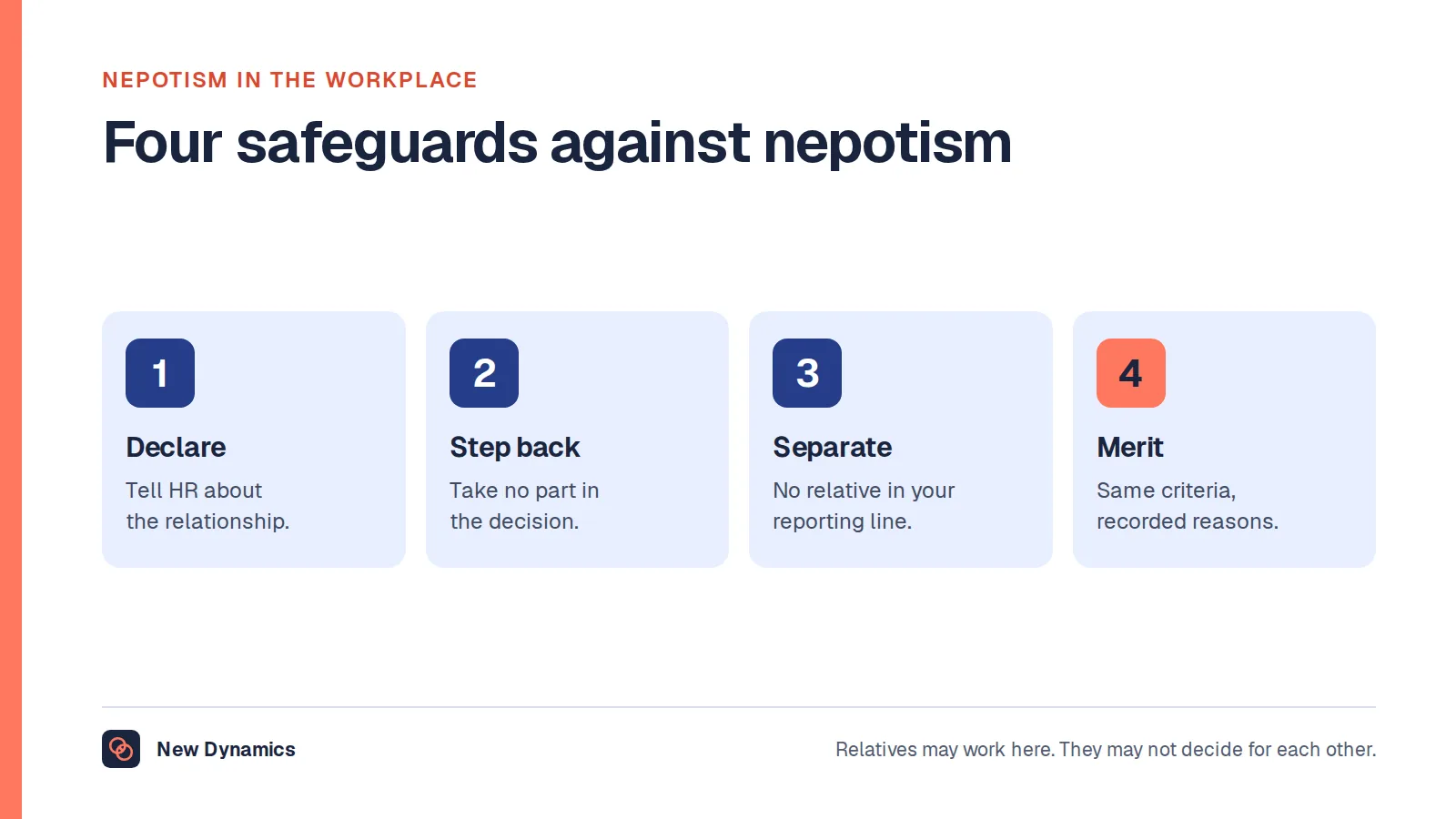
The common thread is decision-making power, not intimacy. That is also why the same policy should cover relatives, close friends and former partners. Our post on nepotism in the workplace covers the family version of the same conflict, and the safeguards are identical.
What a disclosure policy can reasonably require
A workable disclosure rule is narrow, specific and routed away from gossip. Require disclosure where one of the situations above applies, not simply because a relationship exists. Name a single recipient, usually HR or a named senior person rather than the immediate manager. Say what will be recorded, who will see it, and how long it is kept.
There is a data protection trap here that most policies walk straight into. A record of who is in a relationship with whom can be special category data. The Information Commissioner's Office guidance on what is special category data lists "data concerning a person's sexual orientation" among the categories given extra protection, and is explicit that the category covers inference as well as statement: "If the information itself clearly reveals or concerns something specific and definite about one of the special categories, that counts as special category data. For example, a statement that says Mr X is married to Mr Y clearly reveals information about Mr X's and Mr Y's sexual orientation."
So a disclosure register is not a spreadsheet on a shared drive. Identify your Article 9 condition before you collect anything, keep the record to the minimum that supports the decision, restrict access to the people who have to act on it, and set a retention period. Our post on employee handbook contents covers where a rule like this belongs in the wider document set.
Once it is disclosed: recuse, re-route, record
The response should be procedural and boring. Three steps, in order.

Recuse. The person with decision-making power steps out of every decision affecting the other: objectives, ratings, pay, promotion, leave, discipline, references. Recusal has to be specific. "Will be impartial" is not a safeguard.
Re-route. Name the person who takes the decision instead, and make sure they have the evidence to take it properly rather than rubber-stamping. New Dynamics multi-manager reviews exist for exactly this shape of problem, where the person who should contribute to a review is not the person on the org chart above.
Record. Write down what was disclosed, when, what was decided, who now decides, and when it will be reviewed. The record is what protects everybody, including the couple, if the arrangement is questioned a year later. And tell the two people what has been decided. A re-routing they learn about by accident reads as a punishment.
Moving someone's role, hours or team is a last resort, not an opening move, and if you do it, do not default to moving the more junior person. That pattern is how a neutral-looking policy produces a discriminatory outcome.
Consent at one moment does not settle the harassment question
This is the part policies get wrong most often, usually by implying that a relationship, once declared, puts the conduct inside it beyond question. It does not.
Harassment is defined in section 26 of the Equality Act 2010. Subsection (1) provides that a person "harasses another (B) if (a) A engages in unwanted conduct related to a relevant protected characteristic, and (b) the conduct has the purpose or effect of (i) violating B's dignity, or (ii) creating an intimidating, hostile, degrading, humiliating or offensive environment for B". Subsection (2) applies the same test to "unwanted conduct of a sexual nature". Three features of that wording matter here.
First, the test is purpose or effect, not purpose alone. Conduct can be harassment without any intention to harass. Second, subsection (4) sets out how effect is judged, requiring that account be taken of "the perception of B", "the other circumstances of the case" and "whether it is reasonable for the conduct to have that effect". That reasonableness limb is a real filter, and it is the answer to the objection that the definition makes every awkward remark actionable. Third, and most relevant to relationships, subsection (3) covers the case where "A or another person engages in unwanted conduct of a sexual nature", the conduct has that purpose or effect, and "because of B's rejection of or submission to the conduct, A treats B less favourably than A would treat B if B had not rejected or submitted to the conduct". A relationship that ends, or an advance that is declined, followed by worse treatment, is the situation that subsection (3) is written for.
The employer is in the frame too. Section 40(1) provides that "An employer (A) must not, in relation to employment by A, harass a person (B)" who is an employee or an applicant, and section 109 treats anything done by an employee in the course of employment as also done by the employer, adding at subsection (3) that "It does not matter whether that thing is done with the employer's or principal's knowledge or approval." Subsection (4) gives the employer a defence where it shows that it "took all reasonable steps" to prevent the conduct.
The duty to prevent sexual harassment, and what is in force
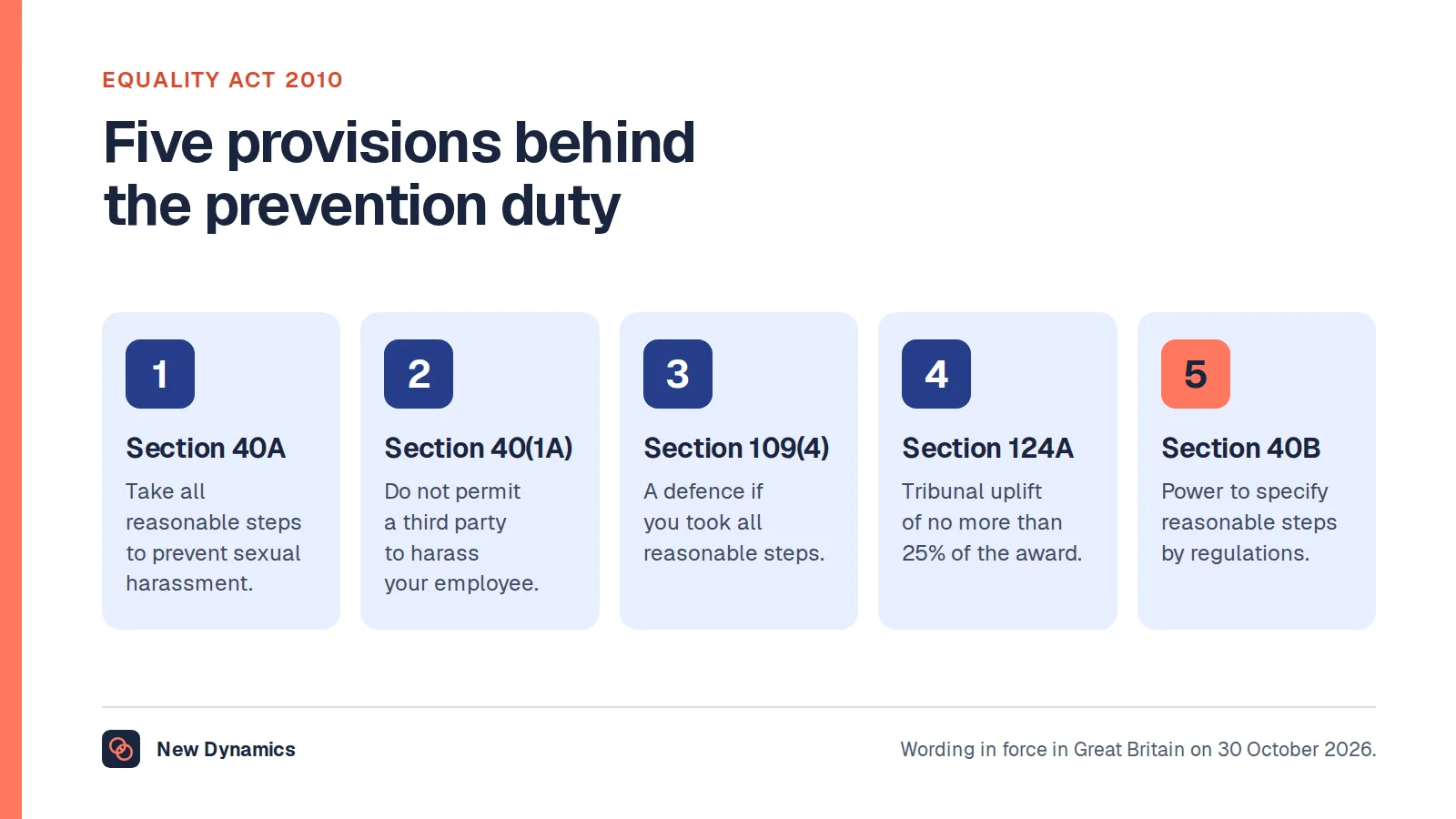
Section 40A of the Equality Act 2010 was inserted on 26 October 2024 by the Worker Protection (Amendment of Equality Act 2010) Act 2023. As it now reads, section 40A(1) requires that "An employer (A) must take all reasonable steps to prevent sexual harassment of employees of A in the course of their employment." The word "all" was inserted on 30 October 2026 by section 20 of the Employment Rights Act 2025, commenced by SI 2026/1065, regulation 3(a). The same instrument, at regulation 3(b), brought in section 40(1A) to (1C) on third parties, under which an employer "must not permit a third party to harass a person (B) who is an employee of A", which happens where the employer "failed to take all reasonable steps to prevent the third party from doing so". Acas states the position in its guidance on steps for employers to prevent sexual harassment, last updated 30 October 2026: "On 30 October 2026, the Employment Rights Act 2025 strengthened the law so that employers have to take 'all reasonable steps'. Before, employers only had to take 'reasonable steps'."
Two things follow for relationships specifically.
Acas names the risk factor in plain terms. Its list of higher risk factors to consider in a risk assessment includes "power imbalances between workers", and among the things it says an employer should make clear to everyone is that "you will not tolerate misuse of power in workplace relationships, for example through seniority or influence". That is the preventative duty meeting the seniority question directly, and it is a better basis for a policy than a prohibition.
There is still no statutory list. Acas is explicit: "What is reasonable depends on the situation. There's no set list of steps that all employers must take." A power to create one now exists. Section 22 of the Employment Rights Act 2025 inserted section 40B into the Equality Act 2010 on 30 October 2026, allowing regulations to "specify steps that are to be regarded as 'reasonable'", including "carrying out assessments of a specified description" and "steps relating to the handling of complaints". At the date of this update no such regulations have been made, so the open-ended test still applies. Our post on the sexual harassment prevention duty sets out the duty, the risk assessment and the compensation uplift in full; the uplift is in section 124A, which caps it at "25% of the amount awarded under section 124(2)(b)".
Break-ups, and what you can and cannot do about them
An employer has no business in the end of a relationship, and every business in what happens at work afterwards. Keep the two apart.
Conduct at work is manageable through the ordinary route. Acas describes misconduct, on its guidance on the disciplinary procedure, as "when an employee's inappropriate behaviour or action breaks the organisation's rules", and notes that "An employee could face disciplinary action for misconduct outside work", where "It depends on how serious the misconduct is and whether it could affect business" and "It's important the employer carries out a thorough investigation and can show the effect on the business." Our posts on workplace investigations and the disciplinary procedure cover the process, and grievance meaning covers the route the other way.
Three practical points. Keep the recusal in place after a break-up until someone actively decides it is no longer needed, because the risk of a retaliatory decision is higher then, not lower. Expect a complaint about conduct during the relationship to arrive after it ends, and do not treat the delay as evidence against it, because section 26(3) describes exactly that sequence. And do not try to buy silence. Section 24 of the Employment Rights Act 2025 inserts a new section 202A into the Employment Rights Act 1996 making void any agreement provision that "purports to preclude the worker from making an allegation of, or a disclosure of information relating to, relevant harassment or discrimination". That provision is in force only for the purpose of making regulations, commenced for specified purposes by SI 2026/3 and SI 2026/323, so the substantive prohibition is not yet law. It is on the way, and an agreement drafted today may be unenforceable before it is tested.
No official source publishes how common relationships between colleagues are in the United Kingdom. There is no Office for National Statistics series and no government estimate, so any percentage quoted comes from a survey the publisher commissioned itself. Do not build a policy case on one. The figures that do exist on related matters are in our HR statistics hub.
The discrimination traps in applying the policy
A policy that reads neutrally can still be applied in a way that produces a claim. These are the patterns to watch, each of which is a section 13 or section 19 problem rather than a presentational one.

- Uneven enforcement by seniority. The rule is applied to a junior pair and quietly not applied to an executive. This is also the fastest way to destroy the policy's credibility.
- Married and unmarried couples treated differently. Directly engages section 8 and section 13(4).
- Same-sex relationships handled more intrusively, or disclosed to more people than a different-sex relationship would be. That is less favourable treatment because of sexual orientation, and it is also a data protection breach.
- Gendered outcomes. The woman is moved, the man keeps the role. Each decision looks individual; the pattern is the evidence.
- Assumptions about age gaps or about who initiated. Age is a protected characteristic, and a judgement about who must have pursued whom is not evidence.
Our post on the definition of discrimination covers the framework, and unconscious bias examples covers the decision-making habits that produce the patterns above. Keep a short record of how the policy has been applied, every time, so you can answer the comparison question rather than guessing at it.
For the wider subject of building and managing working relationships, which is a different question from this one, see our post on workplace relationships.
Frequently asked questions
Can an employer ban romantic relationships at work?
An employer can write such a rule, but it is unlikely to be defensible or useful in Great Britain. Marriage and civil partnership is a protected characteristic under section 8 of the Equality Act 2010, so a rule distinguishing married from unmarried couples is exposed, and a blanket ban has no proportionality argument under section 19 because it makes no distinction between relationships that create a conflict of interest and relationships that do not. A disclosure and recusal rule achieves the legitimate aim with far less risk.
Do employees have to tell their employer about a relationship with a colleague?
Only if the employer has a policy requiring it, and the requirement is only likely to be reasonable where the relationship touches a decision: line management, recruitment, promotion, pay, access to the other person's records, procurement, or a safeguarding duty in a regulated sector. Article 8 of the Convention rights, in Schedule 1 to the Human Rights Act 1998, protects respect for private life, so the further a question moves from the work, the harder it is to justify.
Is a relationship between a manager and a direct report a conflict of interest?
Yes, and it is the central case. One person holds decision-making power over the other's objectives, rating, pay, leave and discipline. The answer is recusal and re-routing the decisions, recorded in writing, rather than discipline for the relationship itself. Moving someone's role should be a last resort, and the more junior person should not be moved by default.
Can a relationship still amount to sexual harassment?
Yes. Consent at one moment does not settle the question, because section 26(1) of the Equality Act 2010 turns on whether conduct has the "purpose or effect" of violating dignity or creating an intimidating, hostile, degrading, humiliating or offensive environment, judged under section 26(4) by reference to the perception of the person affected, the other circumstances, and whether it is reasonable for the conduct to have that effect. Section 26(3) specifically covers less favourable treatment because someone rejected or submitted to conduct of a sexual nature.
What does the duty to prevent sexual harassment require about relationships?
Section 40A of the Equality Act 2010 requires an employer to take all reasonable steps to prevent sexual harassment of its employees, the word "all" having been added on 30 October 2026. Acas lists "power imbalances between workers" among the higher risk factors to consider in a risk assessment, and says an employer should make clear that "you will not tolerate misuse of power in workplace relationships, for example through seniority or influence". In practice that means the policy addresses seniority and reporting lines rather than romance in general.
Does this apply in Northern Ireland?
No, not directly. Every provision cited here is marked on legislation.gov.uk as extending to England, Wales and Scotland. Northern Ireland has its own separate discrimination legislation and its own enforcement body, and the duty to prevent sexual harassment sits in the Equality Act 2010, so it does not reach Northern Ireland employment. If you employ people across both, write the rule twice and label each.
Your next step: turn the morality question into a decision map
- Delete any blanket prohibition from the current policy and replace it with the list of situations where a relationship touches a decision.
- Name one recipient for disclosures, and make sure it is not the immediate manager.
- Write down your Article 9 condition, access list and retention period before you create a disclosure register.
- Draft the recusal wording so it names the decisions, not a promise of impartiality, and name who takes each one instead.
- Check your last two years of applied cases for the uneven patterns above, by seniority, by sex and by marital status, and fix what you find.
- Add the seniority point to your sexual harassment risk assessment, where the preventative duty now expects to find it.
For the policy document itself, read and download our anti-harassment policy guide. The guide is free to read, and the PDF uses our short download form.
Want the reporting lines, review participants and decision owners to be visible before you have to re-route one? Book a New Dynamics demo and bring your current policy. You can also email contact@new-dynamics.com.