TL;DR
- Training and development are not the same purchase. Training targets one competence that can be assessed at the end. Development builds capability over time, mostly through real work: of the £53.0 billion UK employers spent over the 12 months covered by the Employer Skills Survey 2024, spend was "relatively evenly divided between off-the-job training and on-the-job training (£26.9bn and £26.1bn respectively)".
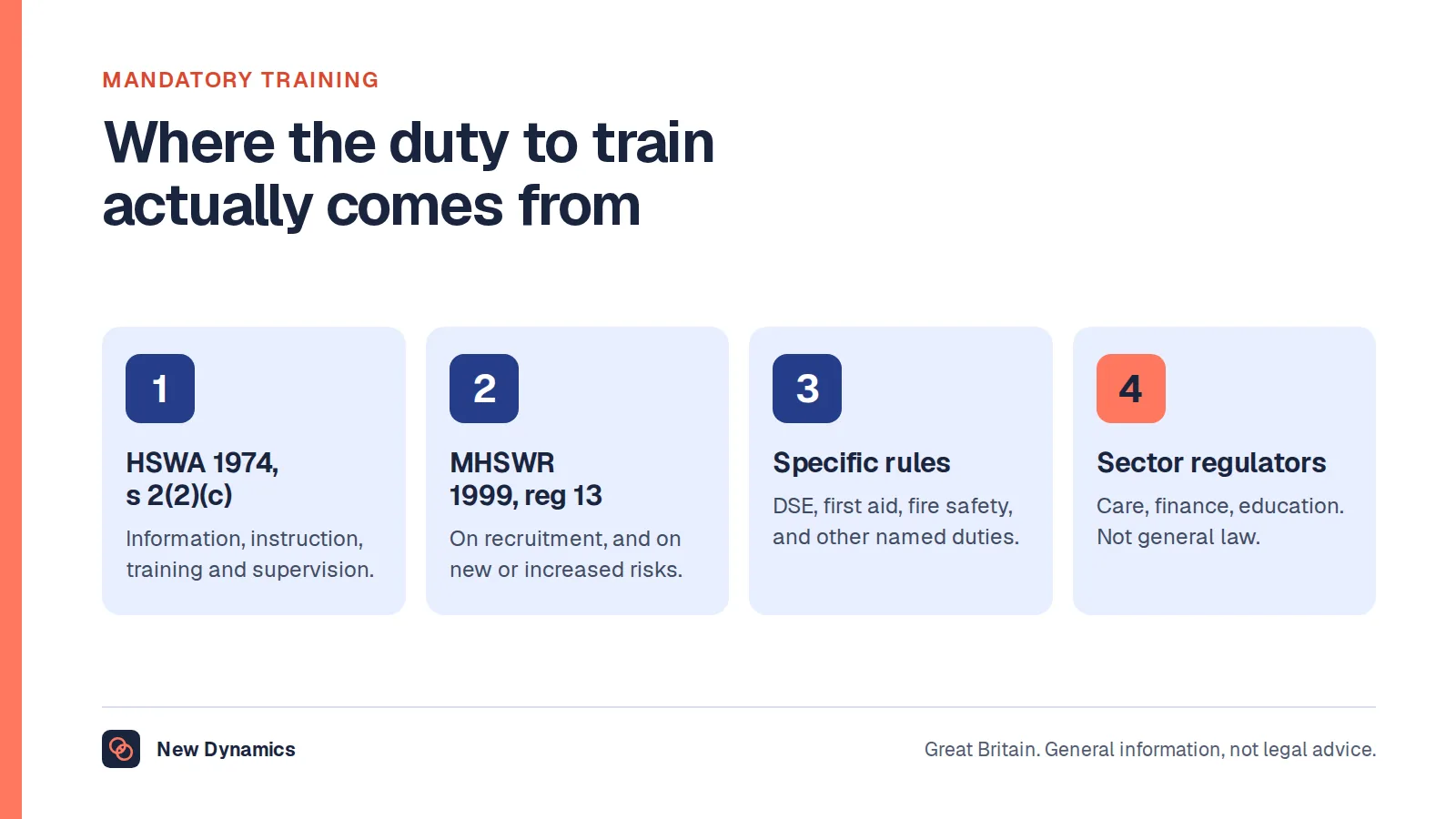
- Part of it is not optional. Regulation 13(2) of the Management of Health and Safety at Work Regulations 1999 requires "adequate health and safety training" on recruitment and on exposure to new or increased risks, and regulation 13(3) says it shall "take place during working hours".
- Development that is not recorded cannot be reviewed. HSE puts the reason plainly: "Keeping training records will help you decide if refresher training is needed." Acas adds that for a review conversation, "It's important to keep a written record of what is discussed."
Most organisations say they believe in staff development. Fewer can say what theirs consists of. The gap is usually filled by a course catalogue, a box on an appraisal form, and an intention that never becomes a date in anyone's diary.
This article answers what staff development is for an employer in the United Kingdom, who owns it, how to find a real need rather than inventing one, the routes available, and how to tell whether anything changed. Half of it is examples by role type, because the word stays a slogan until someone writes down what it looks like for a warehouse operative and for a payroll administrator. It is general information about the position in the United Kingdom and not legal advice.
Development is easier to run when the conversation and the evidence live in the same place. See how New Dynamics performance reviews keep goals, feedback and agreed development actions attached to the cycle, so next year's conversation starts from what was actually agreed.
Training fixes a task. Development changes what someone can be trusted with
The two words are used as one and bought as one, which is why so much money produces so little change.
Training targets a specific competence and has an end. Someone cannot operate the new till, raise a purchase order, or fit the harness correctly. You can describe the gap, close it, and assess whether it closed. Our post on how to write a training plan covers that half.
Development builds capability over a longer period and has no single end point. Nobody is "developed" on a Thursday. The goal is that in a year someone can be given work you would not hand them today: a difficult customer, a budget, a small team, an audit, a decision that cannot be escalated. It cannot be delivered as a module, because what is being built is judgement applied to real work.
The practical test is the handover question. If you can say what someone will be able to do by the end of Friday, that is training. If the honest answer is what you would be willing to hand them in twelve months, that is development.

Where development actually happens, according to the official figures
Budget tends to go where the invoice is, and most development does not generate one.
The Employer Skills Survey 2024, published by the Department for Education and Skills England, surveyed 22,712 UK employers, with fieldwork between June 2024 and January 2025 and a follow-up Investment in Training survey between July 2024 and February 2025. On spending over the previous 12 months it reports: "Total employer expenditure on training and development over the previous 12 months was £53.0 billion. Spend was relatively evenly divided between off-the-job training and on-the-job training (£26.9bn and £26.1bn respectively)." It also found that "Almost half of all employers (48%) provided on-the-job training" against "two-fifths (40%)" providing off-the-job training.
So the on-the-job half is both more common and close to half the national spend. If your development plan is a list of courses, it is describing the smaller half and ignoring the part already costing you supervision time. For the wider set of published figures, see our post on UK learning and development statistics and the statistics hub.
Who owns staff development
Four owners, and the confusion between them is where most schemes die.
- The employer owns the floor and the funding. Some training is a legal duty rather than a kindness, covered below. Beyond that, the employer decides what capability it needs next and pays for it.
- The line manager owns the conversation and the opportunity. Only the manager can hand over the work that develops someone, protect the time, and notice when an agreed action has quietly stopped. Acas states that "Employers should conduct regular performance reviews for anyone with the legal status of employee" and that it is "a good idea to do them at least once a year", in its guidance on performance management.
- The employee owns the effort and the choice.
- HR owns the system, not the outcome. The framework, the record, the budget and the reporting. A scheme built so that HR chases managers for completions will produce completions.
A quick test: name the person who will notice if nothing happens by the review date. If the answer is nobody, or "HR will send a reminder", it is not owned.
How to find the real need, without inventing one
The common failure is not neglect, it is invention. Someone picks three plausible themes, buys them, and reports participation. Start from work that is changing instead.
- Name the work, not the skill. "Resilience" is not a need. "Can run the month-end close alone when the finance manager is on leave" is. Write the need as a task someone cannot currently be given.
- Find your own gap first. The Employer Skills Survey measures it as proficiency: "Skills gap density is the number of employees that were judged not fully proficient as a proportion of all employees." Judged by the employer, in other words by the people who see the work. Reported gaps rise sharply with size, "ranging from 4% among the smallest sites with 2 to 4 employees to 38% among those with 100 or more employees", which says as much about who notices gaps as about who has them. Our skills gap analysis guide sets out how to run one.
- Check it against something about to happen. A system going live, a contract starting, a retirement, a new regulator requirement. A need with no date in the business will not get time in the diary.
- Ask the person. They usually know which part of the job they are faking, and will say so if the conversation is not attached to their rating.
- Then check it is a development need at all. Some gaps are process, resourcing or job design problems. Developing someone to cope with a badly designed handover is an expensive way to avoid fixing the handover.
The legal floor you must provide anyway
Development is discretionary. Some training is not, and it belongs in any staff development plan as a fixed line rather than an aspiration.
Regulation 13(2) of the Management of Health and Safety at Work Regulations 1999 provides that "Every employer shall ensure that his employees are provided with adequate health and safety training" both "on their being recruited into the employer's undertaking" and on their being exposed to new or increased risks because of a transfer or change of responsibilities, new work equipment, new technology, or a new or changed system of work. Regulation 13(3) adds that the training shall "be repeated periodically where appropriate" and shall "take place during working hours". Regulation 13(1) sits above all of it: "Every employer shall, in entrusting tasks to his employees, take into account their capabilities as regards health and safety."
Those regulations extend to England, Wales and Scotland. Regulation 13 of the Management of Health and Safety at Work Regulations (Northern Ireland) 2000 is worded identically for Northern Ireland.
Read that list as a development trigger rather than a compliance one. Promotion, a transfer, a new machine and a new process are exactly the moments when someone is being stretched, and the law already requires training at each. The sector duties, and who pays, are in our post on mandatory training.
The five routes, and what each is good for

On-the-job development. Real work slightly beyond someone's current range, with a safety net: a recurring decision delegated, a report handed over, chairing the meeting, facing the customer. Cheapest and most effective, and the most frequently skipped, because it costs the manager time rather than the budget money.
Coaching and mentoring. Coaching works on how someone approaches the work; mentoring passes on experience and context. Both need a cadence and an agreed subject, or they become pleasant chats. See what coaching means for the distinction.
Secondment, shadowing and job rotation. The route for breadth: how another function decides things, and what your own work looks like from the other end. Settle the terms in writing first, including the return, as our post on the secondment agreement sets out.
Qualifications and formal courses. Right when the capability is codified, externally assessed or required by a regulator. Wrong when used as proof of effort. Agree before you pay what the person will do differently.
Apprenticeships. A funded route for new entrants and for existing staff moving into a different occupation. Employers with an annual pay bill over £3 million pay the Apprenticeship Levy, which GOV.UK describes as "an amount paid at a rate of 0.5% of an employer's annual pay bill" in its guidance on how to pay Apprenticeship Levy. How the funds work, and how they expire, is in our post on the apprenticeship levy.
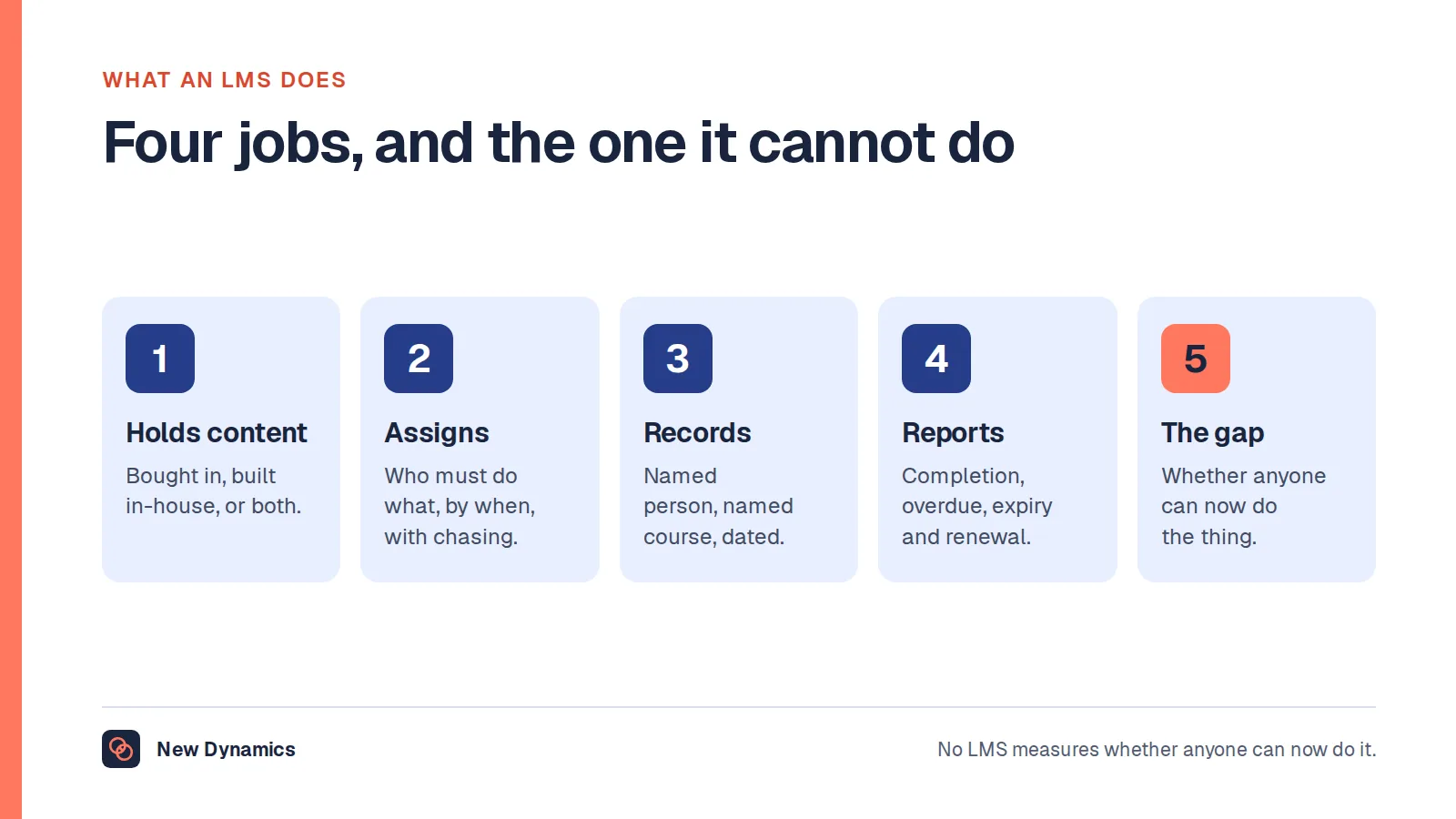
On administering all of this, our post on learning management system software covers when a system helps and when a spreadsheet is the honest answer.
Staff development examples by role
Generic lists of staff development examples are useless because they skip the need and the proof. Each example below is three things: the work the person cannot currently be given, the route, and what would count as evidence.
Warehouse operative moving towards team leader
Cannot be given yet: running the shift handover and allocating the day's picks when the supervisor is absent. Route: on-the-job. Runs the handover one morning a week with the supervisor present but silent, then alone. Takes the counterbalance truck competence formally rather than informally. Proof: two handovers completed unsupervised with no missed priority order, and the supervisor takes leave without arranging cover.
Care worker moving towards senior care worker
Cannot be given yet: writing and reviewing care plans, and being the named person on a safeguarding concern. Route: a qualification, because the capability is codified and externally assessed, plus shadowing the senior on three reviews. Proof: three care plans accepted without amendment by the registered manager, and one concern escalated correctly within the required timescale.
Customer service advisor moving towards complaint handling
Cannot be given yet: owning a complaint from first contact to resolution, including the decision to refund. Route: on-the-job with a defined limit. Authority up to a stated value, every case above it reviewed, fortnightly coaching on the three hardest calls. Proof: the escalation rate on their own cases against their own baseline, and the share of their resolutions that come back.
Payroll administrator moving towards running a cycle
Cannot be given yet: running a full monthly payroll cycle alone, including statutory payments and the year-end return. Route: parallel running. They complete the whole cycle in a test environment while the manager runs the live one, for three months, then swap. Proof: three parallel runs reconciling to the live run, and one cycle run live with checks but no intervention.
Software engineer moving towards technical lead
Cannot be given yet: owning a change that touches other teams, and refusing a request with a reason. Route: a secondment of one day a week into the platform team, plus leading one cross-team change end to end with a named sponsor. Proof: the change ships, and two engineers outside their team say they knew what was happening and when.
First-line manager moving towards managing managers
Cannot be given yet: holding another manager to account for their team's performance instead of doing it for them. Route: coaching, plus taking the second-level review conversations for one cycle with their own manager observing. Proof: their reports' own team members confirm they had a review, and the manager stops writing other people's feedback.
Notice what is missing: no course titles, and no example whose proof is attendance.
The person who does not want to be developed
Every plan meets one, and the usual response is to file them as a problem. Separate the two cases.
The compulsory part is not a choice. Health and safety training is a duty on the employer, and section 7(b) of the Health and Safety at Work etc. Act 1974 puts a matching duty on the employee: "as regards any duty or requirement imposed on his employer or any other person by or under any of the relevant statutory provisions, to co-operate with him so far as is necessary to enable that duty or requirement to be performed or complied with". Refusing a statutory training requirement is a conduct matter, handled through your normal procedure, and should be stated as such rather than negotiated.
The discretionary part is a choice, and may be a reasonable one. A proficient employee who does not want promotion, a qualification or a stretch project is not failing. Pushing them produces a resentful attendee occupying a place someone else wanted. Instead:
- Ask what is behind it: capacity, caring responsibilities, a bad experience of the last scheme, or an accurate reading that the promotion on offer pays worse per hour than the job they have.
- Offer depth rather than height. Becoming the person who trains others, or who owns the hardest category of work, builds capability without implying a move upwards.
- Keep the door open and dated. Record that it was offered, declined, and will be raised again at a stated point. If it is not written down, next year's conversation starts from scratch and feels like pressure.
Acas is careful about the same balance, saying that "Objectives should be fair and reflect the employee's usual tasks and workload" while adding that "they might also stretch them to develop in certain areas". Fair first, stretch second.
How to tell whether staff development worked
Completion was never the point. Four checks, in order of how much they tell you.
- Has the handover happened? The need was written as work the person could not be given. Have they been given it, unsupervised, and did it go well enough to happen again? This is the only check that tests capability rather than exposure.
- Did the thing you counted move? The escalation rate, the rework rate, the unsupervised handovers, the parallel runs that reconciled. If no number was named at the start, that is a design fault rather than a reporting one.
- Did someone else notice? Ask the people around the person, not the person.
- Did the cover problem go away? The honest organisational measure is whether a key role can now be absent.
Two things to stop reporting as outcomes: satisfaction with the session, which measures the session, and hours or courses consumed, which will be gamed the week it becomes a target.

What to record, and for how long
Three separate records, often wrongly merged into one.
The statutory training record. What, who, when, by whom, and when it is due again. HSE is direct about why, in its guidance on how to decide what training your workers need: "Keeping training records will help you decide if refresher training is needed." The same guidance says to "Ask your workers if the training is relevant and effective", which is a useful second line in the same record.
The development agreement. The need, the route, the owner, the date and the proof. Acas says of review conversations that "It's important to keep a written record of what is discussed. This should be shared with the employee afterwards." Shared is the part that gets dropped, and it is what makes the record usable next time.
The spend record. What was funded, for whom, and on what terms. Keep it separate: once the development record and the budget record are one document, the development conversation becomes a funding negotiation.
All three are personal data. Article 5(1)(e) of the UK General Data Protection Regulation requires that personal data be "kept in a form which permits identification of data subjects for no longer than is necessary for the purposes for which the personal data are processed". A statutory training record has an obvious purpose for as long as the duty and the risk persist. A note of a development conversation from eleven years ago does not. Set a retention period for each.
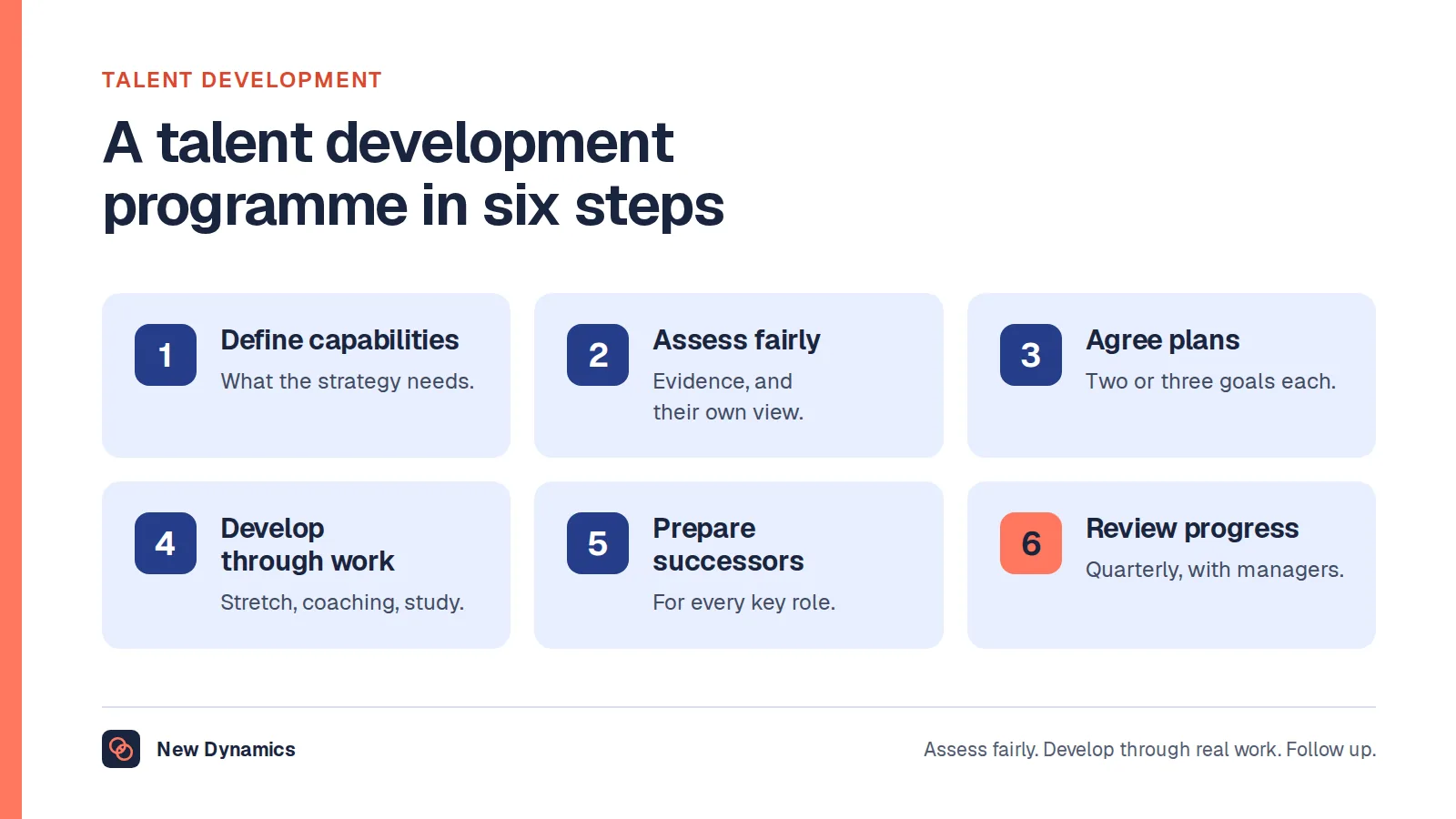
For the template side of this, see our post on the employee development plan, and for the succession layer above it, talent development.
Frequently asked questions
What is staff development?
Staff development is the work an employer does to increase what its people are capable of over time, rather than to close one named gap in a task. It covers on-the-job stretch work, coaching and mentoring, secondments, qualifications and apprenticeships. The test is the handover question: training is what someone can do by Friday, development is what you would be willing to hand them in a year.
What is the difference between staff training and staff development?
Training targets one competence, has an end point, and can be assessed on a date. Development builds capability over a longer period and is mostly delivered through real work rather than a course. The Employer Skills Survey 2024 found UK employer spend on training and development split almost evenly between off-the-job and on-the-job, at £26.9bn and £26.1bn of a £53.0 billion total.
What are examples of staff development?
Concrete ones look like this. A warehouse operative runs the shift handover alone once a week before covering the supervisor's leave. A payroll administrator runs three parallel payroll cycles in a test environment before running one live. A software engineer spends a day a week seconded to another team and leads one cross-team change. Each names the work the person cannot yet be given, the route, and what counts as proof.
Who is responsible for staff development?
Four parties with different responsibilities. The employer owns the legal floor and the funding, the line manager owns the conversation and the chance to hand over real work, the employee owns the effort and the choice, and HR owns the framework and the record rather than the outcome. If nobody would notice that an agreed action had not happened, it is not owned.
Is an employer legally required to develop staff in the UK?
There is no general legal duty to develop an employee's career. There are specific duties to train. Regulation 13(2) of the Management of Health and Safety at Work Regulations 1999 requires adequate health and safety training on recruitment and on exposure to new or increased risks, and regulation 13(3) requires that it take place during working hours. Sector regulators add their own. This is general information and not legal advice.
What do you do if an employee does not want to be developed?
Split the two cases. Statutory training is not optional, and section 7(b) of the Health and Safety at Work etc. Act 1974 places a duty on the employee to co-operate, so refusal is a conduct matter. Discretionary development is a choice: ask what is behind the decline, offer depth instead of promotion, record that it was offered and declined, and set a date to raise it again.
Your next step: write one handover sentence
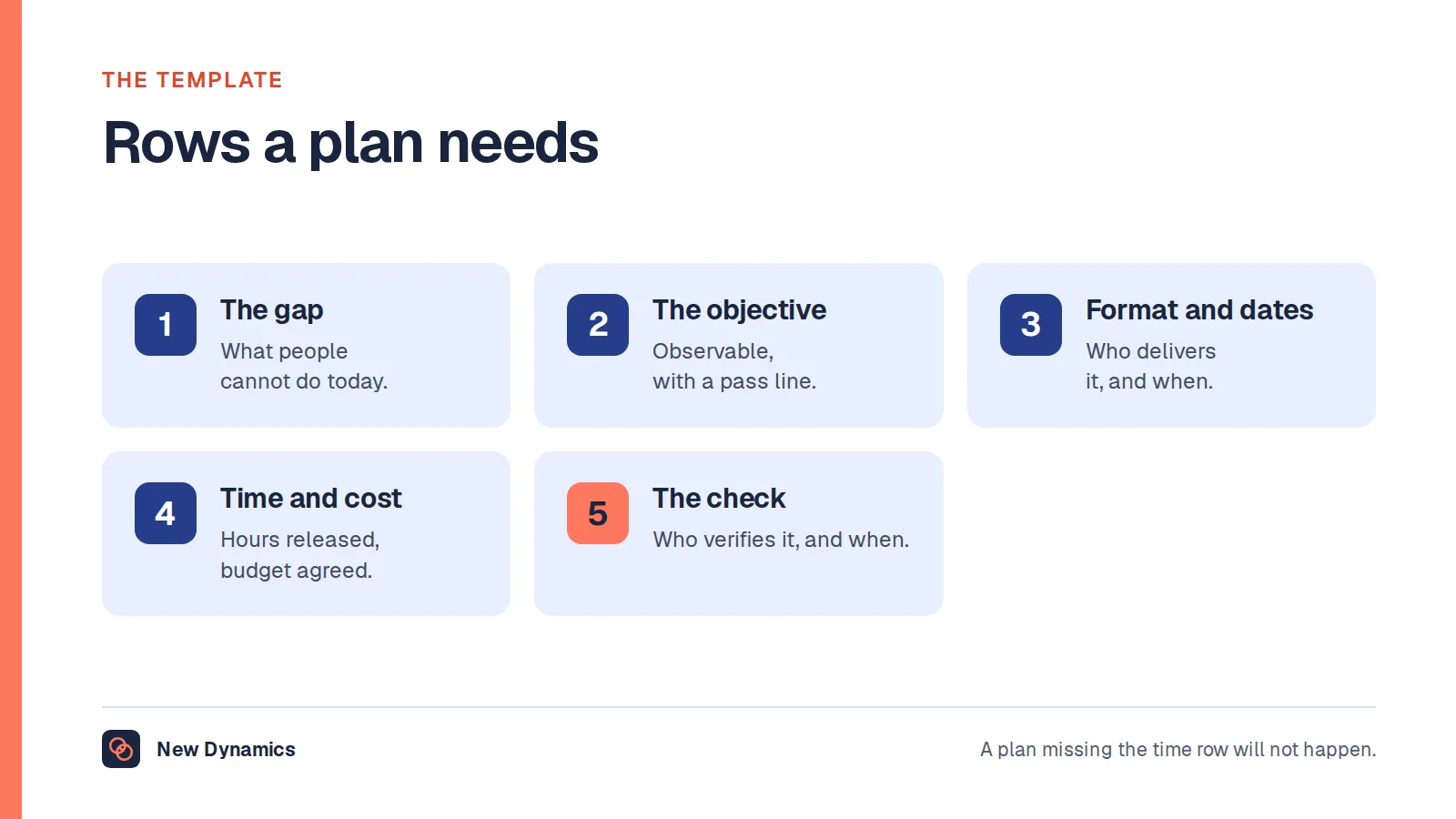
Pick one person. Finish this sentence about them: in twelve months, I want to be able to hand them what? Then write the route, the date and the proof underneath it. That is a staff development plan, and it fits on one side of paper.
If you want the structure around it, read and download our career development guide. The guide is free to read, and the PDF uses our short download form.
Want development actions, goals and feedback to sit in one record instead of three inboxes? Book a New Dynamics demo and bring your current appraisal form. You can also email contact@new-dynamics.com.