TL;DR
- Be professional is not a standard. It names no situation, no action and no failure, so two managers can read it two ways and both believe they are being fair. An expectation only works once somebody could film the thing it asks for.
- Most teams need six or seven stated behaviours, not twenty virtues. The test is not whether the behaviour is good. It is whether reasonable people here already disagree about it, and whether anybody has been caught out by the gap.
- Behaviour stops being a feedback conversation at a definite point. The Acas Code says organisations may wish to consider dealing with issues involving bullying, harassment or whistleblowing under a separate procedure, and section 26 of the Equality Act 2010 sets a legal test that no amount of coaching replaces.
Somebody has asked you to write down the behaviour you expect from your team. You open a document, type "respect", "integrity" and "collaboration", and stop, because you know what happens next. The list goes on an intranet page, nobody disagrees with it, and nothing changes. Six months later the same conversation about the same person is no easier, because the thing that actually bothers you is not covered by the word "respect".
This article is about the problem underneath that: how to describe workplace behaviour precisely enough to settle an argument, without writing platitudes or a rulebook. It covers why "be professional" fails, how to write behaviour so it can be observed, which behaviours are worth stating, how they sit alongside a conduct policy and a review, feedback on behaviour rather than character, the point where behaviour stops being a feedback matter, and what changes with a hybrid team.
Behaviour expectations become real when somebody writes down what happened. See how New Dynamics performance reviews keep behaviour and delivery in one record, so a review has evidence rather than impressions.
Two notes first. Where law appears, this article names the jurisdiction and is general information rather than legal advice. And there are no statistics here, deliberately: no official UK source publishes a count of how many employers have written behaviour standards, or how often a stated expectation changes anything. Acas, GOV.UK and the Health and Safety Executive publish duties, not prevalence figures. The numbers that do exist are in our HR statistics hub.
Why "be professional" fails as a standard
"Be professional" sounds like a standard. It is a request that the reader guess what you mean, and it fails in four ways.
It names no situation. A usable expectation says when it applies. "Be professional" applies always, which means whenever somebody chooses to invoke it, usually after the fact and usually in an argument.
It names no action. Nobody can do "professional" on Monday morning. They can reply to a client within a working day, raise a slipping date in the week it slips, or decline a meeting rather than attend it silently.
It names no failure. If you cannot say what breaking the standard looks like, you have a preference. The useful question: what would somebody have to do for me to say that fell short, and would I say so if the person were senior and successful?
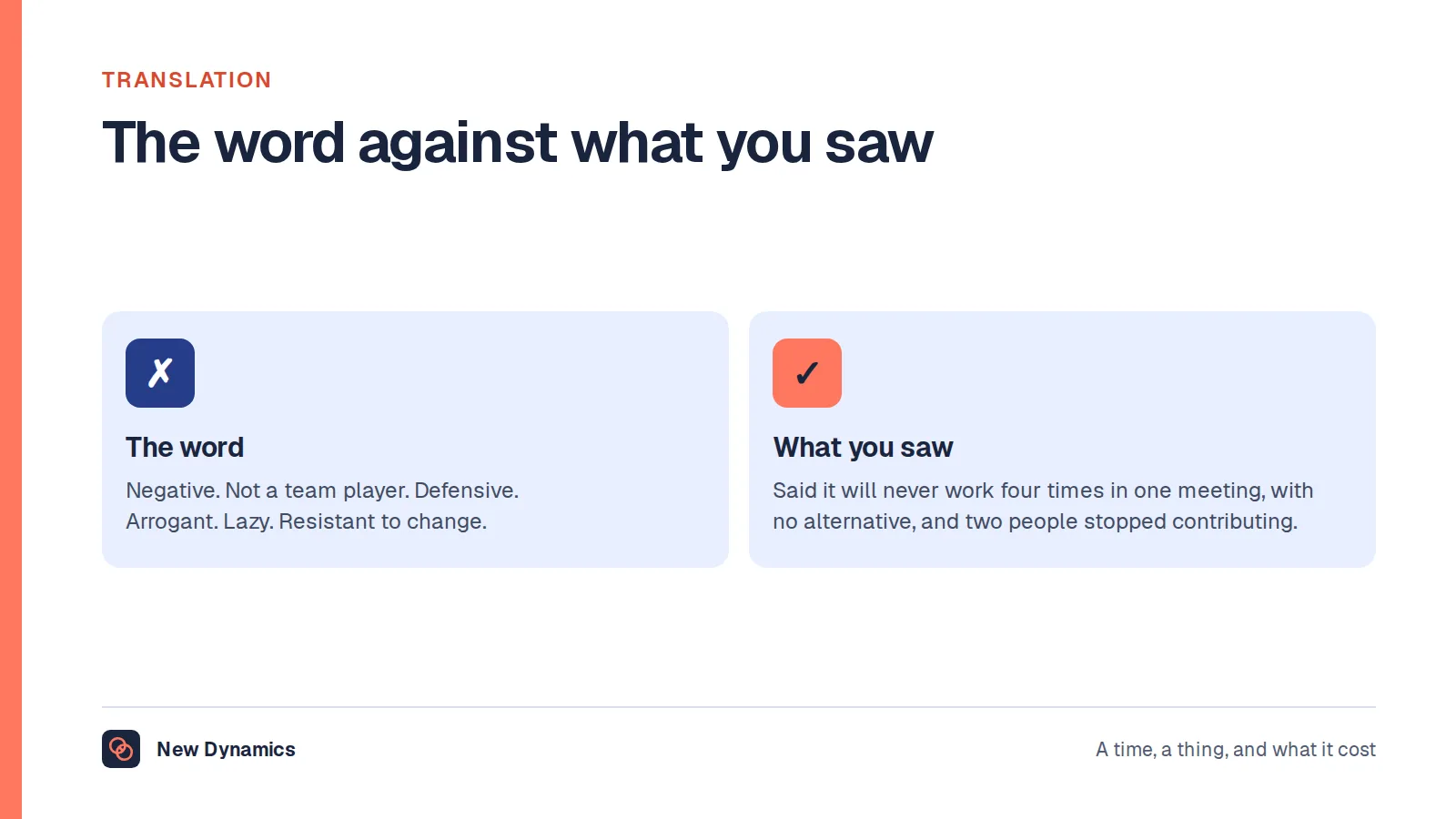
It is not evenly understood. This is the expensive one. "Professional" carries assumptions about accent, dress, volume, directness and humour. Two managers can apply the word honestly and reach opposite conclusions about the same person, who cannot argue, because the standard was never written down. As a phrase, professional behaviour at work tends to describe whoever most resembles the people already in charge.
Acas puts the general principle more carefully. Its Code of Practice on disciplinary and grievance procedures, published 11 March 2015 and applying in Great Britain, says that "fairness and transparency are promoted by developing and using rules and procedures", and that "these should be set down in writing, be specific and clear". Specific and clear is a higher bar than nice and uncontroversial.
The same vagueness drives the most common complaint managers bring to HR, which is about somebody's attitude. Our post on feedback on attitude at work translates ten of those complaints into something observable. This article is the step before it.
Which document does what
Most behaviour documents fail by being three documents at once.

Values say what the organisation prefers when two reasonable courses conflict. They are tie-breakers, and a value nobody could argue against does no work. Our post on company values sets out that test.
A behaviour standard says what people here can expect from each other on an ordinary day. Neither aspirational nor disciplinary, it answers "how do we actually work with each other", so a new starter does not spend four months inferring it from what gets praised and ignored.
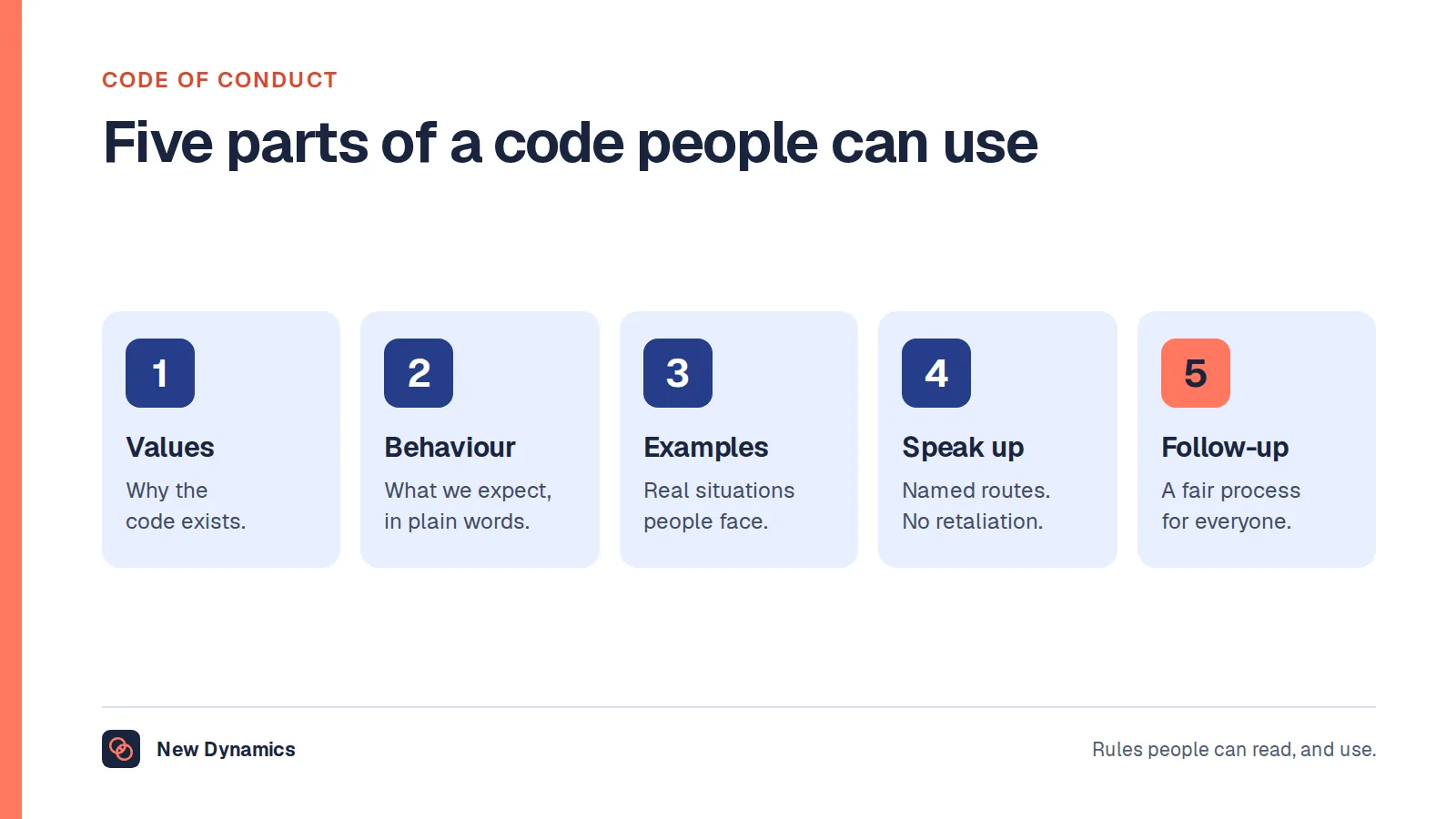
A conduct policy says what is not optional and what follows a breach, with procedural consequences. Our post on code of conduct examples covers what goes in it, section by section.
A fourth gets confused with these. A competency framework describes capability at different levels of a role, and is what you rate against in a structured review; writing indicators that work across levels has its own craft, covered in our post on behavioural indicators.
The consequence of keeping them apart: a legal or safety requirement belongs in the policy, because it is not a choice. A preference belongs in the values. What is left, the ordinary friction of working together, is the behaviour standard, and it is usually the only one of the four that nobody has written.
How to describe behaviour so it can be observed

Five moves turn an expectation into something you can see and discuss.
1. Name the situation. Behaviour expectations are conditional. "When a client emails you." "When a date you own will slip." The condition stops the standard being invoked at random.
2. Name the action as a verb somebody could film. If you pointed a camera at the person, could you tell whether they had done it? "Communicates openly" fails. "Posts the decision in the project channel on the day" passes.
3. Name the effect, and who relies on it. If you cannot finish "we do this because otherwise X happens to Y", drop it.
4. Name what falling short looks like. The highest-value step. It tells people where the line is without a disciplinary conversation, and it exposes the drafts that cannot be breached.
5. Use one wording for everyone. The Acas Code's list of what fairness requires includes the blunt instruction that "employers and employees should act consistently". A standard written once and applied to the whole team is consistent by construction. One that lives in each manager's head is not.

Applied to the four traits that appear most often in draft documents.
| Trait wording | Observable wording | What falling short looks like |
|---|---|---|
| Be professional | Reply to a client within one working day, or say in the thread why not | A client chases twice before anyone answers |
| Be a team player | Say yes or no to a request for help within the day | A colleague waits a week and then does it |
| Be accountable | Raise a slipping date in the week it slips, with a revised estimate | The first anyone hears of it is the due date |
| Be respectful | Disagree with the idea, and do not characterise the person | The objection arrives later, to a third party |
"Be respectful" did not become softer. It became narrower and harder to wriggle out of, because it now says what is in scope (the idea) and what is not (the person).
One caution. Some behaviour is affected by a disability, a health condition or a working pattern, so a standard written purely as output can disadvantage somebody for a reason unconnected to their work. Build the adjustment in rather than bolting it on. Acas notes that objectives "should be fair and reflect the employee's usual tasks and workload", and the same applies to behaviour.
The behaviours that actually need stating
The instinct is to cover everything. Resist it. A list of twenty cannot be recalled or prioritised, so in a real disagreement people reach for whichever item supports the position they already held.
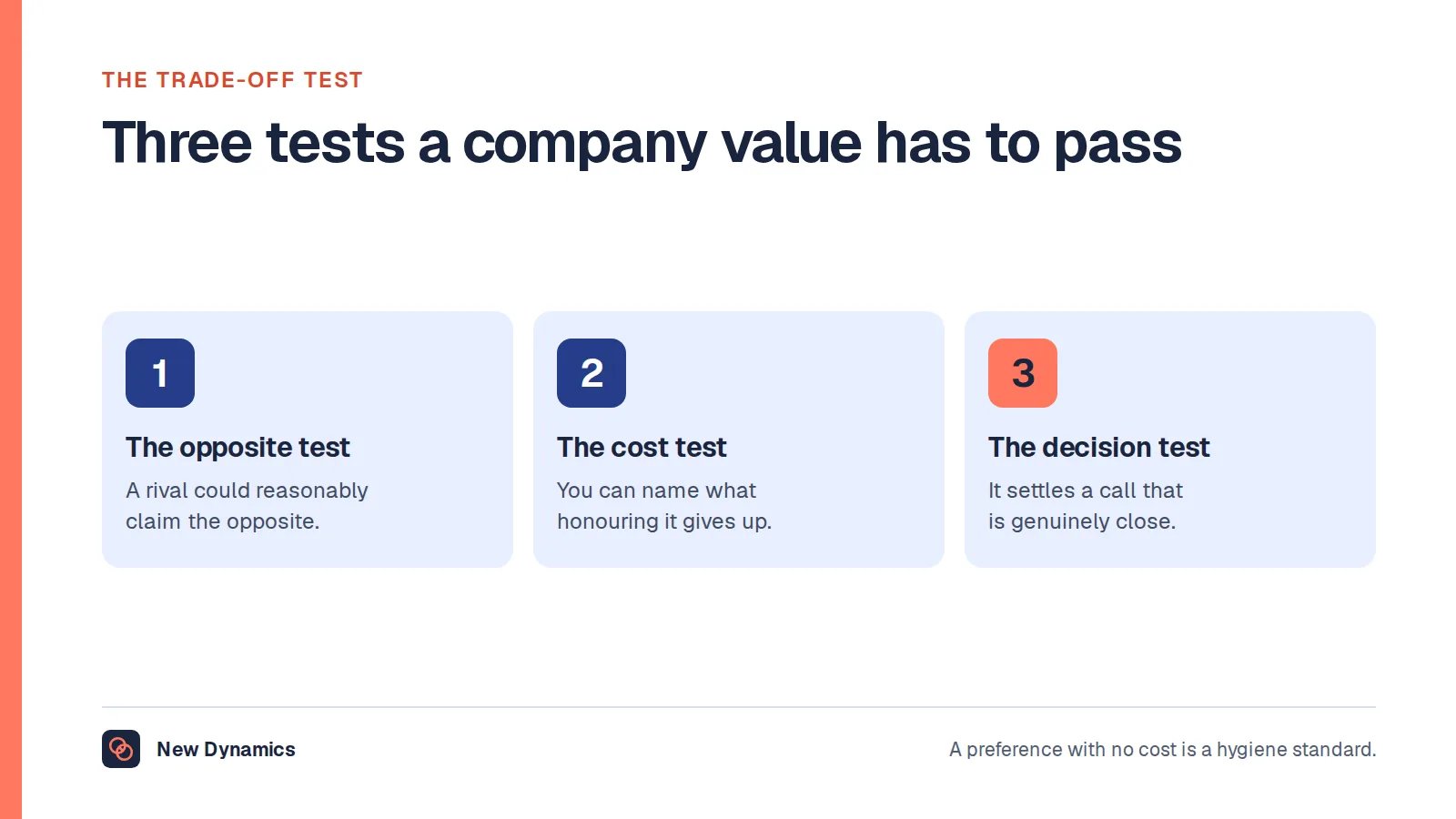
Three tests decide whether a behaviour earns its place.
- Do reasonable people here already disagree about it? If everybody already does it, writing it down is decoration. If nobody could object, it is a platitude.
- Has somebody been caught out by the gap? The best source is the last six months of small frustrations: the handover that was not written, the decision nobody heard about, the meeting that ran twice.
- Could you raise it on a Tuesday without a meeting? If a breach needs a formal process, it is a conduct matter and belongs in the policy.
Applied honestly, most teams end up with six or seven, clustered in the same places: responsiveness, where disagreement belongs, handover, the timing of bad news, who gets credit, honesty about meetings, and how long is too long to be stuck. Those are where behaviours in the workplace are genuinely contested rather than merely desirable, and the next section writes all seven out.
If your draft has fifteen, the surplus are values or policy requirements (move them) or virtues (delete them).
A worked behaviour standard for one team
Written for this article, and illustrative. The shape is the point: one page, a situation, an action and a failure version per line, and a date at the bottom.
How we work here. Agreed by the delivery team, reviewed every six months.
- When somebody is waiting on you, you answer within one working day. The answer can be "not yet, and here is when". Falling short looks like a client chasing twice before anyone replies.
- You disagree in the meeting, not afterwards. If the decision goes the other way, support it in public or put the objection in writing to the person who made it. Falling short looks like the meeting agreeing one thing and the corridor another.
- Nothing leaves your hands without a note the next person can act on. Falling short looks like the next person booking a meeting to ask what was decided.
- You raise a slipping date in the week it slips, with a revised estimate. Falling short looks like the first mention arriving on the deadline.
- You name the person who did the work, in the room where the decision is made. Falling short looks like a senior meeting hearing an outcome and not who produced it.
- If you have accepted a meeting, you are in it. If you cannot be, you decline it. Falling short looks like silent attendance and then a question the meeting answered.
- You ask for help before the second day stuck. Falling short looks like a week of no visible progress and no question asked.
What is not in this document. Anything in the conduct policy, including bullying, harassment, discrimination, confidentiality, health and safety and use of company systems. Those are not expectations we agree between ourselves. They are obligations, written down elsewhere, with their own procedure.
Adjustments. If any line here is harder for you for a reason connected to a health condition, a disability or your working pattern, tell your manager and we will change how it applies to you. The expectation is the outcome, not the method.
That last paragraph is what stops a behaviour standard becoming a fitness test. The team should also be in the drafting: the Acas Code says "employees and, where appropriate, their representatives should be involved in the development of rules and procedures", and that it is important "to help employees and managers understand what the rules and procedures are, where they can be found and how they are to be used".
How a behaviour standard meets the conduct policy
A conduct policy is a formal instrument. In the United Kingdom, GOV.UK's guidance on the written statement of employment particulars says employers "must give employees and workers a wider written statement within 2 months of the start of employment", and that this "must include information about" a list including "disciplinary and grievance procedures". A statutory duty with a deadline, not optional paperwork.
The Acas Code adds that "disciplinary rules should give examples of acts which the employer regards as acts of gross misconduct", which "may vary according to the nature of the organisation and what it does". Our posts on gross misconduct and the disciplinary procedure cover that territory.
The division of labour.
| Question | Behaviour standard | Conduct policy |
|---|---|---|
| Who writes it | The team, with the manager | HR, with legal input, approved centrally |
| What it covers | Ordinary friction between colleagues | Obligations that are not negotiable |
| How a breach is raised | In conversation, usually the same week | Through a defined procedure, in writing |
| What a breach can lead to | A different habit | A formal outcome, up to dismissal |
Two mistakes recur. The first is putting conduct obligations into a behaviour document, which makes serious matters look like preferences and invites a manager to handle a harassment report with a quiet word. The second is the reverse: writing ordinary habits into a disciplinary policy, so a missed handover is formally a breach and will never be raised, because nobody starts a procedure over a handover.
A behaviour standard is not a prerequisite for acting on serious misconduct. But for the ordinary, arguable, habit-shaped behaviours, writing it down beforehand is the difference between a conversation about a standard and one about a person.
Behaviour in a performance review
Behaviour belongs in a review, and Acas says so. Its performance management guidance, last updated 23 June 2026, says reviews "might be based on a combination of things, like whether an employee is" doing several things, among them "meeting or has met any agreed objectives" and "demonstrating the right behaviours in their work". It adds that "it's important to keep a written record of what is discussed".
The question is what form behaviour can safely take on a review form. Four rules keep it usable.
Rate against the written standard, not an impression. If the standard says "raise a slipping date in the week it slips", the comment is about dates and weeks. With no written standard, what gets rated is how the person comes across.
Require an example with a rough date for any judgement, especially a negative one. No example, no rating. That removes most of the unfairness and the unanswerable comments.
Never let a behaviour rating silently override delivered work. If somebody delivered and still scored badly on behaviour, the reason has to be a specific incident raised at the time. A score appearing for the first time in a review is a process failure, not a finding.
Read the distribution. Count behaviour ratings by manager, and by group where the numbers protect anonymity. A pattern is usually a finding about the raters.
Behaviour is easier to review honestly when it was written down as it happened rather than reconstructed in the week the forms are due. See how New Dynamics continuous feedback keeps small notes attached to the person and the date. Our performance review guide covers the cycle, and the competency framework covers rating across levels.
Feedback on behaviour, not on character
Everything above is the standard. This is the conversation, and the rule is short: the sentence you say out loud contains a situation, an action and an effect, and no adjectives about the person.
"You are unreliable" is a verdict, and the only available response is denial. "The last three handovers arrived without notes, and Priya booked a meeting each time to ask what had been decided" is a description, and the responses available include an explanation you need to hear. Character judgements also age badly in writing: they outlive the manager who wrote them and carry no evidence.
Three additions specific to behaviour.
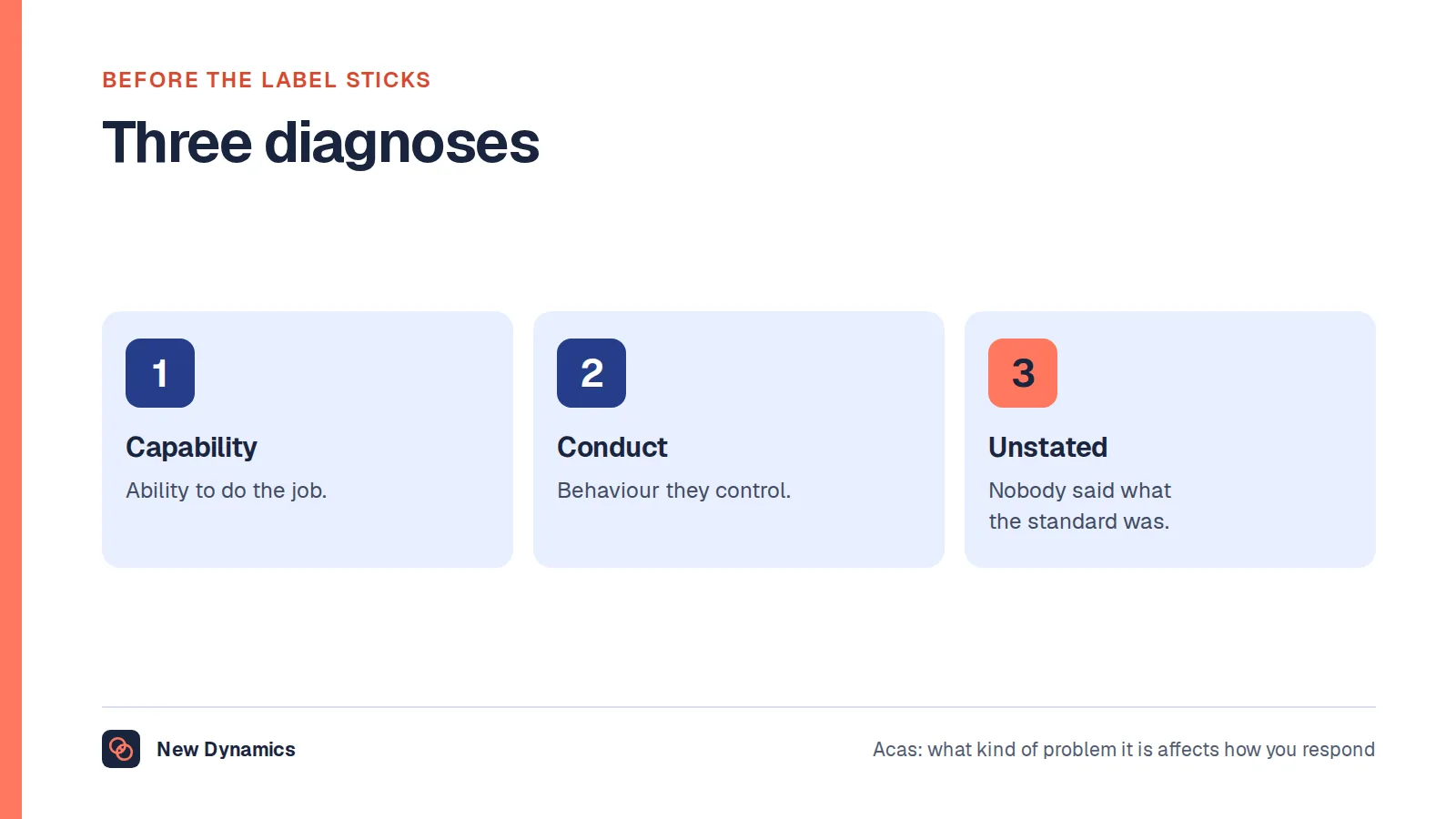
Check the explanation before you restate the standard. Behaviour that changed has a date attached, and usually a cause: workload, a health condition, a working pattern, a decision taken without the person. Our post on difficult employees sets out the capability and conduct split.
Say which half of the fix is yours. The handover was often not written because nobody has time to write one. A conversation that ends with only the employee holding an action was probably about character after all.
Write down what was agreed, on the day. One sentence, with a date to look at it again. That is also what makes a later formal step fair.
The line where a feedback conversation has to stop
Some behaviour is not a standards conversation at all, and treating it as one leaves the people affected unprotected and the employer exposed. The Acas Code says so in its foreword: "organisations may wish to consider dealing with issues involving bullying, harassment or whistleblowing under a separate procedure". Separate is the operative word. These do not belong in a behaviour conversation or a review.
Three signals that the line has been crossed.
The behaviour is directed at a person rather than at work. Not a disagreement about a decision, but a pattern aimed at somebody: exclusion, undermining, humiliation, pressure. Our post on workplace bullying covers what a manager must do, including the fact that UK law has no definition of bullying while the duties are real.
It may relate to a protected characteristic. Then a legal test applies, and it is not about intention. Section 26 of the Equality Act 2010 says that "A person (A) harasses another (B) if" two things hold. First, that "A engages in unwanted conduct related to a relevant protected characteristic". Second, that "the conduct has the purpose or effect of" either "violating B's dignity" or "creating an intimidating, hostile, degrading, humiliating or offensive environment for B". Section 26 is marked on legislation.gov.uk as extending to England and Wales and Scotland, and the page states it is up to date with all changes in force on or before 6 November 2026, the day we read it. Three phrases carry the weight: "unwanted", "related to", and "purpose or effect". A manager who answers this with a coaching conversation about communication style has mishandled it. General information, not legal advice.
Somebody's health is involved. Behaviour between colleagues is a health and safety matter as well as an employment one. The Health and Safety Executive's Management Standards include one on relationships at work, covering "promoting positive working to avoid conflict and dealing with unacceptable behaviour". The standard is that "employees indicate that they are not subjected to unacceptable behaviours, eg bullying at work" and that "systems are in place locally to respond to any individual concerns". What should be happening includes systems "to enable and encourage managers to deal with unacceptable behaviour" and "to enable and encourage employees to report" it. That pair is the best test of any behaviour document.
A behaviour standard helps here in one way, with a clear limit. It gives shared language for the ordinary end of the scale, so the serious end stands out rather than blending in. What it cannot do is substitute for a procedure.
Behaviour expectations for remote and hybrid teams
Hybrid working does not create new behaviours. It removes the ambient information that made the unwritten ones work. In a room you could see that somebody was busy, stuck or absent. Now you cannot, so every expectation that relied on visibility has to be stated.
Acas's guidance on managing employees who work from home, last updated 22 May 2025, is practical here. It says what to "discuss and agree" includes "how to manage and measure performance", and its illustration is worth repeating: "an employer might agree to assess the quality of work done rather than the time an employee spends at their desk". It advises that you "agree how and when to communicate with each other", then adds the counterweight most hybrid documents miss: "it's important to find the right balance and be clear about the purpose for getting in touch", because "constant or unnecessary contact can cause stress and affect morale".
Five expectations worth adding, each replacing information that used to be free.
- Availability, not presence. State the hours in which a reply is expected and the channel for urgent things. Do not set a response time for every channel, or none of them means anything.
- Decisions get written where others can find them. In an office, decisions leak. Remotely they do not. A decision is posted where the people affected will see it, on the day.
- Say when you are stuck, in the channel. The office version was looking frustrated at a desk; the remote one has to be deliberate.
- Calendars tell the truth. Blocked means unavailable, accepted means attending, and declining is normal.
- Camera expectations are stated, with an exception route. An unstated camera norm becomes a loyalty test, and falls hardest on people with a reason not to be on camera, including a disability or a home they would rather not broadcast.
Keep the mechanics of who works where and when out of the behaviour standard. That belongs in a policy, and Acas draws the distinction cleanly. Its guidance on home and hybrid working policies, also last updated 22 May 2025, says a policy "outlines how things work" and "sets flexible limits", which "allows managers and employees to discuss and agree specific arrangements". The policy sets the limits; the behaviour standard says how people treat each other inside them.
One fairness point. Every expectation that rewards visibility advantages whoever is in the building, and falls along lines of caring responsibility, disability, commute and seniority. The fix is the second rule above: judge the work, not the attendance.
Three ways a behaviour standard goes wrong
It gets used to suppress disagreement. The serious one. "Assume positive intent" or "bring solutions, not problems" can be turned into a rule against raising problems, and then a challenge becomes a breach rather than a contribution. Watch for a standard cited in response to a challenge rather than to a decision. Where the concern involves wrongdoing, legal protection applies: GOV.UK says that in the United Kingdom "you're a whistleblower if you're a worker and you report certain types of wrongdoing", and that "as a whistleblower you're protected by law - you should not be treated unfairly or lose your job because you 'blow the whistle'".
It applies to everyone except the people who set it. A standard survives exactly one visible exception. If somebody senior breaks it in public and nothing is said, the document is finished. The question before publishing is not whether the behaviours are right, but whether you would apply them upwards.
It becomes a disciplinary instrument by drift. Notes accumulate, nothing is raised in the moment, and a file appears in a formal meeting. Unfair whatever the contents, and weak too, because a pattern that was never raised is one the person was never given a chance to change. Put a review date on the page, and ask the team which line nobody has mentioned since it was written.
Frequently asked questions
What is workplace behaviour?
Workplace behaviour is what people actually do at work in their dealings with colleagues, customers and the organisation: how they respond, how they disagree, how they hand work over and how they raise problems. It is distinct from performance, which is about results, and from conduct in the formal sense, the narrower set of obligations covered by a disciplinary policy.
What are examples of acceptable workplace behaviour?
Useful examples name a situation and an action rather than a quality. Replying within one working day when somebody is waiting, even if the reply is "not yet, and here is when". Raising a slipping date in the week it slips. Disagreeing with an idea rather than characterising the person who brought it. Handing work over with a note the next person can act on.
Why is "be professional" not a good behaviour standard?
Because it names no situation, no action and no failure, so nobody can act on it and nobody can be shown to have met it. It is also unevenly understood: the word carries assumptions about accent, dress, volume, directness and humour, so two managers can apply it honestly and reach opposite conclusions about the same person.
Should behaviour be part of a performance review?
Yes, and Acas supports it. Its performance management guidance says a review might be based on a combination of things, including whether an employee is meeting agreed objectives and "demonstrating the right behaviours in their work". Rate against a written standard, require an example with a date for any judgement, and never let a behaviour score override delivered work without a reason raised at the time.
When does workplace behaviour become a disciplinary or harassment matter?
When it stops being about the work and starts being directed at a person, or when it may relate to a protected characteristic. The Acas Code says organisations may wish to consider dealing with bullying, harassment or whistleblowing under a separate procedure. Section 26 of the Equality Act 2010, which extends to England and Wales and Scotland, makes unwanted conduct related to a protected characteristic unlawful where it has the purpose or effect of violating dignity or creating an intimidating, hostile, degrading, humiliating or offensive environment. Intention is not required. General information, not legal advice.
How do you set behaviour expectations for a hybrid team?
State the things an office used to make visible. Acas advises agreeing how and when to communicate, and notes that an employer might agree to assess the quality of work done rather than the time an employee spends at their desk. In practice: say when a reply is expected and on which channel, write decisions where everyone affected can find them, make it normal to say you are stuck, keep calendars honest, and decide the camera expectation openly.
Your next steps
- Write down the last six small frustrations in your team. Those are your candidate behaviours, and they beat any list of virtues you could borrow.
- For each one, write the situation, the action, the effect and the failure version. Delete anything you cannot give a failure version to.
- Cut the list to six or seven. Move the legal and safety items into the conduct policy and the preferences into your values.
- Take the draft to the team, change it where they are right, and date it.
- Add the sentence that keeps it fair: tell people to say if a line is harder for them for a reason connected to health, disability or working pattern.
- Check the two tests from the relationships standard: easier for a manager to deal with unacceptable behaviour, and easier for an employee to report it.
For the companion document, the one covering obligations rather than habits, read and download our code of conduct guide. The guide is free to read, and the PDF uses our short download form.
Want behaviour recorded in the week it happens, so a review has evidence in it rather than adjectives? Book a New Dynamics demo and bring your review form and whatever you have written about behaviour today. You can also email contact@new-dynamics.com.