TL;DR
- Compensation management is a sequence, not a policy: what the organisation pays for, how jobs are levelled, how ranges are set, where in a range a person sits, what the review budget allows, who signs the decision, and what record survives it.
- The Equality Act 2010 implies a sex equality clause into every contract by operation of law. Section 66(1) says that if the terms of A's work do not “(by whatever means) include a sex equality clause, they are to be treated as including one”, so a market led number that leaves a less favourable term than a comparator doing equal work is modified by statute.
- Acas and the gender pay gap regulations word the reporting threshold differently. Acas says “more than 250 workers”; the 2017 Regulations say “250 or more employees on the snapshot date”. The instrument governs, so an employer with exactly 250 employees on 5 April is in scope.
A pay rise gets agreed in a meeting. Three weeks later nobody in the room can say what it was for. The money has gone out, the structure it came from cannot be described, and the first person who asks why a colleague is on more gets an improvised answer that becomes the organisation's pay policy by accident.
That is what the absence of compensation management looks like. This article is about the practice itself: the decisions it consists of, in the order an employer actually works through them, and the statutory limits that sit underneath all of them. It covers the position in the United Kingdom and it is general information, not legal advice.
Pay decisions are easier to defend when the evidence behind them already exists. See how New Dynamics performance reviews keep a year of goals, feedback and ratings attached to one record, so a pay recommendation is read off something rather than remembered.
Compensation of management is a different question from compensation management
Three similar phrases carry three different intents, and it is worth separating them before going further.
Compensation management, or compensation and management, means the employer side discipline: setting and running pay across a workforce. That is the subject of this article.
Objectives of compensation management asks what the practice is for. There is a short answer below.
Compensation of management usually means something else entirely: executive and director remuneration. In the United Kingdom that is governed largely by company law rather than by an HR pay structure. Section 420(1) of the Companies Act 2006 provides that the directors of a quoted company "must prepare a directors' remuneration report for each financial year of the company", and section 439(1) requires a quoted company to put a resolution approving that report to its members as an ordinary resolution before the accounts meeting. Directors' pay therefore has a disclosure and shareholder vote layer that ordinary employee pay does not. Everything below concerns the first meaning.
What compensation management is, and what it is for
Compensation management is the set of decisions by which an employer settles what it pays for, how much, to whom, on what evidence, and with what record. It is not one policy document. It is a sequence, and the order matters, because each decision constrains the next.
The objectives are best written as tests the system has to pass:
- It attracts and keeps enough of the right people at a cost the organisation can carry.
- It pays consistently for work of equal value. In Great Britain that is a legal duty, not a preference.
- It is explainable to the person receiving the number, in the words of the structure rather than in the words of the meeting.
- It stays inside the statutory floor and discharges the reporting duties.
- It survives a change of manager without the answer changing.
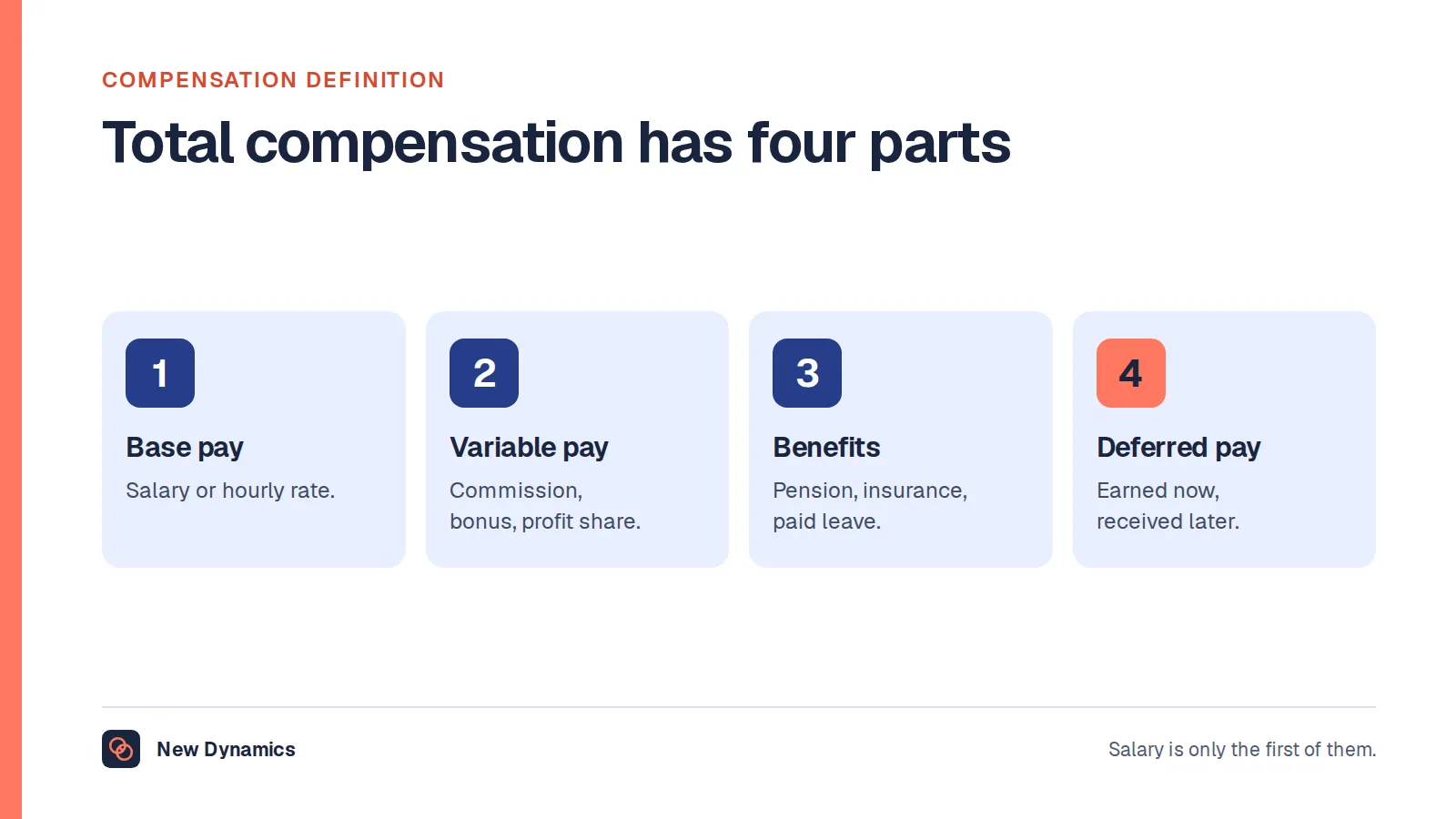
For what sits inside the package being managed, our post on the definition of compensation sets out base pay, variable pay, benefits and deferred pay.

Deciding what you pay for
The first decision is not a number. It is what the organisation is buying.
- The job. Pay is attached to the role and its level. Movement comes from moving role.
- The person. Pay follows accumulated skill or qualification, so two people in the same role can sit apart.
- The output. Pay follows volume or piece, which brings its own minimum wage arithmetic.
- The result. Pay follows an outcome, usually through a variable element.
Most employers combine these, and the combination is the real policy. Decide the split between guaranteed and variable pay here, before any range is drawn, because a wide variable element changes what the fixed range has to do. The cost of the whole thing belongs in the same conversation; see our post on labour costs.
Job architecture and levelling
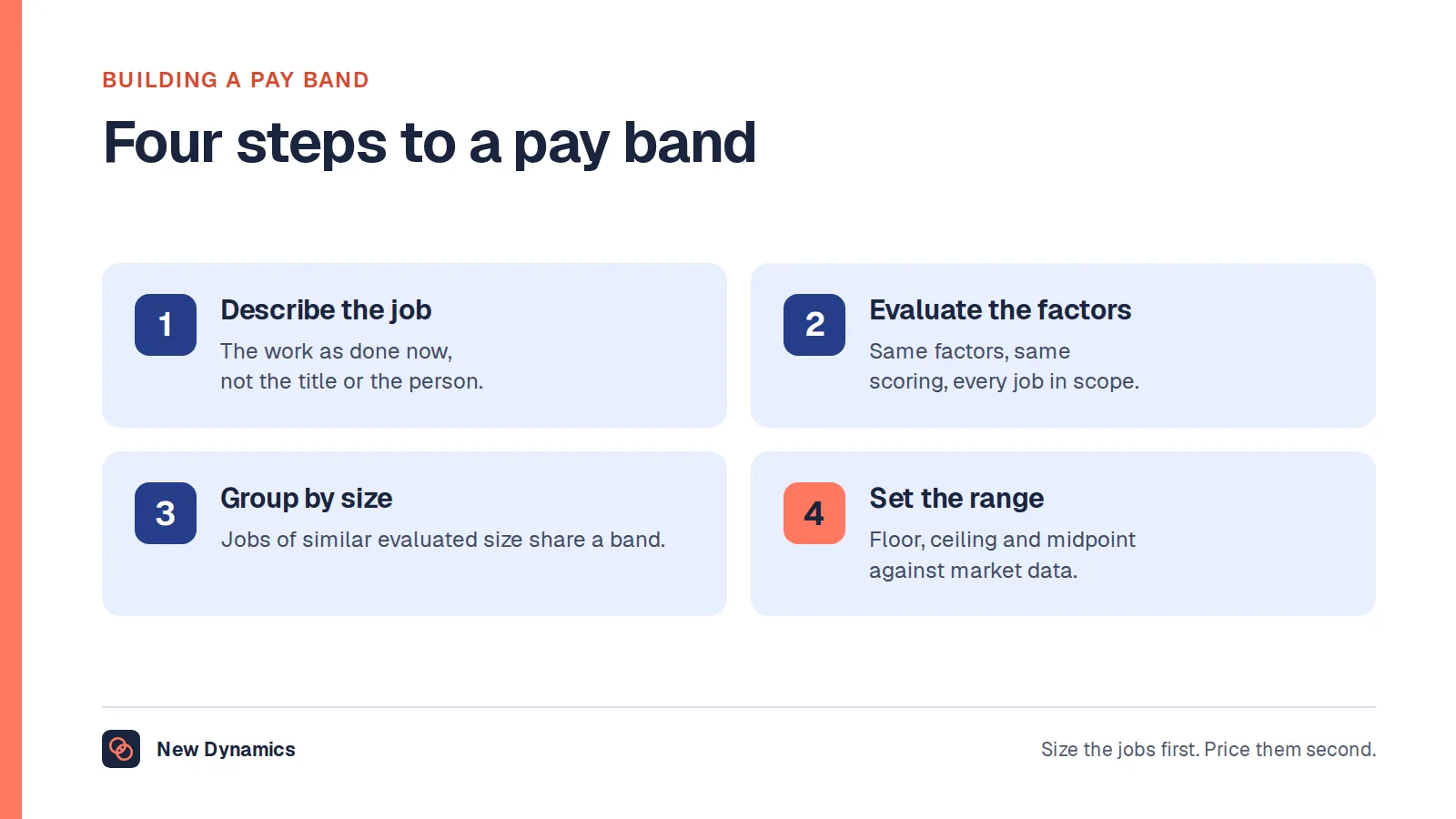
Next, group jobs into families and levels so that comparable work sits in comparable places. This is where equal pay exposure is either created or avoided, and the reason is statutory rather than cultural.
Section 65 of the Equality Act 2010 gives three routes by which work counts as equal. Subsection (1) states that "A's work is equal to that of B if it is (a) like B's work, (b) rated as equivalent to B's work, or (c) of equal value to B's work". Subsection (4) then ties the middle route directly to levelling: "A's work is rated as equivalent to B's work if a job evaluation study (a) gives an equal value to A's job and B's job in terms of the demands made on a worker". Subsection (5) adds that a system is sex specific, and so unusable, if "for the purposes of one or more of the demands made on a worker, it sets values for men different from those it sets for women".
So a job evaluation scheme is not administrative tidying. It is the mechanism the Act names. Our post on pay bands and job evaluation covers the scheme design, band width, overlap and the compa ratio in detail.
Setting the pay ranges
A range needs a minimum, a reference point and a maximum, and a rule about how wide it is and how far it overlaps the level above. Two choices do most of the work:
- Where the reference point sits against the market. At, above or below, and stated deliberately rather than discovered later.
- How wide the range is. A wide range gives room for progression and room for drift. A narrow range forces promotion as the only route up.
Write the rule down. A range with no stated reference point is a list of numbers that a manager can argue with.
Where market pay data comes from, and what it is worth
In the United Kingdom the official source for employee earnings is the Annual Survey of Hours and Earnings, published by the Office for National Statistics. In Employee earnings in the UK: 2026, released on 22 October 2026, ONS reports that "Median weekly earnings for full-time employees were £811.20 in April 2026, compared with £766.60 in April 2025", an increase of 5.8% on the year. The same release states that "median gross annual earnings for full-time employees who had been in their job for at least a year were £40,911 in April 2026, compared with £39,157 in April 2025, a 4.5% increase".
Name the reference period when you use any of this. ONS is explicit: "All estimates for 2026 are provisional and relate to the pay period that includes 22 April 2026." The 2025 figures relate to the pay period including 30 April 2025, and the final 2026 data is due in October 2027 under the annual revision policy.
Three limits matter when you turn a national statistic into a pay range.
- It is a sample. ASHE "is based on employer responses for a 1% sample of employees, using HM Revenue and Customs Pay As You Earn (PAYE) records to identify individuals' current employers". The achieved sample in 2026 was 197,000, the largest on record.
- Precision varies by job. ONS states plainly that "The quality of earnings estimates varies by occupation". A granular occupational median can rest on very few observations.
- The occupational series has a break in it. "From 2021, we moved our occupation coding to Standard Occupation Classification 2020 (SOC 2020), from SOC 2010. This means that estimates for earnings in April 2021 on an SOC 2020 basis represent a break in the ASHE time series. Estimates will not be directly comparable with estimates for earnings on an SOC 2010 basis and, as such, should not be used in direct comparison with each other." Splicing a pre-2021 SOC 2010 figure onto a current one to show a trend produces a number that means nothing.
There is also something ONS does not publish, and it is worth saying rather than filling in. No official United Kingdom source publishes a benchmark pay range for a named job title at a named size of employer in a named town. ASHE gives medians by occupation, industry, region and age, and that is the honest limit of the public evidence. Where you need more than that, say in the pay paper that no official figure exists for the comparison you are making, and base the decision on your own structure and your own recruitment experience instead of importing a number whose method you cannot inspect. Our post on median pay explains which average you are actually looking at, and the statistics hub collects the wider picture.
Progression inside a range
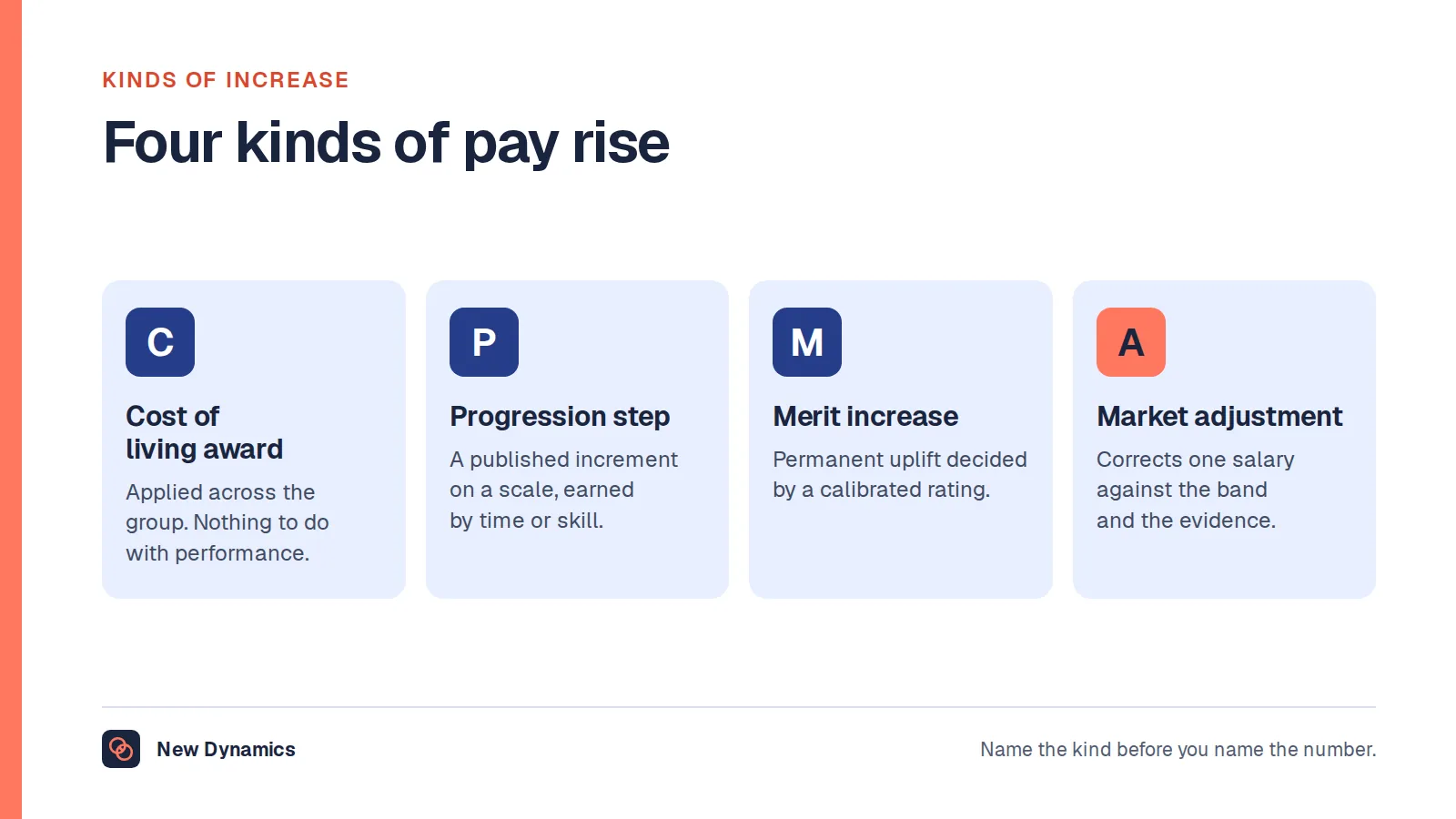
Once ranges exist, the recurring question is not what the range is but why a given person sits where they do in it. Answer it with a rule rather than a history. The usual mechanisms are a progression step on published criteria, a merit increase driven by a calibrated rating, or a market adjustment to one salary with a stated reason.
Keep the three apart in your records, because they behave differently when questioned. Our posts on merit pay and on pay and the performance review cover the rating link, and cost of living awards covers the across the board kind.
The pay review, and the budget that governs it
A review that holds up runs in one order: budget, then evidence, then recommendation, then moderation, then letters. Reversed, the moderation meeting becomes a negotiation about money that has already been promised. Our post on the salary increment and the annual pay review sets out the process and the letter.
One part of the budget is not discretionary. The statutory floor rises every year, which means part of next year's pay bill is already decided. Build that in before the merit pot is allocated, or the uprating quietly eats it.
One pay decision, and who signs it
Reduce the whole apparatus to a single case and it should be possible to state five things on one page:
- The job and its level, and the range that follows from it.
- The current position in the range, and where the proposal moves it to.
- The basis, named as one of your own mechanisms rather than as a percentage.
- The equal pay check: what colleagues doing like work, work rated as equivalent, or work of equal value are paid, and why any difference is explained by something other than sex.
- The signature, from somebody who was not the recommending manager.
If a decision cannot be written in that form, it is not ready to be communicated. Say the basis in the letter, not only the number.

Records and governance
Three record keeping duties bear directly on pay, and all three are statutory.
The written statement of particulars. Section 1 of the Employment Rights Act 1996 requires an employer to give a worker a written statement of particulars of employment, in a single document, "not later than the beginning of the employment". The pay particulars it must contain include "the scale or rate of remuneration or the method of calculating remuneration" and "the intervals at which remuneration is paid (that is, weekly, monthly or other specified intervals)". A method of calculation is part of the required content, which is an argument for having one.
The itemised pay statement. Section 8(1) of the same Act gives a worker "the right to be given by his employer, at or before the time at which any payment of wages or salary is made to him, a written itemised pay statement", showing the gross amount, deductions and their purposes, and the net amount. Where pay "varies by reference to time worked", section 8(2)(e) requires the total number of hours worked for the variable part.
Minimum wage records. Regulation 59(1) of the National Minimum Wage Regulations 2015 requires an employer to "keep in respect of that worker records sufficient to establish that the employer is remunerating the worker at a rate at least equal to the national minimum wage", in a form that can be produced as a single document for a pay reference period. Regulation 59(8) requires those records to be kept "for a period of six years beginning with the day upon which the pay reference period immediately following that to which they relate ends". The six year retention period was substituted on 1 April 2021 by the National Minimum Wage (Amendment) Regulations 2021 (SI 2021/329).
The statutory floor: the National Minimum Wage
No range minimum may sit below the statutory rate for the worker in front of you. GOV.UK publishes the rates and states that "The rates change on 1 April every year". The current rates table gives, for April 2026, £12.71 for workers aged 21 and over, £10.85 for 18 to 20, £8 for under 18 and £8 for apprentices. The same table already carries the April 2027 figures: £12.71 rises to £13.21, £10.85 to £11.27, and both the under 18 and apprentice rates to £8.31.
Two points follow for a pay structure. The apprentice rate is conditional, not an age band: GOV.UK states that apprentices get the apprentice rate only if they are "aged under 19" or "aged 19 or over and in the first year of their apprenticeship", and gives its own worked case, that "An apprentice aged 21 who has completed the first year of their apprenticeship is entitled to a minimum hourly rate of £12.71". And the floor is an hourly test applied to a pay reference period, so a salary that looks comfortably above it on paper can still fall short once extra hours are counted. Our post on base salary works through how that happens to salaried staff.
Equal pay: why paying what the market pays is not a complete answer
This is the single largest legal constraint on a pay structure in Great Britain, and it operates whatever the market data said.
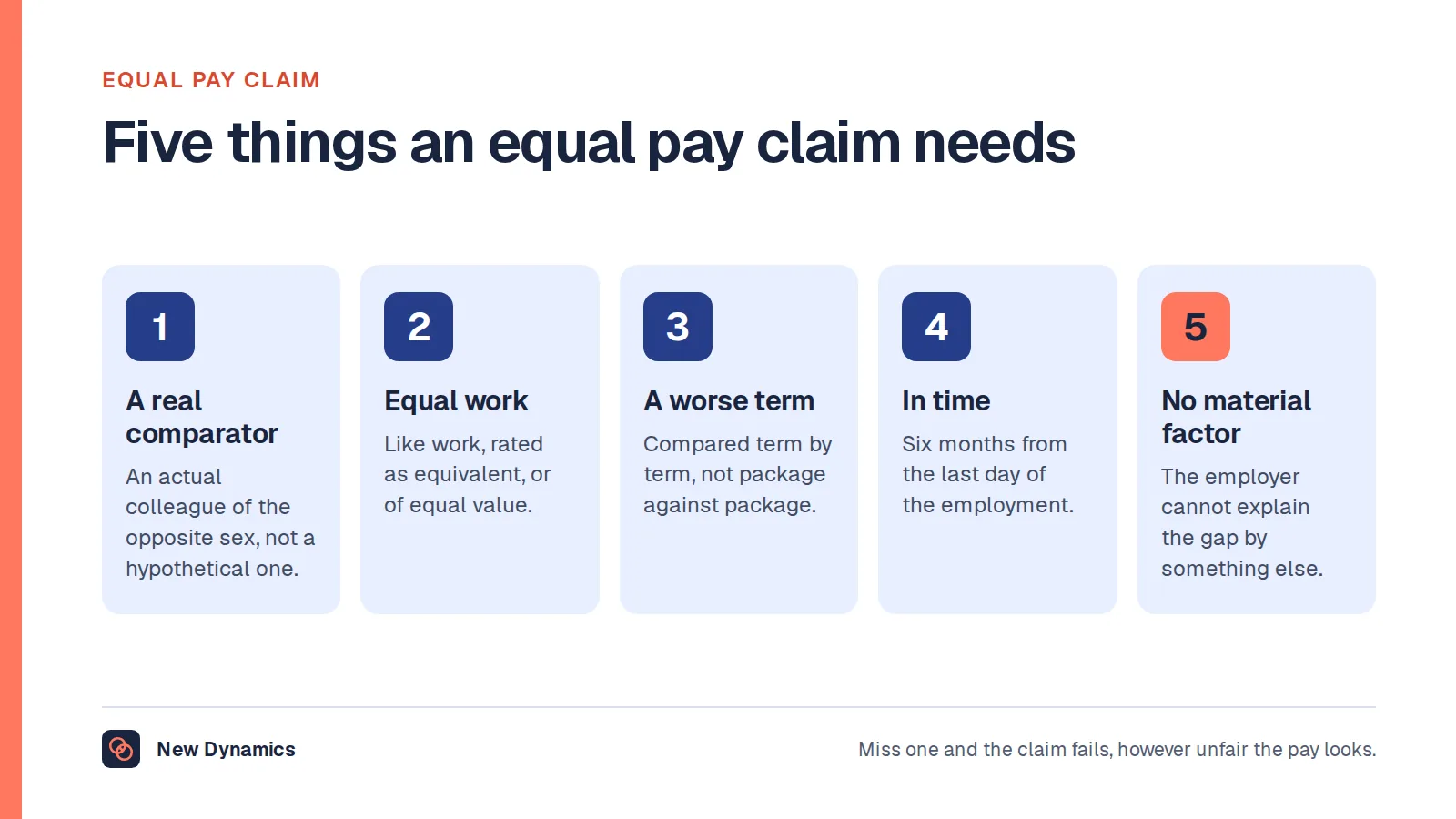
Section 66(1) of the Equality Act 2010 provides that "If the terms of A's work do not (by whatever means) include a sex equality clause, they are to be treated as including one". The clause is implied by law, without anybody agreeing to it. Section 66(2) then sets out what it does, term by term: "if a term of A's is less favourable to A than a corresponding term of B's is to B, A's term is modified so as not to be less favourable", and "if A does not have a term which corresponds to a term of B's that benefits B, A's terms are modified so as to include such a term".
Read that against section 65 and the shape of the duty becomes clear. Work counts as equal if it is like work, work rated as equivalent, or work of equal value. Section 65(2) defines like work: "A's work is like B's work if (a) A's work and B's work are the same or broadly similar, and (b) such differences as there are between their work are not of practical importance in relation to the terms of their work". Section 65(6) defines equal value as work that is "neither like B's work nor rated as equivalent to B's work, but nevertheless equal to B's work in terms of the demands made on A by reference to factors such as effort, skill and decision-making".
Two consequences for compensation management:
- Term by term, not package against package. A more generous bonus does not cure a less favourable basic rate, because the clause modifies the individual term.
- The market is not a defence by itself. Paying what the market pays can still leave a less favourable term than a comparator doing equal value work, and the statute modifies it. An employer defending a difference needs a material factor that explains it and is not sex related.
Our posts on equal pay claims and pay equity cover the comparator, the material factor defence and what an audit involves.
Pay secrecy clauses
A contract term that stops staff comparing pay does not survive contact with section 77. Subsection (1) provides that such a term "is unenforceable against P in so far as P makes or seeks to make a relevant pay disclosure", and subsection (3) defines a relevant pay disclosure as one made to find out "whether or to what extent there is, in relation to the work in question, a connection between pay and having (or not having) a particular protected characteristic". Our post on discussing pay at work covers the detail, including who falls outside the protection.
Gender pay gap reporting, and a threshold two official sources word differently
Reporting is what separates compensation management from a generic management topic, because it is a positive duty with a date on it.
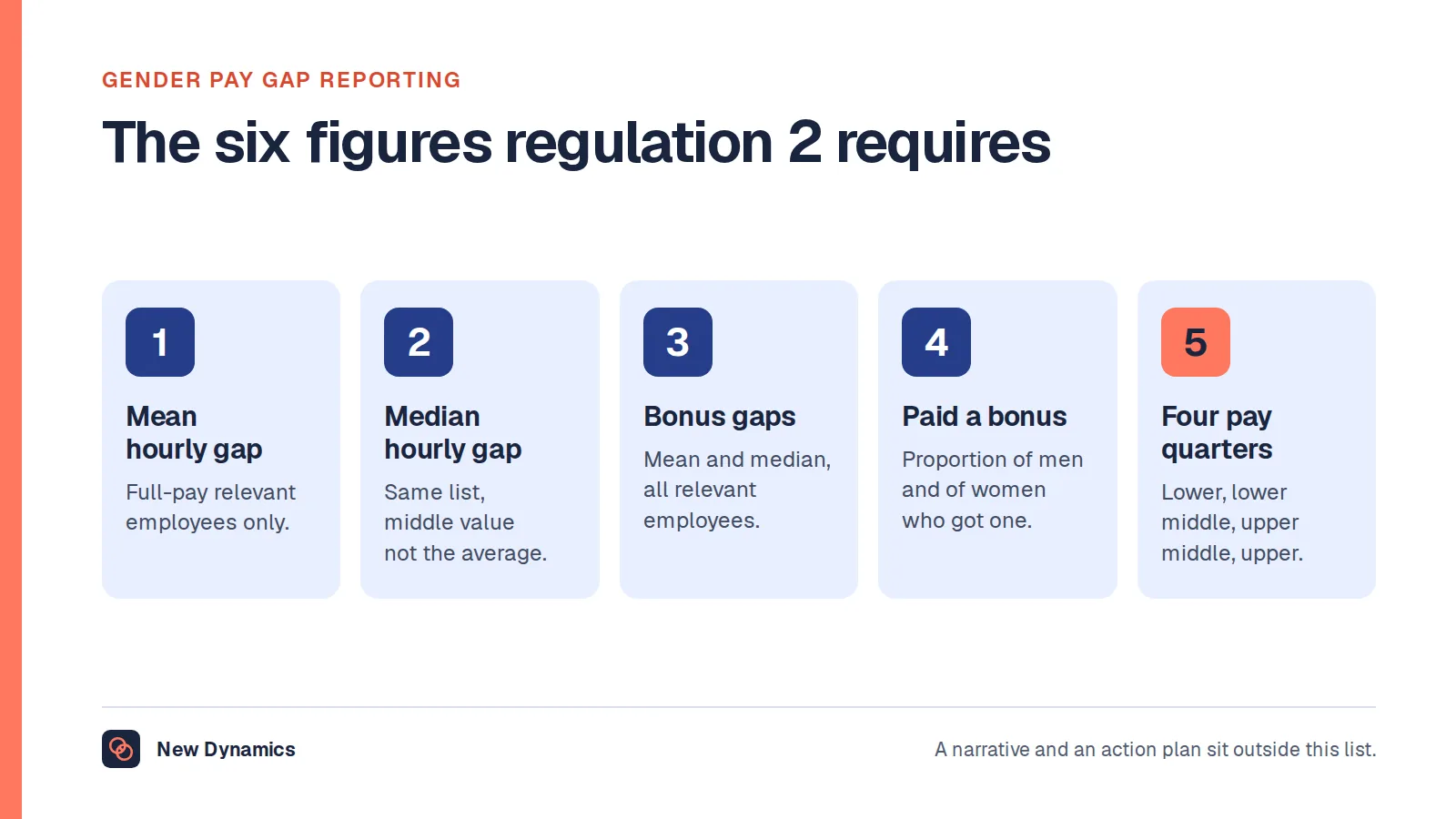
For private and voluntary sector employers, the instrument is the Equality Act 2010 (Gender Pay Gap Information) Regulations 2017 (SI 2017/172). Regulation 1(2) defines the two terms that decide whether you are in scope: "'relevant employer' means (subject to paragraph (6)) an employer who has 250 or more employees on the snapshot date", and "'snapshot date' means the 5th April in the year to which the information required by regulation 2 relates". Regulation 2(1) lists six figures, including the mean and median hourly pay differences and the proportions of men and women in each quartile pay band. Regulation 2(2) requires publication "within the period of 12 months beginning with the snapshot date", regulation 14 requires a signed accuracy statement, and regulation 15 requires publication on the employer's own website for at least three years as well as on a website designated by the Secretary of State.
Specified public authorities report under a different instrument, the Equality Act 2010 (Specific Duties and Public Authorities) Regulations 2017 (SI 2017/353). Schedule 1 paragraph 1(2) uses the same workforce test, a public authority "which has 250 or more employees on the snapshot date", but a different date: "'snapshot date' means the 31st March in the year to which the information required by paragraph 2 relates".
Now the disagreement. Acas, on its gender pay gap reporting page last updated on 7 April 2026, says that "Employers with more than 250 workers must report their organisation's gender pay gap". GOV.UK's guidance for employers says that "Any employer with 250 or more employees on a specific date each year (the 'snapshot date') must report their gender pay gap data".
Those are not the same test. The regulation governs, and the regulation says 250 or more, so an employer with exactly 250 employees on the snapshot date is in scope and an employer reading the Acas sentence literally would conclude the opposite. Acas's own page is not internally consistent either: two paragraphs further down it uses "250 or more workers" for action plans. Take the threshold from the instrument, not from a summary of it. Our post on gender pay gap reporting works through the six figures and the deadline.
What is coming, and what is not here yet
Section 33 of the Employment Rights Act 2025 inserts a new section 78A into the Equality Act 2010 on equality action plans. It came into force on 6 April 2026 by SI 2026/323, regulation 3(1) and (7). Read it carefully, because it is a power rather than a duty: "Regulations may require employers to (a) develop and publish a plan (an 'equality action plan') showing the steps that the employers are taking in relation to their employees with regard to prescribed matters related to gender equality". Section 78A(2)(a) states that the section "does not apply to an employer with fewer than 250 employees", and section 78A(4) names the matters covered, which "include (a) addressing the gender pay gap, and (b) supporting employees going through the menopause".
Acas describes the current position as voluntary and says that "In 2027, publishing an action plan will become mandatory for employers with 250 or more workers". Section 34 of the same Act, which would allow regulations requiring publication of the identity of a person supplying contract workers, remains prospective: the commencement note records that it is "not in force at Royal Assent, see s. 159(3)". Plan for the action plan, but do not tell a board that either duty already bites.

Frequently asked questions
What is compensation management?
Compensation management is the employer practice of deciding what an organisation pays for, how much, to whom and on what evidence, and then keeping the record that explains it. In practice it is a sequence: what the organisation pays for, job levelling, pay ranges, market data, position in range, the review budget, the signed decision, and the records and reporting that follow.
What are the objectives of compensation management?
Five tests cover it. Attract and keep the right people at a cost the organisation can carry. Pay consistently for work of equal value, which in Great Britain is a legal duty. Be explainable to the person receiving the number. Stay inside the statutory floor and discharge the reporting duties. Survive a change of manager without the answer changing.
What is the difference between compensation management and compensation of management?
Compensation management is the discipline of setting and running pay across a workforce. Compensation of management usually means executive and director remuneration, which in the United Kingdom carries its own company law layer. Section 420 of the Companies Act 2006 requires the directors of a quoted company to prepare a directors' remuneration report, and section 439 requires a members' resolution approving it.
Where can I get reliable market pay data in the United Kingdom?
The official source is the Annual Survey of Hours and Earnings from the Office for National Statistics, which publishes medians by occupation, industry, region and age with a named reference period. No official United Kingdom source publishes a benchmark pay range for a named job title at a named size of employer in a named town, so say so rather than importing a figure whose method you cannot inspect.
Can an employer stop staff comparing their pay?
Not by contract, in Great Britain. Section 77 of the Equality Act 2010 makes a term that purports to prevent or restrict a pay disclosure unenforceable so far as the person makes or seeks a relevant pay disclosure, meaning one made to find out whether pay is connected to a protected characteristic. Seeking, making or receiving such a disclosure is also treated as a protected act.
How many employees before gender pay gap reporting applies?
The 2017 Regulations use 250 or more employees on the snapshot date, which is 5 April for private and voluntary sector employers and 31 March for specified public authorities. Acas words the same threshold as more than 250 workers, which is narrower than the instrument. The regulation governs, so an employer with exactly 250 employees on the snapshot date must report.
Does a salary above the minimum wage make an employer compliant?
Not by itself. The National Minimum Wage is an hourly test applied to each pay reference period, so a salaried worker whose hours run beyond the contractual basic hours can fall below the rate while the monthly payment stays the same. GOV.UK gives £12.71 as the rate for workers aged 21 and over from April 2026, rising to £13.21 from April 2027.
Your next step: write down one pay decision in full
- Take one real pay decision from your last review and write it on a single page: job, level, range, current position, proposed position, basis and the second signature. Note which of the five lines you cannot fill.
- Check every range minimum against the rate for the youngest and the newest worker who could sit in that range from April 2026, and again against the April 2027 figures.
- Run one equal pay comparison inside a level, using the three routes in section 65 rather than job titles.
- Count your employees on your next snapshot date against the instrument's words, 250 or more, not a summary's words.
- Date every market figure in your pay paper, and delete any that splices SOC 2010 and SOC 2020 occupational data together.
For the policy that holds all of this in one place, read and download our compensation policy guide. The guide is free to read, and the PDF uses our short download form.
Want pay decisions to rest on evidence that already exists rather than being reconstructed in the meeting? Book a New Dynamics demo and bring your current review cycle. You can also email contact@new-dynamics.com.