TL;DR
- An evaluation question has one job: to produce something you did not already know, in a form you could show to somebody who was not in the room. A question that can only be answered yes is a prompt for agreement, not a question.
- Separate the four purposes. What happened, what changed, what got in the way, and what next. Most forms blur all four into one box marked overall performance, which is why the answers read the same every year.
- Write the answers down, share the record before anyone signs it, and act on one commitment with a date against it. Then delete the question that produced nothing, before the next cycle starts.
Nobody designs an evaluation form. It accumulates. A question gets added the year somebody complains about teamwork, another survives three HR systems because no one can remember who asked for it, and a rating scale arrives with a template. Then a few hundred conversations a year run on the result, and everybody blames the conversations.
The questions are the cheapest thing in the whole review cycle to change, and the least often changed. Rewrite one question and you change what every manager in the organisation notices during the year, writes down in October and has to defend in calibration.
This article is about the questions themselves: what an employee evaluation question is actually for, the difference between a question that gathers evidence and one that invites a verdict, questions grouped by purpose, the questions that reliably produce useless answers, how to ask about work you never saw, where self evaluation questions and manager questions have to diverge, what to ask at a probation review, and what to do with the answers once you have them.
Questions work better when last year's answers, the goals and the feedback are already in front of both people. See how New Dynamics performance reviews carry that evidence into the conversation.
If you want a ready-made set rather than a method, our library of 100 performance review questions is there to pick from. This article is about how to choose from a list like that, and how to write the questions it does not contain.
What an employee evaluation question is for
Every question on a form is doing one of four jobs, and it is worth knowing which.
- Producing a record. Something will be written down and kept, and may be read back years later by a person who was not there.
- Surfacing information the manager does not have. Obstacles, dependencies, work nobody saw, a piece of context that changes the reading of a number.
- Making the employee think. The question earns its place by the thinking it causes, even if the written answer is short.
- Justifying a decision. A rating, a pay outcome, a promotion, the end of a probation period.
The trouble starts when one question tries to do all four. "How would you rate your overall performance this year?" is asked as if it surfaces information, written down as if it were a record, and then used as if it justified a decision. It does none of the three, because the answer is a number with no sentence attached.
Acas, whose advice on this covers England, Wales and Scotland, puts the purpose plainly. Its performance management guidance says performance reviews "are a chance to discuss someone's work", and lists four subjects: "what they are doing well", "any areas for improvement", "whether they need more support or training", and "their career and any development objectives". Note that none of the four is a score, and that two of them (support and development) are things the employer has to do, not the employee.
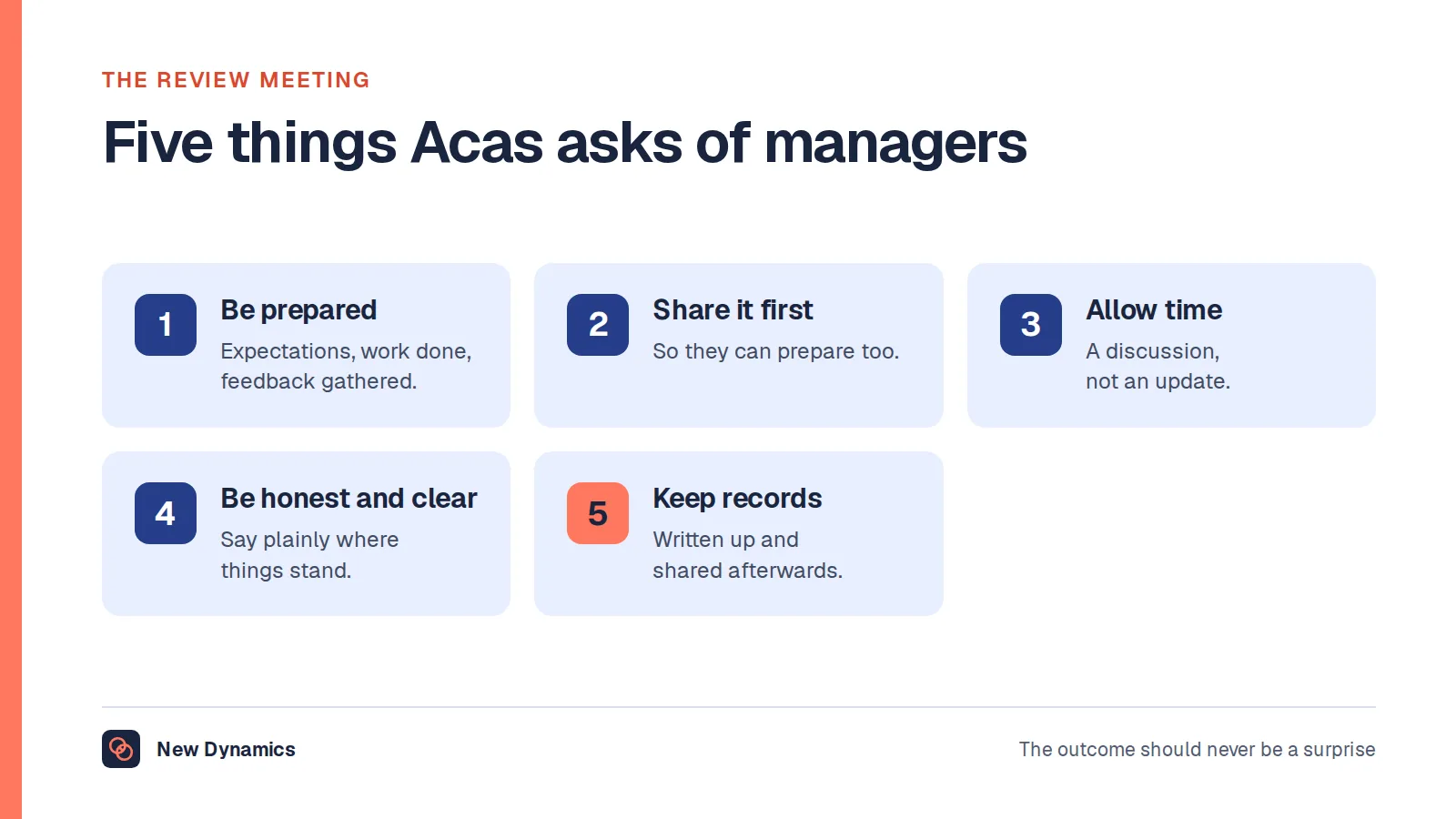
The same page is direct about the record: "It's important to keep a written record of what is discussed. This should be shared with the employee afterwards." That single sentence rules out a surprising number of common questions, because it means every answer you collect is an answer you are going to have to show the person who gave it.
In Northern Ireland the equivalent advisory body is the Labour Relations Agency and employment law is made separately, so check the Northern Ireland position rather than reading Acas guidance across. Everything here is general information, not legal advice.
The test for keeping a question
For each question on your current form, finish this sentence: "We ask this because it changes _____." If the blank can only be filled with "the length of the form", delete the question.
The Information Commissioner's Office makes the same point from the data protection side. Its guidance on collecting and keeping employment records lists "appraisal or performance review records" among the records an employer may need to keep, and is reassuring about keeping them: "Data protection law sets out principles for collecting and using personal information. These do not stop you keeping the records you need about your workers." But it also says that under the data minimisation principle, "you must identify the minimum amount of personal information you need to hold about your workers, and not hold more information than that". UK GDPR and the Data Protection Act 2018 apply across the United Kingdom. A question whose answer you have no use for is not a neutral addition to a form.
Evidence or verdict: the distinction that decides everything

There are only two kinds of question in an evaluation, and telling them apart is most of the skill.
A verdict question asks somebody to grade something. "Are you a good communicator?" "How well did the team collaborate this year?" "Would you say you exceeded expectations?" The answer is an opinion. It arrives with no evidence attached, and you cannot do anything with it except agree or disagree, which turns the meeting into a negotiation about adjectives.
An evidence question asks what happened. "Which piece of writing this year took the most drafts, and what made it hard?" "Which handover went wrong, and what did you change afterwards?" The answer is an event, with a date and usually a witness. You can check it, build on it, or be surprised by it.
| Verdict question | Evidence question |
|---|---|
| Are you a good team player? | Who did you depend on most this year, and what did you do to make that easier? |
| How is your time management? | Which deadline did you miss, and what did you do when you knew you would? |
| Do you take ownership? | Which problem did you fix that was not yours to fix? |
| How would you rate your communication? | Which decision did you have to explain twice, and why? |
| Have you developed this year? | What can you do now, unsupervised, that you could not do in January? |
| Do you feel supported by your manager? | What did you need from me this year that you did not get? |
Read the right-hand column and notice that every answer is checkable, and that several of them could embarrass the manager. That is the sign of a question worth asking.
Verdict questions are not merely weak, they are where bias gets in. Acas lists ways to reduce unconscious bias at work, two of which apply directly to a review form: "allowing time to make decisions" and "keeping a written record of why decisions were made". A verdict question produces a decision with no written reason behind it, because the question never asked for one. An evidence question produces the reason as a by-product.
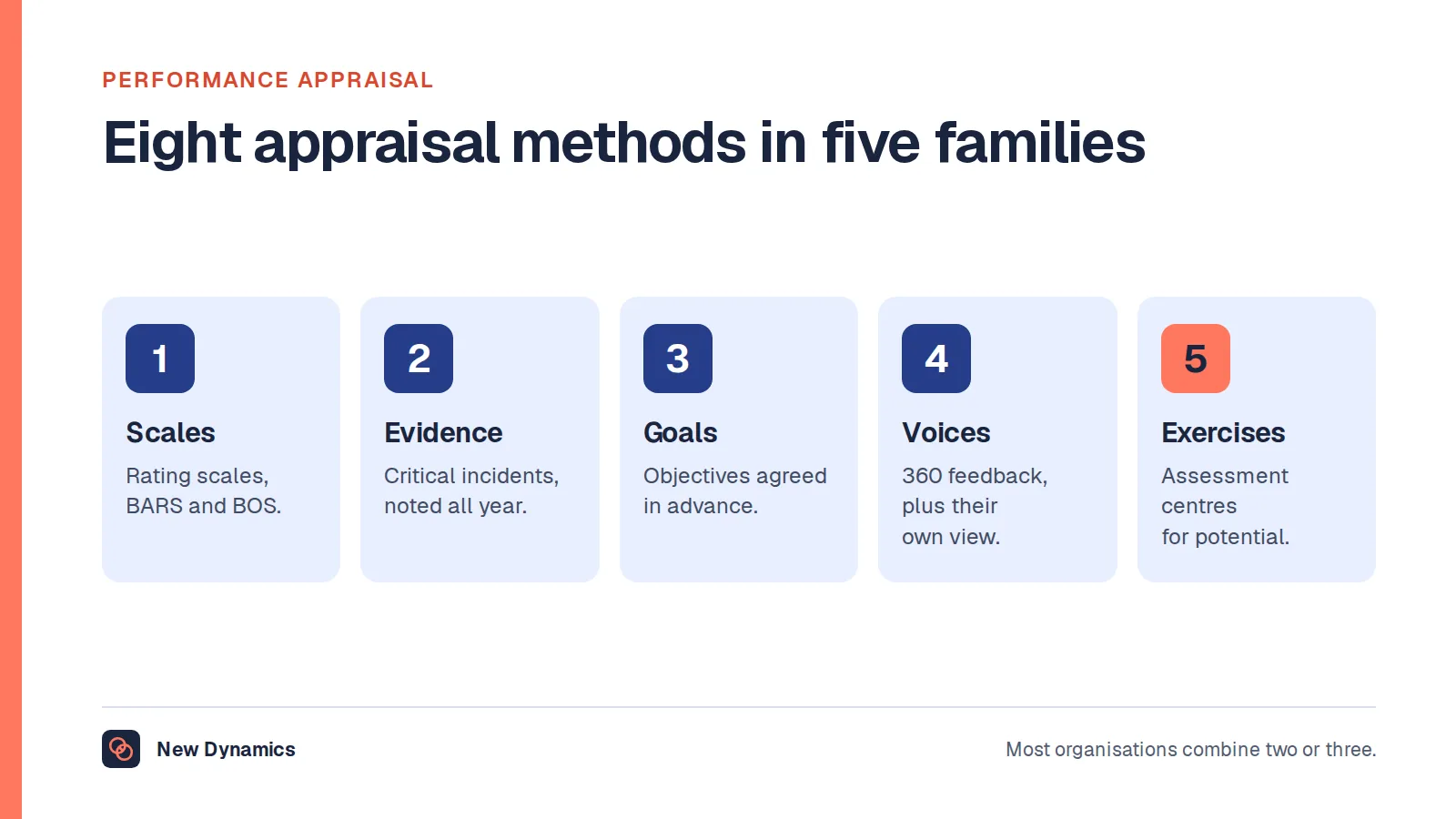
Keep the ratings if your process needs them. Just make sure every rating has an evidence question sitting next to it, and that the rating is derived from the answer rather than the other way round. Our post on performance appraisal methods covers the scales and their failure modes in more detail.
Questions by purpose, in the order that works

Performance evaluations for employees tend to collapse into a single undifferentiated conversation about how things are going. Four purposes are worth separating, and the order matters, because each one makes the next easier to answer honestly.
What happened
Establish the facts before anybody interprets them. These questions should be answerable from documents, tickets, calendars and goals rather than from memory.
- Which three pieces of work from this period would you want somebody to look at?
- Which goal is finished, which is in progress, and which never started?
- What did you spend the most time on, and was that the plan?
- Which part of your job did somebody else end up doing?
A good answer here names things: a client, a document, a release, a month. If the answers are all adjectives, the question is being read as a verdict question, which usually means the form around it is scoring people.
What changed
This is the question most forms skip, and it is the one that makes a year of review records worth keeping. Comparison with the last cycle is more informative than comparison with a job description.
- What can you do now that you could not do at the last review?
- Which task has stopped being difficult?
- Which piece of feedback from last time did you act on, and what happened?
- Which part of the role has grown without anybody writing it down?
- Where are you now the person other people come to?
Ask the last one out loud rather than on the form. It catches invisible load: the colleague everyone asks, whose own work is late as a result.
What got in the way
An evaluation that only measures output ends up grading circumstances. These questions separate the person's contribution from the conditions they worked in.
- What was outside your control that affected the result?
- Which dependency let you down, and when did you first know?
- If this period had gone perfectly, what would have been different, and who would have had to do it?
Ask these before any rating is discussed. Asked afterwards, they sound like an invitation to make excuses, and people stop answering them.
What next
Two commitments, one each. A review that generates only employee commitments is an instruction, not an evaluation.
- What is the one thing you want to be better at by the next review?
- Which piece of work would you ask for if you could choose?
- What do you need from me in the next three months?
- What should the first line of your next review say?
Acas suggests objectives "should be fair and reflect the employee's usual tasks and workload", and sets out the familiar specific, measurable, achievable, relevant and time-bound test for writing them. Our post on appraisal objectives covers how to write one that can still be judged a year later.
Six questions that reliably produce useless answers
Some questions fail every time, for reasons worth understanding rather than memorising.
"Do you feel valued here?" The answer is almost always a polite yes, because the honest no has a cost and the question offers no route to action. Ask instead: "When did you last get credit for something, and who gave it?" The absence of an answer is the finding.
"Rate your communication from one to five." There is no shared definition of communication, so the manager's three and the employee's three are different numbers. Ask instead: "Who did you have to keep informed this year, and how did you do it?" Then rate it if you must, with that answer in view.
"What are your weaknesses?" This asks somebody to hand a weapon to the person who writes their review. The reliable answers are the safe ones: perfectionism, impatience, caring too much. Ask instead: "Which part of the job would you rather somebody else did?" or "What would you need help with if the volume doubled?"
"Where do you see yourself in five years?" Most people do not know, and the ones who do often cannot say it to this particular manager. Ask instead: "Whose job would you like to understand better?" or "What would you like to be known for here?"
"Why did you not hit the target?" Grammatically a question, functionally an accusation, so the answer is a defence rather than information. Ask instead: "At what point did it become clear the target would not be hit, and what happened then?" That question has a timeline in it, and the timeline usually indicts the process rather than the person.
"Is there anything else?" asked with two minutes left. Everybody says no. If you want the answer, ask it at the start, or ask it as a specific: "What were you hoping I would ask about, that I have not?"
The pattern across all six: a question fails when the best answer for the person answering is not the true one. Fix it by removing the cost of honesty, or by narrowing the question until only a fact fits.
How to ask about work you did not see
Most managers now evaluate work they only partly witnessed: matrixed projects, remote teams, people seconded elsewhere for half the year. The wrong response is to ask the employee for a verdict on themselves and write it up as your own, or to ask a colleague "how is Priya doing?" and treat whatever comes back as evidence.
Ask the employee for the route to the evidence, not for the conclusion:
- Who saw this work most closely?
- What would the client say the difficult part was?
- Who would say you made their job easier this year, and what did you do?
Then ask the colleague a question with a boundary around it. Not "how is Priya doing", which invites a character reference, but "what did Priya do on the migration, what did she do that you would want repeated, and what would you want done differently next time?" Scope it to a piece of work, a period and an observation.
Three rules for handling what comes back. Record whose observation it is, so the record says "the project sponsor's view in September" rather than stating it as fact. Never put a second-hand opinion in a review without naming where it came from and giving the person a chance to answer it. And if the only evidence you have for a critical point is one person's impression, that is not yet evidence, and your question for the employee is "help me understand this", not "this has been raised".
Where several managers genuinely share a person, structure beats goodwill: multi-manager reviews let each one answer the questions about the work they actually saw. If your reporting lines changed mid-cycle, our post on reviewing an employee who changed manager covers who answers what.
Self evaluation questions and manager questions are not the same question
The most common form design error is the mirror: the same ten questions, one column for the employee and one for the manager. It wastes both. Each party has access to different information, and the questions should ask for what only they can supply.
| Ask the employee | Ask the manager |
|---|---|
| What did you intend here, and what did you try first? | What did this look like from outside, and what did others rely on? |
| What would you do differently with the same brief? | How does this compare with the standard the role is held to? |
| What slowed you down that I would not have seen? | What did I fail to remove, decide or provide? |
| Which feedback have you acted on, and what changed? | Which feedback have I given more than once without it landing? |
| What are you proud of that nobody mentioned? | What have I not said out loud that will be in the written record? |
| What do you want next, and what is the first step? | What can I actually commit to, with a date? |
The employee has the only reliable account of intent, effort, obstacles and what they would do differently. The manager has the only reliable account of comparison, standard, visibility and consequence. Ask each for the other's material and you get guesswork in both columns.
Sequence matters too. The employee answers first, before any manager draft exists, or the self evaluation becomes a negotiation with a document that has already been written. Acas advises managers to gather the information on performance before a probation review, and then says: "Managers should share this information with the employee before the review meeting." The reason given is that the employee can then prepare the things they want to discuss. The same courtesy is the difference between a two-way conversation and an ambush at any stage of employment.
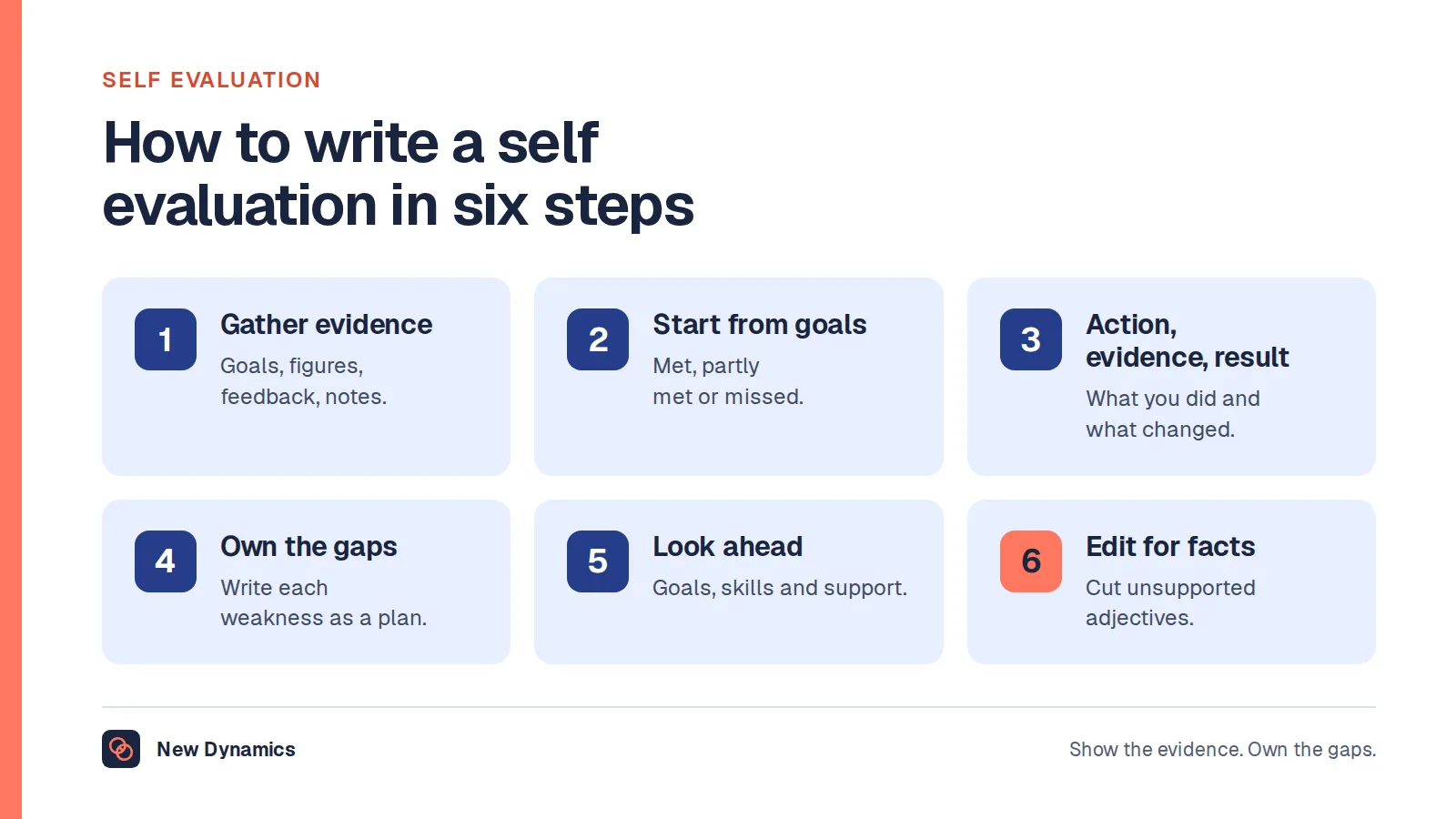
For the employee's side of this, including how to answer the usual questions with evidence rather than adjectives, see our self evaluation examples. For the phrasing of the manager's written comments, our performance review phrases post covers wording that survives being read back.
Questions for a probation review
A probation review is not a small annual review, and the questions are genuinely different, because the thing being evaluated includes the employer. Acas describes these as formal checkpoints: "Probation reviews are formal checkpoints during an employee's probation period."
Early, around week two or three. The subject is onboarding, not performance. Is the job what we described at interview? What do you still not know who to ask about? Which system or access are you missing? What has surprised you? Who have you not met yet that you need to?
Midway. Now ask about the work, with a standard attached. Which task do you now do without checking? Which part still takes you longer than you expect? What feedback have you had, and from whom? Which piece of the role have you not touched yet? What would make the next month easier?
The final review. This is where the outcome is confirmed, and it should not be where it is revealed. Acas is explicit: "The outcome of probation should not come as a surprise to the employee." Questions here are about completeness and evidence. Which of the expectations we set has been met, and what shows it? Which has not, and what did we do about it when we first noticed? What support did you ask for? What do the next six months look like?
Two practical points. Acas says that if an employee is off sick for their probation review, their employer should rearrange it, and that employers should consider whether a long-term absence is disability-related and whether reasonable adjustments might help. And on the record: "Employers must keep records in line with UK GDPR."
Probation rules, notice and dismissal differ by jurisdiction and by contract, and the Acas guidance above applies in England, Wales and Scotland. This is general information and not legal advice; take advice on a specific case. Our post on the probation review meeting covers extensions, failing probation and the paperwork.
How many questions, and who answers first
More questions do not produce more information. They produce shorter answers.
A workable budget for an annual or mid-year cycle is five to eight questions on the form, with everything else left to the conversation. One should be about obstacles, and one should ask what the employee needs from the manager. If a question exists only because a committee wanted a data point, ask whether that data point has ever been looked at.
Sequencing, in the order that produces the most honest answers:
- The employee answers the self evaluation questions, with notice and with the evidence available to them.
- The manager gathers evidence, including from anybody who saw work the manager did not.
- The manager drafts, then meets. The draft is a question list, not a verdict.
- The meeting happens, and the record is written during or immediately after it.
- The employee adds their own comments. Then it is signed, and not before.
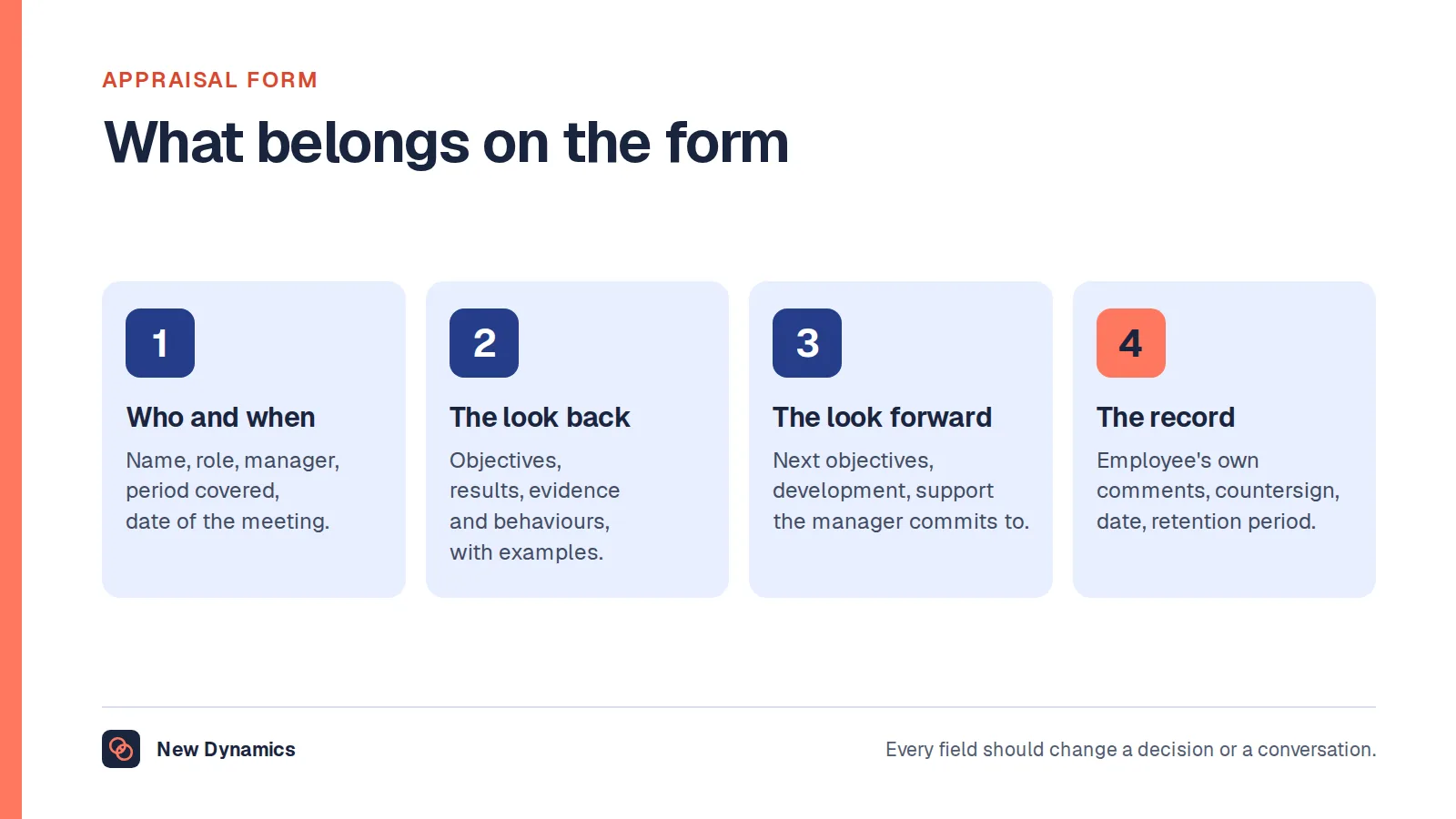
Keep the form shorter than your process. Our post on what belongs on an appraisal form sets out the four blocks worth keeping, and performance review length covers how long the written record needs to be.
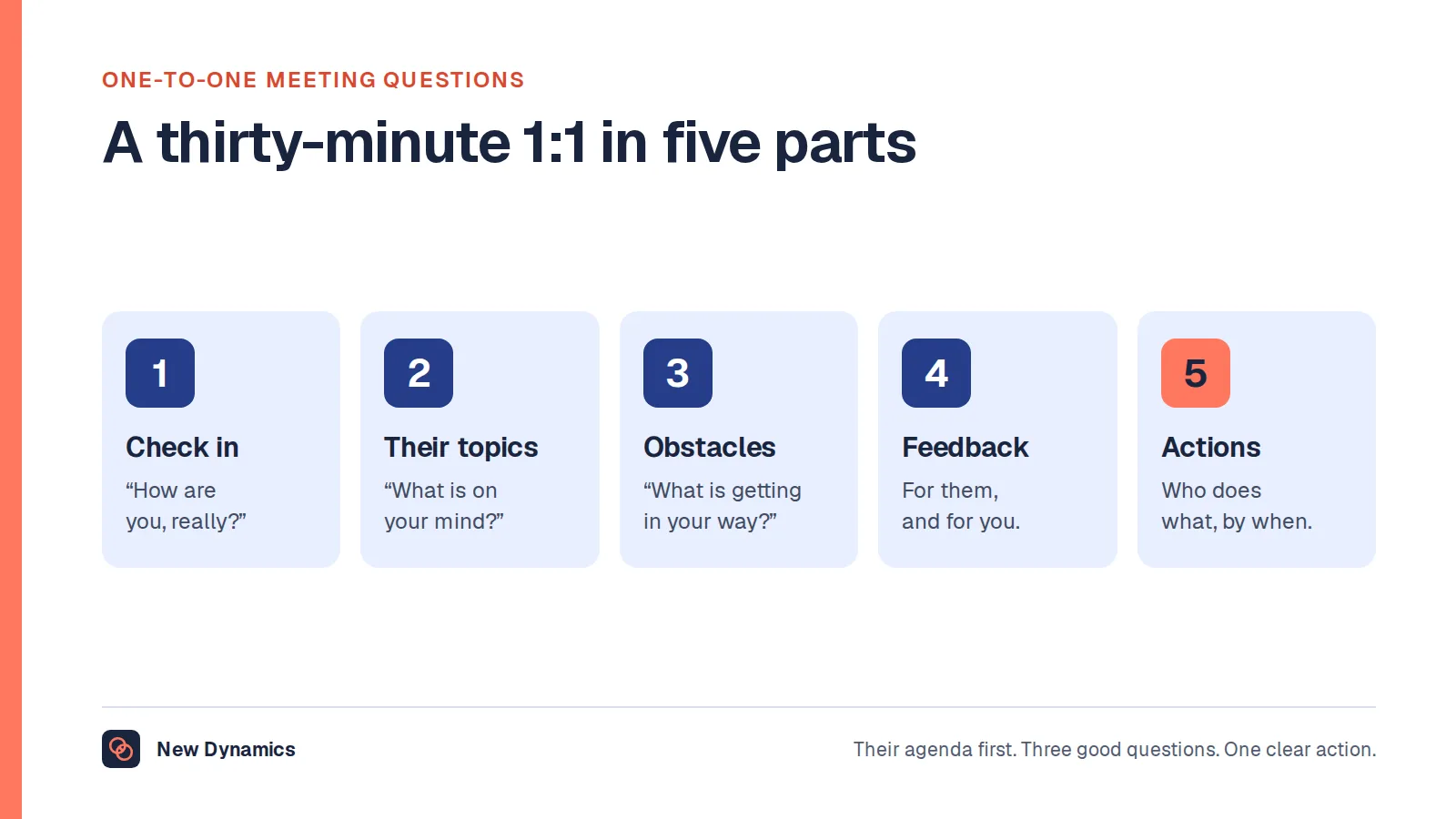
Questions also do not all belong in the annual cycle. Anything that needs an answer this month belongs in a one-to-one, where it can change something: our one-to-one meeting questions post has seventy of them.
Six tests for a question you wrote yourself
Before a new question goes on the form, run it through these.
- Could two honest people give materially different answers? If every answer will be the same, the question collects nothing.
- Can the answer be wrong? A question whose answer can never be contradicted by evidence is a mood survey, not an evaluation question.
- Does it name a period? "This year", "since the last review", "in the last quarter". Without a period, people answer about their whole career or last week, whichever is more flattering.
- Does it ask about something the person controlled? If the honest answer is "the supplier was late", the question is measuring the supplier.
- Would the answer change a decision, a plan or a sentence in the record? If not, you are collecting it for its own sake.
- Would you be comfortable if the answer were read back to the person a year later? It may well be. Acas advises keeping a written record of what was discussed and sharing it with the employee.
A question that passes all six is usually shorter and more specific than the one you started with.
What to do with the answers

Good questions wasted on bad handling are still wasted. Five things to do with what you collected.
Write it down in their words. Not your paraphrase. Where you summarise, mark it as a summary. The record Acas asks for is a record of the discussion, which means the employee's answers as well as the manager's conclusions.
Separate the three layers. In the written record, keep the fact ("the migration slipped by six weeks"), the judgement ("the slip was handled well, given the dependency") and the action ("Priya will own the next cutover plan, drafted by 14 March") visibly apart. Most disputes about a review are disputes about which layer a sentence belongs to.
Share it before anyone signs. The employee should see the record, and have somewhere to add their own comments, before a signature is asked for. For what that signature does and does not mean, see our post on the performance review signature.
Act on exactly one thing. Not five. One commitment from the employee and one from the manager, each with a date, beats a development plan with nine items and no owner. What happens after a performance review covers the follow-through.
Prune the questions. At the end of the cycle, read the answers to each question across every review. Any question that produced the same answer every time, or an empty box, should be rewritten or removed before the next cycle. That is also the data minimisation point the ICO makes: hold the minimum you need, and review what you hold.
Keep the answers somewhere they will be in front of you at the next review, rather than in a spreadsheet nobody reopens. A year later, the question "what changed since last time?" is only answerable if last time is still legible. For the wider published picture on reviews and HR practice, see our HR statistics hub.
Frequently asked questions
What are good employee evaluation questions?
Good ones ask what happened rather than how it felt. "Which handover went wrong this year, and what did you change afterwards?" produces an event with a date and a witness. "Are you a good team player?" produces a yes. Across a full review, cover four purposes: what happened, what changed since the last review, what got in the way, and what happens next, including what the employee needs from their manager.
What questions should be asked in a performance evaluation?
Five to eight on the form, with the rest left to the conversation. Acas says a performance review is a chance to discuss what someone is doing well, any areas for improvement, whether they need more support or training, and their career and development objectives. That gives you four anchors. Add one question about obstacles outside the person's control, and one asking what they needed from you and did not get.
How do you answer evaluation questions?
Answer with an example, a number or an artefact, in that order of preference, and name the period. Say what you did, what the evidence is, and what resulted, then add the context your manager could not see. Where the answer is a weakness, answer it as a plan with a first step rather than a confession. Prepare from notes rather than memory: our self evaluation examples post has worked answers to the usual questions.
What questions should you avoid in an employee evaluation?
Avoid any question whose only available answer is yes, such as "do you feel valued?", and any whose honest answer carries a cost for the person answering, such as "what are your weaknesses?". Avoid bare rating prompts with no shared definition, open-ended career questions nobody can answer truthfully, and "is there anything else?" asked with two minutes left on the clock.
How many questions should a performance evaluation have?
Fewer than most forms contain. Five to eight written questions is enough for an annual or mid-year cycle, because every extra question shortens the answers to the others. The honest test for each one is whether the answers have ever changed a decision. Questions that need an answer this month belong in a one-to-one rather than in the annual form.
What should you ask at a probation review?
Different questions at each checkpoint. Early on, ask whether the job matches what was described, what the person still does not know who to ask, and what access or training is missing. Midway, ask which tasks are now routine and which still take longer than expected. At the final review, ask which expectations were met and what shows it. Acas says the outcome should not come as a surprise.
Your next step: rewrite one question
- Open the form you will use in the next cycle and find the question you would least like to defend in a tribunal.
- Decide which of the four purposes it is meant to serve: what happened, what changed, what got in the way, or what next.
- Rewrite it as an evidence question, with a period in it and a subject the person controlled, and check it against the six tests above.
- Add the matching manager question, the one about what you failed to provide, and delete a question that has produced the same answer three years running.
For agendas, preparation, the conversation itself and the follow-up, read and download our performance review guide. The guide is free to read, and the PDF uses our short download form.
Want last year's answers, the goals and the feedback in front of you when you ask this year's questions? Book a New Dynamics demo and bring the form you use today. You can also email contact@new-dynamics.com.