TL;DR
- An appraisal does two jobs at once. It reaches a verdict on the objectives set a year ago, and it agrees the objectives for the year ahead. The first makes people defensive and the second needs them open, which is why the second half is so often rushed.
- The test for a new objective is not whether it sounds ambitious in January. It is whether a manager who was not in the room could judge it from named evidence next December, including the part that events took out of the person's hands.
- Set the mid-year check before either of you leaves the meeting, and treat it as the only place an objective can be changed. An objective quietly rewritten in December is worth nothing, and an objective silently dropped is worse.
Most appraisals are booked for an hour. In that hour a manager is expected to reach a defensible verdict on five objectives set thirteen months earlier, and to agree five more that will govern the next year of somebody's working life. The first job takes fifty minutes, because that is the part with a rating attached. The second gets the last ten, which is how organisations end up with objectives nobody remembers by March.
This article is about the objectives that sit inside an appraisal: how many are honest for one person, how to write one that can still be judged a year later, what to do when events overtake one, what to set for a job with no projects, how team and individual objectives divide, how objectives become a rating, and the mid-year check that stops the whole thing being theatre. It ends with worked objective sets for five roles.
The second half gets rushed because the first half is reconstructed from memory. See how New Dynamics performance reviews carry last year's objectives, their check-in history and the evidence into the meeting, so the verdict takes minutes rather than the hour.
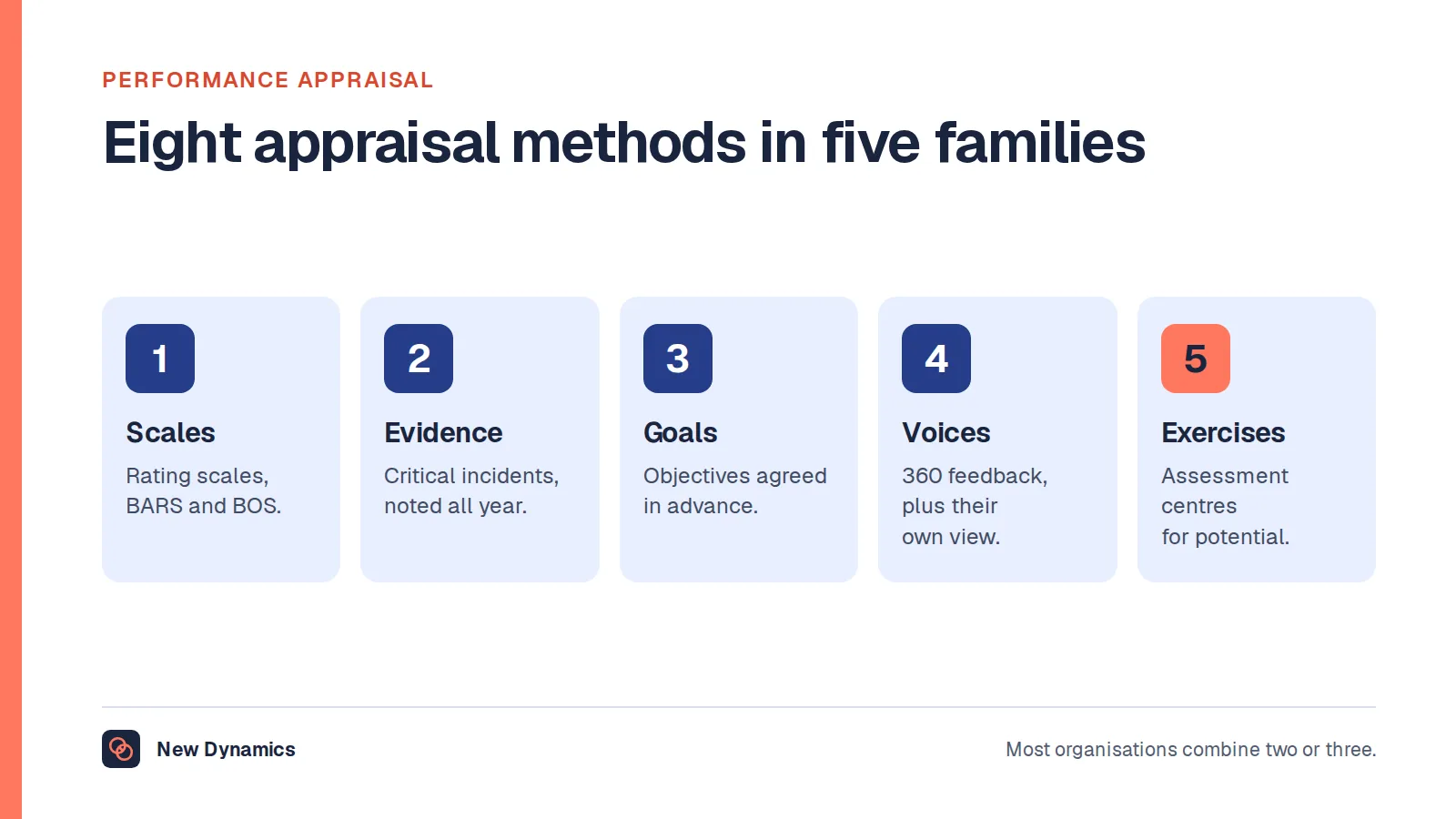
Our post on the performance appraisal compares eight methods. This one assumes you have chosen objectives.
What appraisal objectives are, and the two jobs one meeting does
An appraisal objective is a commitment, agreed between employee and manager at the appraisal, about what will be different by the next one. It is the forward half of a meeting whose backward half is a verdict.
Acas, the UK's workplace advisory service, notes that performance reviews "are sometimes known as 'appraisals'". Its guidance on reviews and appraisals, last updated on 23 June 2026, says that "Objectives should be fair and reflect the employee's usual tasks and workload. But they might also stretch them to develop in certain areas." It recommends they be specific, "by being clear about what the employee will actually do", measurable, "so you know whether they've been achieved", achievable, relevant and time-bound.
That describes one objective well. It says nothing about one hour doing two incompatible things.
The backward half asks a person to defend their record. The forward half asks them to admit what they are not yet good at, where they need help and which target they are nervous about. People are candid in the second conversation and guarded in the first, and the first one happens first. Worse, the verdict reached in minute twenty quietly sets the ambition of the objectives agreed in minute fifty. Somebody who has just been told they met four of five will not volunteer a stretch target. Three arrangements help, in descending order of effort.
Split the meeting. Hold the look back, then set the objectives a fortnight later. This is the best answer and the one most organisations say they have no room for.
Invert the order. Ask for the person's draft objectives beforehand, open with them, and do the look back second. The forward conversation happens while nobody is braced.
Name the switch out loud. If both halves must share the hour, say when you are moving from one to the other, and why the second needs a different kind of honesty.

How many appraisal objectives is honest for one person?
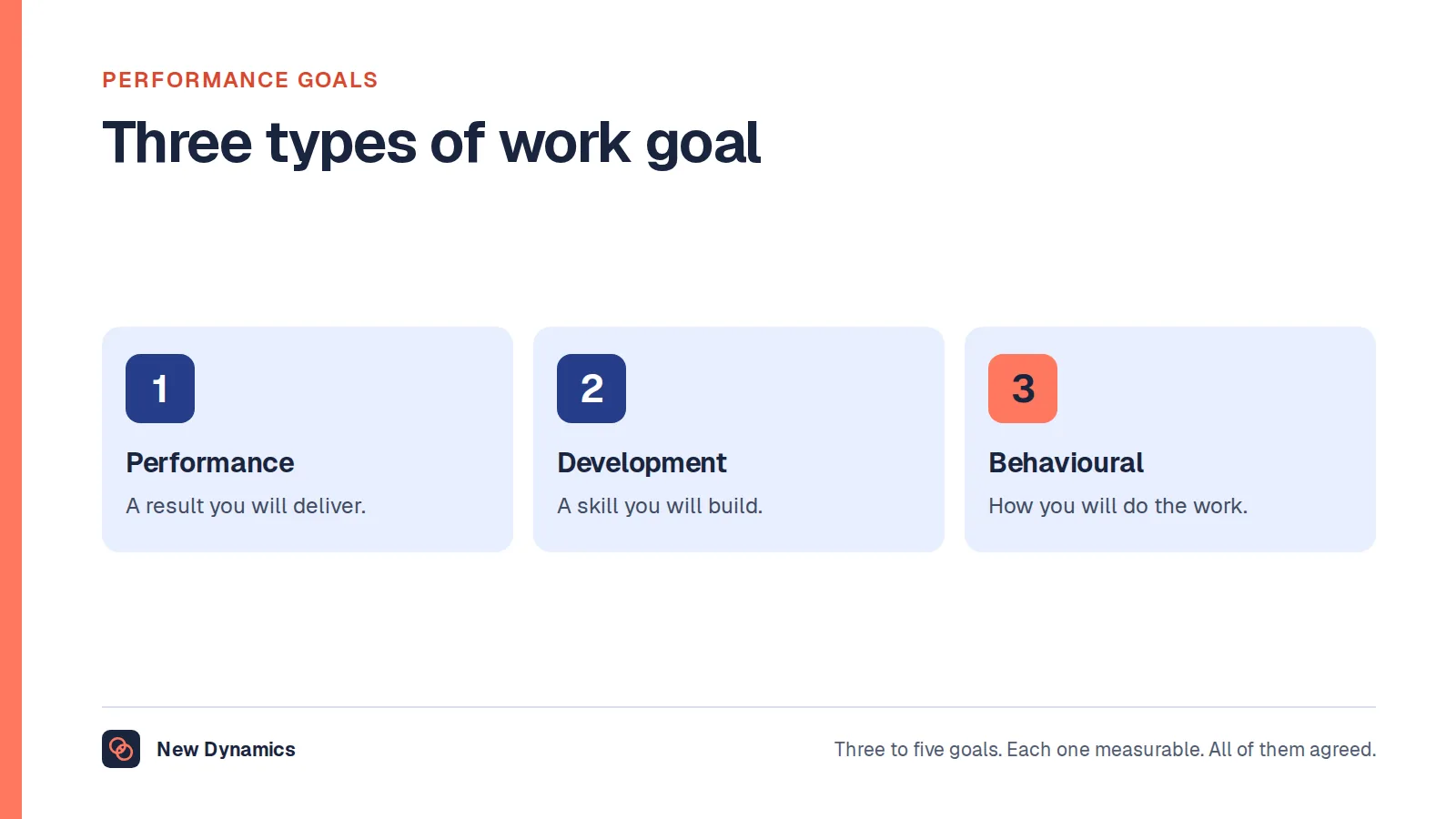
Three to five is the usual answer, and our performance goals examples post sets out why. The more useful question is how many you can evidence next year.
Work it from the manager's side. Eight direct reports with five objectives each is forty judgements, each needing a figure from a named source and a sentence of evidence. Managers asked for forty produce five real judgements and thirty-five sentences beginning "generally good progress".
So the honest count turns on three things.
What the year actually contains. A role with one large piece of work in it has one objective, plus perhaps a standard to hold and something to learn. Padding that to five means inventing three.
What you can measure without building something first. If the data does not exist today, the objective is a promise to build a report, which is a different objective.
How much of the year the person is there for. A starter in September, somebody back from parental leave in June, a colleague on three days a week: the count and the targets scale, and the scaling is agreed at the start, not negotiated at the review. Our post on performance reviews for part-time employees covers the pro-rata arithmetic.
If some objectives matter more than others, weight them and write the weights down in January, because that argument is poisonous in December. And if a role is genuinely covered by two objectives, set two. A form that demands five has told you about the form, not the job; our post on the appraisal form covers designing a better one.
Writing an appraisal objective that can be judged a year later
The test is not whether an objective reads well. It is this: could a manager who was not in this room, holding only this sentence and the evidence it names, decide next December whether it was met?
That manager is not hypothetical: people change managers, and our post on reviewing an employee who changed manager covers the handover. Five things make an objective judgeable, and four are usually missing.
- A baseline recorded at the time. A baseline reconstructed in December is whatever makes the result look right.
- A named source, and a named person who pulls it. Not "the helpdesk data" but "the monthly helpdesk export, run by the service desk lead on the first working day".
- A defined population. "Reduce late deliveries" invites a December argument about whether the two site closures counted. Say which orders, which sites, which months.
- A date the measure is taken, which is not the date the work ends. A target hit in November and lost in December needs a rule, agreed now.
- A written exception. Name the one or two things that would legitimately make this impossible. An objective with no sanctioned way to fail teaches people to argue rather than report.

One rewrite shows what the five catch. "Improve the quality of management reporting" has no baseline, source, population, date or exception, so judging it means judging whether the manager likes the reports. Rewritten: "From the April pack onwards, every monthly management pack reaches budget holders by working day four with the three agreed variance notes written, for at least nine of twelve months, measured from the distribution log. If the ledger close slips past working day three for reasons outside the team, that month is an exception."
The tests do not require a number. Inventing a percentage for something qualitative is how forms fill with figures nobody checks. A defined event, a named artefact and a colleague's written view are all evidence. What they must not be is a feeling recalled later.
For the wording, our SMART goal template gives a sheet, and management by objectives covers the method all of this descends from.
Reviewing last year's objectives in the same meeting
The backward half has one rule: judge the objective as it was written, not as you now wish it had been written.
An order that takes four minutes per objective:
- Read it out as written, baseline and exception included. People are often surprised by what they agreed to.
- State the result from the named source. The number, not an impression of it.
- Ask the person to account for the gap or the overshoot first. Their account is the part most likely to contain something you did not know.
- Separate the result from the contribution. A result that landed because a competitor withdrew is still a result, and it is not a performance.
- Record one sentence, naming the evidence. If you cannot write it you do not yet have a judgement, and the honest entry is that the objective could not be assessed.
That last option is the one organisations refuse to allow. An unassessable objective should be recorded as unassessable, not quietly marked met to avoid an awkward conversation and not marked missed to keep a distribution tidy. Our posts on rating an employee fairly and what "meets expectations" means cover the pressure that produces both.
What to do with an appraisal objective overtaken by events
This is the most common failure in the backward half, and it has four shapes.
Cancelled. The project was stopped, the product withdrawn, the site never opened. Record it as withdrawn, with the date and who decided, and say what the person did instead. Do not average it into a rating in either direction.
Superseded. The work continued under another definition: another system, another target, another scope. Record the original, the replacement, the date and who agreed it, then judge the replacement. With no record of the change you are judging something invented after the fact.
Blocked by a dependency. The person did everything available to them and waited on another team, a supplier, a regulator or a budget. Judge what they controlled, name the dependency in writing, and take the lesson into next year's objective rather than this year's rating. Our post on process objectives pairs a result with the behaviour behind it, which keeps this case reviewable.
Made trivial. Overtaken the other way: a reorganisation or a new tool handed the person the result in a fortnight. Say so. An objective met by accident and recorded as an achievement teaches everyone the process is a game.

One rule covers all four. A change to an objective is recorded when it happens, by the two people who agreed it, where the objective lives. Our post on the goal review meeting covers the mid-cycle mechanics. What matters for the appraisal is that December is where you read those records, not where you write them.
Appraisal objectives for a steady-state job with no projects
Plenty of jobs have no projects in them. Payroll runs every month, the ward is staffed every shift, the phones are answered. These roles get the worst objectives anywhere: the form asks for change and the job is about reliability, so the manager either copies the job description across or invents a project that dies by April.
Our performance goals examples post explains why "run payroll" is a duty rather than a goal. Four kinds of objective work instead, and none needs a project.
Hold a standard, and say how it is proved. The objective is the standard plus the evidence, not the activity. "Twelve monthly payrolls run with no more than two post-payroll corrections across the year, each correction logged with its cause." That can be met, missed and discussed.
Reduce variance rather than raise an average. Steady-state work is judged on its bad days. "No month where more than 5% of pay queries wait longer than two working days for a first reply" is harder than an improved average, and it points at the queue that causes complaints.
Remove a single point of failure. The objective these roles most need and least often get. "Write a one-page runbook for each of the four tasks only you can do by 31 March, and have a colleague run one of them, with you watching, before July."
Finish one improvement small enough to finish. One form shortened, one reconciliation automated, one handover rewritten, scoped so it is done by the half year rather than 60% done in December.
A fifth option is fewer objectives and more space for behaviours, which our post on behavioural indicators covers.
Team objectives against individual ones
Shared objectives are popular because they describe how work really happens, and awkward at appraisal time because a rating goes to one person. Three patterns, and what each does in December.
The same line on everybody's form. Simple, honest about interdependence, and it rates the carrier and the passenger identically. Use it only where everyone can see who did what and the rating is not formulaic.
A shared result with a named individual contribution. The team line states the result; each form names the part that person owns and the evidence for it. This is the arrangement that survives an appraisal, and it removes most of the argument.
A team objective on nobody's appraisal. Some objectives belong to the team as an entity and should be reviewed in the team's own meeting. A collective target that depends on everybody, including the two people who left in June, is one of these. Writing it onto nine forms creates nine unfair judgements rather than one commitment.
The free rider is why managers resist shared objectives, and a named contribution solves it. The carrier, who quietly delivers while others drift, is why shared objectives damage retention, and only a manager willing to write down who carried it solves that.
Our team goals examples post covers setting the team's objectives first, and how to cascade goals at work covers connecting them downwards without turning one company target into nine impossible ones.
How appraisal objectives turn into a rating, and sometimes into pay
Between the objectives and the rating sits a decision most organisations never write down: whether objectives are the rating or evidence for it.
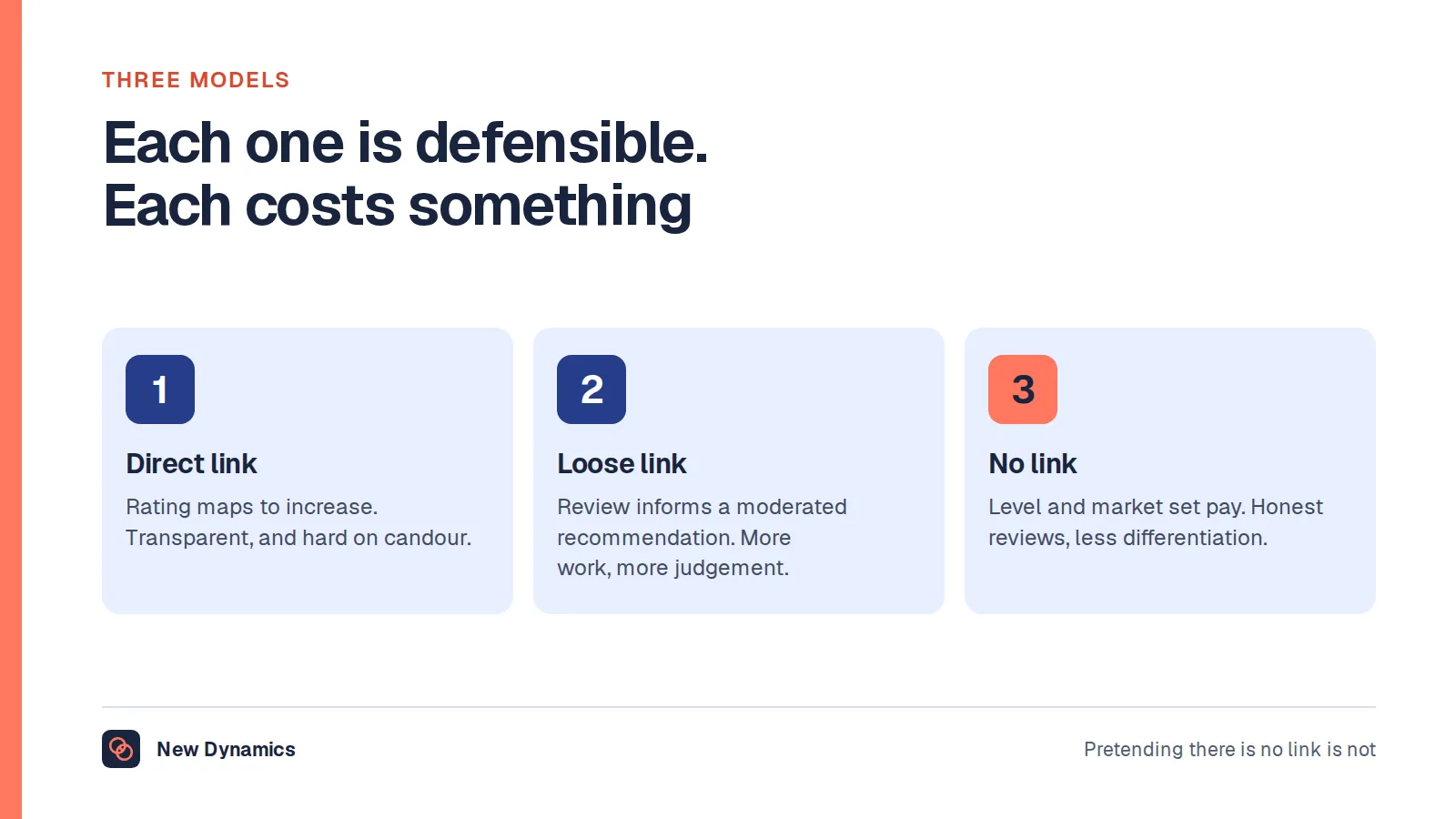
A formula is transparent and gameable, and it punishes whoever took the hard objective. Judgement handles that objective properly and varies by manager. Both are defensible. What is not defensible is leaving it unstated, because then the generous manager and the strict manager are both following the rules. Three things make the conversion survive scrutiny.
Write the conversion rule down before the cycle starts, including how a withdrawn objective is treated, how a stretch objective delivered to 80% is treated, and whether behaviours can move a rating the objectives alone would not support.
Calibrate across managers on the evidence, not the scores. Comparing numbers produces negotiation; comparing the sentence behind each judgement produces consistency. Our performance calibration guide sets out how to run that session.
Keep stretch out of the formula. If an ambitious objective costs a rating point, next cycle will contain only safe objectives.
On pay, Acas is direct. Its guidance on performance-related pay, also last updated on 23 June 2026, lists "bonuses for meeting certain targets or objectives" among its examples and says: "Employers should be careful with how they use performance-related pay. The process for deciding this should be fair and objective. Employers must avoid treating people 'less favourably' because of a protected characteristic."
Our post on whether performance reviews should affect pay compares the models and how to keep the conversations apart. The point for objectives is narrower: the moment an objective feeds a pay decision, every weakness in its wording becomes a dispute about money. An objective you would defend in a development conversation is not automatically one you would defend in a pay appeal.
Fairness and the law when objectives feed a pay or capability decision
Objectives are a requirement applied to a person, and the rating that follows can affect pay, promotion and eventually employment. That puts them inside discrimination law.
The Equality Act 2010, section 39, Employees and applicants, provides that an employer "must not discriminate against an employee of A's (B)" as to "B's terms of employment", or in the way access is afforded "to opportunities for promotion, transfer or training", or "by subjecting B to any other detriment". It adds that "A duty to make reasonable adjustments applies to an employer." A rating, and the pay attached to it, can be a detriment within that section.
Section 19, Indirect discrimination, bites harder on objectives. A person discriminates where they apply "a provision, criterion or practice which is discriminatory in relation to a relevant protected characteristic", and such a practice is discriminatory where it "puts, or would put, persons with whom B shares the characteristic at a particular disadvantage when compared with persons with whom B does not share it" and the employer "cannot show it to be a proportionate means of achieving a legitimate aim". The characteristics listed there are age, disability, gender reassignment, marriage and civil partnership, race, religion or belief, sex and sexual orientation.
An objective is exactly the kind of provision, criterion or practice that section describes. Three everyday examples:
- A volume target set at the full-time rate and applied unchanged to a part-time colleague.
- An objective built on a method a disabled colleague is disadvantaged by, where another method reaches the same result. Section 39(5) means the duty to adjust reaches the objective itself, not only the equipment.
- A full-year target left unchanged for somebody absent four months on maternity or sick leave, then rated as missed.
Acas, on discrimination and the Equality Act 2010, notes that "It can still be discrimination even if the less favourable treatment was not intended." The exposure comes from copying last year's target onto a form without asking who it now applies to.
The protections are mundane. Pro-rate targets and record the arithmetic. Discuss adjustments when the objective is set, not when it is missed. Keep the written record of every change, because the record is what exists later. On that last point, the Ministry of Justice's tribunals statistics quarterly for April to June 2026, published on 10 September 2026 and updated on 20 October 2026, reports that for that quarter "There were 70,000 single claim cases in the open caseload at the end of June." That figure covers employment tribunal single claims of every kind, not appraisals, and says nothing about why claims are brought. What it does say is that an appraisal record may be read a long time after the meeting, by people who were not there.
Where objectives are already being missed, Acas's guidance on problems with an employee's performance says employers "should try to understand why", and notes that something that "might seem like a conduct issue" could be capability, in which case an adjustment may be needed "before taking any disciplinary action". Our post on the capability procedure covers what follows.
Sections 19 and 39 of the Equality Act 2010 extend to England, Wales and Scotland; Northern Ireland has its own discrimination legislation. This is general information about the position in Great Britain and not legal advice, and a specific case needs proper advice.
The mid-year check that stops the whole thing being theatre
Everything above depends on one thirty-minute meeting around month six. Without it the appraisal is annual archaeology, and objectives agreed in January are judged on evidence invented in December.
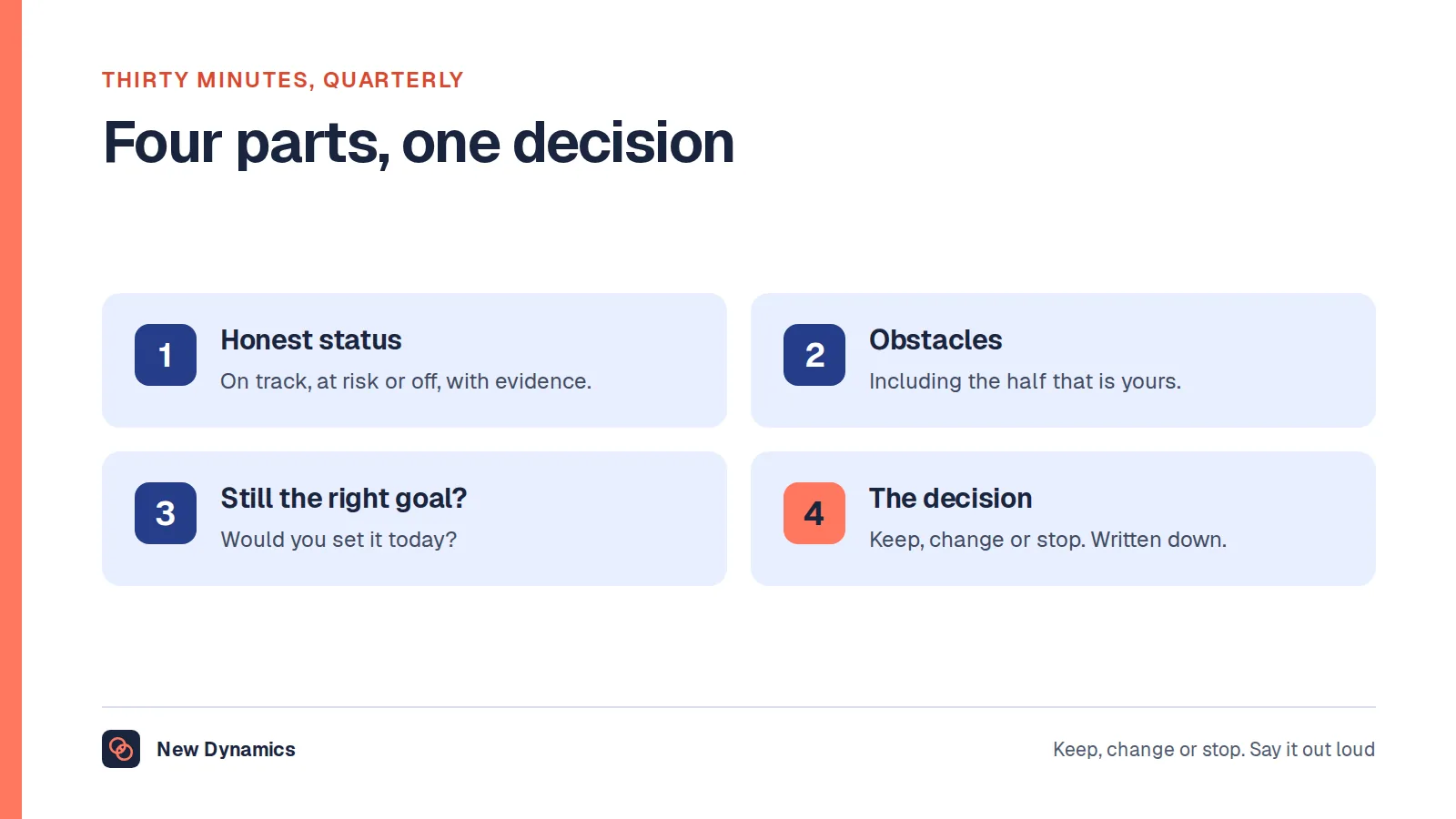
The mid-year check is not a second appraisal: there is no rating yet to change. It is the only place an objective is legitimately changed. Three questions per objective.
- On the named source, where is it now? The number, the artefact or the colleague's written view, not an impression.
- Is this still the right objective? If not, change it now, and record what changed and who agreed. This is the whole purpose of the meeting.
- What is in the way, and what will I do about it? The manager's half of that answer gets written down too, with a date.
The output is one line per objective: on track, changed, or at risk with a reason. Ten minutes of typing, and it is what makes the appraisal defensible six months later. A mid-year that is really a rating teaches people to perform rather than report, and they stop telling you what is at risk.
Acas's own example of a SMART objective ends with the employee and manager agreeing to "discuss progress in regular check-ins" and to "arrange a meeting to review it in 3 months' time". Our post on how often performance reviews should happen covers choosing the rhythm, and our one-to-one meeting guide covers the monthly conversation that keeps the mid-year check short.
A mid-year where nothing is written down leaves no trace, so December has nothing to read. Book it before either of you leaves the appraisal. It is the cheapest thing you can do to make the objectives you just agreed worth something.
Worked appraisal objective sets for five roles
Three objectives each, because three that are evidenced beat five that are not. These figures are examples, not benchmarks. Measure your own baseline first.
Payroll officer: a steady-state role
- Run all twelve monthly payrolls with no more than two post-payroll corrections across the year, logging the cause of each within two working days.
- By the November run, no month in which more than 5% of pay queries wait longer than two working days for a first reply, from the mailbox report.
- Write a one-page runbook for each of the four tasks held only by you, by 31 March, and have a colleague complete one under supervision before July.
Associate in a law firm: a professional services role
- Record all chargeable time within two working days of the work, with no more than four weeks in the year needing a retrospective entry, from the time system.
- By 30 September, lead the quarterly review for the four accounts in the appendix, with the partner present but not presenting, evidenced by the notes and the partner's written view.
- Cut write-offs on your own matters from 7% of recorded value to 4% by the year end, with a scope letter issued before work starts on every new matter.
Site supervisor: a construction role
- Hold the weekly site briefing every week the site is open, with attendance recorded, and close every action within seven days or record why not.
- Cut items raised as immediate at monthly inspection from eleven last year to four or fewer, with the open list reviewed and signed every Friday.
- Get both apprentices through all four quarterly reviews on time, with the provider's paperwork returned within five working days.
Internal communications manager: measured on other people's behaviour
- Publish the monthly operations update by working day three, and raise the open rate from 46% to 65% by the December edition, from the email platform's report.
- Run the quarterly leadership question session four times, publishing the three most asked unanswered questions with an answer or a named owner within five working days.
- By the half year, agree a channel map with the four function heads, and cut all-staff emails sent outside it from 90 last year to 40 or fewer.
Account manager at an agency: a role where the client decides
- Hold a documented scope conversation with each of the four retained accounts at least two months before its renewal date, evidenced by the scope note on file.
- Cut unbilled overservice across those accounts from 180 hours a quarter to 90 by the fourth quarter, with no reduction in the agreed deliverables.
- Hand over two accounts to the incoming junior account manager by 31 May, with the client told in advance, and no escalation in the following eight weeks.
Every set names its evidence, and every set includes an objective the person can deliver whatever the market does. None is the job description with a date bolted on.
For objectives grouped by performance area, see our performance goals examples and 50 SMART goal examples. To keep objectives, check-ins and evidence in one place between appraisals, see New Dynamics Goals and OKRs. The wider published picture sits in our HR statistics hub.
Frequently asked questions
What are appraisal objectives?
Appraisal objectives are the commitments agreed between an employee and their manager at an appraisal about what will be different by the next one. They usually cover results to deliver, standards to hold and something to develop. Acas says they should be fair, reflect the employee's usual tasks and workload, and be specific, measurable, achievable, relevant and time-bound.
How many objectives should an appraisal set?
Three to five suits most roles, but the honest number is the number you can evidence next year. A manager with eight reports and five objectives each has committed to forty evidenced judgements. Where a role genuinely contains two pieces of work, set two rather than inventing three, and scale the count for anyone there for part of the year.
What are good objectives for a performance appraisal?
Good ones name a baseline recorded on the day they were set, a data source and the person who pulls it, the population counted, the date the measure is taken, and one written exception. The test: could a manager who was not in the room judge this from the evidence it names? Not every objective needs a percentage, but every one needs evidence.
What happens to an appraisal objective that is no longer relevant?
Record which of four things happened: it was withdrawn, superseded by a different definition, blocked by a dependency, or made trivial by a change elsewhere. Name the date and who agreed it, then judge what the person controlled. A cancelled objective should not be quietly marked as met, nor missed to keep a distribution tidy.
What objectives work for a job with no projects?
Four kinds. Hold a standard with the evidence named, such as twelve payrolls run with no more than two corrections. Reduce variance rather than raise an average, which targets the bad weeks. Remove a single point of failure by documenting and cross-training a task only one person can do. And finish one improvement small enough to be done by the half year.
Should appraisal objectives be linked to pay?
That is a decision to write down before the cycle starts, not one to leave to each manager. Acas says the process for deciding performance-related pay "should be fair and objective" and that employers must avoid treating people less favourably because of a protected characteristic. Once an objective feeds a pay decision, every vague phrase becomes a dispute about money.
Your next step: make one objective judgeable
- Take the objective on your current form you would least like to argue about next December.
- Check it against the five tests: baseline recorded today, named source and named person, defined population, date the measure is taken, one written exception.
- Rewrite it, and if the measure cannot be a number, name the artefact or the person whose written view stands in for one.
- Put the mid-year check in both calendars before you close the document.
For agendas, preparation and a fair process from the look back to the follow-up, read and download our performance review guide. The guide is free to read, and the PDF uses our short download form.
Want last year's objectives, their check-in history and the evidence in front of you when you set next year's? Book a New Dynamics demo and bring the objectives from your last appraisal. You can also email contact@new-dynamics.com.