TL;DR
- CRM has two established meanings. Customer relationship management is a category of software for contacts, pipeline and service history. Certified Records Manager is a professional credential awarded by the Institute of Certified Records Managers. In recruitment, a third use, candidate relationship management, is common too.
- We publish no CRM rankings, no top 10 CRM software list and no prices. Best only means something in relation to the work you do, so the article gives you a method instead: write scenarios from your own week, shortlist by type, test with your own data and cost the exit.
- A CRM is a database of other people's personal data. In the UK, the ICO says you must not keep personal data for longer than you need it, and marketing by email or text to individuals needs consent or the narrow existing-customer exception. This is general information, not legal advice.
The pipeline lives in a spreadsheet. The useful notes live in one person's inbox, the rest live in their head, and when they leave, the relationship leaves with them. CRM software exists to fix exactly that. Before you compare anything, though, settle one question: there are two established things called CRM, and people searching for one keep landing on the other.
Customer relationship management is a category of software. Certified Records Manager is a professional credential for records and information managers. This article covers both, because the search results for "CRM certification" mix them up, and a reader who wants the credential should not have to read a software buyer's guide to find out.
Targets and pipeline are not the same thing, and a CRM is a poor place to keep the first. If you want the number a salesperson is working towards to sit somewhere both they and their manager can see it, that belongs in New Dynamics goals and OKRs rather than in a deal record.
This article explains what CRM software does, the real types of CRM systems, what to check in UK law before you load anyone's details into one, what recruiting agencies must hold by law, and what the Certified Records Manager credential involves. It names no products, ranks nothing and quotes no prices. The reasons are set out below, with what to do instead.
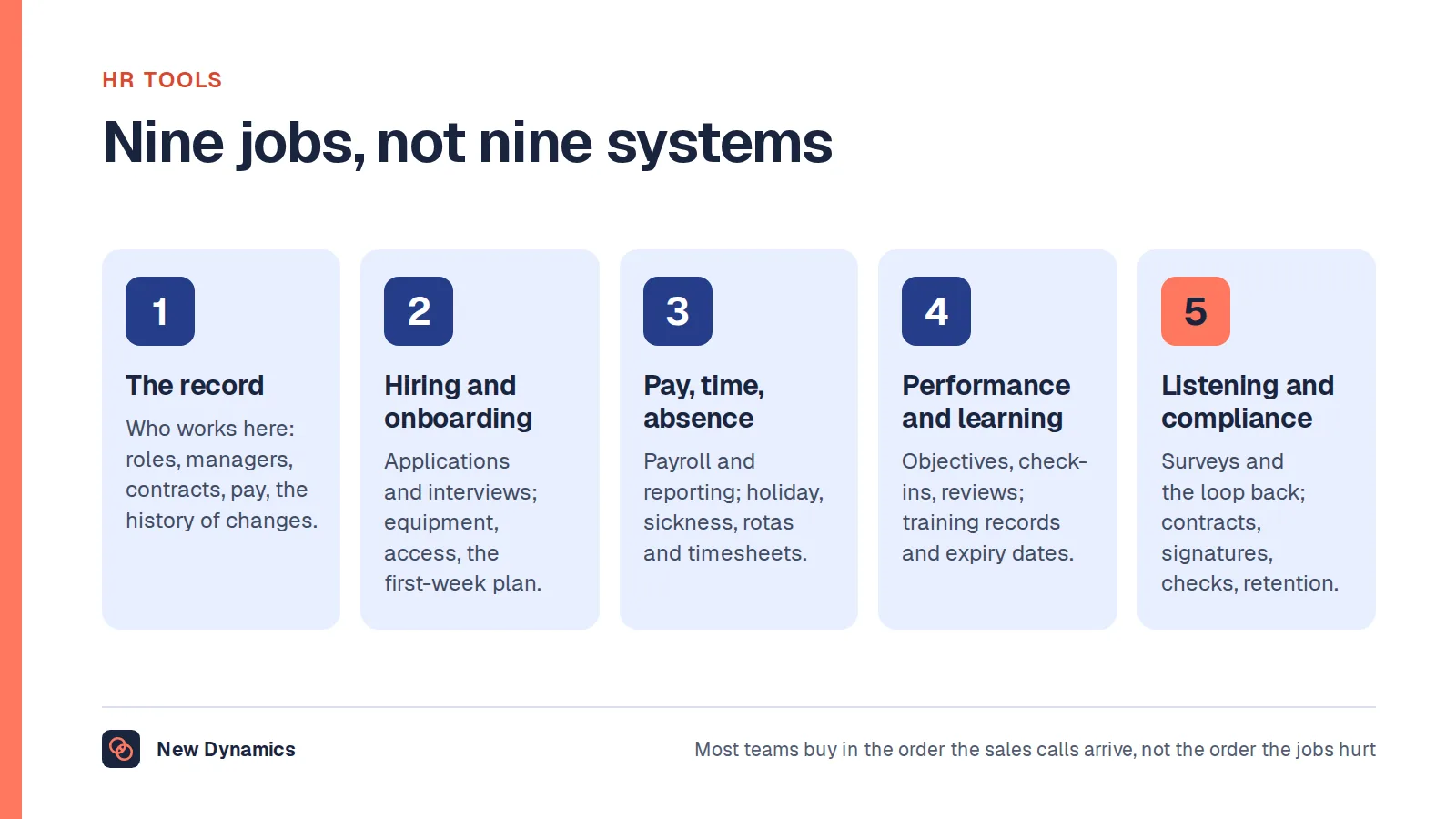
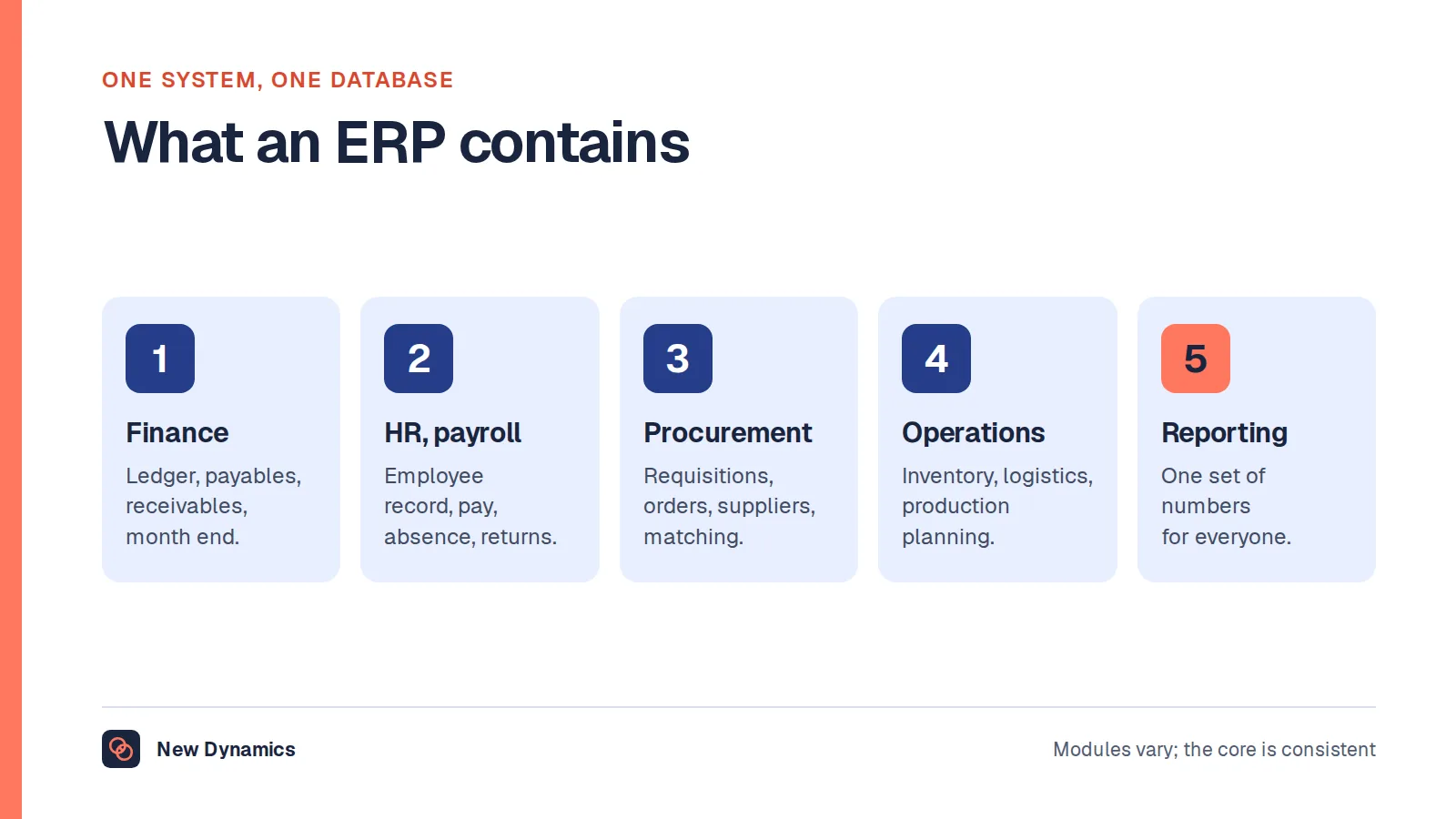
If you are mapping the wider stack rather than one category, our guide to HR tools covers the jobs software does inside a people function, and our post on the ERP system covers the back-office platform that sometimes contains a CRM module.
Two different things called CRM

Customer relationship management is the software meaning, and the dominant one. It describes a system that holds the people and organisations you sell to or serve, what has happened with each of them, and what is meant to happen next.
Certified Records Manager is a credential. The Institute of Certified Records Managers describes itself as "an international certifying organization of and for professional records and information managers", and says its primary mission "is to certify Records and Information Management professionals as Certified Records Managers (CRM) and Certified Records Analysts (CRA) including specialty designations and to administer a certification maintenance program that ensures its members remain current in this dynamic field". If that is the CRM you came for, skip to the section on the certification below.
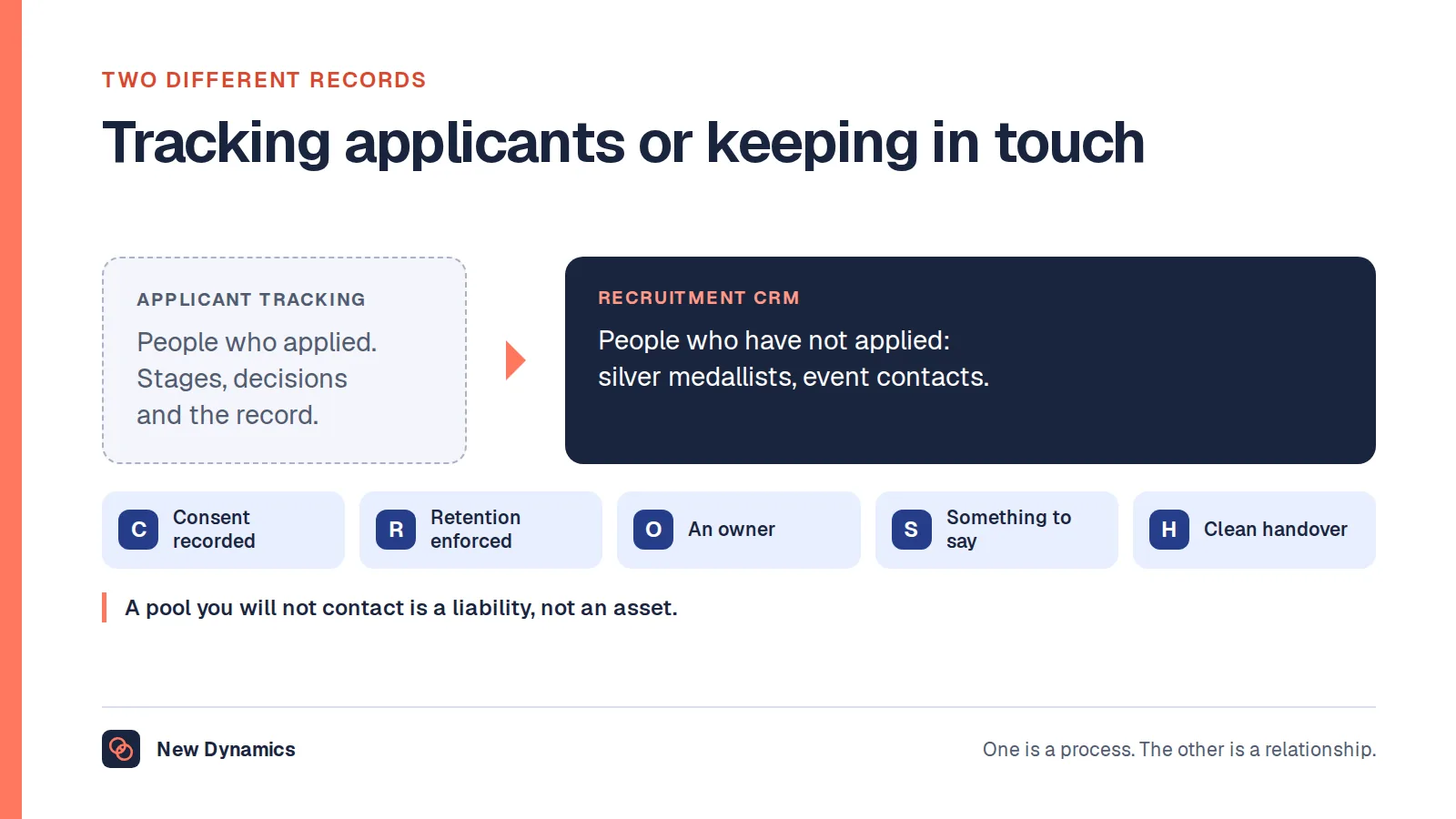
Candidate relationship management is a third use, and it is specific to recruitment. It describes software for people who have not applied yet: past applicants who agreed to stay in touch, event contacts, speculative approaches. Our post on the recruitment CRM covers that meaning in full, including how it differs from an applicant tracking system.
Three meanings, one acronym. Spell out which one you mean the first time, and in a procurement document spell it out every time.
What CRM software actually does: five jobs
Strip away the marketing and a CRM does five things. Most products are strong at two or three of them.
1. The contact record. Who this person is, which organisation they belong to, how to reach them, and what they have agreed to. This is the part that makes a CRM a personal data system rather than a sales tool, and it is the part most buyers think about least.
2. The pipeline. Opportunities, stages, value and expected close date. This is where sales CRM software earns its keep, turning a set of conversations into something a manager can read on a Monday without asking anyone.
3. The activity history. Emails, calls, meetings and notes, attached to the person and the organisation rather than to an individual's mailbox. This is the single most valuable thing a CRM holds, and the first thing that decays when nobody logs anything.
4. Service and support. Cases, tickets, entitlements and resolution history. Some CRM platforms treat this as a separate product, some as a module, some not at all.
5. Reporting and forecasting. Conversion by stage, pipeline coverage, win rate, activity volumes. Useful when the underlying data is maintained, misleading when it is not.
Marketing automation (campaigns, forms, email sequences, lead scoring) is often bolted on as a sixth job. Treat it as a separate decision, because it carries a separate rulebook under UK marketing law, covered below.
What a CRM is not
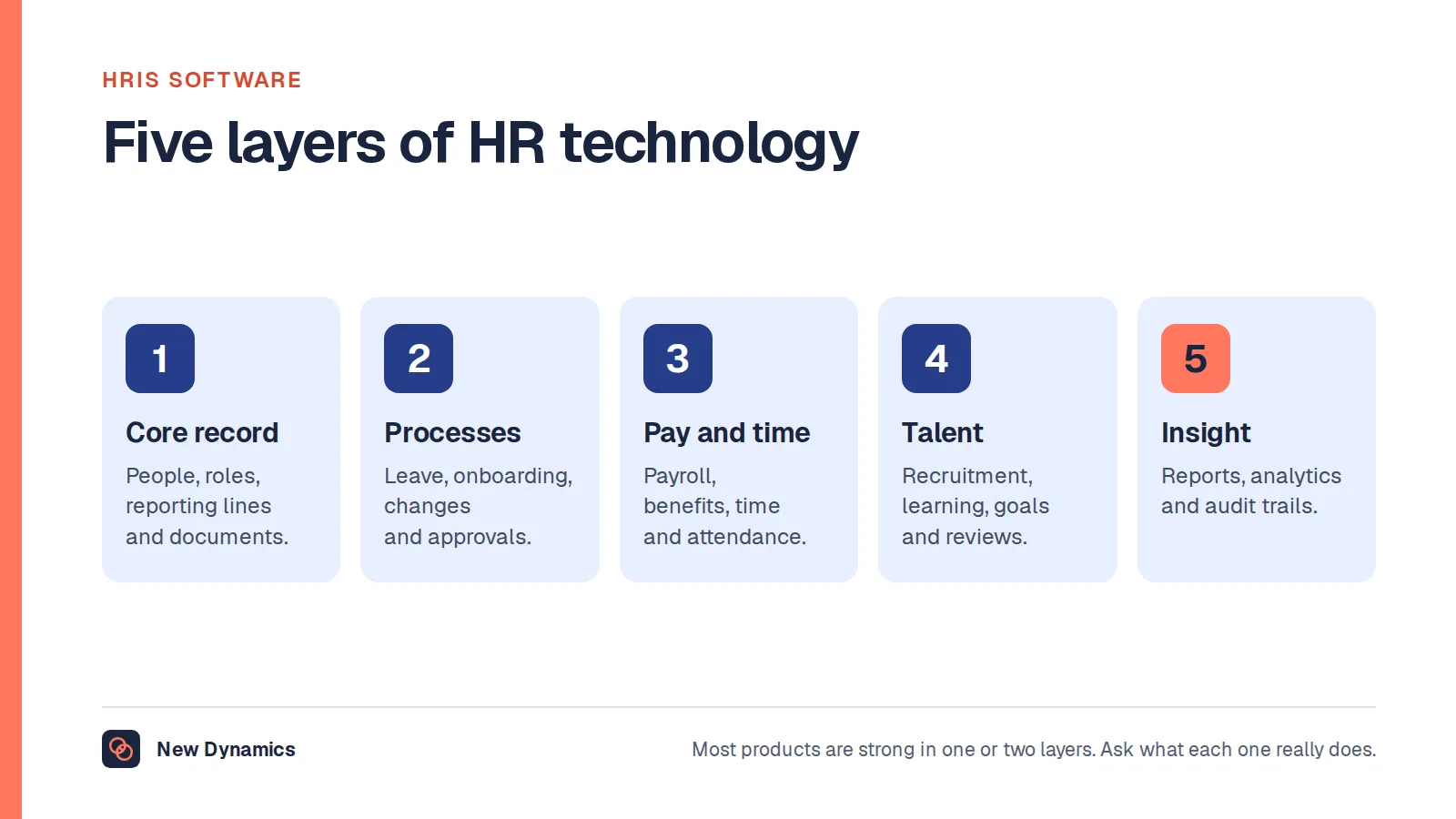
It is not a product database, an invoicing system or a project tool, though plenty of CRM products reach into all three. It is not an HR system either: the record of your own employees belongs somewhere else, which our post on HRIS software covers.
And it is not a decision. A CRM records decisions made by people. If the honest state of your pipeline is "we are not sure", it will record that faithfully.
Types of CRM systems: the useful list of CRM categories
Any honest list of CRM systems is a list of categories, not products. Here is the one worth knowing. Decide which row you are in before you look at a single supplier.
| Type | What it is | Who it tends to suit |
|---|---|---|
| Sales CRM | Pipeline, deals, activity and forecasting as the core | B2B teams with named accounts and a sales cycle measured in weeks or months |
| Service CRM | Cases, queues, entitlements and resolution times as the core | Support teams and anyone with a contractual response time |
| Marketing-led CRM | A contact database with campaigns, forms and automation on top | High-volume B2C and lead generation |
| Suite or ERP module | A CRM component inside a wider back-office platform | Organisations that already run the suite and want one database |
| Industry CRM | A CRM shaped for one trade: recruitment, property, charity supporters, education | Anyone whose process is the industry's process |
| Spreadsheet | A shared sheet with a contact list and a pipeline tab | The genuinely smallest teams, until two people need to edit it |
Two things fall out of that table.
First, a lot of CRM software comparison is a category error. Comparing a sales CRM with a marketing-led CRM on feature count tells you almost nothing, because they are built for different work.
Second, the spreadsheet row is not a joke. A shared sheet stops working at a predictable point: when two people need to edit it at once, when you need to know who changed a figure, or when somebody asks you to delete one person's details and prove it. Those moments justify buying something. "We should have a CRM" does not.
Industry CRM is worth a second look
If your process is your industry's process, an industry CRM often fits sooner than a general platform configured heavily. Recruitment is the clearest case, which is why it gets its own section below. The trade-off is portability: a narrow product fits sooner and constrains later, so ask what happens if your process changes.
Why we do not publish a top 10 CRM software list
Search for CRM software and you will find any number of articles ranking the best CRM programs, the most popular CRM systems and the top CRM for small business. We do not publish those, for the same reasons we set out in why we do not publish a top 5 HRIS list.
Three of them matter here.
Rankings are often commercial. Many "top CRM software" lists are funded by referral fees, and the reader cannot see which positions were bought. Even where no money changes hands, the order reflects whoever answered the questionnaire.
Best is not a property of software. It is a relationship between a product and a situation. A ranking cannot know your sales cycle, your team's size, the country your data must sit in, the system you already pay for, or whether anyone will log a call. Those five facts decide the answer, and none of them are in the article.
Rankings go stale invisibly. A list published eighteen months ago reads as current while the pricing, the packaging and the integrations behind it have all moved.
So we will not tell you which CRM is best, biggest or most popular. Here is the method we would use instead.

- Write scenarios, not feature lists. For example: "A customer complains by email, calls the next day and renews the week after. Show us where each of those three lands, who sees it, and what the account looks like afterwards."
- Shortlist by type using the table above, before you look at suppliers. Four candidates of the right type beats twelve of mixed types.
- Ask every supplier the same questions and insist on seeing the product with data shaped like yours, not the demo dataset.
- Take references from organisations of your size, in your country, using the same modules.
- Cost the whole commitment: licences, implementation, integrations, data migration, internal time and the cost of leaving.
Our post on choosing HR software sets out the same discipline for a different category, and the performance management software RFP template shows how to structure supplier questions so the answers are comparable. If the term is new to you, our guide to RFP meaning explains what a request for proposal is.
The biggest CRM company, and why that is the wrong question
"Which is the biggest CRM company" and "largest CRM company" are asked constantly, and the honest answer is that we do not publish vendor market-share claims, because we would be repeating a figure we cannot verify at the publisher and that changes every quarter.
More importantly, the question is a proxy for three better ones. Ask those directly.
Will this supplier still be here in five years? For a UK supplier, the accounts are public. Companies House lets you read the filing history, the accounts and the officers of any registered company for free. A small supplier with filed accounts and a long history is a different risk from a small supplier with none.
Will they care about an organisation my size? Scale cuts both ways. The largest platforms have the deepest ecosystems and the least interest in a twelve-seat customer. Ask who your named contact would be, what support hours apply to your tier, and what the escalation path is when something breaks during month end.
What happens when I want to leave? Size cannot answer this; the contract can. Ask for the notice period, the export format, whether the export includes attachments and activity history, and how long your data is kept after termination. Get it in writing before you sign.
Market share tells you which product other people bought, not whether it fits your week.
What UK law means for the customer data in your CRM
This section describes the position in the United Kingdom. It is general information and not legal advice; take advice on your own circumstances, and involve your data protection lead before you load anything into a new system.
A CRM is a database of other people's personal data. That means the UK GDPR applies, and two specific points catch buyers out.
You cannot keep it indefinitely. The Information Commissioner's Office is direct on the storage limitation principle: "You must not keep personal data for longer than you need it." It also declines to give you a number, saying that "the UK GDPR does not set specific time limits for different types of data. This is up to you, and will depend on how long you need the data for your specified purposes." Its practical instruction is to write the periods down: "To comply with documentation requirements, you need to establish and document standard retention periods for different categories of information you hold wherever possible." Read the ICO's guidance on storage limitation before you decide what your CRM should delete and when.
The practical consequence for a CRM shortlist: ask how the product reviews, deletes and proves deletion of a record. A system that can only archive is a system that cannot comply with the schedule you just wrote.
Marketing has its own rulebook. Holding someone's details lawfully is not the same as being allowed to email them. On electronic mail marketing, the ICO states: "You must not send electronic mail marketing to individuals, unless: they have specifically consented to electronic mail from you; or they are an existing customer who bought (or negotiated to buy) a similar product or service from you in the past, and you gave them a simple way to opt out both when you first collected their details and in every message you have sent." The ICO also notes that this existing-customer exception "does not apply to prospective customers or new contacts (eg from bought-in lists)". See the ICO's guide to electronic mail marketing for the full position.
Two further points from the ICO's wider direct marketing guidance are worth pinning to the wall. "Direct marketing covers promoting aims and ideals as well as selling products and services", so a charity or a membership body is not outside the rules. And "people have an absolute right to object to or opt out of direct marketing at any time", which means your CRM needs a preference field that every outbound process actually honours, not a note in a comment box.
How common is any of this?
There is no official UK statistic we could open that reports how many businesses use CRM software specifically. The UK Innovation Survey 2025 report, published on 4 June 2026 and covering innovation activities "in 2022 to 2024 (2022, 2023 and 2024)", asks businesses which management technologies they use, and the figures it publishes name accountancy and payroll software: "Accountancy software was by far the most used management technology, by 94% of broader innovators and 93% of non-broader innovators who used any of the management technologies." CRM is not broken out there, and we would rather say so than guess.
The closest official measure of the underlying problem is the handling of customer data. The UK Business Data Survey 2026, published by the Department for Science, Innovation and Technology on 18 June 2026 from fieldwork between October 2025 and January 2026 with 4,450 UK businesses, reports that "in 2025 to 2026, 67% of businesses handled non-employee personal data", and that "large (83%), medium (81%), and small (76%) businesses were more likely to handle personal data (other than employee data), compared to sole traders (66%) and micro businesses (67%)." Two-thirds of businesses holding other people's personal data is the real context for a CRM purchase. For the wider picture on people data and HR measurement, see our HR statistics hub.
CRM for recruiting agencies
Recruiting agencies are the clearest case where the generic advice above is not enough, because an agency in Great Britain has statutory record-keeping duties on top of the data protection position.
Regulation 29 of the Conduct of Employment Agencies and Employment Businesses Regulations 2003 requires that "every agency and every employment business shall keep records which are sufficient to show whether the provisions of the Act and these Regulations are being complied with", including particulars about every application received from a work-seeker, every application received from a hirer, and dealings with other agencies. On how long, the regulation is specific: the records "shall be kept for at least one year from the date of their creation, and in the case of the particulars referred to in sub-paragraphs (a) and (b) of paragraph (1), at least one year after the date on which the agency or employment business last provides services in the course of its business as an agency or an employment business to the applicant to whom they relate." It also confirms that the records "may be kept in electronic form, provided that the information so recorded is capable of being reproduced in legible form", and that an agency is not required to keep work-seeker or hirer particulars "in respect of applications on which the agency or employment business takes no action".
You can read regulation 29 in full on legislation.gov.uk. These regulations apply in Great Britain; Northern Ireland has its own framework, and this is general information rather than legal advice.
So an agency CRM has to do two things that pull in opposite directions: hold a defined set of particulars for a minimum period, and not hold personal data longer than needed for anything else. That is a retention schedule with more than one rule in it, which generic CRM products handle badly.
Three practical requirements for an agency shortlist:
- Separate the obligation from the pool. The records you must keep under regulation 29 are a compliance set with a floor. The talent pool you keep because you might place someone again is a different purpose with a different justification, and the candidate needs to have been told about it.
- Make the minimum period calculable. "One year after we last provided services to this person" is a date the system has to be able to work out. If retention is a single global setting, it cannot.
- Keep the placement process and the relationship apart. An applicant tracking system runs a live vacancy; a candidate relationship manager keeps people warm between them. Our posts on what an ATS is and on recruiting software cover the first, and the recruitment CRM post covers the second, including the consent question that decides whether you can hold a pool at all.
The other CRM: Certified Records Manager certification
If you searched for CRM certification and meant the credential, this is your section.
The Certified Records Manager designation is awarded by the Institute of Certified Records Managers. In its own words, "the ICRM was incorporated in 1975 to meet the requirement to have a standard by which persons involved in records and information management could be measured, accredited and recognized according to criteria of experience and capability established by their peers". The body also awards the Certified Records Analyst, or CRA.
Who can apply. The ICRM's guidance on applying for the examination states that the preferred qualifications are "a college degree (four-year or bachelor's degree) and one year of professional records and information management (RIM) experience", and that "one additional year of professional RIM experience may be substituted for each year of college not completed". The minimum standard it sets out is a "High School Diploma or GED PLUS five years professional level RIM experience". Approved candidates, it adds, "have five years to obtain a certification".
What the examination covers. The ICRM's page on taking the examination says "the CRM designation is attained by completing Parts 1-6". The parts are listed as "Management Principles and the Records and Information (RIM) Program"; "Records and Information: Creation and Use"; "Records Systems, Storage and Retrieval"; "Records Appraisal, Retention, Protection and Disposition"; "Technology"; and "Business Cases". On the last of those, the ICRM says "Part 6 consists of 2 essay questions and requires a well thought-out and detailed written business case". Confirm the current fees, sittings and maintenance requirements with the ICRM directly rather than with any third-party summary, including this one.
How it sits in the UK. Records management is not a licensed profession here, so the Certified Records Manager is a voluntary credential rather than a legal requirement. What is formal is the framework public authorities work to. The National Archives explains that "section 46 of the Freedom of Information Act 2000 required the Lord Chancellor to issue a Code of Practice on the management of records", describes it as "a technical document aimed at supporting management of public authority records and information under the Act", and says the revised version works on "a principles-based, format-neutral basis". If you work in or sell to the UK public sector, the records management code is the document to know.
For the broader map of HR and people-profession credentials, see our post on HR certifications. And if your interest in records is narrower, our posts on employee records retention and performance review record keeping cover the periods that come up most often in practice.
How to build your own CRM shortlist

The four checks in that graphic are the ones that get skipped, so they are worth spelling out.
The record. Ask to see what a contact, an organisation and a deal contain, field by field. Then ask what happens when one person works at two organisations, when an organisation is acquired, and when a deal involves three people who each want something different. Those cases break more CRM implementations than any missing feature.
Lawful basis and consent. Ask where the lawful basis for each category of data is recorded, how marketing consent is captured and timestamped, and what the system does with an objection. Then ask to see the opt-out being honoured in a live campaign, not described on a slide.
Retention and deletion. Ask whether retention can differ by record type, whether the period can be calculated from an event rather than set globally, and what evidence of deletion you get. Match the answer to the schedule you wrote earlier.
Export and audit. Ask for a full export, including attachments and activity history, in a format you can read without the supplier. Ask who can see the audit trail and how far back it goes.
Two more that do not fit on a slide.
Adoption. A CRM that nobody updates is worse than a spreadsheet, because people trust it. Ask what the daily data entry looks like for a salesperson on a bad week, and how much happens automatically from email and calendar.
Integration. Be specific about direction. "It integrates with our accounting system" is not a requirement; "a new customer created in the CRM must appear in the accounting system within a day, with the same reference" is.
Our HRIS selection guide sets out this process with a scorecard. It is written for HR systems, but the scorecard, the scenario method and the implementation checklist transfer directly to a CRM evaluation.
Where a sales CRM stops and performance management starts
Both systems contain numbers about people, which is why the boundary gets confused.
A CRM holds the work: accounts, pipeline, activity, revenue. Performance management holds the expectation and the conversation: what this person is working towards, how it is going, what was agreed, and what happens next. The CRM can tell you that someone closed 60% of target. It cannot tell you whether that was a good quarter given the territory they were handed in March.
Three rules that keep the boundary clean.
- Pull the number, do not retype it. If a sales target appears in a review, it should come from the system of record, with the period named. Retyped numbers get argued about.
- Do not run appraisals in the CRM. Review content needs its own permissions, retention and audit trail, and a sales manager should not be able to edit history.
- Keep judgement visible. The point of a review is the part the CRM cannot calculate. Our post on performance reporting covers what to put in front of a leadership team.
New Dynamics is a performance management platform, not a CRM. We cover goals and OKRs, feedback, performance reviews and multi-manager reviews for people who report to more than one person, and workflows for shaping forms and approvals around your own process. Our integrations directory lists the platforms we discuss during planning; a listing there is not a promise of a ready-made connector, so ask us, and any supplier, exactly which integrations exist today.
Frequently asked questions
What is CRM software?
CRM software is customer relationship management software. It holds the people and organisations you sell to or serve, the history of what has happened with each of them, and what is meant to happen next. Most products combine a contact record, a pipeline of opportunities, an activity history, service cases and reporting.
What does CRM stand for?
CRM most often stands for customer relationship management, the software category. It also stands for Certified Records Manager, a credential awarded by the Institute of Certified Records Managers. In recruitment, CRM is also used for candidate relationship management, which describes keeping future applicants warm between vacancies.
Which is the best CRM software?
There is no single best CRM, and we publish no rankings. Best is a relationship between a product and a situation, and no list can know your sales cycle, your team size, the country your data must sit in or whether anyone will log a call. Write scenarios from your own week, shortlist by type, test with your own data and cost the exit.
What is the biggest CRM company?
We do not publish vendor market-share claims, because we cannot verify them at the publisher and they change every quarter. Size is usually a proxy for three better questions: will this supplier still exist in five years, will they support an organisation of my size, and what happens to my data when I leave. For a UK supplier, Companies House lets you read the filed accounts for free.
Do recruiting agencies need a different kind of CRM?
Often, yes. In Great Britain, regulation 29 of the Conduct of Employment Agencies and Employment Businesses Regulations 2003 requires an agency to keep specified particulars about work-seekers and hirers for at least one year from creation, and at least one year after it last provided services to that person. A CRM for a recruiting agency therefore needs retention that can be calculated from an event, not one global setting. This is general information, not legal advice.
What is the CRM certification for records managers?
The Certified Records Manager is awarded by the Institute of Certified Records Managers, which was incorporated in 1975. Applicants are preferred to hold a four-year degree plus one year of professional records and information management experience, with additional experience substituting for education. The designation is attained by completing Parts 1 to 6 of the examination, the last of which is a written business case. Confirm current requirements with the ICRM.
Your next step: write three scenarios
Before you look at a single CRM product, do this.
- Write three situations from your own last month, in sentences, ending with "show us what happens".
- Decide which row of the type table you are in, and shortlist no more than four suppliers of that type.
- Write your retention schedule first, then ask each supplier how their product delivers it.
- Ask for a full export in your trial, and try reading it without the supplier's help.
For a scorecard and an implementation checklist you can adapt to a CRM evaluation, read and download our HRIS selection guide. The guide is free to read, and the PDF uses our short download form.
Want to see where performance management sits alongside your CRM, so that targets and reviews stop living in a spreadsheet? Book a New Dynamics demo and send us the review form you use today. You can also email contact@new-dynamics.com.