TL;DR
- A leadership goal is hard to write because the thing you are changing is a behaviour other people experience, not an output you control. That is why so many of them end up as wishes with a date attached.
- The repair is to name one behaviour, name who would notice it, and name how they would tell you. Four cheap sources of evidence beat one annual score, and none of them needs a survey programme.
- Pair every leadership goal with a delivery goal so it is not dismissed as soft, and keep it out of a rating unless the evidence behind it would survive being read back to the team.
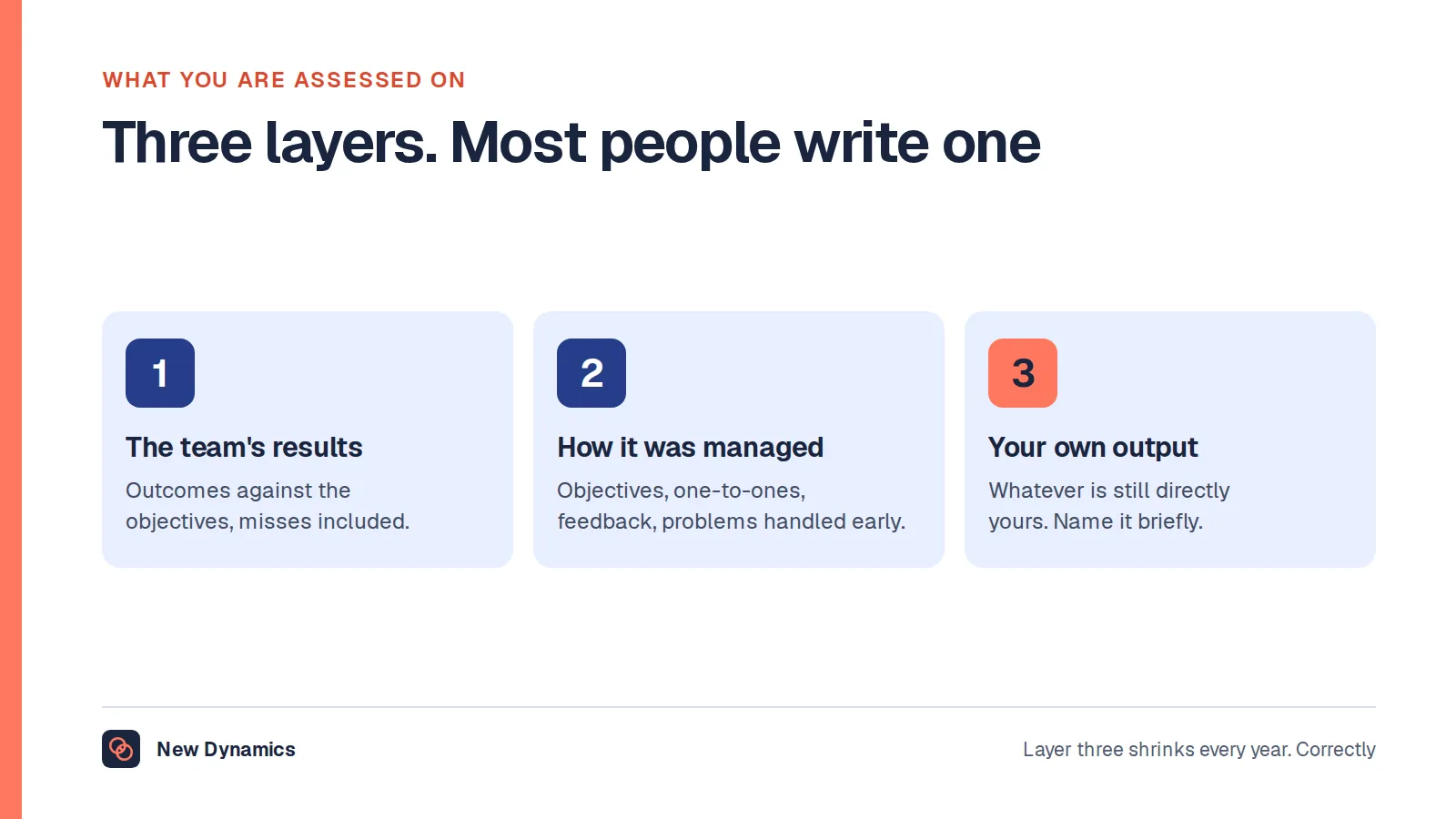
Every objective-setting season, a manager types "become a more effective leader" into a performance form and moves on. It survives the review because nobody can argue with it, and achieves nothing because nobody can tell whether it happened. Twelve months later the same sentence goes into the same box.
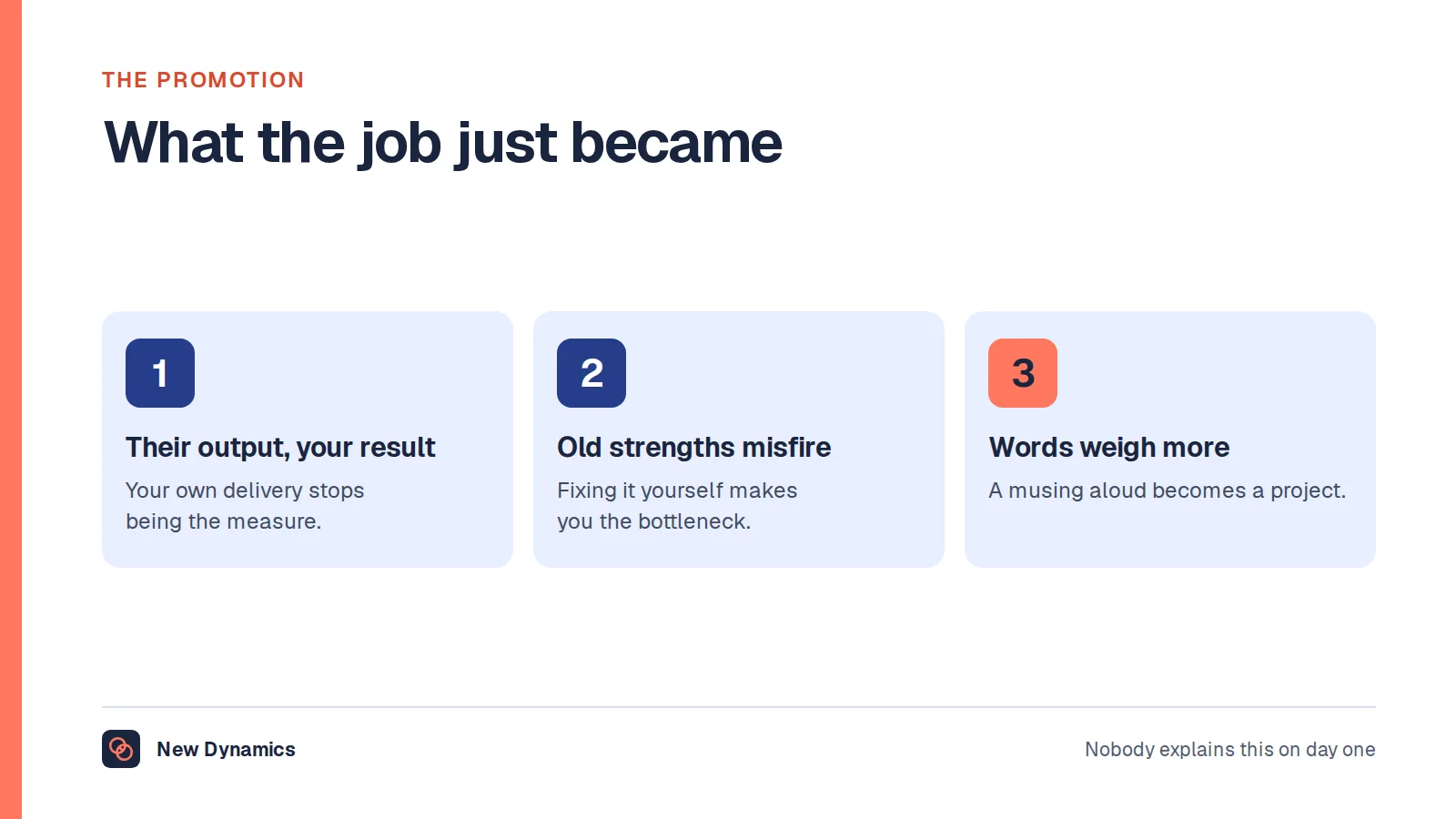
The reason is not laziness. Leadership goals are harder to write than delivery goals, for one specific reason: the thing you are changing lives in other people's experience of you. A sales target is yours. Whether your team feels able to disagree with you is not, and you are the least reliable witness to it.
This post is about the mechanics: what makes most goals for leadership unmeasurable, how to turn a wish into something a team could notice, the five things managers have to get better at, how to gather evidence cheaply, what the goal should do to a rating or to pay, and three worked examples.
Leadership goals usually fail in the gap between the form and the year. See how New Dynamics Goals & OKRs keeps a behaviour goal and its evidence beside the delivery goals, so it is reviewed in check-ins rather than rediscovered the week before the appraisal.
One boundary. This is about a goal held by somebody who leads people, as part of the job, agreed with their own manager. It is not about the ambitions an employee holds for their own working life, which have different rules at review time. Those are covered in personal goals at work.
Why most leadership goals are unmeasurable wishes
Three shapes recur in any objectives system, and each fails differently.
The trait. "Be more approachable." "Develop gravitas." A quality rather than an action, so there is nothing to do on a Tuesday morning and nothing to look at in November. Traits also invite a reader to assess the person rather than the work.
The attendance record. "Complete the leadership programme." Measurable, which is why it is popular, and the wrong thing to measure. Nobody experiences your attendance.
The borrowed metric. "Improve team engagement score by five points." The manager has reached for the only number available and tied their own rating to a figure produced by twenty other people's answers, moved by a reorganisation, a pay round and who resigned that month.
Underneath all three sits the real problem. A delivery goal describes something you produce. A leadership goal describes something other people experience because of how you behave. You control the behaviour, not the experience.
Official UK guidance is clearer on this than most management writing. The Advisory, Conciliation and Arbitration Service, better known as Acas, says in its guidance on reviews and appraisals, last updated on 23 June 2026, that a performance review might be based on a combination of things, including whether an employee is "demonstrating the right behaviours in their work". Behaviours, not qualities. That word choice is this article's argument.
The same page sets the test an objective must pass. Acas says it is a good idea for objectives to be specific, "by being clear about what the employee will actually do", and measurable, "so you know whether they've been achieved". Read "what the employee will actually do" back against "be more approachable" and the verb is missing.
One note on numbers. No official United Kingdom source publishes a figure for how many managers hold a leadership goal, or what becomes of the ones who do, so this post quotes none. Figures that are published are collected in our HR statistics hub and in our post on manager training statistics.
What a leadership goal is, and what it is not
A leadership goal is an agreed, dated change in how a person leads, written as a behaviour that somebody other than the goal holder could notice. Three things follow.
It has a verb and a frequency. Not "listen better" but "start every one-to-one with their agenda". GOV.UK's Success Profiles: Civil Service behaviours defines behaviours as "the actions and activities that people do which result in effective performance in a job", and says plainly why the framework is built that way: "As behaviours can be observed and measured, they can help us to predict what your performance in the role could be." Observed, by somebody. That is the property your goal needs.
It is about one thing. The same guidance notes that managers "will choose a selection of behaviours which are best suited to the specific job role", and tells candidates: "You will not be asked to demonstrate all Civil Service Behaviours for one role." A manager with four leadership goals has none.
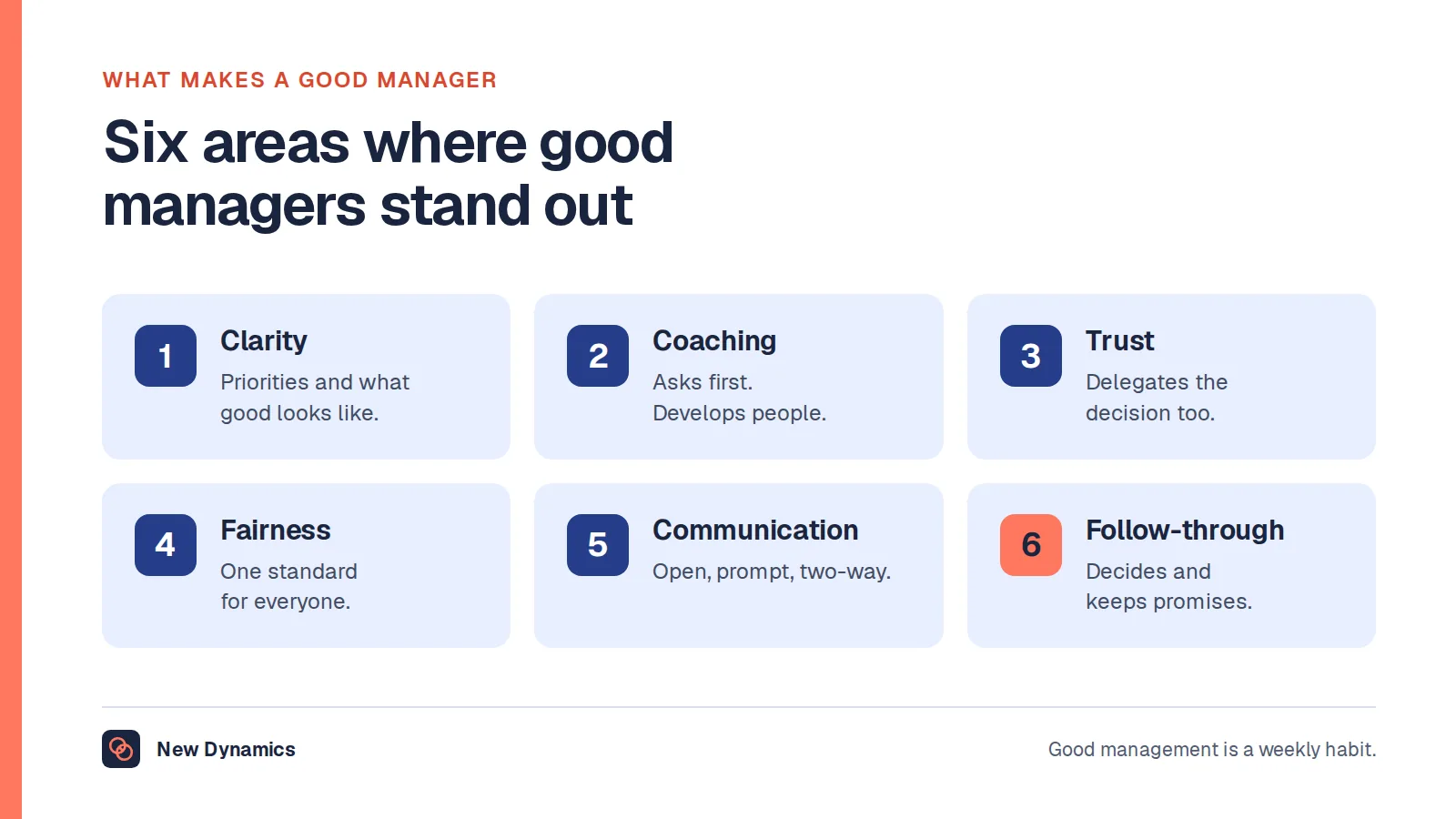
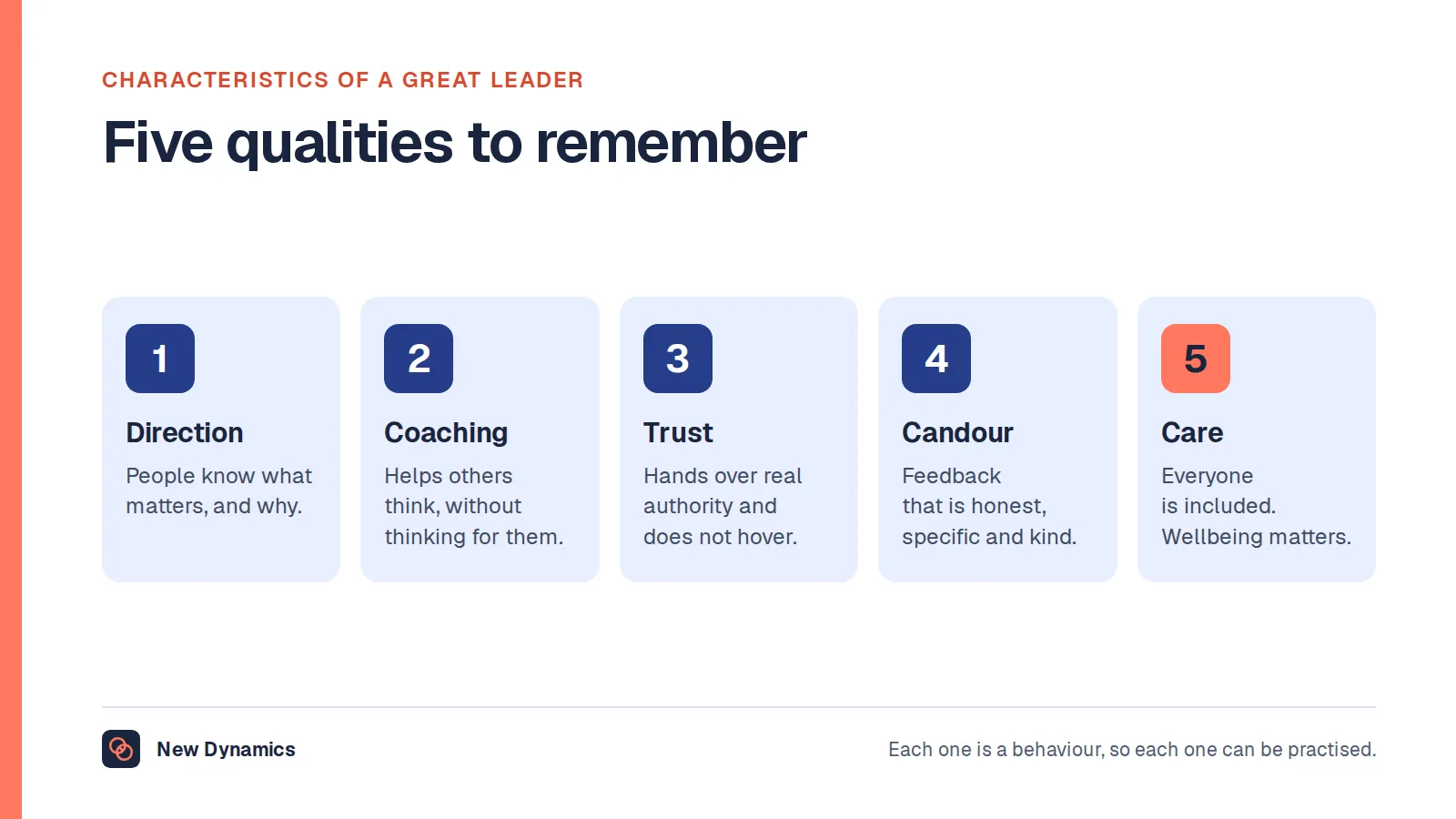
It is not a framework, a course or a development plan. A framework lists what good looks like at a grade; a plan is the activities. The goal is the one dated change for this cycle. Our posts on what makes a good manager and characteristics of a great leader cover the qualities.
There is also a duty most leadership goal templates never mention. The Health and Safety Executive, the regulator for workplace health and safety in Great Britain, treats a manager's behaviour as a health and safety matter rather than only a cultural one. Its Line Manager Competency Indicator Tool page says that "managers also need to think about their behaviour, and how it can either add to the stress their staff experience or help alleviate the problem", and that "Management behaviour is often highlighted as a major factor by those suffering from work related stress". This is general information about the position in Great Britain and not legal advice; arrangements differ in Northern Ireland, and a specific situation needs proper advice.
From "be a better listener" to something a team could notice
The rewrite takes five moves, and it is the part most goal templates skip.
1. Name the complaint, not the virtue. Start from what someone would say about you if they were being honest. "You interrupt" is more useful than "listening". "Decisions sit with you for weeks" beats "decisiveness".
2. Name one behaviour that would change if the complaint were fixed. If I got better at this, what would a person in the room see? Interrupting less becomes "I will not speak until the person has finished and I have said back what I heard". Slow decisions become "every decision I am asked for gets an answer or a date within three working days".
3. Name who would notice. By name, not "the team". Two or three people who see the behaviour most often. If nobody can be named, it happens where only you see it.
4. Name how they would tell you. One question, twice in the cycle, at a time already in the calendar.
5. Name the date and the safeguard. A review date, plus a line protecting the delivery it sits next to.
The result reads less impressively than the wish it replaces, and that is the point. "In every one-to-one this quarter, their agenda is first, I do not interrupt, and the note is shared the same day" either happened or did not.

Acas's own worked example on its reviews and appraisals page follows the same pattern for an ordinary objective: a specific thing the employee will do, an agreed measure, agreed support, a regular check-in and a review meeting "in 3 months' time". A leadership goal needs the same furniture, except somebody else holds the evidence.
Goals for leadership skills: by what you actually have to get better at
Most lists of leadership development goals are organised by virtue: communication, vision, emotional intelligence, resilience. That is why they are useless. Organise instead by what a manager has to get better at doing, which is where a goal can bite.

Delegating
The failure mode is handing over the task and keeping the decision. People do the work and wait, and the manager becomes the bottleneck while believing otherwise.
A goal here names what moves. "By the end of this quarter, Dan signs off supplier spend up to a stated limit without asking me, and I have told the team in writing that he does." The Civil Service behaviour examples give two borrowable phrases: "empower others to make decisions where appropriate", and "consider the contributions of all team members and delegate work to aid the learning and development of all".
How you would know: count the decisions that reached you which somebody closer to the work could have made.
Giving difficult feedback
The most avoided management task, and the one with the worst compound interest. A concern raised in days is a conversation. The same concern seven months later is a process in which the person can fairly say nobody told them.
Acas's guidance on problems with an employee's performance draws the distinction a manager needs first: "It's a conduct issue if the problem is with the employee's behaviour, rather than their ability to do the job", and where instead "the problem is with the employee's ability to do something", an employer could help by offering "support, for example through coaching or mentoring" and training. Acas adds that employers "should talk to employees informally first if there are problems with their conduct".
The goal is about latency, not tone. "Anything I notice is raised with the person inside five working days, in a booked private slot, with a note shared the same day." Our difficult conversations examples post has the wording.
How you would know: check whether any item in a review was new to the person.
Making a decision with incomplete information
Managers rarely get stuck because they chose wrongly. They get stuck waiting for information that is not coming, and the team pays in rework.
The Civil Service behaviour examples name three parts of doing this well at middle-manager level: "display confidence when making difficult decisions, even if they prove to be unpopular", "invite challenge and where appropriate involve others in decision making", and "present strong recommendations in a timely manner outlining the consideration of other options, costs, benefits and risks".
A goal here puts a clock on it. "Every decision I am asked for gets a decision or a dated answer within three working days, and when I decide without full information I say in writing what I assumed and what would make me change my mind." The last clause teaches the team to do it too.
How you would know: a list of decisions asked of you and the date each was answered.
Running a meeting that ends somewhere
A recurring meeting with no decision and no owner is the most expensive habit in most organisations, and almost always within the chair's gift to fix. This goal is mechanical, which makes it easy to evidence. "From this month, every meeting I chair has a stated purpose in the invitation, ends with the decisions and owners read back aloud, and the note is out the same day. If a meeting has no decision to make twice in a row, I cancel it."
How you would know: the notes exist, or they do not.
Developing someone
The hardest one to fake, because it shows up in another person's year. The Civil Service behaviour examples describe it as when you "identify capability gaps for yourself and your team" and "ensure development objectives are set and achieved to address any gaps", and when you "take time to coach, mentor and develop other colleagues".
A goal here needs a named person and a transfer of real work. "By the end of September, Amina has run two of the client planning sessions I usually run, with me in the room once and not at all the second time, and we have agreed in writing what she would still need to do the whole thing." Giving away work that teaches costs the manager visible output, which is why it slips and why the goal names it.
How you would know: ask what they can now do that they could not in January.
How to get evidence on a leadership goal without a survey industry
This is where most leadership goals die. The behaviour is real, the goal is well written, and then nobody can say whether it happened, so the review falls back on the manager's own account.
The HSE is candid about why self-assessment is not enough. Its line manager tool page says that "It is difficult for managers to get feedback that allows them to assess how their staff are affected by their behaviour", and adds the uncomfortable part: "a manager may be doing something that affects their staff but they are unaware of it". The tool it publishes to close that gap comes in versions for self-assessment and for input from staff, senior managers and peers, with the aim of helping managers "reflect on their behaviour and management style".
No platform or annual programme needed. Four sources, all cheap.

1. Count what is already countable. Many leadership behaviours leave a trace nobody looks at: decisions that reached you unnecessarily, days between noticing something and saying it, meetings you chaired that produced a note, one-to-ones held against one-to-ones booked. None of it needs anybody's opinion, and a count that has not moved is an answer.
2. Ask two named people the same question twice. Not a survey. One question, put to two or three people who see the behaviour, once near the start of the cycle and once near the end, in identical wording: "when you bring me a decision, how long does it take to get an answer, and does the answer come with reasons?" The Civil Service describes the habit at junior grades as when you "listen to and act on feedback from colleagues to find areas you can develop". It works the same way upwards.
3. Add one question to the existing check-in. Acas says that alongside formal reviews, managers "should still talk to employees informally about their performance on a regular basis", through "sharing regular feedback", "coaching" and "regular check-ins, sometimes known as one-to-ones". That conversation is already in the calendar, and one standing question costs nothing: "what is one thing I did this month that made your work harder?" Our one-to-one meeting questions post has more prompts, and manager self-assessment covers your own side.
4. Keep the written record. Acas is explicit that for a review, "It's important to keep a written record of what is discussed. This should be shared with the employee afterwards." For a leadership goal that record is the evidence, and a note shared the same day is both the behaviour and the proof of it.
If your organisation already runs a staff survey, the HSE's Management Standards are a reasonable lens, because the six areas they name are about work rather than personality: Control is "how much say the person has in the way they do their work", and Relationships "includes promoting positive working to avoid conflict and dealing with unacceptable behaviour". HSE presents the standards as a way of assessing the current situation "using pre-existing data, surveys and other techniques", so use the data you have before commissioning more. Do not attach your own rating to a team score. For a fuller multi-rater process, our 360 feedback guide sets out how to run one.
Pair the leadership goal with a delivery goal
The commonest objection to a leadership goal is that it is soft, usually from somebody who watched a manager spend a year on their communication style while a programme slipped. The answer is to write the pair.
A leadership goal travels with a delivery goal and a safeguard line, the way a quality target travels with a volume target. "In every one-to-one this quarter, their agenda is first and the note is shared the same day, while both team commitments for the quarter land on their agreed dates." Now it cannot be achieved by retreating into meetings about meetings, and cannot be dismissed as decoration.
Acas supports the pairing rather than a choice. Objectives, it says, "should be fair and reflect the employee's usual tasks and workload", adding that "they might also stretch them to develop in certain areas". Usual workload first, stretch alongside. A goal that assumes the day job shrinks is the kind abandoned in week six.
Keep it to one leadership goal, and write the cost down: if you will personally produce less because you gave work away, say so at the start. Our performance goals examples post covers the delivery side.
How a leadership goal should, and should not, feed a rating or pay
This question decides whether anyone tells the truth about a leadership goal.
What it can fairly do. It can be reviewed, discussed with evidence, used for a development conversation, and recorded in writing both people have seen. Countable traces, like notes shared or decisions answered within three days, can be read in a review like any other agreed objective.
What it should not do. It should not become a score derived from other people's feelings about the manager, and it should not be the hinge on which money turns. Three practical reasons.
First, the evidence is held by people who report to the manager. The moment a team learns its answers set their manager's pay, the answers change. You have bought a worse instrument.
Second, behaviour evidence is thin by design. Two or three people's observations over six months can steer a development conversation, not defend a pay differential.
Third, the fairness standard is higher than most leadership scoring survives. Acas's guidance on performance-related pay says employers "should be careful with how they use performance-related pay" and that the process for deciding it "should be fair and objective". It warns that "If it is not used in a fair way, performance-related pay can affect working relationships", and that where workers do not think it is being used fairly there is a risk they will be "less motivated", "dissatisfied at work" and "more likely to leave". That is general information about the position in Great Britain, not legal advice, and a pay scheme should be checked with your own advisers.
The workable middle. Three rules.
- Rate the behaviour, not the sentiment. "Did not raise a known performance concern for seven months" is a fact about what the manager did. "Team finds him unapproachable" is a mood with no date on it.
- Never attach pay to a score the team produces. Use their input to improve the manager, and delivery, judgement and conduct for the pay decision.
- Apply the read-back test. Before a leadership goal influences a rating, ask whether you would read the evidence back to the team it came from. If not, it is not good enough to pay on.
Our manager performance post covers assessing managers, and appraisal objectives the rest of the form.
Leadership goals examples: three worked cases
One per level. Every name and date below is invented, and the dates assume a January cycle.
A first-time manager: stop taking the work back
The goal. By 30 June, the two recurring pieces of work I handed to Josh and Priya are theirs, including the decisions, and I have not taken either back. Josh approves the weekly dispatch exceptions up to the stated limit without asking me, and Priya owns the client status report end to end. The team has been told in writing.
The evidence. A one-line note each time either brings me a decision that was already theirs, with that count expected to reach zero by May. In April and again in June I ask both: is there anything in your area you are still checking with me that you should not?
The safeguard. Dispatch exceptions resolved within the day stay where they are now, and the status report goes out on Fridays.
Why it is written this way. The instinct to fix it yourself is the main failure mode of a new manager, and it feels like diligence. Our new manager guide covers the first ninety days.
A mid-level manager: say the difficult thing while it is small
The goal. From 1 February, anything I notice about someone's work is raised with that person inside five working days, in a booked private slot, with a written note shared the same day. By the end of the cycle, nothing in anyone's review is news to them. Where the issue is capability rather than conduct, the note records the support we agreed.
The evidence. Two counts I keep myself: days between noticing and saying, and the number of year-end review items the person had not already heard. The second should be zero. At mid-year I ask my six people whether there is anything about their work I am not telling them.
The safeguard. The two delivery commitments for the first half land on their agreed dates, and the one-to-ones are not cancelled to make room.
Why it is written this way. It measures latency, which the manager controls, not the recipient's comfort, and it respects the Acas distinction between conduct and capability.
A senior leader: decide, and show the reasoning
The goal. By 31 March, every decision escalated to me gets a decision or a dated answer within three working days, each recorded in two or three sentences saying what I decided, what I assumed where the information was incomplete, and what would make me revisit it. From April the same record goes to the heads of the three teams affected, whichever way the decision went.
The evidence. One running list of escalations with the date asked and the date answered, which is also the artefact I am committing to produce. Twice in the cycle I ask the three heads: are decisions reaching you in time to use, and can you tell what the reasoning was?
The safeguard. The two board commitments for the year keep their dates, and nothing gets decided alone that needed consultation.
Why it is written this way. At this level the behaviour and the delivery are nearly the same thing: a decision not made is a cost somebody else carries. The Civil Service describes the senior version as ensuring colleagues and stakeholders "have a clear understanding of objectives, activities and time-frames". Our post on leadership styles covers how the message lands.
Reviewing a leadership development goal, and where it still goes wrong
A leadership goal reviewed once, at the end, has not been managed. It has been remembered. Three checkpoints are enough.
Week four: is the behaviour actually happening? Not whether it is working. Whether you are doing it. Most leadership goals fail here, silently, because the behaviour never started and nobody was watching. If you have not done it four times, the goal is too big.
Mid-cycle: ask the two people. Same question, same wording as the first time, and write down what they say, including the part you did not like. "I have not noticed any difference" is useful, and not a verdict on your character.
End of cycle: write the evidence before the opinion. Put the counts and the two answers down first, then what you conclude. That order is the difference between a review and a reminiscence. Our goal review meeting post covers the conversation.
Three failures survive even a well-written goal. The goal the team never heard about cannot be reported on by the only people who can see it. The goal that needs the organisation to change is arithmetic rather than willpower: a goal about the quality of your one-to-ones does not survive fourteen direct reports, and direct reports per manager sets out how to argue it. The goal that punishes the honest answer is the quietest: if the temperature drops when somebody says nothing has changed, you will not be told again.
Frequently asked questions
What are leadership goals?
Leadership goals are agreed, dated changes in how someone leads, written as behaviours other people could notice. The useful ones name what the manager will do differently, who would see it, and how those people would report on it. Acas guidance on reviews notes that a review may consider whether someone is demonstrating the right behaviours in their work.
What are examples of goals for leadership skills?
Five areas cover most of it: delegating, which means handing over the decision as well as the task; giving difficult feedback within days rather than months; deciding with incomplete information and saying what you assumed; chairing meetings that end with decisions and owners; and developing one named person. Each becomes a goal once you add a date, the people who would notice, and a count.
How do you make a leadership goal measurable?
Stop measuring the quality and measure the behaviour. Count things you control: decisions answered within three working days, days between noticing an issue and raising it, meetings that produced a shared note. Then add two named people asked the same question twice. Four thin sources beat one annual score.
Should leadership goals affect a manager's rating or pay?
A behaviour goal can fairly be reviewed and recorded, and countable traces can appear in a review like any other agreed objective. It should not become a score produced by the manager's own team and attached to money, because the answers change once the team knows what they decide. Acas says a performance-related pay process should be fair and objective. General information for Great Britain, not legal advice.
How many leadership goals should a manager have?
One, alongside the delivery goals that were coming anyway. GOV.UK's Success Profiles guidance makes the same point about its own framework: a selection is chosen for a role, and nobody is asked to demonstrate all of them at once. A manager carrying four behaviour goals is carrying none.
What is the difference between a leadership goal and a personal goal?
A leadership goal is part of the job, agreed with your own manager, and about how you lead other people. A personal goal is something you want for your own working life, which nobody assigned, so a review cannot fairly rate it.
Your next step: write one sentence this week
- Ask two people who report to you: what is one thing I do that makes your work harder?
- Turn the most common answer into one behaviour with a verb and a frequency, not a quality.
- Name who would notice it, how they will tell you, the date, and the delivery that must hold meanwhile.
- Put it next to your delivery goals, tell your team, and book the week-four check.
For a structure that turns observed behaviour into development actions, read and download our competency-based feedback guide. It is free to read, and the PDF uses our short download form.
Want behaviour goals, delivery goals and the evidence behind both in one place, reviewed in check-ins rather than reconstructed in December? Book a New Dynamics demo and bring the leadership objective your managers wrote last year. You can also email contact@new-dynamics.com.