TL;DR
- The role has three distinct versions, and they are not interchangeable: the shop floor, specialist or high-value retail, and inside sales in a business setting. The accountabilities, the training time and the sensible measures change with each one.
- The conditions are what define the job: rotas, part-time and zero hours contracts, age-banded minimum wage rates and the right to breaks. GOV.UK states that workers have the right to one uninterrupted 20 minute rest break during their working day, if they work more than 6 hours a day.
- Commission is not a detached extra. Acas lists payments linked to doing tasks required in the contract, for example commission, among the payments that must be included in holiday pay. This is general information about the United Kingdom rather than legal advice.
The hardest part of managing this role is not deciding what the person should do. Any manager can list that in two minutes. The hard part is that almost everything which actually determines whether the job goes well sits outside the duty list: who gets the Saturday shift, whether the rota appeared on Tuesday or on Sunday night, whether a contract guarantees hours, whether the individual sales figure the manager is reading means anything at all, and whether anyone saw the person handle a difficult customer well.
That is why a job description on its own is not enough to run this role. You also need a management position on rotas, pay bands, breaks, incentives and measurement, written down before the questions arrive rather than invented in the moment.
Recognition is the part most often left to chance in a shift-based team, because the manager who saw the good work is rarely the manager at the review. See how New Dynamics Recognition keeps praise visible across sites and shifts.
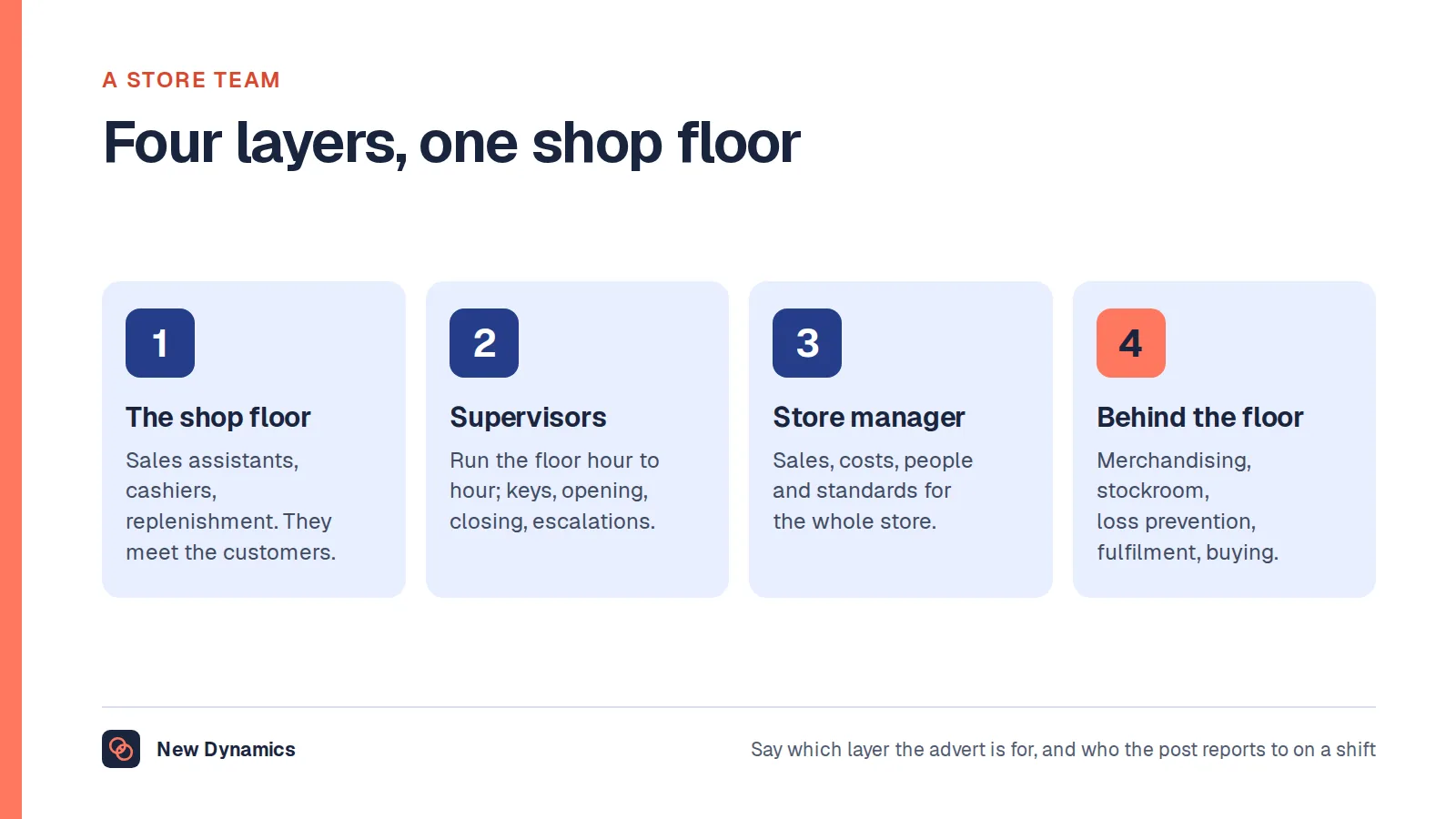
This article is written for the employer. If you want the role definition, the typical duties and a job description template to adapt, our sales associate job description post covers that ground, and our guide to retail job descriptions sets out the whole store team layer by layer. What follows is the management document instead: what the role is for, how retail and shift realities shape it, and how to measure it without being unfair.
Where the law is mentioned, the sources quoted describe the United Kingdom. This is general information rather than legal advice, and you should take advice on any real case.
What the role is, and what to call it
A sales associate sells goods or services and looks after the customer while doing it. The post exists so that a person who walks in, calls or emails with a need leaves having met it, and leaves willing to come back.
One naming point, said once and then dropped. "Sales associate" is largely an American term for the job that UK employers usually advertise as a sales assistant, retail assistant or shop assistant. The work is the same. If you are recruiting in the UK, the UK terms will reach more candidates, and the rest of this article uses them.
What the role is not: a till operator with a greeting attached. The distinguishing feature of a good sales assistant is judgement about the customer in front of them, which is why the role resists being written as a checklist and why measuring it badly does real damage.
Three versions of the role, and what changes in each
Employers run into trouble when they copy a role outline from one of these settings into another. The title stays the same and almost everything else moves.
Shop floor retail
High volume, low value per transaction, many short interactions. Stock work, tills, deliveries and tidying are a genuine part of the job rather than an interruption to it. Training is short and mostly about systems, procedures and the range. The individual contribution is hard to isolate, because several people serve the same customer in one visit.
What changes: service quality and standards matter more than individual sales. Measure the team.
Specialist or high-value retail
Furniture, jewellery, bicycles, hearing care, kitchens, cars. Fewer customers, longer conversations, a considered purchase and often a return visit before anything is bought. Product knowledge is deep and takes months to build, not days. The sale may complete weeks after the conversation that caused it.
What changes: a longer ramp-up, a real need for product training time on the rota, and measures that look at the pipeline and the follow-up rather than today's takings.
Inside sales in a business setting
Based at a desk, selling to other businesses by phone, email and video, often with a defined account list or inbound enquiries. Activity is logged in a system, so there is far more data about the work than there is on a shop floor. Hours are usually office hours, and the contract is usually full-time.
What changes: the role genuinely can be measured individually, so the risk flips from unfair measurement to too much of it. Our sales representative job description post covers this version of the role in more detail.

A role outline written as outcomes
Accountabilities beat duty lists because a duty can only be confirmed, while an outcome can be judged. Five is enough. Adapt the standards to your store before they go anywhere near a document.
- Customer outcome. Customers who ask for help leave with the right product or a clear answer, and are willing to be served by us again.
- Product knowledge. Advice given to customers is accurate and current on the range, the price, the stock position and the terms.
- Transaction integrity. Sales, refunds, exchanges and age-restricted sales are handled correctly first time, with cash and card procedures followed.
- Shop floor readiness. The area the post holder is responsible for is stocked, priced, safe and presentable at the start of trade and again at handover.
- Team contribution. Colleagues are covered at busy times, new starters are shown how the store works, and problems that cannot be solved on the spot are escalated rather than absorbed.
Note what is absent. There is no individual revenue target in the outline, because in most shop floor settings the post holder does not control footfall, the promotion, the delivery or the queue. If you want a sales measure, add it as a team accountability. The method behind this, and how to rewrite any duty list the same way, is in our post on how to write a job description.
What good looks like after three months
Probation in this role is usually three months, and it is usually wasted, because nobody wrote down what passing it means. Four tests, all observable by a supervisor without a report.
- Unsupervised on the floor. The person can be left on their section at a reasonably busy time, and the supervisor does not need to watch them.
- Accurate without checking. Tills, refunds and age checks are right without someone standing behind them, and they ask when a case is genuinely unusual.
- Advises rather than points. They ask what the customer is for, and recommend accordingly, including recommending the cheaper option or no purchase when that is the honest answer.
- Reliable on the rota. They arrive for the shifts they agreed to, give notice when they cannot, and are willing to be asked.
Write those four into the probation review before the person starts, and give them to the post holder on day one. Our probation review meeting post covers how to run the conversation.
The employment realities that define this job
This is the section most role description pages leave out entirely, and it is the part that decides whether the job works.
Shift patterns and contract types
Trading hours set the rota, so evenings, weekends and peak seasons are the job rather than an imposition on it. Teams are commonly a mix of full-time, part-time, variable-hours and seasonal staff, which means the people doing one job are on several different contracts with different expectations.
Two consequences follow. First, a part-time member of staff is not a smaller version of a full-time one, and a review process built for full-timers tends to penalise them for being present less; our post on performance reviews for part-time employees sets out the adjustments. Second, rota predictability is a management decision, not a fact of retail. Publishing further ahead and keeping to what was published costs you flexibility and buys you retention, and employee scheduling software is usually how larger teams make that stick.
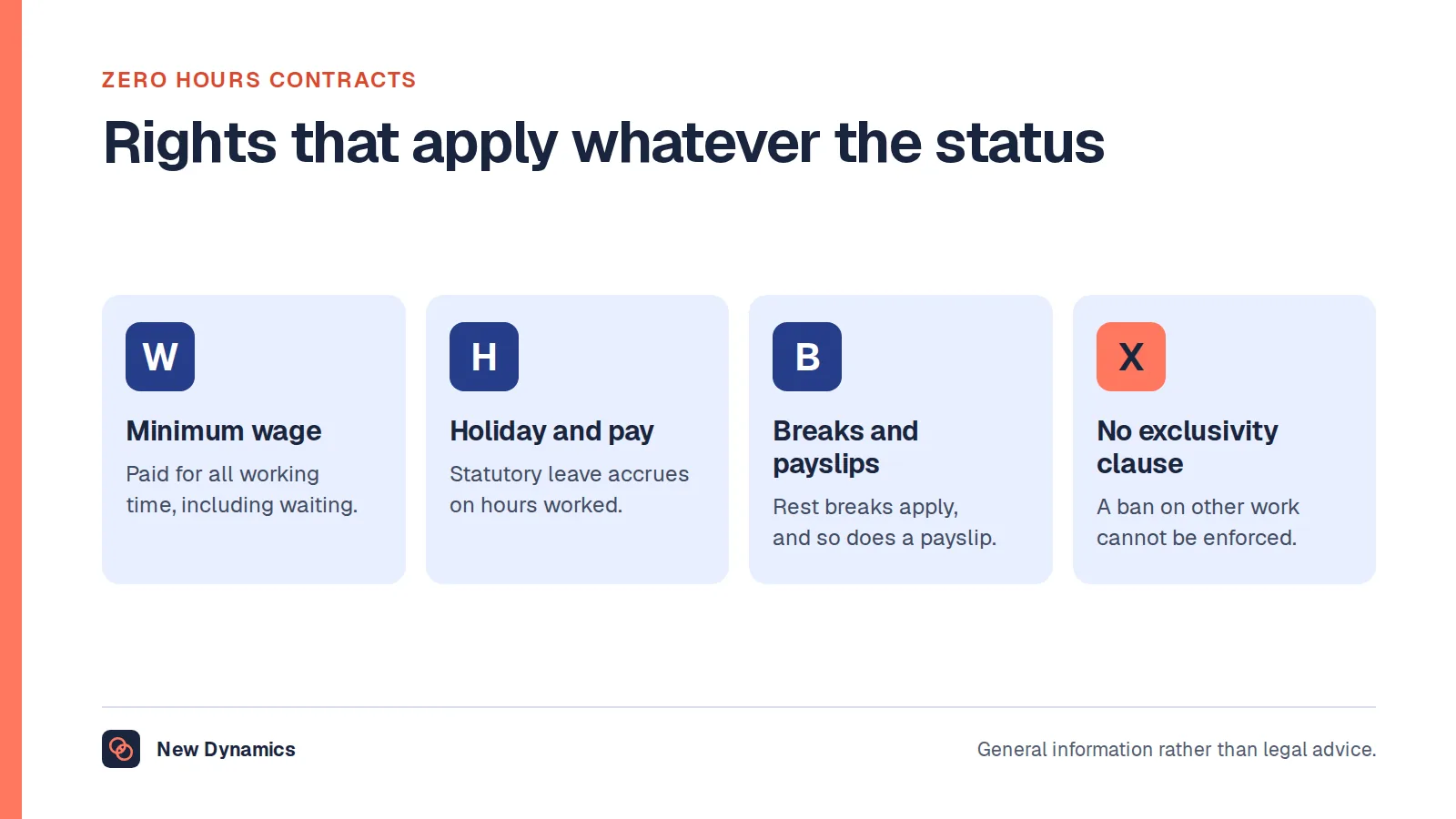
Where hours are not guaranteed, be precise about what the contract is. Acas's guidance on zero hours contracts describes the arrangement as one where "your employer does not have to give you any minimum working hours" and where "you do not have to take any work offered". It is also clear that the employer "must not try to stop you working for another employer by putting an exclusivity clause in your contract". Acas lists the rights these workers still hold, including the "National Minimum Wage and National Living Wage", "holiday and holiday pay" and "rest breaks". Our zero hours contract post goes through the practical management of them.
The minimum wage age bands
Retail employs a lot of young and first-job staff, so the age bands are a live operational matter rather than a payroll footnote. GOV.UK sets out the rates by category: "21 and over" receive the National Living Wage, with separate rates for "18 to 20", "Under 18" and "Apprentice". It states that "The rates change on 1 April every year."
On apprentices, GOV.UK says they are entitled to the apprentice rate if they are either "under 19" or "19 or over and in the first year of their apprenticeship", and that those "over 19 who have completed the first year of their apprenticeship are entitled to the correct minimum wage for their age". Its guidance on who gets the minimum wage confirms that the entitlement covers workers who are "part-time", "casual labourers, for example someone hired for one day" and "agency workers", and that "Contracts for payments below the minimum wage are not legally binding. The worker is still entitled to the National Minimum Wage."
Two management habits come out of that. Hold the birthdays of staff near a band boundary in payroll so a rate change is not missed, and check that unpaid time at the start or end of a shift, such as a bag search or a handover, has not quietly pulled someone's hourly pay below the rate for their age. We have not quoted the rates themselves, because they change annually; the current figures are on the GOV.UK minimum wage rates page, and the published pay and working time figures we track are collected in our HR statistics hub.
Rest breaks
Breaks go wrong on a shop floor because the floor must stay covered, so the break becomes the thing that gets dropped. GOV.UK's guidance on rest breaks at work states that "Workers have the right to one uninterrupted 20 minute rest break during their working day, if they work more than 6 hours a day". It adds that "Workers have the right to 11 hours rest between working days" and to either "an uninterrupted 24 hours without any work each week or an uninterrupted 48 hours without any work each fortnight". On pay it says "The break does not have to be paid - it depends on their employment contract."
The operational point is the word uninterrupted. A break taken on the shop floor, within sight of customers, interrupted twice, is not a break. Build cover into the rota rather than hoping for a quiet half hour, and make the break times explicit on the shift plan.
Most of the team has no work email
This is the single most underrated fact about managing this role. Hourly retail staff typically have no company email address, no laptop and no reason to log into anything between shifts. Every management process built on email quietly excludes them.
So communication has to be designed for it. Put the things that must be read where the shift actually happens: a short team brief at handover, a noticeboard that is genuinely current, a mobile-accessible system for payslips, rotas and holiday requests. Recognition has to travel the same way, which is the reason the praise a customer gave on Saturday never reaches the person who runs Monday's review. Our post on internal communication tools covers the options for a workforce that is not at a desk.
Two rules help. Never ask someone to do work-related admin in unpaid time at home. And never treat "they did not see the message" as a performance matter until you are satisfied the message reached a channel they actually have.

Commission and incentives, handled carefully
Commission is popular in this role because it looks like a free lever: pay more only when more is sold. It carries two complications that employers regularly miss.
The first is legal and mechanical. Commission that is regularly paid counts as earnings for holiday pay purposes. Acas's guidance on calculating holiday pay includes among the relevant payments "payments linked to doing tasks required in the contract, for example commission", alongside "payments related to professional or personal status, for example for length of service, seniority or professional qualifications" and "other payments, for example overtime payments, if a worker has regularly been paid these during the last year". If your holiday pay calculation uses basic hourly pay only while your staff regularly earn commission, that is worth checking now rather than at a tribunal. Our holiday entitlement post covers the entitlement itself.
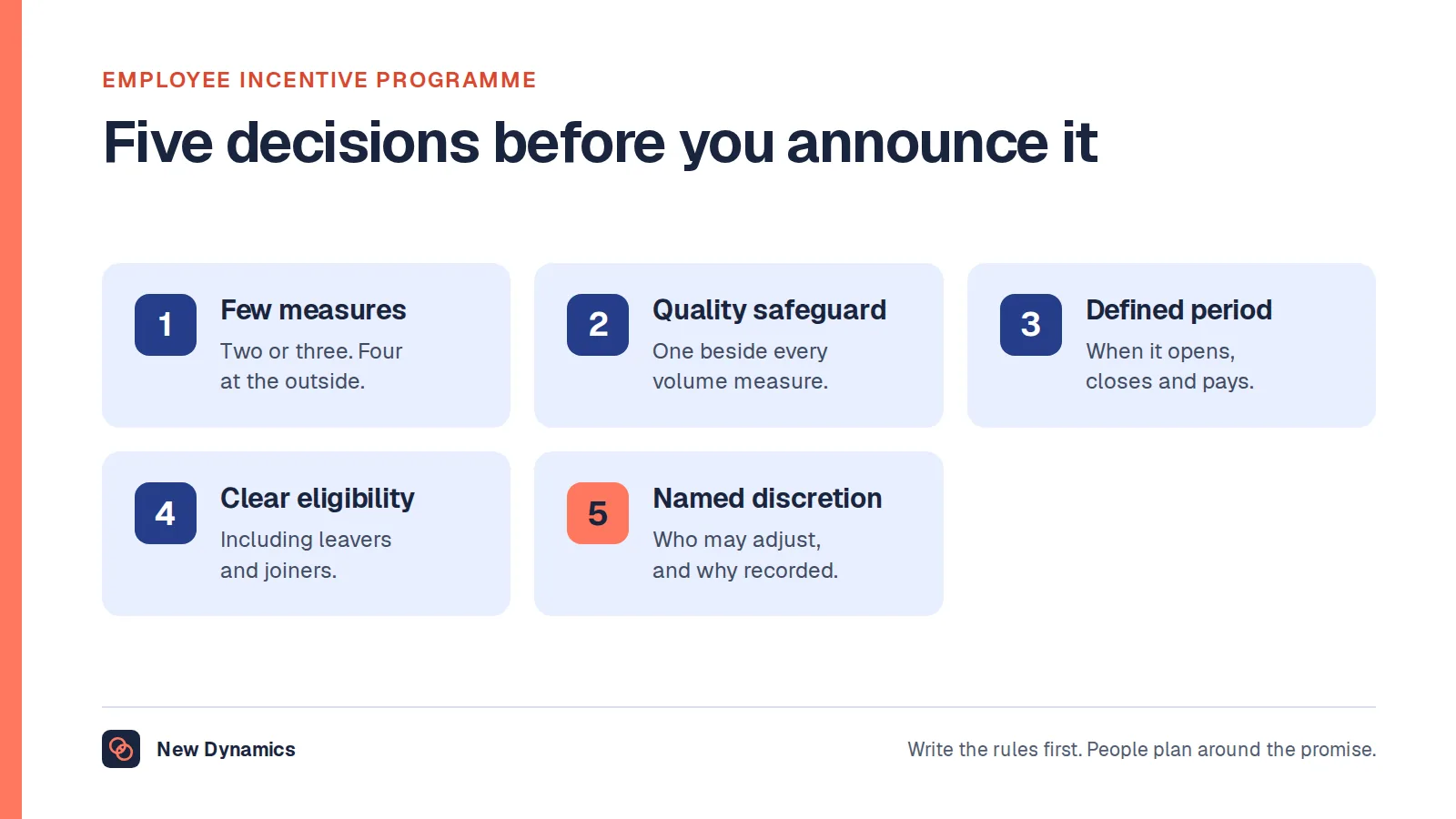
The second is behavioural. An individual sales target on a shared shop floor changes behaviour in ways you did not ask for: the easy customers get competed over, the awkward ones get avoided, people get sold the extended warranty they do not need, and colleagues stop covering for each other at the exact moment cover matters. Returns and complaints are the places this shows up, usually a month after the sales figure that pleased everyone.
If you use an incentive, make it something the team can win together, weight service and accuracy alongside sales, and watch the return rate as closely as the sales line. Our post on employee incentive programmes sets out the design choices, and employee recognition ideas covers the much cheaper non-financial options that work well on a shop floor.
Measuring the role fairly
Individual sales figures are a poor sole measure here, for reasons that have nothing to do with effort. Footfall is set by the location, the weather and the marketing calendar. The range and the promotion are set by head office. Several people touch one customer visit. The person on the quiet section on a wet Tuesday cannot out-sell the person on the busy section on the Saturday before Christmas, and ranking them against each other teaches everybody that the measure is noise.
Use a small set of measures together, and be explicit that no single one decides anything.
- Customer-reported service. Named feedback, survey comments and complaints. Thin on its own, useful in a pattern over months.
- Observed service. A supervisor watching real interactions against the four probation tests above. This is the measure with the most signal and the least data, which is why it has to be scheduled rather than hoped for.
- Accuracy and compliance. Till variances, refund errors, age-check performance. Objective, individual, and genuinely within the person's control.
- Standards on their section. Availability, pricing accuracy, presentation at handover.
- Sales as a team measure. Store or department takings, items per transaction, conversion, with the individual figure used for coaching conversations and not for ranking.
Normalise anything that depends on hours worked before you compare two people, or part-time staff will look worse at everything. And separate the two questions a figure can answer: whether the store is trading well, and whether this person is doing the job well. The first is a business question, the second is a management one, and a single sales number answers neither cleanly.

Development, progression and why people stay
There is a real ladder in retail, and it is one of the more open routes into management: assistant, keyholder or senior assistant, supervisor or team leader, assistant manager, store manager, then area management or a head office function such as buying, merchandising or HR. Our store manager job description post shows what the job three or four steps up actually involves, and career pathing covers how to map the route so people can see it.
Development in this role is cheap and mostly neglected. Product training, a session on handling complaints, a day with the buying team, standing in for the supervisor on a quiet shift, a structured apprenticeship for a new entrant. None of it requires a budget line so much as time on the rota, which is the resource managers are least willing to give and the one that most improves retention.
On retention, the pattern is worth stating plainly, because employers reach for pay first. People leave this role over rota predictability and over their manager far more often than over the hourly rate, and both of those are free to fix. Someone who cannot plan their week around their shifts will take a job that lets them, even at the same pay. Someone whose good work was never noticed will leave for the employer who notices. Our post on employee retention covers how to measure whether you have the problem.
Frequently asked questions
What is the sales associate role?
The role is to sell goods or services and look after the customer while doing it, so that someone who arrives with a need leaves having met it and is willing to come back. In the United Kingdom the same job is usually advertised as a sales assistant, retail assistant or shop assistant, and the work does not change with the title.
What are the main job responsibilities of a sales associate?
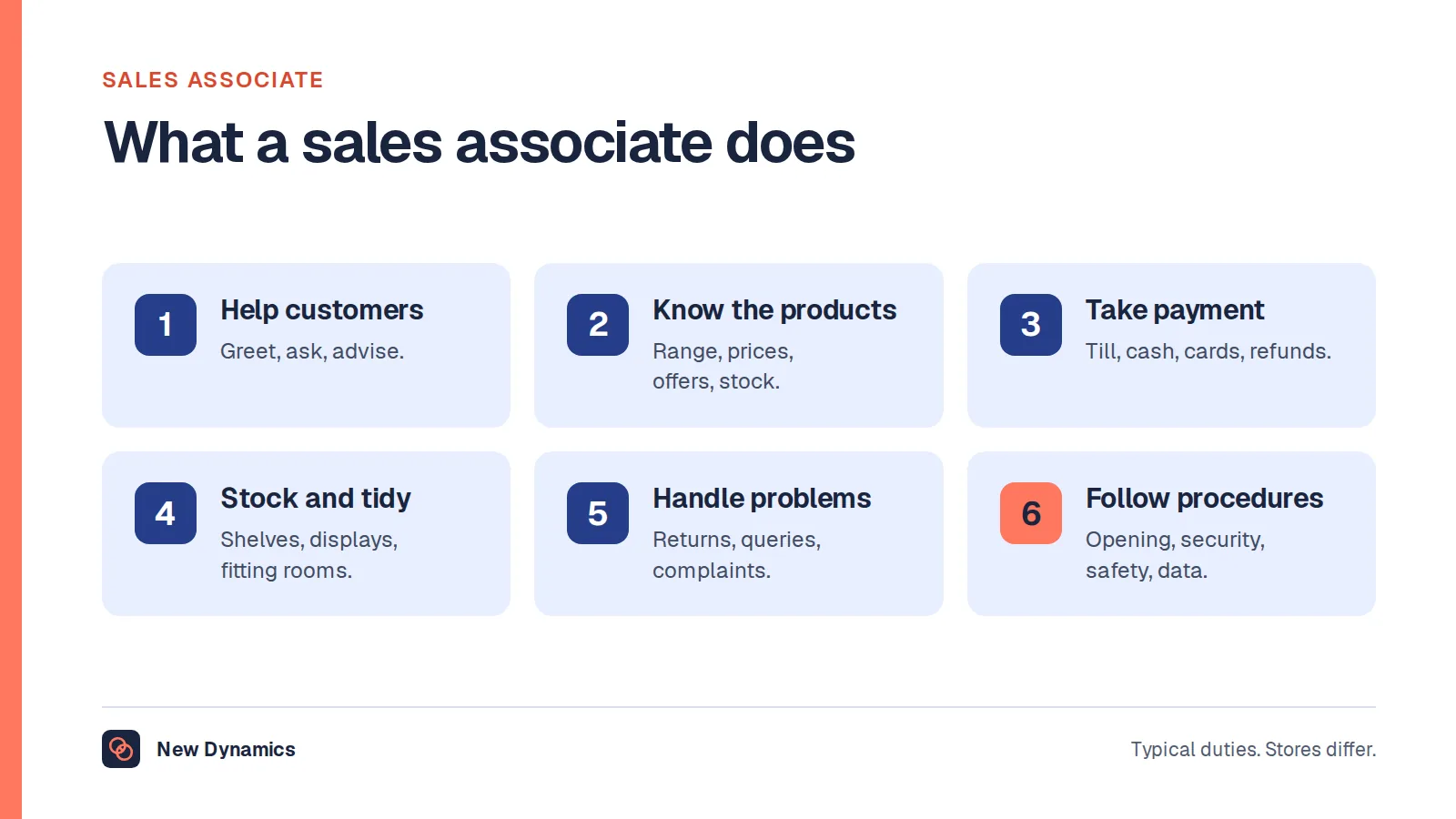
Written as outcomes rather than tasks, there are five: customers get the right product or a clear answer, advice given is accurate and current, transactions and refunds are handled correctly first time, the section is stocked and presentable at handover, and colleagues are covered at busy times. The underlying activities are serving customers, tills, stock, deliveries and store procedures.
What are the job requirements for a sales assistant?
Keep the essential list short: a helpful manner with customers, reliability on an agreed shift pattern, comfort with a till after training, and the ability to meet the physical demands of the role with reasonable adjustments where needed. Retail experience is usually desirable rather than essential, because systems and product knowledge can be taught and warmth cannot.
Are sales assistants entitled to rest breaks?
Yes. GOV.UK states that workers have the right to one uninterrupted 20 minute rest break during their working day, if they work more than 6 hours a day, plus 11 hours rest between working days and either 24 uninterrupted hours off each week or 48 each fortnight. Whether the break is paid depends on the employment contract. This is general information about the United Kingdom rather than legal advice.
Does commission count towards holiday pay?
Where it is regularly paid, yes. Acas lists payments linked to doing tasks required in the contract, for example commission, among the relevant payments that must be included in holiday pay, along with status-related payments and overtime that has been paid regularly during the last year. Check how your holiday pay is calculated if your staff earn commission. Take advice on any specific case.
Should sales assistants have individual sales targets?
On a shared shop floor, rarely as the main measure. The post holder does not control footfall, the promotion or which colleague the customer speaks to, so the figure reflects the shift as much as the person. Use sales as a team measure, keep individual accuracy and observed service measures alongside it, and watch returns whenever you introduce an incentive.
Your next step: write down the three things you have never written down
- Decide how far ahead the rota is published, and then keep to it for a quarter.
- Choose the measures for this role, and say in writing which one does not decide anything on its own.
- Pick one channel that reaches staff with no work email, and move recognition onto it this week.
Retention in a shift-based team is mostly made of those three decisions. For the full method, including how to work out what your turnover is actually costing you and which fixes move it, read and download our employee retention guide. It is free to read, and the PDF uses our short download form.
Want recognition, goals and reviews to reach every shift rather than only the people with an inbox? Book a New Dynamics demo and bring your current rota and review process. You can also email contact@new-dynamics.com.