TL;DR
- Goal tracking software exists to stop goals rotting. One record per goal, one owner, one measure, a current value with a date, and a visible history of every change to it.
- The job is the rhythm, not the dashboard. The software should prompt the goal owner, accept an honest status, record what changed and show leaders where goals have gone quiet.
- Test three things in a demo: change a goal mid-quarter and see what the record keeps, explain where a progress figure came from, and show how a goal reaches a review without becoming the rating.
Most organisations do not have a goal problem in January. They have one in September, when somebody opens the file for the first time since the planning day and finds goals written for a world that has moved on. Half have no owner. A third refer to a project that was cancelled. One says "65% complete" and nobody can say what the other 35% would be.
That is what goal tracking software is for. Not the writing of goals, which is a management conversation, and not the reporting of numbers, which a dashboard already does. The job is narrower and more useful: hold each goal in one place, keep it current, and make it obvious when it has gone quiet.
If you want to see what that looks like in a product, start with New Dynamics Goals & OKRs, which holds objectives, key results and check-ins in one place.
Plainly, so you can discount it as you read: this is a category we sell into. New Dynamics is a performance management platform for goals, feedback, recognition, reviews and onboarding. The rest of this page is written on the assumption that you may well buy elsewhere, or build it from what you already have, and it will not name, rank or price any product, including ours.
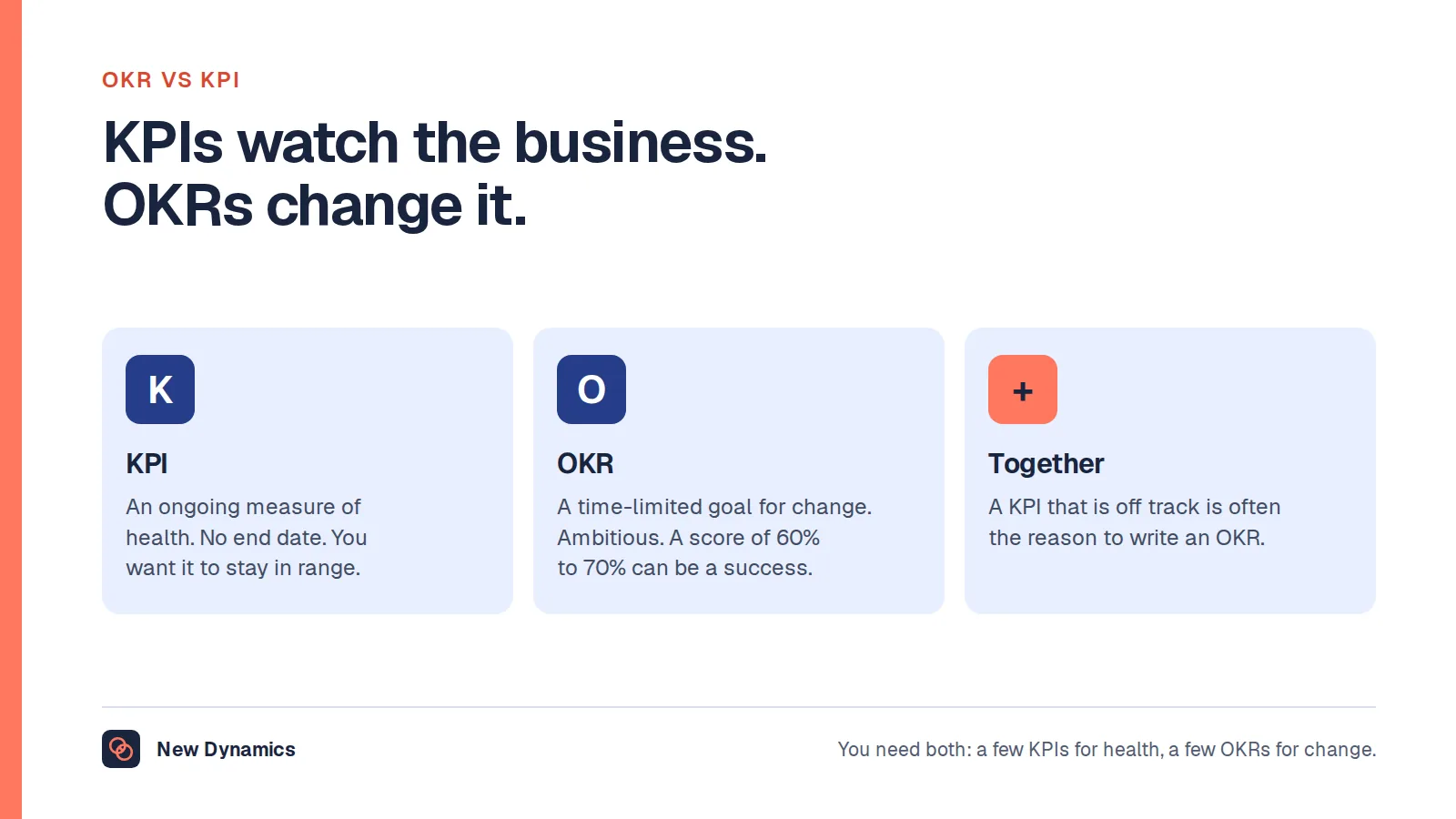
Two companion posts cover ground this one deliberately leaves alone. OKR vs KPI is the vocabulary: what an objective, a key result and an indicator each are, and when to use which. KPI tracker is the measure and the dashboard: how to define a number, baseline it and review it. This post is about the software that holds the goals and keeps them alive between the day they are set and the day they are judged.
Why goals rot
Goal rot is not a motivation problem. It is a records problem, and it happens the same way almost everywhere.
The record is a copy. Goals are agreed in a conversation, typed into a form, then copied into a slide for a leadership meeting and a spreadsheet for HR. Within weeks there are three versions and no way to tell which is current. Everyone stops trusting all three.
Nobody owns the goal, only the work. A goal written as "improve onboarding" belongs to a team, which means it belongs to nobody. There is no single person whose job it is to say, this month, where it stands.
The measure was never defined. "Better customer satisfaction" cannot be updated, because no two people would calculate it the same way. A goal that cannot be measured can only be described, and descriptions drift towards optimism.
Nothing prompts anyone. The goal sits in a system that waits to be visited. People visit systems that chase them, which is why the review cycle gets attention and the goal does not. Our post on chasing performance reviews covers what prompting actually does to completion.
Changing a goal feels like cheating. Priorities move in March. The goal does not, because editing it looks like moving the goalposts, so people quietly ignore it instead. An abandoned goal is worse than an amended one, and the software is usually what makes amendment feel illegitimate. We set out the legitimate reasons to change one in goal reviews: keeping, changing and abandoning goals mid-cycle.
The goal outlives its reason. The thing it was written to fix got fixed, or stopped mattering. Nobody has permission to close it, so it sits at 40% until December and teaches everyone that the exercise is theatre.

What software adds to a goal, and what it does not
A spreadsheet with one row per goal is goal tracking software. It is worth being honest about that, because plenty of organisations of fewer than fifty people need nothing more, and a well-kept sheet beats an ignored platform every time.
A dedicated tool starts to earn its place when one of these is true.
- More than a handful of people need to update goals at the same time, and version conflicts have started.
- You want each person to see their own goals without seeing everyone's, which a shared sheet handles badly.
- You need the history: what the goal said in April, who changed it, and why.
- You want prompts to go out without somebody remembering to send them.
- Leaders want to see which goals have gone quiet, not only which are red.
- Goals have to reach the review cycle as evidence, rather than being retyped into a form.
- Someone will ask, in two years, what was agreed and what happened.
What software does not do is fix a vague goal. If the objective is unclear, the tool will hold the unclear objective faithfully, prompt people about it every fortnight and produce a tidy chart of nothing. Write the goal properly first: our SMART goal template and performance goals examples are for that part, and the goal-setting conversation is where a goal becomes real.
One record per goal: the fields that matter
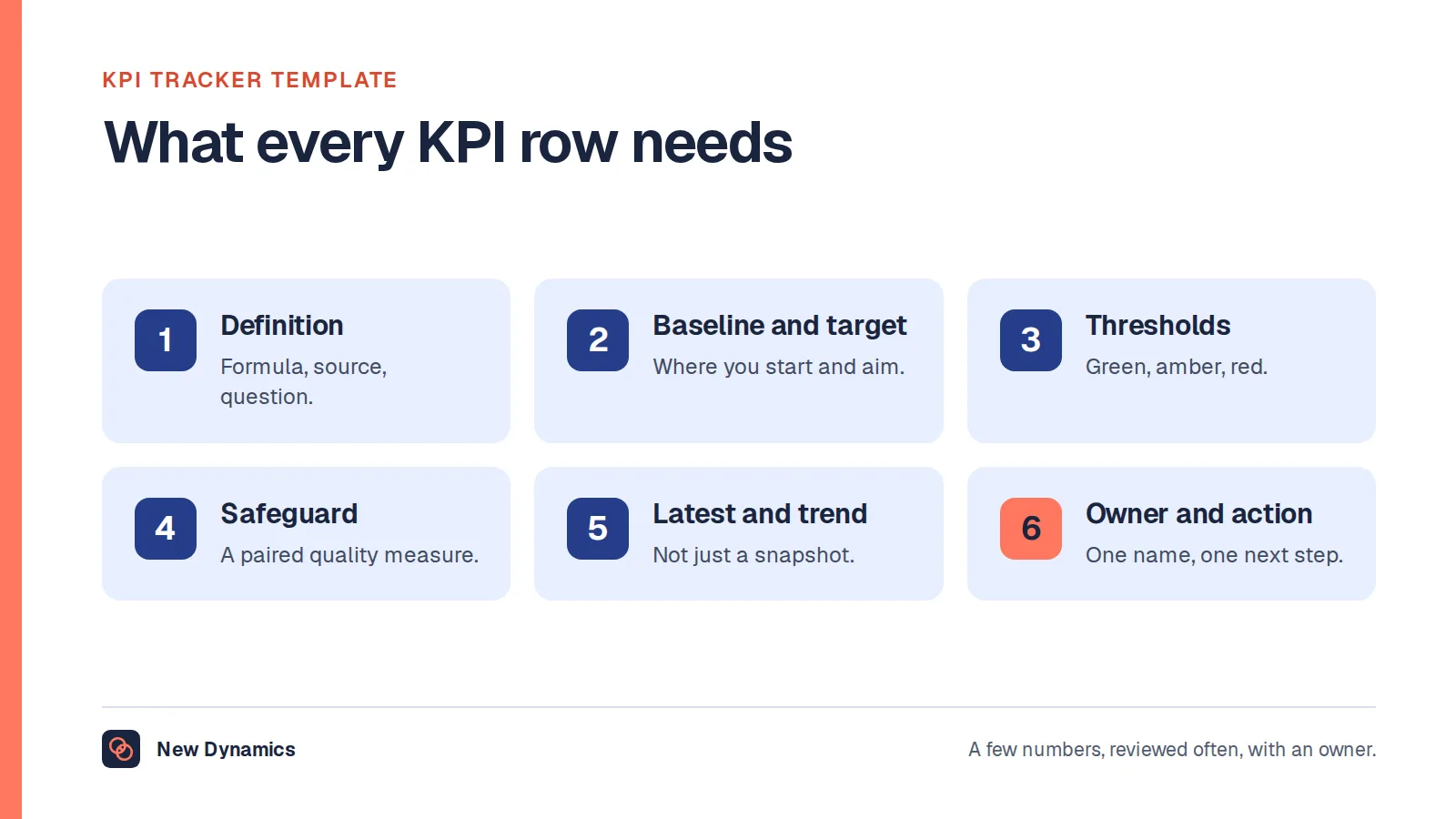
The single most valuable thing an objective tracking system does is be the only place the goal lives. Everything else follows from that. Here is the record a goal needs. The figures are examples.
| Field | Example |
|---|---|
| Goal | Cut median time to first response from six working hours to two |
| Type | Key result, under the objective "make it effortless to get help" |
| Owner | One named person, not a team |
| Period | 1 October to 31 December |
| Measure and definition | Median working hours from ticket creation to first human reply |
| Where the number comes from | Helpdesk report, excluding automated replies |
| Baseline | 6.0 hours, average of July to September |
| Current value and date | 4.2 hours, taken on 5 November |
| Status | At risk, set by the owner at the last check-in |
| Last check-in | 5 November, with two sentences of commentary |
| Visible to | The owner, their manager, the team, anyone the owner shares it with |
| History | Every change to the target, measure, owner or period, with who and when |
Three of those fields do most of the work.
The owner. One name. A goal with two owners has none, and a goal owned by a department is a report, not a goal. Ownership here means who answers the question "where is it", not who does all the work.
The current value with its date. Not a percentage. The actual number and the day it was taken. A reader can judge "4.2 hours on 5 November" for themselves. "68%" they can only accept or dismiss.
The history. This is the field most spreadsheets lose and most buyers forget to ask about. If a target moved from 90% to 80% in week nine, the record should say so, who decided it and why. Keeping the change visible is what makes changing a goal honest rather than furtive.

Tracking progress against tracking activity
This is the distinction that decides whether anyone believes the system.
Progress is movement in the measure. The median response time was six hours, it is now 4.2, the target is two. That is progress whether anyone was busy or not.
Activity is evidence of effort. Fourteen workshops held, 300 tickets reviewed, 22 tasks ticked off. Activity is useful context in a check-in and it is not progress. A goal tracker that fills up with activity tends to produce a comfortable feeling and a flat measure, because the hard question is never asked: did any of that move the number?
Two practical rules keep them apart.
- The progress field only accepts the measure. Tasks, notes and updates live in the commentary, not in the number.
- Never infer progress from task completion. A goal that is 80% of the way through its task list can be 0% of the way to its outcome. If a tool calculates progress from tasks ticked, it is tracking activity and labelling it progress.
There is also a boundary worth naming. Once a system starts collecting detailed records of what individuals did, minute by minute, it stops being goal tracking and becomes monitoring. In the United Kingdom, the Information Commissioner's Office defines monitoring workers as "any form of monitoring of people who carry out work on your behalf", and says employers "must document why you are monitoring workers and what you intend to do with the information you collect" and "must make sure workers are aware of how and what personal information you are collecting during any monitoring". A goal record with a measure, a status and a check-in note does not look like monitoring. An activity feed that logs keystrokes or screen time is a different thing with different obligations, and your data protection lead should be in the room before you buy it. This is general information about UK data protection practice and not legal advice.
Percentage complete, and what to show instead
Ask three people in a goal review what the 65% on screen means and you will usually get three answers: 65% of the way to the target, 65% of the time elapsed, or 65% of the tasks done. Sometimes it is an average of other percentages, each of which was already a guess.
A percentage is fine when the goal is genuinely countable: 180 of 300 managers trained is 60% and everyone can check it. It is misleading when the underlying measure is a rate, a score or a ratio, because a move from 6.0 hours to 4.2 against a target of 2.0 is 45% of the distance, which feels nothing like 45% of the work.
So show two things instead.
The current value against the baseline and the target. Three numbers and a date. No arithmetic that needs explaining.
A status the owner sets by hand. Three options are enough: on track, at risk, off track. People searching for software that shows which goals are on track are usually looking for exactly this, and the value of it depends entirely on whether "at risk" is safe to say. If amber draws a meeting invitation and a raised eyebrow, every goal will be green until the week it fails.
If your tool insists on a percentage, make it derive from the measure, not from tasks, and keep the three underlying numbers next to it.
The check-in rhythm, and who gets prompted
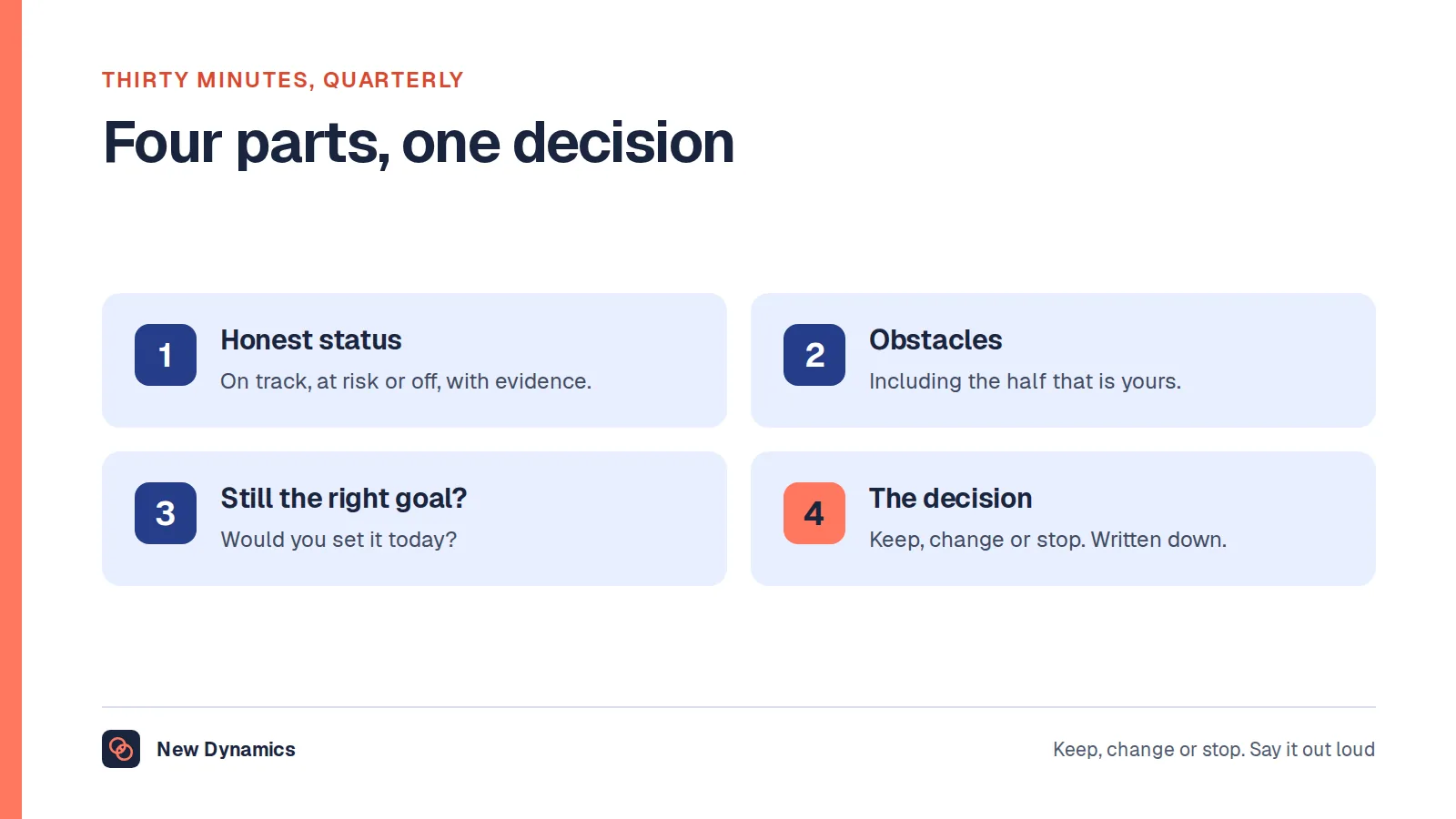
A goal reviewed only at the end of its period was never tracked. The rhythm is the product.
Cadence. Monthly suits most goals. Fortnightly suits quarterly key results with fast-moving measures. Weekly is usually a project stand-up wearing a goal's clothes. Pick one rhythm for the organisation rather than letting each team choose, because mixed cadences make the roll-up meaningless.
Who is prompted matters more than how often. Prompt the goal owner, by name, with the goal in the message and a link that opens the record. Do not prompt managers to chase, at least not first. A system whose main output is a list of overdue items for managers to pursue has moved the work onto the person least able to update the number.
What a check-in should write to the record. Four things, in under two minutes: the current value, the status, one or two sentences on what changed, and anything the owner needs from someone else. Acas, whose performance management guidance applies to employers in England, Wales and Scotland, says managers should "still talk to employees informally about their performance on a regular basis", for example through "sharing regular feedback, coaching, regular check-ins, sometimes known as one-to-ones", and that "it's important to keep a written record of what is discussed". The check-in is where the goal record and that conversation meet. Acas also notes that objectives "should be fair and reflect the employee's usual tasks and workload", which is a useful test when a goal has drifted from the job someone actually does. Acas guidance covers England, Wales and Scotland, so check the position separately for Northern Ireland. It is general information, not legal advice.
Silence is data. The most useful report in a goal tracker is not the red list. It is the list of goals that have not been updated in six weeks. Those are the ones that have quietly stopped mattering, and each needs a decision: keep, change or close.

Alignment without a cascade nobody believes
Every goal management tool offers alignment. Most offer it as a tree: company objective at the top, then divisions, then teams, then individuals, each neatly beneath its parent.
The tree is usually built once, for a board paper, and never touched again. It breaks for ordinary reasons. Real goals contribute to two or three things at once. Some of the most valuable work supports no company objective at all, because it keeps the lights on. People who report to more than one manager do not fit a single branch, which is why multi-manager reviews exist as a separate problem. And a tree implies arithmetic that does not hold: a parent objective is not the sum of its children.
What alignment should mean in the software is modest and achievable.
- A goal can link to one or two parents, and can honestly link to none.
- The link says "contributes to", not "rolls up into". No percentage flows upward.
- From any company objective you can see which goals claim to support it, who owns them and when each was last updated.
- Changing a parent does not silently rewrite its children, but it should flag them for review.
That is enough for the question leaders actually ask, which is not "what is the aggregate score" but "who is working on this, and is it moving". Our post on cascading goals covers how to do the translation between levels without the mechanical cascade, and team goals examples shows what the team layer looks like when it is written well.
How goals meet the review cycle without becoming the review
Goals and reviews need each other and should not be welded together.
The useful connection is evidence. When a review opens, the goals from that period should already be in the form: what was agreed, what the measure says now, what changed mid-period and why, and the check-in notes as they were written at the time. That removes the worst part of review writing, which is reconstructing nine months from memory, and it removes the temptation to rewrite history in the light of how things turned out. Connected reviews are the point of keeping performance reviews in the same place as the goals.
The connection to avoid is arithmetic. A rating calculated from goal attainment produces three predictable effects: goals get set low, stretch disappears, and mid-period changes become a negotiation about next year's rating rather than about the work. Keep the grade a human judgement that cites the goal data, with the manager able to say in writing that a goal was missed for reasons outside the owner's control, or achieved in a way that cost more than it was worth. We cover the pay question in OKR vs KPI, and the wider cycle in choosing a performance management system.
Three settings to check in any product:
- Can a goal be marked "withdrawn, with reason" and still appear in the review as context rather than as a failure?
- Does the review form pull the goal record, or does it make people retype it?
- Can a reviewer see the history of the goal, not only its final state?
What is actually published, and what is not
A note on numbers, because this subject attracts invented ones.
You will see confident claims that a specific percentage of goals fail, or that only a certain share of employees can name their company's objectives. We do not repeat them. Those figures circulate widely without a traceable, dated source behind them, and a number you cannot check is worse than no number.
What is published, officially, is thinner and more honest. The Office for National Statistics reports on structured management practices in its bulletin Management practices in the UK: 2016 to 2023, released on 13 May 2024 and drawn from the Management and Expectations Survey. The survey covers firms with 10 or more employees in production and services industries, excluding agriculture, financial services and the public sector, across the UK for 2023 and Great Britain for the earlier waves. Scoring practices from 0 to 1, where a firm needs to "continuously review their processes" to score 1, the 2023 results were that "continuous improvement continued to have the highest mean score at 0.80, but this was a slight fall on 2020 (0.82)", while "use of key performance indicators (KPIs) scored the lowest at 0.42". That KPI category covers the number of indicators a firm tracks and how often they are reviewed.
That is not a statement about goal software. It is the nearest official UK evidence that the weakest link in British management practice is the tracking, not the setting. If you want the wider picture, our HR statistics hub collects what official sources publish, and goal setting statistics covers this particular question in more detail, including the claims we could not source.
What to look for in a demo
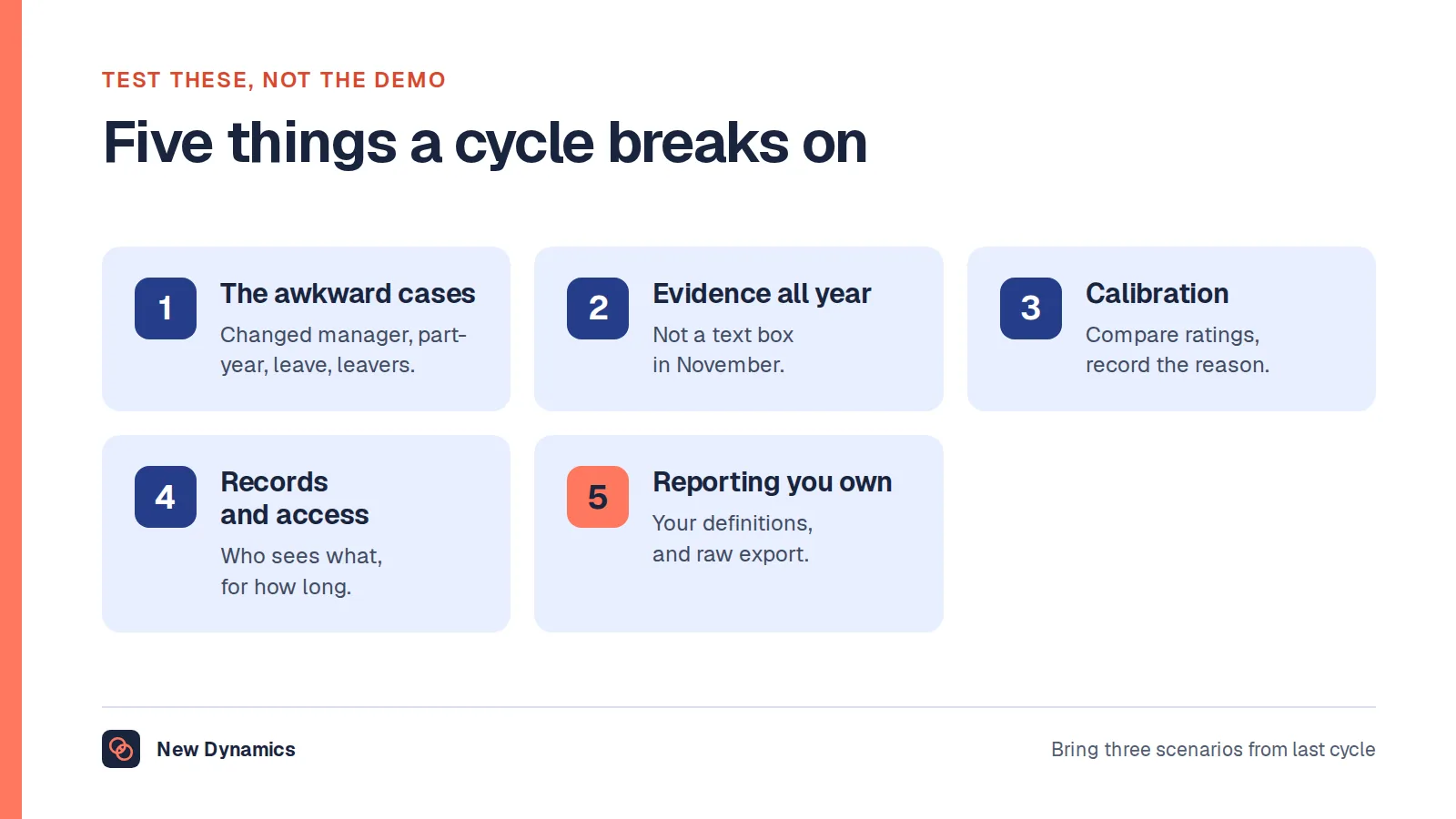
Feature lists will not separate these products. Scenarios will. Ask every supplier to run the same ones, on screen, with data that looks like yours, and watch what the record holds afterwards.
- Create a goal with a measure that is a ratio, not a count. Show the baseline, the target, the current value and the date.
- Update it as the owner would, from the prompt, on a phone. Count the clicks and the seconds.
- Change the target mid-quarter, for a good reason. Show what the record keeps: the old target, the new one, who changed it, when and why. Then show what the review will see.
- Mark one at risk and show exactly who finds out and how.
- Close a goal that has stopped mattering, with a reason, and show how it appears at the end of the period.
- Explain a progress figure. Point at any percentage on the screen and ask what it is a percentage of.
- Show the quiet list: goals not updated in six weeks, by team.
- Link a goal to two parents, then to none, and show both are allowed.
- Move a person to a different manager mid-period and show what happens to their goals, their history and the visibility.
- Export everything, including the history, in a format you can read without the product.
Our performance management software RFP template turns this kind of question set into something you can send to several suppliers at once, and choosing HR software covers running the selection without a feature-count spreadsheet.
Failure modes to test for
Each of these is a real pattern, and each is visible in a demo if you look for it.
Goals that cannot be changed mid-quarter. A system that locks goals after approval forces the whole organisation to lie for nine months. Reality moves. The record should move with it and remember that it did.
A tree diagram built once for a board paper. Beautiful on the slide, stale by February. Check when the alignment was last touched, not whether the diagram exists.
A percentage nobody can explain. If the number is an average of averages, or derived from a task list, it will be quoted in a leadership meeting and it will be wrong.
Activity presented as progress. A busy update feed with a motionless measure. Ask to see the measure's history on its own.
Prompts that go to managers first. The owner is the person who knows the number. Prompting the manager to chase the owner adds a step and moves the burden.
A goal with no owner, or two. Shared ownership sounds collaborative and reliably produces an unanswered goal.
Manual data entry nobody will do. If the current value has to be looked up in another system every fortnight, it will be updated twice and then estimated.
An archive that loses the history. Some tools roll goals over at period end and overwrite the detail. The next cycle's planning needs last cycle's reality.
A dashboard only leaders can see. If the people who own the goals cannot see where they stand without asking, the software is a reporting tool, not a goal tracker.
Status options that are not safe to use. Amber has to be usable without consequence, or every goal is green until it is a crisis.
No rankings here
Many searches that reach a page like this one want a ranked list: the best OKR software, the top goal trackers, five tools compared on price. This site does not publish those, and will not name, rank, compare or price any product in this category, ours included. The reasons are set out in why we do not publish a top 5 HRIS list: rankings are often shaped by commercial relationships a reader cannot see, and even an honest one cannot know your size, your cadence, your reporting lines or what your last attempt at goals did to people's trust.
What we can offer is the test above. Run your own scenarios against three products, including the one you already pay for, and buy the one whose record you would still trust in September.
Frequently asked questions
What is goal tracking software?
Goal tracking software holds each goal in one place, with a named owner, a defined measure, a current value and the date it was taken, a status set by the owner, and a history of every change. It prompts the owner to check in on a fixed rhythm and shows which goals have gone quiet. It is not the same as a dashboard, which displays numbers but does not record ownership, commentary or decisions.
What is the difference between a goal tracker and a KPI dashboard?
A dashboard shows measures, usually automatically. A goal tracker holds a commitment: this measure, moving from here to there, by this date, owned by this person. The same number can appear in both. In the dashboard you are watching it. In the goal tracker someone has promised to move it, and the record keeps the promise, the check-ins and any changes to it.
How often should goals be updated in the software?
Monthly suits most goals, and fortnightly suits quarterly key results whose measures move quickly. Pick one rhythm for the whole organisation so the roll-up means something. More useful than frequency is the report of goals not updated for six weeks, because each of those needs a decision to keep, change or close it.
Can goals be changed mid-quarter?
Yes, and software that prevents it causes more harm than it avoids. Priorities move, dependencies slip and scopes turn out to be wrong. What matters is that the change is recorded: the old target, the new one, who decided and why, visible at review time. A quiet edit in week ten is moving the goalposts. A dated, reasoned amendment is management.
Should goal scores feed the performance review or pay?
Goal data should feed the review as evidence, not as arithmetic. A rating calculated from attainment teaches people to set goals they are certain to hit, and makes every mid-period change a negotiation about pay rather than about the work. Let the manager cite the goals, the measures and the context, and keep the judgement human.
Do we need goal tracking software, or will a spreadsheet do?
A spreadsheet is enough while few people update it, nobody needs private goals and no one will ask what changed. Move to a dedicated tool when version conflicts start, when you need prompts to go out without someone remembering, when the history matters, or when goals have to reach the review cycle without being retyped.
Your next step: audit the goals you already have
- Open the file where your current goals live. Count how many have a named owner, a defined measure and a value updated in the last six weeks.
- For every goal that fails that test, decide now: keep it, change it with a written reason, or close it.
- Write down the check-in rhythm you will actually keep, and who gets prompted first.
- Take the ten demo scenarios above to whatever you are considering, including the spreadsheet.
For the method behind objectives, key results and check-ins, read and download our OKR guide. The guide is free to read, and the PDF uses our short download form. For worked examples by team, see the OKR examples library.
If you want to see goals, check-ins and the review cycle in one place, book a New Dynamics demo and bring the goals you set last quarter. You can also email contact@new-dynamics.com.