TL;DR
- A picker turns an order into a physical collection of items. Read the pick, travel to the location, check the code, count, handle the goods, confirm and move on, a few hundred times a shift. The National Careers Service lists warehouse picker as an alternative title for warehouse worker, and publishes pay for that job as £21,000 for a starter to £30,000 for someone experienced, with typical hours of 40 to 48 a week.
- The picking method changes the job more than the title does. A paper list, a handheld scanner, a voice headset and pick to light each move the reading, the hands and the pace around, and each one changes what a rate target is really measuring.
- Safety is the part of this job description that earns its place. HSE tells employers in Great Britain to “change the work routine to avoid excessive work rates and tight deadlines”, and its latest sector report puts the non-fatal injury rate in transportation and storage statistically significantly above the all industry average. General information, not legal advice.
A picker's job looks simple from the office. Someone reads a line, walks to a location, takes four of something and puts it in a tote. Repeat.
What that hides is the volume of decisions. Over a shift a picker makes a few hundred to a few thousand small judgements, each of which can go wrong expensively later: the wrong variant of a nearly identical code, a short pick recorded as complete, a heavy item on a crushable one. The job is accuracy under pace, done by a body that still has to work at the end of the week.
This article sets out the warehouse picker role as an employer needs to write it: the shift, the four ways a pick gets issued, why rate targets misfire, the picker packer combination, pay, the injury figures, the safety duties, a template you can paste, and where picking leads.
The document and the measure usually drift apart within a month of hiring: the advert talks about teamwork and the scoreboard counts lines per hour. See how New Dynamics performance reviews keep the job description, the measures and the review conversation pointing at the same job.
If you are writing the broader warehouse role, our warehouse worker job description covers receiving, put away, dispatch and stock records. This article goes one level down, into the picking.
What a warehouse picker actually does across a shift
The National Careers Service, the government's careers service in England, publishes no separate profile for a picker. It lists "warehouse operative, warehouse picker" as alternative titles for warehouse worker, and sums that job up in a line: "Warehouse workers load and unload deliveries, move goods to storage areas and pack orders for dispatch." In a large operation those are three jobs in three parts of the building, and picking is the middle one.
Underneath the title sits one repeating loop. A pick is issued, the picker travels to the location, confirms the item is the right one, counts, lifts or slides it into a tote, cage, carton or pallet, confirms the pick, and is given the next one. Everything else is preparation for that loop or an interruption to it.
Start of shift. The briefing, logging into a device or headset, collecting a trolley or a low level order picker, and the pre-use check on equipment. Which wave goes first, which cut-off is tightest, which aisle is blocked.
The picking loop. Most pickers work to a wave, a batch or a route the system has sequenced. A good pick path saves miles of walking; a bad one is the largest hidden cost in a pick area.
Problem picks and replenishment. The pick face is empty but the system says there is stock, the barcode will not scan, the location holds something other than its label. Handling these well is what separates an experienced picker from a fast one.
The rate and the cut-off. Pickers work against a dispatch cut-off rather than a clock, which changes the last hour. How breaks sit inside the rate calculation, and whether the final wave is absorbed or handed over, are facts a candidate should have.
Handover and housekeeping. Clearing the aisle, returning empty pallets and cages, flagging locations for a count, and telling the next shift what is unfinished.

For an American task list, O*NET OnLine, published by the United States Department of Labor, maps the role to Stockers and Order Fillers, code 53-7065.00, updated 2026, names "Order Picker" and "Order Filler" among the reported job titles, and lists tasks including "Obtain merchandise from bins or shelves". American data, so a checklist rather than a British job description.
Four ways a pick gets issued, and what each changes for the person
The method decides what the work feels like and which people the job suits, so it deserves a line in the advert.
Paper pick list
A printed list of locations, codes and quantities. Cheap, works when the network is down, still common in small and seasonal operations. Nothing confirms the pick was right, so errors surface later and elsewhere.
Handheld scanner
A radio frequency device directs the picker, who scans the location and the item to confirm. The most common arrangement in UK distribution. The pick is validated as it happens, catching a wrong code before it leaves the aisle, and new starters learn it quickly because the device tells them where to go.
Pick by voice
The picker wears a headset. The system speaks the location, the picker speaks a check digit and the quantity back, so both hands and both eyes stay on the goods. The cost is a quieter fatigue, because the person listens and speaks continuously all shift, and it is worth asking whether the system copes with the accents and first languages on your shifts.
Pick to light
Lights and displays on the pick face show the location and quantity, and the picker presses to confirm. Normally used at a fixed station or a batch area. Travel largely disappears and the work becomes stationary and repetitive, trading walking for the risk factors of repeated upper limb movement.

Batch picking and goods to person change the job as much as the method does, so name them if they apply.
Pick rates: how they are measured, and the problem with the target
Every picking operation measures something. The usual units are lines (or picks), units, cases and pallets per hour, and most warehouse systems calculate them from the confirmations the picker makes. Accuracy is measured separately, through audits before dispatch, shortage claims and returns.
The first honest point: we are not aware of an official UK source that publishes a typical or expected pick rate, in any unit, so we are not going to borrow a number and present it as a benchmark. A rate that is routine in a chilled case operation is impossible in a slow moving parts store full of near identical codes.
The second is that a rate target is a health and safety decision as well as a productivity one. HSE's guidance on how to reduce the risk of injury from manual handling lists, among the things an employer can do, "change the work routine to avoid excessive work rates and tight deadlines", alongside "modify the workplace to reduce carrying distances, twisting movements, or the need to lift things from floor level or above shoulder height". A rate set without reference to the load, the travel or the height of the pick is the work routine that guidance is asking you to change.

- Say which unit, and band it by area rather than by person. Lines per hour and units per hour reward completely different behaviour, and a bulk case aisle, a split case shelf and a hazardous goods cage are three different jobs. One site wide number flatters some people and punishes others.
- Publish the ramp. Say what is expected in week one, week four and week twelve. A missing ramp is the commonest reason a picker leaves in the first month.
- Take problem picks out of the denominator. Time on a blocked location or a failed scan is time the picker did not choose.
- Keep accuracy separate, and explain the calculation. HSE's advice on assessment applies here: "consult and involve your workforce", because "operators can often tell you which activities are unpopular, difficult or hard work".
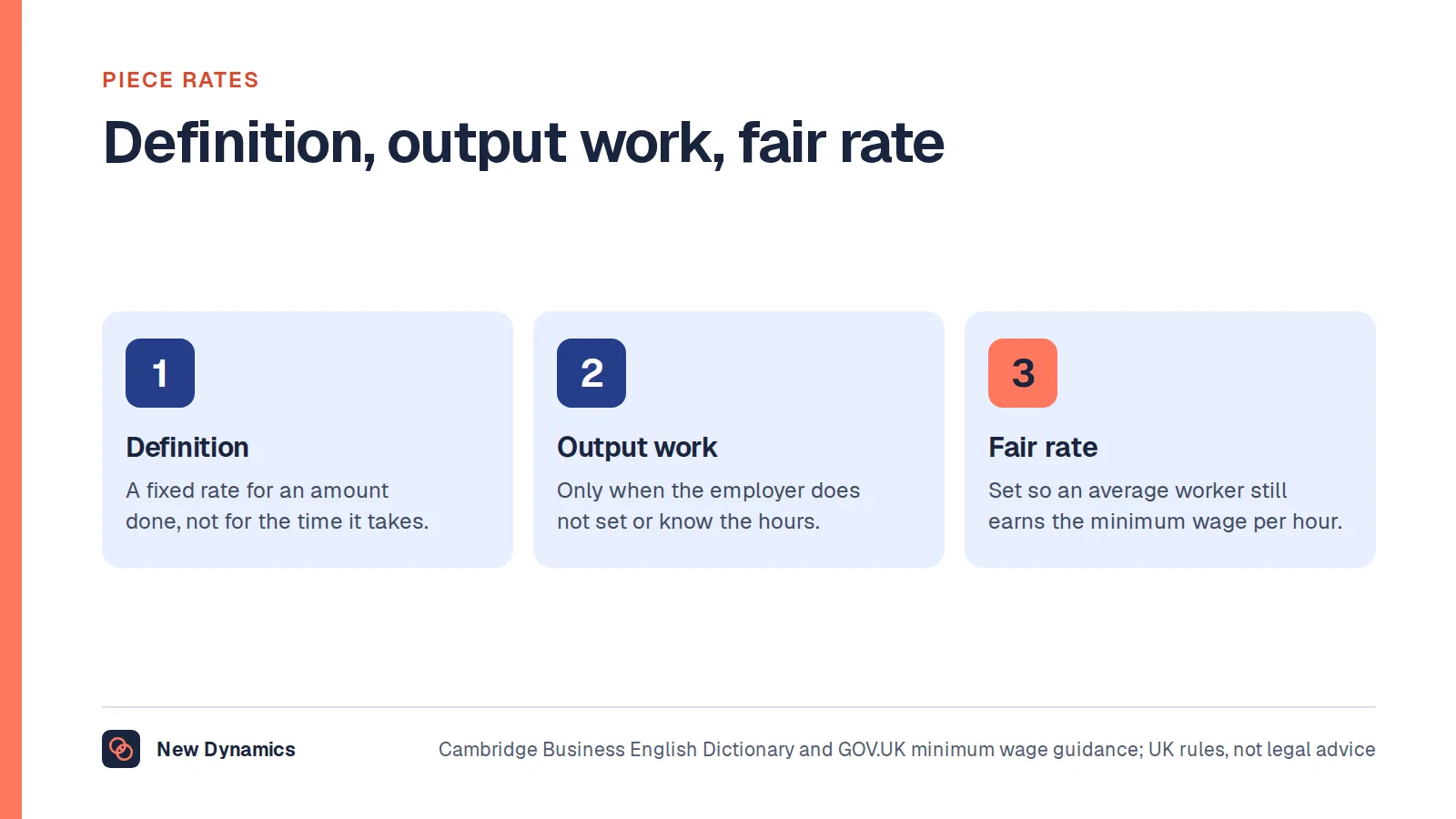
If pay depends on output rather than hours, our guide to piece rate pay covers that separate set of rules. For targets that survive a review, see performance goals examples.
Picker, packer, and the picker packer combination
"Picker packer" is a real advert title and a real job, not a clumsy way of saying picker. The National Careers Service publishes a separate packer profile, with "order packer, food packaging worker, bottler" as alternative titles, whose tasks include "pick and pack items listed on customer order sheets" and "use hand-held scanners to track stock".
The halves ask for different things. Picking is travel, searching and identification under pace. Packing is stationary, repetitive, and judged on whether the parcel survives the journey and matches the order. Combining them suits a smaller operation or an order profile of a few lines each, and stops suiting you where packing needs a specialist step such as temperature control, dangerous goods or a serial number record.
If the post does both, write both in: how the shift splits, whether the person moves between them by rota, and the packing standards they will be held to.
What official sources publish about pay and hours
Candidates search for pay first, and it is easy to publish a number you cannot support. Here is what is published in the United Kingdom.
The National Careers Service profile for warehouse worker, the one that names warehouse picker as an alternative title, gives an average salary of "£21,000 Starter to £30,000 Experienced" and typical hours of "40 to 48 a week", worked "evenings / weekends / bank holidays" and "on shifts". Its sibling profiles put packer at "£23,000 Starter to £28,000 Experienced", forklift driver at "£23,000 Starter to £32,000 Experienced" and warehouse manager at "£25,000 Starter to £42,000 Experienced". The service names no reference period beside those figures, so quote them as what it publishes rather than as current market pay. We opened all four on 5 November 2026.
There is also a legal floor across the United Kingdom. GOV.UK publishes the National Minimum Wage and National Living Wage rates and states that "the rates change on 1 April every year". From April 2026 they are £12.71 an hour for workers aged 21 and over, £10.85 for ages 18 to 20, and £8 for workers under 18 and for apprentices entitled to the apprentice rate, with £13.21, £11.27 and £8.31 published for April 2027. Those are minimums, not market rates, and this is general information about the UK rules named rather than legal advice.
Nobody official publishes an hourly market rate for pickers by region, shift or temperature band, so the honest route to a defensible number is your own payroll and your own acceptance rates. Our HR statistics hub collects the published people figures we do use, with the reference period named for each. Three things matter more to a candidate than the headline: the premium for nights and weekends, whether the temperature band carries an allowance, and whether any pay depends on hitting a rate.
The physical demands, and what the injury figures actually say
Picking is demanding in a specific way: not one heavy lift, but repeated light to moderate ones, with walking, bending and reaching, all to a clock. The National Careers Service describes the environment plainly: "Your working environment may be at height, physically demanding and outdoors some of the time."
For Great Britain, HSE publishes "Transportation and storage statistics in Great Britain, 2025", issued on 20 November 2025 with data up to March 2025. On a Labour Force Survey average over 2022/23 to 2024/25 it records "an estimated 32,000 workers suffering from a work-related musculoskeletal disorder (new or long-standing), 47% of all ill health in this sector", a rate of "around 1.8% of workers" that it calls "statistically significantly higher than that for workers across all industries (1.2%)". On the same basis it reports "an estimated 40,000 workers who reported sustaining a workplace non-fatal injury", "around 2.4%" of workers against "1.8%" across all industries.
One caveat: that sector covers road haulage, ports, courier work and passenger transport as well as warehousing, so none of it is a picker specific figure, and HSE publishes confidence intervals beside these survey estimates.
The safety duties that belong in a picker's job description
Everything below is HSE guidance for Great Britain, meaning England, Scotland and Wales. Northern Ireland has its own arrangements. This is general information rather than legal advice, and no substitute for your own risk assessment.
HSE's short guide Warehousing and storage: Keep it safe (INDG412) names what hurts people here: "The main causes of accidents in warehousing and storage are: slips and trips; manual handling; work at height; vehicles in and around the warehouse; and moving or falling objects." A picker meets all five, often in one aisle. A job description that mentions safety only in a closing line wastes the one place where an employer gets to be specific.
Manual handling
HSE's guidance on manual handling at work puts the duty on the employer, in the order avoid, assess, reduce. Its page on assessing manual handling you cannot avoid asks you to consider "the task, the load, the working environment and individual capability", and its examples read like a pick face: "the postures adopted", "the frequency of the task", "cramped work areas" and "poor lighting, extremes of temperature". It also names the warning signs a supervisor should watch for: "workers breathing heavily and sweating", "workers who complain of excessive fatigue", and "reluctance to do a particular task".
On training, HSE puts it in its place: "Training can be important in raising awareness and reducing risk, but it won't ensure safe manual handling on its own". A certificate on an induction checklist is not the control measure; the layout of the pick face, the height of the heavy lines and the weight of the cases are. HSE's sector page on warehousing adds that "lifting and moving by hand is the main cause of reportable accidents in the 'freight by road' industry".
Picking is also repetitive by design. HSE publishes an instrument for that, the Assessment of Repetitive Tasks (ART) tool, which it describes as "designed to help assess repetitive tasks involving the upper limbs" and which "assesses some of the common risk factors in repetitive work that contribute to the development of upper limb disorders".
Pedestrians, lift trucks and traffic routes
A picker spends the shift on foot, or on a low level machine, in a building where counterbalance and reach trucks are working. HSE's introduction to workplace transport safety opens with the consequence: "Every year, there are accidents involving transport in the workplace, some of which result in people being killed." People are "knocked down, run over, or crushed against fixed parts by vehicles (eg HGVs, lift trucks and tractors), plant and trailers", and "your risk assessment must consider all workplace transport activities such as loading and unloading".
HSE's warehousing page states the principle in a sentence: "Every workplace should be organised so that pedestrians and vehicles can circulate safely", adding that "where vehicles and pedestrians use the same traffic route, ideally there should be adequate separation between them". INDG412 sets the hierarchy: "consider the complete separation of vehicles and pedestrians first". The warehousing page also flags the moment that catches picking operations worst, asking that risk assessments "take account of periods where the number of vehicles or pedestrians moving along traffic routes change, eg ... when shifts change", with a control as specific as "stopping lorry movements during shift changes".
That becomes three lines the post holder controls: use the marked routes and crossings, never walk behind a reversing vehicle, and report a blocked or unlit route.
Racking, pallets and work at height
A pick face is the bottom of a system holding tonnes above it. Two of INDG412's instructions are absolute: "never climb on racking unless it is specifically designed for use as access equipment", and "never use pallets on fork-lift trucks for accessing work at height or as working platforms". Climbing the racking to reach the second level is the commonest unsafe act in a pick aisle, and usually a symptom of a pick face replenished late.
The same guide asks employers to "inspect pallets each time before use" and to "protect racking if it is likely to be struck by lift trucks and other vehicles". It sets out three types of inspection: "immediate reporting of damage and defects", "visual inspections at regular intervals", and "'expert' inspections carried out at intervals by a competent person". Where damage affects the safety of the racking, it says to "offload the racking and introduce controls to prevent it being used until remedial work has been carried out". The picker owns the first of the three, so reporting a bent upright belongs in the document as a duty rather than a hope.
Slips, trips and housekeeping
INDG412 is equally firm about the fifth cause, naming the trip hazards a pick aisle generates, "goods, waste packaging, banded strapping loops and pallets", and warning that slips and trips "are often seen as trivial and 'just one of those things'". Clearing the aisle is therefore a safety duty rather than housekeeping, and the document should say so in those words. Our post on workplace safety tips covers the wider habits.
Why we do not publish a named employer's picker job description
Some of the most common searches here ask for the picking job description of one very large operator by name. We are not going to publish one, and the reason is worth stating rather than burying.
We do not hold that employer's internal job description, and we will not write something that reads like it. Adverts from large operators vary by site, shift, season and contract, and they change often. Anything we wrote would be a guess presented as a document.
The reliable source is that employer's own careers page and its live advert for the site you would actually work at. Read the shift pattern, the temperature, the rate expectation and the contract type there, and ask about the ramp for new starters at interview. Everything in this article is the generic role, written from UK official sources, and it is the right basis for comparison.
What a good picking advert says
Most picking adverts fail in the same four places, and all four are cheap to fix.
- The method. Say whether the work is paper, handheld scanner, voice or pick to light, in the first few lines.
- The physical reality. Distance walked, typical and maximum weights, work at height, temperature band and the protective clothing provided. Honesty costs you some applicants and saves the ones who would have left in week two.
- The rate. Say that a rate exists, what unit it is in and how it is calculated. An advert silent on rate is read, correctly, as hiding something.
- The shift, in full. Start and finish, days, rotation, weekend expectations, overtime at peak, and whether the role is permanent, temporary or seasonal. The National Careers Service notes that "some warehouse worker jobs are temporary or seasonal", and our post on what counts as a seasonal job covers the distinction.
Say what training comes in the first week, and name the route out of picking. For the method behind the document, see how to write a job description and our job description template.
Warehouse picker job description template
Replace everything in square brackets. The bracketed numbers are placeholders, not benchmarks: set them from your own operation first.
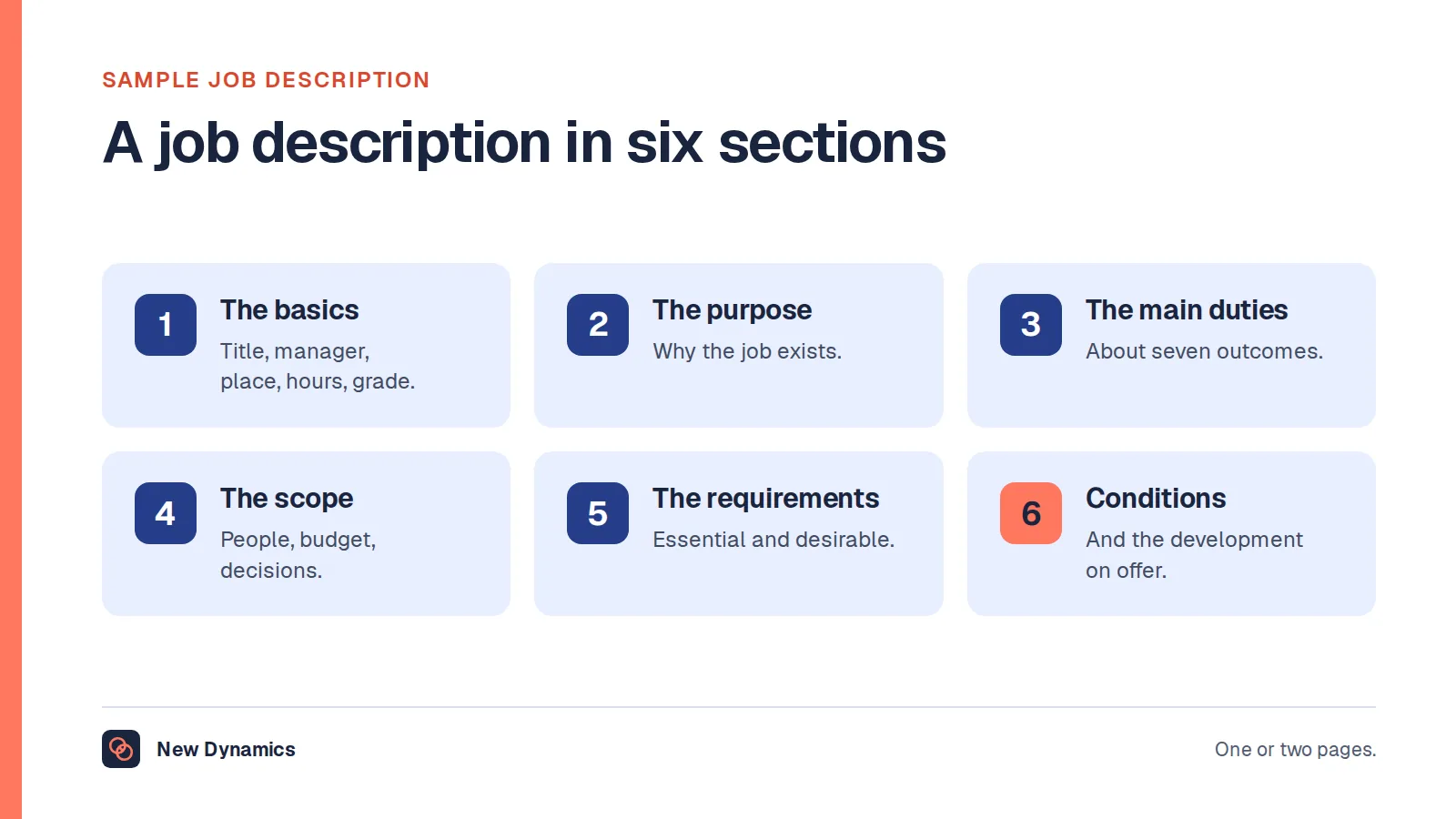
Job title: Warehouse picker [or order picker, picker packer, order assembler]
Reports to: [Pick area team leader or shift supervisor]
Location, shift and environment: [Site]. [Hours] per week, [shift pattern], including [weekends and bank holidays]. [Ambient, chilled or frozen], [temperature], [any work at height]. [Permanent, fixed term or seasonal].
Purpose of the job: To assemble customer orders accurately, safely and in time for the dispatch cut-off, and to report anything that stops that happening.
Main duties
- Pick customer orders from a [paper pick list, handheld scanner, voice headset, pick to light station] in the sequence the system issues.
- Check each item against the code and description before picking it, and count the quantity.
- Record short picks, damaged stock and location discrepancies immediately, rather than completing the line.
- Build totes, cages and pallets so the load is stable and nothing underneath is crushed.
- [Pack, label and seal orders for dispatch to the agreed packing standard.]
- Replenish pick faces [and operate a low level order picker or powered pallet truck after training and authorisation], carrying out pre-use checks and reporting defects.
- Follow manual handling procedures, use the lifting aids provided, and ask for help with any load that should not be handled alone.
- Use marked pedestrian routes and crossings, and keep clear of lift trucks and reversing vehicles.
- Report damage to racking, beams, uprights and pallets immediately, and do not pick from a location you believe to be unsafe.
- Keep aisles clear of packaging, strapping and empty pallets, report hazards and near misses, and take part in stock counts.
How we set and review the pick rate
[We measure (lines, units, cases) per hour, calculated as (method). A new starter is expected to reach (figure) in week one and (figure) by week (number), after which the area rate of (figure) applies. Accuracy is measured separately and never traded for speed. Time on blocked locations and failed scans is excluded, and the rate is reviewed (frequency) with the team.]
Essential: reliable attendance, able to work the shift pattern above, able to work accurately at a steady pace for a full shift after training, careful with codes and labels, able to follow spoken and written instructions in English [to the standard needed to use a voice picking system safely], and willing to report problems rather than work round them.
Desirable: previous picking or packing experience [in a (chilled, frozen, hazardous) environment], experience of [handheld scanning, voice picking, a warehouse management system], or [a current licence for (truck type)].
What we provide: [rate of pay and shift premiums], [breaks], [protective clothing], [induction and manual handling training], [holiday], [the progression route].
Where picking leads
Picking is an entry point rather than a dead end, and saying so in the advert is true and useful. The National Careers Service states for the warehouse worker role that "with experience, you could become a team leader, shift supervisor or warehouse manager", naming quality control and freight planning as other directions.
- Equipment. Lift truck and reach truck work is the usual first step. The service notes it "may help when looking for work if you've done forklift training, though employers will often put you through this once you've completed your probation period".
- Quality and stock. Pick auditing, cycle counting and inventory control reward the accurate rather than the fastest. See the inventory specialist job description, and the shipping and receiving role on the other side of the building.
- Training and leading. Inducting new starters, running a section, or holding the trainer role for the picking method. Our team leader job description sets out what a first supervisory job asks for.
- Planning and coordination. Waves, labour planning and carrier cut-offs. The logistics coordinator role is the usual next document.
In England the formal route is an apprenticeship: the service lists the Supply Chain Warehouse Operative Level 2 Intermediate Apprenticeship for this job, and notes that "apprenticeships take about one year to complete". See also the meaning of entry level and blue collar work.
Frequently asked questions
What does a warehouse picker do?
A warehouse picker assembles customer orders from stock. The loop repeats all shift: a pick is issued, the picker travels to the location, checks the item, counts the quantity, places it in a tote, cage or pallet, confirms the pick and moves on. Around that sit equipment checks, replenishing pick faces, reporting short picks and keeping aisles clear. The National Careers Service lists warehouse picker as an alternative title for warehouse worker.
What is the difference between a picker and a picker packer?
A picker assembles the order and a packer prepares it for dispatch. A picker packer does both, which is common in smaller operations. Picking is travel and identification under pace; packing is stationary and judged on whether the parcel survives the journey and matches the order. A post covering both should say how the shift splits and which packing standards apply.
What is a good pick rate, and how is it measured?
Rates are counted as lines, units, cases or pallets per hour, calculated from the confirmations the picker makes, with accuracy measured separately through audits and returns. There is no single good figure, and we are not aware of an official UK source that publishes a typical pick rate. A rate copied from another operation means nothing, because the load, the travel distance and the pick height change everything.
Is picking a dangerous job?
The risks are real, known and manageable. HSE names the main causes of accidents in warehousing and storage as slips and trips, manual handling, work at height, vehicles in and around the warehouse, and moving or falling objects. Its report "Transportation and storage statistics in Great Britain, 2025" puts the sector's self-reported non-fatal injury rate at around 2.4% of workers against 1.8% across all industries, on a three year average over 2022/23 to 2024/25, though that sector also covers haulage and courier work. General information about Great Britain, not legal advice.
How much does a warehouse picker get paid in the UK?
No official UK source publishes an hourly market rate for pickers. The National Careers Service profile that names warehouse picker as an alternative title gives an average salary of £21,000 for a starter to £30,000 for someone experienced, with typical hours of 40 to 48 a week, and names no reference period. The published legal floor from April 2026 is £12.71 an hour for workers aged 21 and over.
Do you publish a picker job description for a specific large employer?
No. We hold no employer's internal job description, and we will not write something that imitates one. Adverts from large operators differ by site, shift, season and contract, and they change often. Read that employer's careers page and the live advert for the site you would work at, then ask at interview about the method, the rate and the ramp.
Your next step
- Decide what the post really is, picker, packer or genuinely both, and write the split into the document.
- Name the picking method in the first few lines of the advert.
- Write the rate section before the duties: the unit, the calculation and the ramp. If you cannot explain it in three sentences, do not publish it.
- Put the safety duties among the main duties: manual handling and the aids provided, pedestrian routes and lift trucks, reporting racking damage, and clearing the aisle.
- State the shift, the temperature and the contract type, and name the route out of picking.
For the hiring process around the document, read our recruitment and selection guide. It is free to read, and the PDF uses our short download form.
Want the rate target, the job description and the review conversation to describe the same job? Book a New Dynamics demo and bring the picking advert you use today. You can also email contact@new-dynamics.com.