TL;DR
- A self assessment is the part of a performance assessment that you write. It is one of four inputs, alongside your goals, your manager's own observation and other people's views, and it is the only one you control.
- It is both a reflective exercise and evidence in decisions about ratings, progression and pay. Those two purposes pull against each other, and the way through is to write nothing you would not say out loud in the meeting.
- A completed self assessment is personal data about you. The ICO says you have the right to ask an organisation for copies of your personal information, that anyone can make a request, and that organisations usually have one month to respond.
Most people open their self assessment, read the first question, and close the tab. The box is large, the year is long, and the form rarely says what the words are for. So it waits until the deadline, then gets filled in at speed with sentences nobody, including the person who typed them, finds convincing.
This is about the employee's side of that problem: why you are asked for a self assessment at all, what happens to the words after you submit them, and how to write something accurate when you know it will be read by the person who decides your rating.
If you want the goals, feedback and recognition from the whole period in front of you while you write, rather than scrolling back through a year of email, that is the job a single place for performance reviews does.
One note on the name first. In the United Kingdom, "Self Assessment" with capital letters usually means something completely different: GOV.UK says "Self Assessment is a system HM Revenue and Customs (HMRC) uses to collect Income Tax." If you came here for a tax return, a filing deadline or a penalty, the page you want is Self Assessment tax returns on GOV.UK. Everything below is about the workplace meaning: the part of a performance review that you write about yourself.
What an employee self assessment is, and why you are asked for one
An employee self assessment is your own written account of your work over a review period, written before the review meeting. Organisations also call it a self appraisal, a self evaluation or a self review, and they use the terms interchangeably. It might be three open questions, a page of free text, or a set of ratings with a comment box beside each one.
The reason you are asked for one is less flattering than the form suggests, and more useful. Your manager cannot see most of your work. They see the output, some of the process and whatever happened recently. They do not see the problem you headed off in February, the colleague you spent two afternoons unblocking, or the work you did twice because the brief changed. Unwritten, it may never reach the review at all.
Acas, in its guidance on performance management, describes what the meeting is supposed to cover: "Performance reviews are a chance to discuss someone's work", including what they are doing well, any areas for improvement, "whether they need more support or training", and their career and development objectives. It adds that reviews "can help resolve any performance issues, by giving employees a chance to ask for support". That last clause is the part most self assessments underuse. The form is one of the few places where asking for something is expected rather than awkward.
No official UK source publishes how many employers ask for a written self assessment, or how many employees complete one, so treat any precise percentage you see with suspicion. What is published about reviews and pay sits in our HR statistics collection.
Where the self assessment fits in a performance assessment of employees
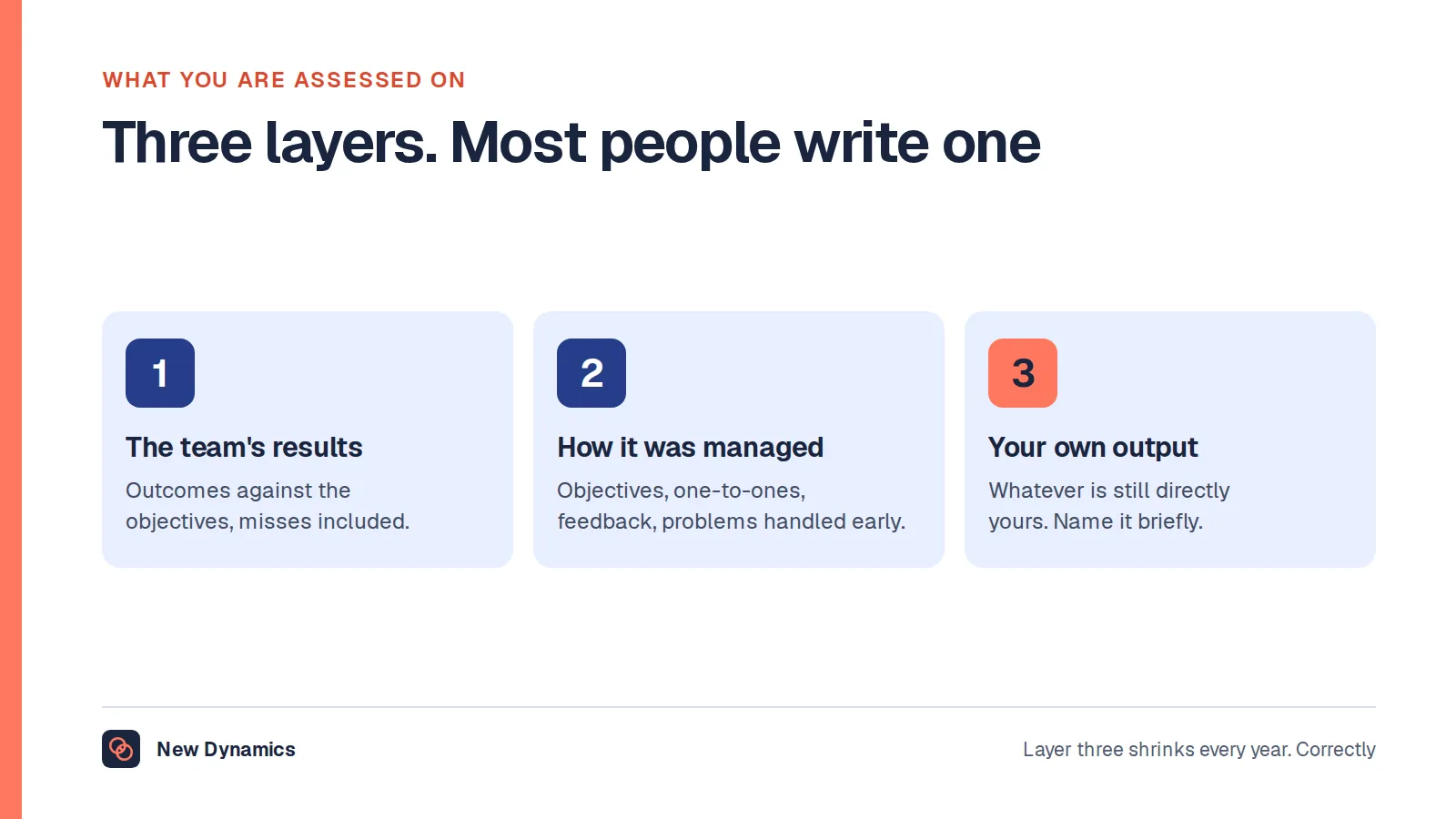
A performance assessment of employees is usually built from four inputs, and the self assessment is one of them.
- The goals and what happened to them, with the evidence for each one.
- The manager's own observation, with examples and dates.
- Other people's views: colleagues, a second manager on shared work, or a full 360 round.
- Your own account. The self assessment.
Each input sees a different part of the work, which is why organisations combine them. Our guide to performance appraisal methods sets out the main ones, and appraisal objectives covers the first input in detail.
The practical point for you is narrow. Of those four inputs, exactly one is written by you. You cannot edit what your manager noticed or what a colleague said about the project. You can decide what the fourth input contains, and treating it as paperwork spends the only part of the process you hold.
What your self assessment is actually used for
Five things, in roughly that order of likelihood.
It sets the agenda for the meeting. A good manager reads it before writing anything and marks where their view and yours differ. Those differences are the conversation. Agreement needs thirty seconds.
It corrects for recency. The last two months are easier to remember than last spring, for everyone. Your account of the whole period is the counterweight.
It becomes raw material for the written review. Your manager should not copy and paste it, but they will lean on it for dates, figures and the names of things. Accurate detail in your draft tends to survive into the final record.
It feeds decisions. Ratings, calibration, promotion cases and pay rounds all draw on the written review, and the written review draws on your self assessment. This is the part the form never mentions.
It outlasts the conversation. Acas says it is "important to keep a written record of what is discussed" and that this "should be shared with the employee afterwards". Your words are part of that record, which gets read later by people you have not met.

One honest caveat: some organisations ask for a self assessment and then never refer to it. If that has happened twice, write the short version near the end of this article and put your effort into the meeting instead.
The honest tension: reflection and evidence at the same time
Here is the thing the instructions on the form never admit. You are being asked to do two incompatible jobs in one document.
The first job is reflective. Look back honestly, notice where you fell short, name what you want to get better at. That requires candour, and candour requires safety.
The second job is evidential. The same document is read when ratings are set, when a promotion case is argued, and when a pay pot is divided. That rewards advocacy, and advocacy is the opposite of candour.
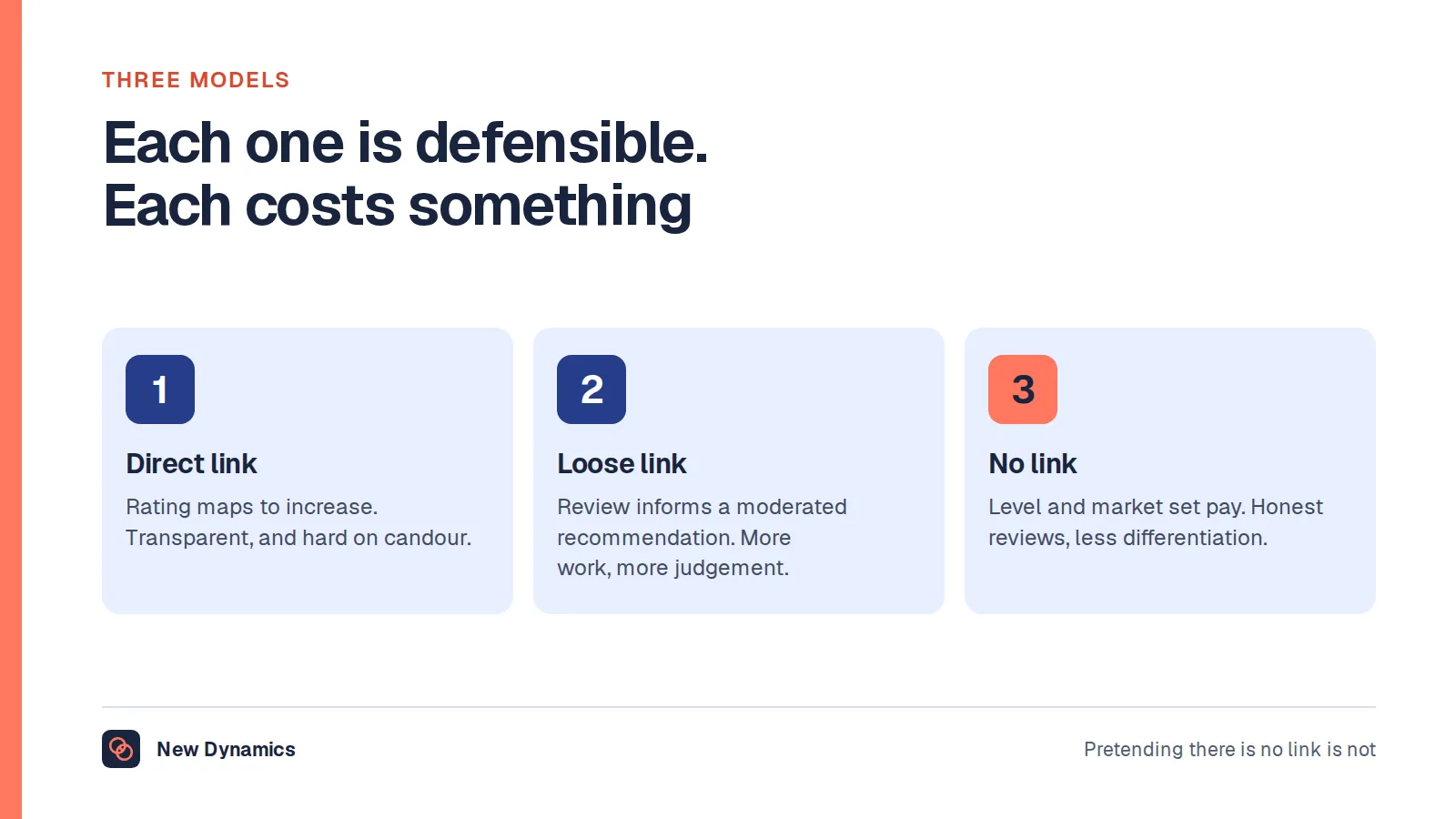
Nobody resolves this tension by pretending it is absent. If your organisation links the rating directly to the increase, expect every self assessment in the building to read like a case for the defence. The fault is in the design, not in you. We set out what the three possible designs cost in should performance reviews affect pay, and a separated pay conversation is the main thing that makes candour safe to write.
Until the design changes, three rules get you through it.
Write nothing you would not say out loud in the meeting. This single test resolves most of the difficulty. It filters out the self criticism you would regret, the complaint about a colleague that should be a conversation, and the claim you could not defend if asked a follow-up question.
Never raise something serious here for the first time. A grievance, a bullying concern or a workload problem that has built up for months should not appear first in a review form. Raise it when it happens, through the route your organisation publishes. Our post on performance reviews explains why a review full of surprises means the process failed months earlier.
Pair every admission with the action you already took. Candour that stands alone looks like a confession. Candour with a dated action beside it looks like judgement. This is the difference between "I am bad at planning" and "I underestimated the audit work in April, so I now write the dependency list before I commit to a date."
Being specific without boasting
Most people who say they cannot write about themselves describe their work perfectly well in conversation. What stops them on the page is not modesty about the work. It is the discomfort of making a claim about the person.
So stop making claims about the person. A boast is a claim about you. Evidence is a claim about the work, and the reader draws their own conclusion. Four moves do almost all of it.
Replace the adjective with the occasion. "Strong attention to detail" asks the reader to agree with your self estimate. "Caught the pricing error in the September renewal batch before it went out, and added a second check to the process" asks them to agree that an event happened. The second is both more modest and more convincing.
Separate "I" from "we", accurately. Writing "we" about something you led reads as false modesty and costs you the credit. Writing "I" about a team's delivery reads as theft and costs you trust. The pattern that is true for most work is both in one sentence: the team shipped the thing, and here is the part that was yours. Managers have a harder version of this problem, and our guide to the manager self assessment deals with it directly.
Put the number next to what it measures, with the starting point. "Made onboarding smoother" is an opinion. "From March, new starters were set up on their first day rather than their fourth, measured on the IT ticket dates" is a fact your manager can check. Only quote a number you can find again. A figure that turns out to be wrong undoes the rest of the document. If you want help choosing measures worth tracking through the year, see measuring your own work.
Stop before the conclusion. Having given the occasion, the evidence and the result, do not add "which shows my commitment to excellence". The reader got there two lines ago.
Hedging is the mirror image of boasting and costs just as much. "I think I probably helped a bit with the audit" is not humble, it is unreadable. If you did the work, say so in a plain sentence and move on.
If you want wording to start from, our library of self evaluation examples has sixty example phrases by skill area and a full worked sample. This article is about the decisions behind the words rather than the words themselves.
What to do about the things that went wrong
Every real year contains work that did not land, and leaving it out costs more than including it, because your manager almost certainly knows already. A gap in your account where a known problem should be does not read as discretion. It reads as a blind spot, and a blind spot is the one thing a manager cannot coach.
The treatment depends on which kind of problem it was.
A goal missed for reasons outside your control. State the goal, state what changed, state what you did about it, and state where the work got to. "The office move audit was paused in July when the lease talks reopened. The site survey is finished and ready if it restarts." This is not an excuse, it is a status report, and it protects you at calibration when somebody counts goals met without reading the context.
A goal missed for reasons inside your control. Name it in one sentence without hedging, give the cause at the level of a decision rather than a personality trait, and say what you changed. "I underestimated the data migration and did not flag the slippage until September. Two of the four systems have moved. I have agreed a revised plan with a fortnightly checkpoint, finishing in March."
A mistake with consequences for other people. Shorter and plainer: what happened, what you did at the time, what stops it happening again. One paragraph. A long apology moves the reader's attention from the work to your feelings about the work.

Four things to keep out. Do not name a colleague as the cause. Do not offer a personality as an explanation, because "I am a perfectionist" cannot be acted on by anybody. Do not list five weaknesses when you were asked for one. And do not promise to "try harder", because effort is not a plan.
One hard case needs stating plainly. If you are already in a formal process, a performance improvement plan or a capability procedure, the self assessment is part of that record. Acas says employers "should take steps to try and help someone to improve, before starting a formal disciplinary procedure", and that it is "important for employers to keep a record of any conversations they have with employees about performance". In that situation, get advice before you write, from a trade union representative if you have one, or from the Acas helpline. This article is general information for employees in the United Kingdom and is not legal advice.
Writing one when the year was disrupted
Review periods assume twelve ordinary months, and plenty of years are not that. Parental leave, long-term sickness, a reorganisation, a change of manager halfway through, a team that lost three people and redistributed the work: any of these breaks the arithmetic the form relies on.
The principle is easy to say and easy to forget under a deadline. Assess the period you actually worked, not the calendar the form prints. Then make the difference visible, because nobody downstream can apply judgement to a context they cannot see.
Four lines do it.
- Name the period. "This covers the seven months I worked, April to October."
- Say which goals predate the change. Objectives set in January for a full-time year are not a fair test of a nine-month, four-day-a-week year. Acas says objectives "should be fair and reflect the employee's usual tasks and workload".
- Say what still got delivered, in the normal evidence pattern and without apology. Reduced time is not reduced quality.
- Say what was paused, and by whose agreement. "The reporting project was handed over in June when my hours changed, with my manager's agreement."

You are not obliged to explain a health condition in detail in a document that goes on your personnel file. "I was absent for four months on certified sick leave" is sufficient for a performance record. Health information carries extra protection under UK data protection law, and the level of detail is your choice, not the form's.
We cover the specific situations separately, because each has its own fairness problem: performance reviews and maternity leave, reviewing someone after long-term sickness, performance reviews for part-time employees and reviewing an employee who changed manager.
Length, format and how long it should take
The constraint on length is not the box. It is the reader. Your manager has several of these to read in the same week, and the one that gets acted on is the one whose main point survives a fast first pass.
Length. For an open question, three to six sentences is usually right, call it 80 to 150 words. For a single free-text box covering a year, one page of specifics beats three pages of adjectives. Put your strongest item first in every section, because the top of each answer is the part that definitely gets read. Our post on how long a performance review should be takes the same question from the review side.
Format. If the form asks questions, answer the questions asked, in order, rather than writing one essay across all of them. If it is one blank box, impose your own structure with four short headings: what I set out to do, what happened, what did not work, what I want next. Bullets are fine for evidence and poor for judgement, so use prose where a reason is attached.
Ratings. If the form asks you to score yourself, read the written definition of each level first, then pick the score your evidence supports. Where the scale itself is the problem, see our performance rating scale guide.
Time. Two sittings, not one long one. The first is twenty minutes of gathering: calendar, sent items, goal list, any feedback you were given. The second is forty minutes of writing from that pile. Writing from memory in a single sitting is what produces the vague version, and it takes longer because you spend most of it staring at the box.
Timing. Send it by the date on the form, not the night before the meeting. A self assessment your manager has not read cannot shape what they write. If your organisation chases these endlessly, the problem is the process, and our post on chasing performance reviews is for whoever owns it.
Your self assessment is personal data, and you can ask to see it
Once submitted, your self assessment is personal data about an identifiable person, namely you. In the United Kingdom that brings it under the UK GDPR and the Data Protection Act 2018, and it gives you a right to a copy of it along with the rest of what your employer holds about you.
The ICO's public guidance on getting copies of your information is direct about it: "You have the right to ask an organisation if they're using or storing your personal information. You can also ask them for copies of your personal information." It then sets the expectations in four short sentences. "This is called the right of access and is also known as making a subject access request, a SAR or a DSAR." "Anyone can make a SAR." "You don't need a solicitor or a lawyer." "Organisations usually have one month to respond to a SAR." Its practical advice is worth following: "When asking for information, be as specific as possible." Asking for your appraisal records for a named period gets a more useful answer than asking for everything. The page carries a notice that the guidance "is under review and may be subject to change" following the Data (Use and Access) Act, so check it rather than a summary.
Two consequences follow for the way you write.
Write it for a stranger. The likely readers are your manager and whoever runs the cycle. The possible readers include a future manager, HR, somebody handling a grievance and, in a dispute, a tribunal. Nothing in it should depend on the reader knowing you well.
Keep other people out of it. Naming colleagues, quoting something said in confidence, or recording a complaint about an individual all put information about someone else into your file. That makes the record harder to disclose and rarely helps your case. Describe the behaviour and its effect, and leave the name out unless the name is the point.
What belongs in the record, who should be able to see it and how long it is kept are covered in performance review record keeping and our employee data protection guide. This is general information about the position in the United Kingdom and not legal advice.
What a manager should do with it, and what they should not
If you manage people, the self assessment you asked for creates obligations. Three of them.
Read it before you write a word of your own. Reading it afterwards wastes it: your assessment is already formed, and the document becomes something to reconcile rather than to learn from. Mark every place your view differs from theirs. That list is your agenda.
Respond to the requests in writing. A self assessment usually contains an ask: a course, a project, a piece of support. Answering it, including answering no with a reason, is what makes the exercise worth repeating. Silence teaches people to write less next year, and they will.
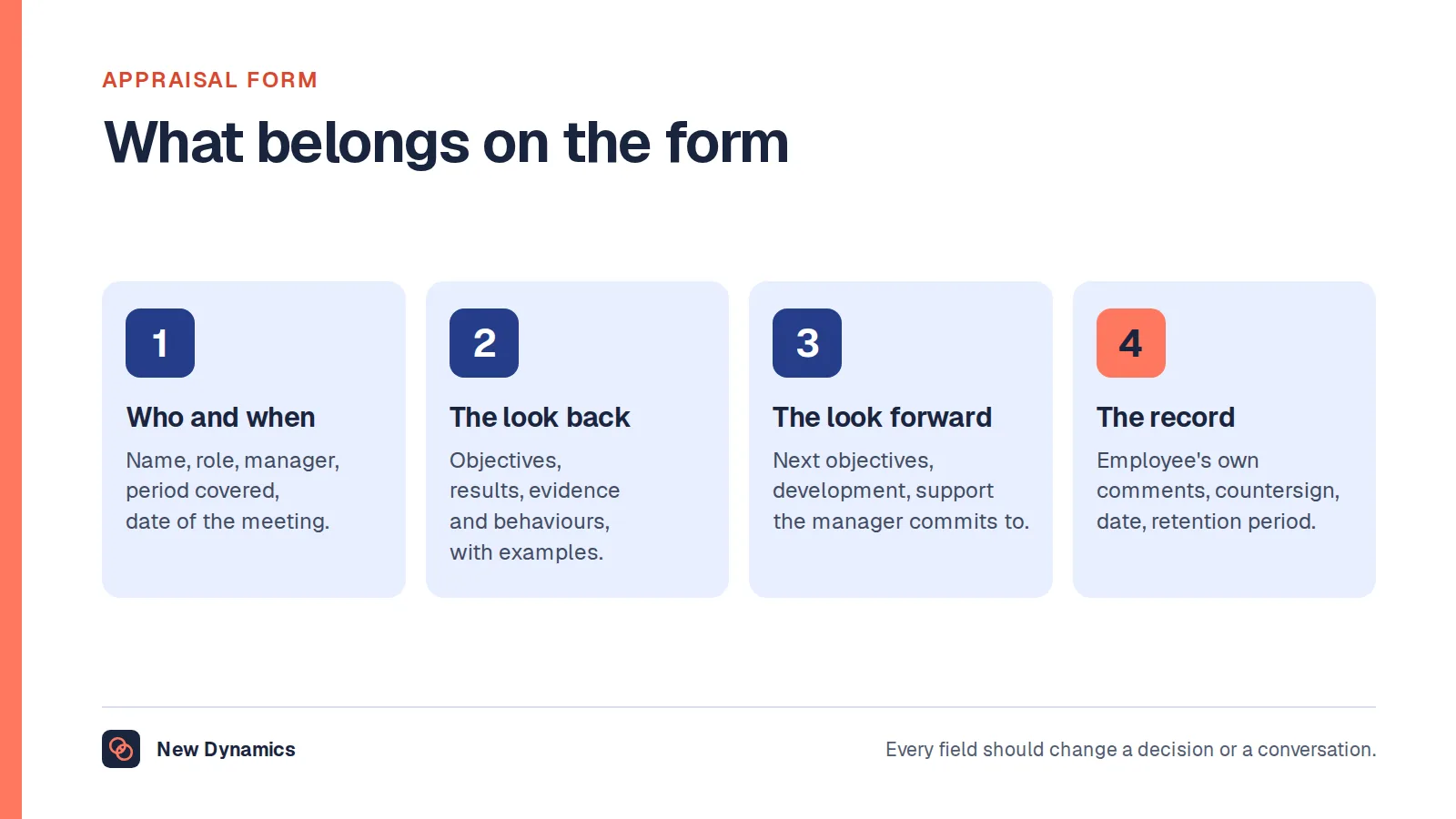
Keep the attribution visible. The employee's words and yours should sit in separate, labelled blocks in the final record, so that nobody reading it in two years has to guess who thought what. That is a form design question as much as a writing one, and we cover it in the appraisal form.
Now the things not to do, which matter more because they are harder to see.
- Do not treat the self assessment as the first draft of the rating. A confident writer and a modest colleague doing better work will produce very different documents, and the stronger document is not the stronger performer. This is the main fairness failure in self assessment, and the fix sits in the form and in calibration rather than in telling quiet people to sell themselves harder. Our performance calibration guide explains the mechanism.
- Do not punish candour. If somebody names a failure you did not know about, and the rating moves because of the telling rather than the failure, you have taught the team that honesty is expensive. They will adjust.
- Do not let it replace the conversation. Acas notes that alongside formal reviews, managers "should still talk to employees informally about their performance on a regular basis", through feedback, coaching and check-ins. Where that happens, a self assessment holds no surprises.
- Do not circulate it. It goes to the people in the process and no further.
- Do not ask for one you are not going to use. It is the fastest way to make the next cycle harder to run.
For managers writing their own, which is a genuinely different task, start with the manager self assessment.
If you hate writing these: the short version
Some people find this task unpleasant rather than merely tedious, and advice about structure does not fix that. So here is a version that takes about twenty-five minutes and is still honest.
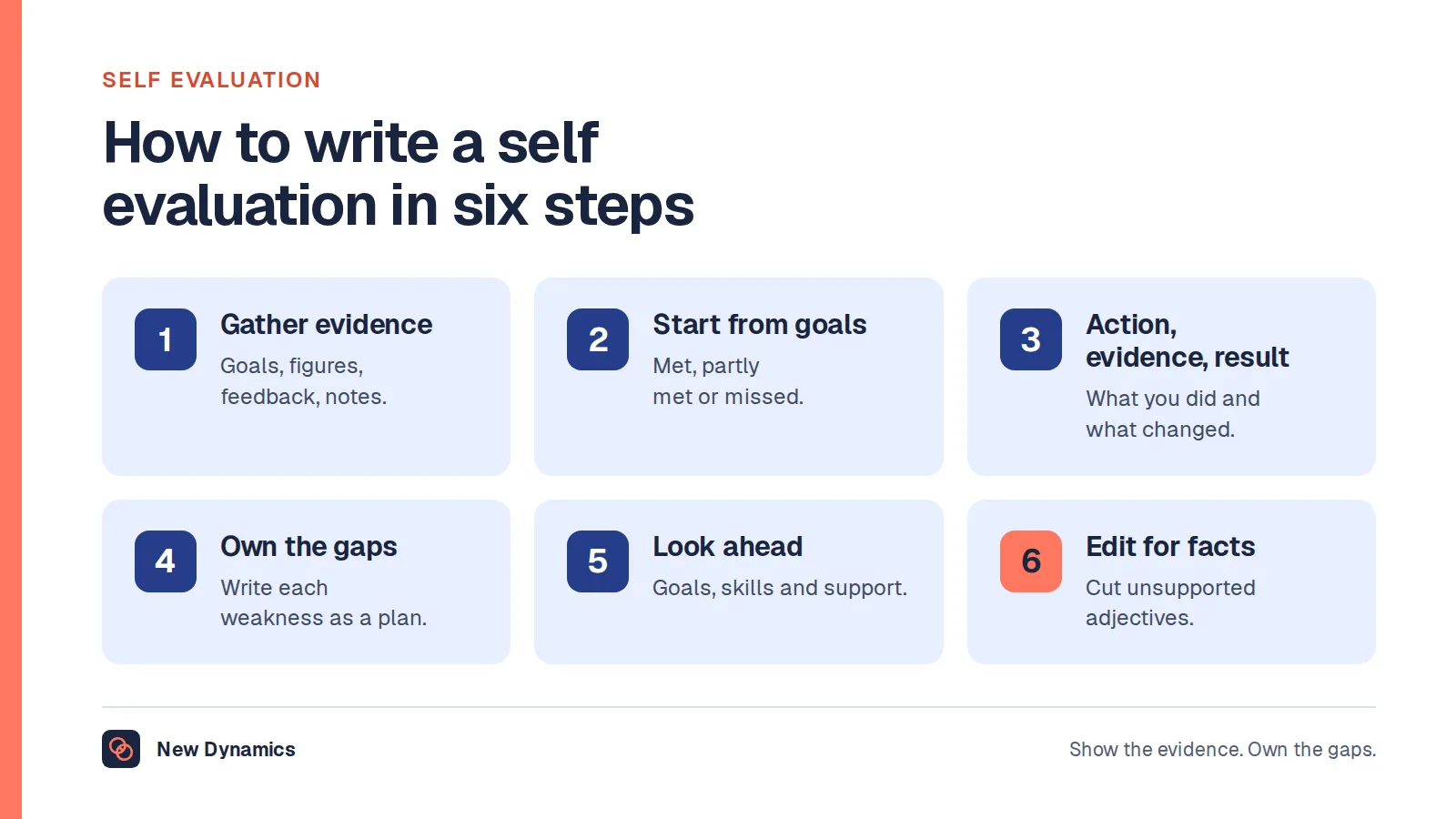
- Open your calendar for the period and scroll month by month. Write down six dates where something happened. Do not judge them, just list them.
- One sentence each. What you did, and what changed because of it.
- Reorder. Put the three strongest first and delete the weakest two.
- One paragraph on what did not work, using the pattern above: what happened, what you did about it, what changes now.
- Two sentences on next period. What you want to do, and what you need to do it.
Stop there. Five short answers written from real dates beat two pages written from memory, in a fraction of the time.
Two further things help. Dictate it: speak the six sentences into your phone and tidy up the transcript, because almost everyone describes their work better out loud than on a page. And ask a colleague who was there what you did in the spring, since other people remember your work more accurately than you do.
If writing is hard because of dyslexia, a health condition or a disability, this is not a character problem and there is a route. GOV.UK's guidance on reasonable adjustments for workers opens with the duty: "Employers must make reasonable adjustments to make sure workers with disabilities, or physical or mental health conditions, are not substantially disadvantaged when doing their jobs." It lists "doing things another way" among them. Acas describes what reasonable adjustments are as including "finding a different way to do something", and names "giving someone more time to do written tasks" as an example in its guidance on problems with an employee's performance. In practice that can mean extra time, speech-to-text software, or giving your self assessment verbally while your manager writes it down. Asking is a reasonable request, not a favour. These duties come from the Equality Act 2010, which applies in England, Scotland and Wales; Northern Ireland has separate disability discrimination legislation, and GOV.UK points readers there. Again, general information and not legal advice.
Frequently asked questions
What is an employee self assessment?
An employee self assessment is your own written account of your work over a review period, completed before the review meeting. It usually covers what you achieved against your goals, how you worked, what did not go well and what you want next. It is also called a self appraisal, a self evaluation or a self review.
What should I write in my self assessment?
Start from the goals you were set and say what happened to each, with a date, a figure or a document as evidence. Add two or three pieces of work your manager would not otherwise see. Name one thing that did not work, with what you changed. Finish with what you want next and the support you need.
Is a self assessment the same as the HMRC Self Assessment tax return?
No. They share a name and nothing else. GOV.UK describes Self Assessment as the system HM Revenue and Customs uses to collect Income Tax, and its tax return pages cover registering, deadlines and penalties. A workplace self assessment is the part of a performance review that you write about yourself.
Can my manager see my self assessment, and can I get a copy?
Your manager reads it, and so do the people who run the review cycle. You can also ask for a copy of what is held about you. The ICO says you have the right to ask an organisation for copies of your personal information, that anyone can make such a request without a solicitor, and that organisations usually have one month to respond. This is general information for the United Kingdom, not legal advice.
How long should an employee self assessment be?
Three to six sentences for each open question is usually enough, or about one page for a single free-text box covering a year. Put your strongest point first in each answer. Specific and short gets read and acted on; long and general does not.
Do I have to admit mistakes in a self assessment?
Leaving out a problem your manager already knows about reads as a blind spot rather than as discretion. Name one or two real things plainly, say what you did at the time and say what changes now. If you are in a formal capability or improvement process, get advice from a union representative or the Acas helpline before you write.
Your next step: twenty minutes with your calendar
- Open your calendar for the review period and write down six dates where something happened. Nothing else, just the dates and a few words each.
- Turn each one into a sentence with an occasion, a piece of evidence and a result, then put the three strongest first.
- Write one honest paragraph about what did not work, with the action you already took beside it.
- Add two sentences on what you want next and what you need from your manager, and send it by the date on the form.
- Start a running notes file for the next period, and put ten minutes in your diary every Friday to keep it current.
For agendas, questions and a fair process from preparation to follow-up, read and download our performance review guide. It is free to read, and the PDF uses our short download form.
Want your own form, your own questions and a year of goals, feedback and recognition in one place when the self assessment is due? Book a New Dynamics demo and bring the form you use today. You can also email contact@new-dynamics.com.