TL;DR
- A process objective commits someone to a behaviour they decide: what they will do, how often, to what standard, over which weeks. An outcome objective commits them to a result they influence but cannot guarantee.
- Most goal setting fails because it hands outcomes to people who do not hold the levers, then rates them on how the quarter happened to go. The repair is a pair: one outcome objective and one process objective, reviewed together.
- Process objectives turn into activity theatre when the count becomes the point. Add a standard, review a sample of the work rather than the total, and keep raw counts out of pay formulas.
A sales objective says "win the Woodburn contract by 31 March". The salesperson qualifies it properly, runs five good meetings and writes a proposal the buyer calls the clearest they received. In February the buyer reorganises, the decision slides into the next financial year, and the objective is marked as missed. Nothing in that rating describes the work.
This article explains process objectives: what they are, how they differ from outcome objectives, when each is right, and how to write one that can be reviewed without an argument. It gives worked examples across five kinds of role, deals with the trap process objectives fall into when the count becomes the point, and covers what to do when the outcome arrives without the process.
Behaviour and result only get reviewed together if they sit in the same place. See how New Dynamics Goals & OKRs keeps both visible between check-ins instead of in two systems that meet once a year.
One published figure shows the size of the problem. The 2025 NHS Staff Survey, with fieldwork between September and November 2025, 766,285 responses and a 49% response rate, reports that "86.42% of staff say they have had an appraisal, annual review, development review, or Knowledge and Skills Framework development review in the last 12 months, which is a five-year high". Of those staff, the proportion saying their appraisal definitely "helped them to agree clear objectives for their work" was 35.32%. Almost everybody gets the meeting; about a third come out with objectives they would call clear. Our post on goal setting statistics sets out what else is published, and the HR statistics hub holds the wider picture.
What is a process objective?
A process objective commits someone to a behaviour they decide: what they will do, how often, to what standard, over which weeks. An outcome objective commits them to a result, a number that moves partly because of their work and partly because of a dozen things nobody in the room controls.
"Win the contract" is an outcome. "Run four discovery calls a week and send each proposal within two working days" is the process.
You will also meet the phrase in programme planning, in public health and education, where a plan separates the change it intends to produce from the activities it will deliver. The logic transfers to a review form unaltered.
| Question | Outcome objective | Process objective |
|---|---|---|
| What does it commit to? | A result | A behaviour |
| Who decides whether it lands? | The person, plus customers, colleagues and timing | The person |
| What is the evidence? | A number at the end of the period | A record kept through the period |
| When does it fail unfairly? | When the world moves | Rarely; it fails when the person stops doing it |
Both are legitimate. The mistake is setting only the first kind, to people who do not hold the levers, and then treating the result as a verdict on the person.
Outcome vs process goals: control, influence and luck
The test takes one sentence. If this person does everything we would want them to do, can somebody else still make this objective fail? If the answer is yes, you have written an outcome.
That splits any objective three ways. There is the part the person controls, their behaviour. There is the part they influence, the result their behaviour makes more likely. And there is luck: the reorganisation, the competitor's price cut, the two people who resigned in the same week. Luck belongs in the conversation and never in the rating.

Acas, in its guidance on setting objectives, says an objective should be specific, "by being clear about what the employee will actually do", and measurable, "so you know whether they've been achieved". Read those together and you can see the tension that produces most bad objectives. The first points at behaviour; the second pulls towards a number at the end. Acas adds that "Objectives should be fair and reflect the employee's usual tasks and workload". Most forms settle the tension by asking for a result and hoping the method takes care of itself.
The US Office of Personnel Management, in its guidance on performance planning, says that "Performance elements and standards should be measurable, understandable, verifiable, equitable, and achievable." Equitable is the word that bites. Two salespeople of equal skill working equally hard, one in a growing region and one in a shrinking one, do not hold equitable outcome objectives however identical the wording.
Be careful about specifying a method, though. The Health and Safety Executive's Management Standards include a standard on control, defined as employees indicating "that they are able to have a say about the way they do their work", with states to be achieved including that "Employees are encouraged to use their skills and initiative to do their work". That is an occupational health standard rather than a goal framework, but it makes the point from the other side: a process objective is something to agree, not to issue. If you are writing the method for somebody who knows the work better than you do, it is probably the wrong objective.
Some frameworks add a middle tier: a personal standard such as a conversion rate, closer to the person than a revenue figure but still not entirely theirs. Our post on success indicator examples covers leading and lagging indicators, the same split seen from the measurement side.
Process objective examples across five roles
The figures below are examples, not benchmarks. Measure your own baseline first and agree the rate with the person who has to sustain it. Each one gives the outcome objective a form usually asks for, the process objective underneath it, and what you would look at to review it.
Sales
Outcome objective: win £400,000 of new business from the public sector by 31 March.
Process objective: from 6 January to 27 March, hold four discovery calls a week with organisations matching the agreed customer profile, recording the problem, its impact and an agreed next step for each, and send every proposal within two working days.
Review: five anonymised call notes a fortnight, plus the proposal send times. One large contract is a sample of one, and a tender can be cancelled after the bid goes in, but the call notes exist whatever the buyer decides.
Customer support
Outcome objective: raise first-contact resolution from 71% to 80% by the end of the second quarter.
Process objective: each week, rewrite one help article from the top repeat-contact list, and ask a colleague who has not seen the draft to complete the task it describes without hitting a gap.
Review: the article list with dates, and the colleague's test notes. First-contact resolution moves with the product and the ticket mix, so an adviser can do everything right in a quarter when a billing change floods the queue.
Engineering
Outcome objective: cut defects found after release in one product area from eight a month to four.
Process objective: add a regression test to every bug fix in that area, keep pull requests under 400 changed lines unless a reason is written in the description, and give every pull request a first review within one working day while on the rota.
Review: the rota, the size of merged pull requests, and which fixes shipped with a test. A defect count depends on what else was released and how hard anybody looked. The three behaviours are a theory about why defects recur; the outcome tests it.
HR and People team
Outcome objective: raise the share of employees who say they have clear objectives in the next engagement survey.
Process objective: between 5 January and 27 February, run four manager clinics, read a sample of 30 objectives a month against the agreed checklist, and give every manager written feedback on three of their own.
Review: the sample scores, using the same rubric each month, and the feedback actually sent. The survey result arrives once, late, and carries the fingerprints of everything else that happened that year.
A manager
Outcome objective: reduce voluntary turnover in the team from 18% to 12% this year.
Process objective: hold a one-to-one with every direct report at least fortnightly, reschedule any cancellation within five working days, and end each one with an agreed action or a recorded note that no action is needed.
Review: meeting coverage and overdue actions monthly. In a team of nine, turnover of 18% is two people, and one may be moving house. But notice how easily this becomes a diary exercise, with nine meetings held and nothing said. That is the next section.
For more objectives by performance area, see our performance goals examples and 50 SMART goal examples, and for objectives owned by a group, team goals examples.

When an outcome objective is right, and when a process one is
Set an outcome objective when:
- the person holds the levers, which is usually true of a budget holder or the owner of a whole process
- the result is attributable to them and measurable from a source you have both agreed
- the period contains more than one or two events, so the number means something
- the job is to produce the result whatever the method, which describes most senior roles.
Set a process objective when:
- the result is rare or lumpy: one tender a year, a handful of large deals, a single migration
- the outcome lands after the review period, so there is nothing to review in December
- the person is new to the work, or the method is new to everybody, and doing it properly is the point
- the result depends on other teams, on pricing, on a regulator or on a procurement committee
- changing the method is the objective: a new review cycle, a new safety check, a new handover.
Set neither when what you are describing is a duty. "Answer the phone", "run payroll" and "produce the monthly report" are the job, and dressing them up as process objectives fills the form without changing anything. Our performance goals examples post works through the difference between a duty and a goal.
When an outcome objective is unavoidable because the organisation needs the number on a page, write the process objective beside it anyway. That pairing costs nothing in January and cannot be improvised in December.
The activity theatre trap
A process objective that nobody thinks about becomes activity theatre: calls logged because the number has to say four, meetings held because the calendar has to show them, articles rewritten because the count is due on Friday.
Four signs, in the order they usually appear:
- The count is met every single period, and nothing downstream ever moves.
- The record is created in a batch at the end of the week rather than as the work happens.
- Quality slips on exactly the dimension you did not write down.
- People stop telling you when the behaviour was the wrong thing to do that day, because admitting it costs them the number.
The cause is not dishonesty. A bare count is the cheapest thing a person can produce, and any measure that decides something about somebody becomes a target, and a target gets produced. Our goal setting definition post lists measuring what is easy rather than what matters among the standard failures of goal setting, and this is its purest form.
Five repairs, in rough order of effect:
- Add a standard. "Four discovery calls a week" becomes "four discovery calls a week where the problem, its impact and an agreed next step are recorded". The standard is what makes the fourth call worth making.
- Review a sample of the work, not the total. Read five call notes. Do not read the number five.
- Cap it. An uncapped count tells people more is always better, which is almost never true.
- Keep the outcome in the pair, and the raw count out of any pay formula.
- Give the person a sanctioned way to miss it. "Four a week, or a note saying why fewer was the right call." An objective with no legitimate exception teaches people to invent one.
The same discipline runs through our post on behavioural indicators: an indicator has to describe something an observer could see.
Pair one outcome objective with one process objective
Write the outcome first, because it says why any of this matters. Then ask: what behaviour, sustained all period, would most raise the chance of that result? Write that underneath and apply the control test to it. If somebody else can still make it fail, you have written a second outcome.
Keep the pair small. One of each for three priorities is already six lines, at the edge of what anybody reviews properly, and three to five objectives in total remains sensible.
At review, the two lines answer different questions, which is the whole point of holding both. The process objective answers "did this person do the job we agreed". The outcome answers "was the job we agreed the right one". Organisations get into trouble when the second question is answered as though it were the first. Our post on the goal setting conversation covers agreeing the pair, and management by objectives gives the longer history of agreeing results rather than assigning them.
Process objectives, pay and the review cycle
Process objectives sit awkwardly with pay, and the awkwardness is worth stating plainly.
They are fairer to pay on, because the person controls them. A bonus that turns on whether a procurement committee met in March is a lottery with paperwork. They are also more gameable, because a count can be manufactured in an afternoon. Those two facts pull in opposite directions, so the practical position is narrow.
- Use the outcome for the pay conversation where, and only where, the person holds the levers.
- Use the process objective as evidence in the judgement, not a number in a formula. "She did the work we agreed, the market closed, and the pipeline she built is why next year looks different" is something a pay committee can act on.
- Never put a raw activity count in a formula. Paying per logged call buys logged calls.
- Agree in advance how a met process objective with a missed outcome will be treated. Our performance calibration guide covers keeping those comparisons consistent across managers.
- Resist weighting the process objective above the outcome. The behaviour is the explanation, not the achievement.
One legal point, for Great Britain. GOV.UK's guidance on reasonable adjustments for disabled workers states that employers "must make reasonable adjustments to make sure workers with disabilities, or physical or mental health conditions, are not substantially disadvantaged when doing their jobs", and gives as an example "doing things another way". A process objective specifies a method, so it is precisely the kind of requirement that may need adjusting: a fixed number of outbound phone calls or a fixed meeting pattern can disadvantage somebody whose condition makes that method harder, even when the result is well within their reach. The same page notes that different arrangements apply in Northern Ireland. Agree an alternative behaviour that serves the same purpose, and record it. This is general information about the position in Great Britain, not legal advice, and a specific case needs proper advice.
When the outcome arrives without the process, or the process without the outcome
Holding a pair produces four results at the end of the period, and three are more interesting than the one everybody plans for.
Both happened. Say so in writing, and name the behaviour that did it. This is the only square that gives you a method worth spreading, and the one most often left unexamined because there is nothing to fix.
The process ran, the outcome did not. The person did the job that was agreed, so review the theory rather than the person. Either the behaviour was the wrong lever, the period was too short, or something outside the objective moved. Change the method next cycle and do not mark the rating down to tidy the arithmetic. Acas, on problems with an employee's performance, says that "If there are problems with someone's performance at work, employers should try to understand why", and notes that a problem that looks like conduct "could actually be capability".
The outcome arrived, the process did not. This is the square people celebrate and should investigate. Three explanations are live: the behaviour you specified was not the one that mattered, so rewrite the process objective; or the person found a better method, so write it down; or it was luck, in which case nothing has been learned. Several quarters of this usually mean the process objective was somebody's guess about work they do not do.
Neither happened. Now you have a performance conversation, and a better one than an outcome objective alone would have given you, because it is about behaviour, which can be coached and supported. Start with why, as Acas advises, and separate a capability gap from a blocked dependency before anything formal. Our posts on the goal review meeting and the performance improvement plan cover both halves.
How to write a process objective that can be reviewed
A process objective that cannot be reviewed is a wish about somebody's habits. This sentence prevents most failures:
From [start date] to [end date], I will [behaviour] [at this rate], to the standard that [what counts as properly done], recorded in [evidence]. We will review it [cadence], alongside [the outcome it is meant to move].

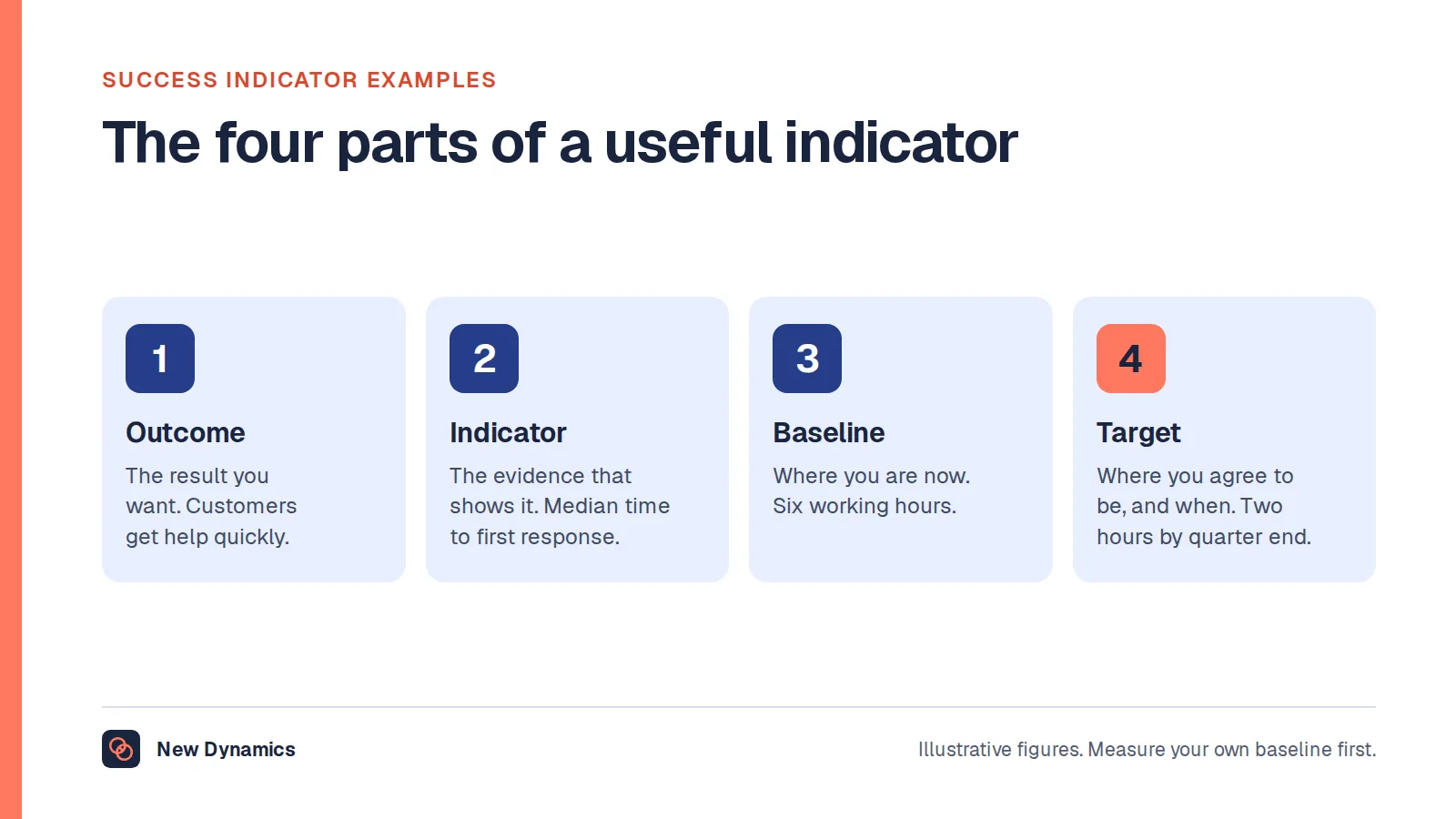
Run five tests before you agree it. Name the behaviour, as a verb the person decides to perform. Set the rate, with the weeks it covers. Add a standard, so the count cannot be met by going through the motions. Name the evidence, including where it lives. Pair the outcome, so there is something to check the theory against.
Two rewrites show what the tests catch.
"Be more proactive with customers." No behaviour, no rate, no standard, no evidence and no agreement about what proactive means. Rewritten: from 6 January to 27 March, contact each of my twelve named accounts at least monthly with something specific to their situation, recorded in the account notes, and bring two of those conversations to each fortnightly one-to-one.
"Make 50 calls a week." A behaviour and a rate, but no standard, no cap and no reason. It will be met, and it will teach the team that dialling is the job. Rewritten: hold at least eight conversations a week with named contacts at target organisations, each recorded with the problem discussed and the agreed next step, and no more than twelve, so preparation does not get squeezed.
Four mistakes survive the template. A behaviour the person cannot schedule, such as attending a forum they must be invited to. Evidence that does not exist yet, which will be invented at the end, all at once. Too many process objectives, so three methods leave no room for the work they support. And a method nobody has agreed is right, because specifying a behaviour claims it causes the result.
Our SMART goal template gives a sheet for the wording, and how to cascade goals at work covers connecting a pair upwards without turning a company target into nine impossible personal ones.
STAR goals: a structure for interview answers, not a goal framework
People search for "STAR goals", and the phrase deserves a straight answer rather than a paragraph pretending it is a method.
STAR stands for situation, task, action and result. It is a structure for asking about, and for answering, a question about past behaviour in a selection interview: describe the situation you were in, the task you faced, the action you took and the result you got.
It is not a goal framework, and it cannot be made into one. It has no target, no date, no measure and no owner, because everything it describes has already happened. There is nothing to agree in January and nothing to review in June.
The confusion is easy to explain, because the two halves of STAR map onto the two halves of this article. The action is a process account; the result is the outcome. A candidate who describes only the result has not told you what they did.
If you came here for the interview structure, our post on interview techniques covers structured, behavioural and situational interviewing and how to use STAR to probe an answer. If you came for a goal method, use SMART or OKRs: our SMART goals acronym post explains the letters, and our OKR guide covers objectives and key results, where the objective is the outcome and the key results are usually a mix.
Frequently asked questions
What is a process objective?
A process objective commits someone to a behaviour they decide: what they will do, how often, to what standard and over which weeks. It is reviewed from a record kept through the period rather than from one number at the end. An example is holding four discovery calls a week and sending every proposal within two working days.
What is the difference between a process goal and an outcome goal?
A process goal describes behaviour the person controls. An outcome goal describes a result they influence but cannot guarantee, because customers, colleagues, timing and chance all get a say. "Win the contract" is an outcome. "Run four discovery calls a week" is the process. The test is whether somebody else can make the objective fail while the person does everything right.
Can you give a process objective example for different roles?
For sales, four discovery calls a week with the problem, impact and next step recorded. For support, one help article rewritten and tested by a colleague each week. For engineering, a regression test on every bug fix. For HR, 30 objectives read against a checklist each month. For a manager, a fortnightly one-to-one with every direct report.
Should an employee have both a process and an outcome objective?
Usually yes, as a pair. The outcome keeps the work pointed at something that matters, and the process keeps the review fair when the outcome moves for reasons nobody controlled. Keep the pair small: one of each per priority, and three to five objectives in total.
Are STAR goals a goal-setting framework?
No. STAR stands for situation, task, action and result, and it is a structure for asking and answering interview questions about past behaviour. It has no target, date or owner, so there is nothing to agree or review. Use SMART or OKRs for goals.
Should process objectives affect pay?
Treat them as evidence in the judgement rather than a number in a formula. A raw activity count is easy to manufacture, so paying for it buys the activity rather than the result. Agree in advance how a met process objective with a missed outcome will be treated.
Your next step: split one objective in two
- Take the objective on your current form that you are least confident about.
- Apply the control test. If somebody else can make it fail while the person does everything right, it is an outcome.
- Ask what behaviour, sustained all period, would most raise the chance of that result, and write it underneath using the sentence above.
- Agree the standard, the evidence and the first review date before either line is saved.
For the full method, with a worksheet and review prompts, read and download our SMART goals guide. The guide is free to read, and the PDF uses our short download form.
Want the behaviour and the result visible in the same place, reviewed in check-ins rather than rediscovered in December? Book a New Dynamics demo and bring the objective you trust least. You can also email contact@new-dynamics.com.