TL;DR
- Most issues with human resource management are design problems rather than competence problems: they come from how time, authority and rules are set, not from who is in the HR chairs.
- The eight that recur are policing instead of help, administration crowding out judgement, no seat at the table, a management problem handed to HR, a process nobody follows, the two-master problem, measuring what is easy, and HR as half of somebody's job.
- Each one has a symptom, a usual misdiagnosis and a change that works. None of them is solved by buying software, including ours.
Ask an HR director what is wrong with HR and you get a longer, more uncomfortable answer than any article offers. Ask the operations director across the corridor and you get a shorter, sharper one. The two lists overlap more than either side expects, and the overlap is where the real work is.
This article sets out the eight issues with human resource management that recur in almost every organisation, whatever the sector and the size. For each one it gives the symptom you actually see, the misdiagnosis that usually follows, and the change that moves it.
Several of these problems show up first as chasing: the reminder, the spreadsheet, the cycle that stalls at 40% complete. New Dynamics workflows let you build your own stages, participants, forms and reminders rather than adopt a software template. That removes keystrokes and gives you a record. It does not remove any of the eight problems below, and an honest article says so before it starts.
This is a problems article, not an introduction. For what the function is and the eleven things it does, read what HR management is. For the strategy layer above it, read strategic human resource management. For the top job and its board work, read what a CHRO does.
The eight problems, and how to read them
Every section below has the same three parts.
- The symptom. What people actually complain about, in their words rather than a framework's.
- The usual misdiagnosis. The explanation reached for first, nearly always about individuals, attitude or communication.
- What actually changes it. A decision about time, authority or rules. Never a slogan.

One structural claim runs through the list. Almost every recurring problem of HRM is a design problem rather than a competence problem: it comes from how the organisation set the hours, the authority and the rules, not from who is sitting in the HR chairs.
That is testable, not a kindness. If the same work, with the same hours and the same authority, would produce a materially different result in different hands, you have a competence problem. If it would not, replacing the person costs a year and changes nothing.
HR seen as policing rather than help
The symptom. HR finds out late or not at all. Conversations start with "this is off the record, but". Managers handle a problem quietly to keep HR out of it, and HR meets it as a formal grievance. At worst, a serious issue circulates for months and reaches HR in a resignation letter. The damaging part is the information loss: a function told things late cannot advise, spot a pattern or resolve anything early.

Why people stop telling HR things. Three reasons, none irrational. Nobody told them what would be passed on and to whom, and in the absence of a stated rule people assume the worst rule. The last person who raised something saw nothing change, or saw it change in a way nobody explained. And HR is only visible once a formal procedure has started, so the association forms itself.
Acas, the public body that advises on workplace relations in Great Britain, does not treat HR as the formal route only. Its guidance on dealing with a problem raised by a worker opens with the line "Many problems at work can be resolved informally, for example through an informal chat", and says a worker can raise a problem informally by telling their line manager "or someone else at work. For example, another manager or someone in HR". HR is expected to be one of the early routes. If in your organisation it is only the late one, that is a local design choice, not a legal requirement.
The usual misdiagnosis. A communications problem, answered with an open door message, a listening tour or a rebrand. None of those touches any of the three reasons, and the rebrand does active damage, because it promises a change in substance that nothing delivered. Our post on people ops sets out what a rename genuinely changes.
What actually changes it.
- Publish the confidentiality rule before anyone needs it, with the exceptions named: safeguarding, allegations of discrimination or harassment, and anything where the employer would be failing a duty by leaving it alone. People accept a limited promise; they do not forgive a broken unlimited one.
- Separate advice from casework. Whoever advises a manager week to week should not investigate that manager's team. Our post on the employee relations function sets out who owns the decision and who advises on process.
- Close the loop in aggregate. You can rarely report an individual outcome. You can report that nine concerns were raised, what the themes were and what changed.
- Be present before the procedures, at team meetings and inductions where nothing is going wrong. That costs time, which is why it is cut first.
Part of this is HR's own doing, created by over-promising confidentiality and then having to act. Promise less and you are told more.
Administration crowds out judgement
The symptom. The most common complaint HR people make about HR, by a wide margin. The week fills with contracts, references, right to work checks, payroll queries, system corrections, holiday questions and chasing an incomplete review cycle. The advice work, the thing that needed two uninterrupted hours, happens at six in the evening or not at all. Nobody notices, because nothing breaks.
What nobody can tell you. No official UK source publishes what share of an HR team's time goes on administration rather than advice. There is no ONS series and no GOV.UK release. Every percentage circulating comes from a private panel, and most of those panels belong to companies selling the software that would save you the time, so we will not quote one. Our post on HR software adoption shows the nearest sourced government parallel and how to produce the number for your own team.
The usual misdiagnosis. That the team is not prioritising, or is not senior enough. This is almost always a resourcing and systems problem. Transactional work arrives whether or not anyone has capacity, carries a deadline and has somebody visible waiting for it, so it wins every time. The only slack in the system is the advice work.
What actually changes it.
- Count the work before you argue about it. Four weeks, a tally sheet, four buckets: transaction, casework, project, advice. An estimate gets argued with. A count does not.
- Decide which transactions should not reach HR at all. The test is whether HR adds a judgement. If not, the work belongs with a manager who can self-serve it, a published answer or a form that routes itself. If it does, it stays, and you stop apologising for the time.
- Book the advice time as a commitment, not the remainder. Two protected half-days a week, in the diary, defended.
- Then, and only then, configure or buy a system, for the transactions you have defined. A system laid over an undefined process gives you a second place to chase. Our post on HR to employee ratio explains why no published ratio exists to size a team against, and how to size one from case load. For what to buy in, see HR outsourcing.
If the work genuinely exceeds the hours available, no prioritisation method and no system fixes it. That is a budget conversation, and HR's job is to bring the count rather than the complaint.
No seat at the table
The symptom. HR hears about the restructure when the consultation timetable is being set. The people item is last and gets four minutes. The function reports through a route that translates it before it reaches the chief executive. Decisions with obvious workforce consequences arrive as instructions.
The honest reasons it happens. Some belong to the executive team and some belong to HR. Both halves have to be said.
- HR arrives with activity rather than consequences. The most common reason and the most fixable. An update made of sessions delivered, cases closed and policies refreshed answers a question nobody asked. One that names a decision, its cost, its cause and two options gets invited back.
- No numbers, or numbers nobody can reconstruct. A figure that cannot be defined on request is worse than none, because the first challenge ends the conversation. Our post on HR metrics separates the measures with a published method from opinion with a decimal point.
- No position. Laying out three options evenly and waiting is a staff habit, not an executive one. People in that room are expected to recommend, and to be wrong sometimes.
- Sometimes the executive team does not want to be told. This is not rare, and better preparation does not fix it. The realistic options are an ally on the board, or the door. Recognising which one you are in is worth more than another attempt.

The usual misdiagnosis. A reporting line problem, solved with a title. Our post on what a CHRO does is direct about it: appointing a chief people officer to fix a function that is not working is an HR director problem with a new title attached. Our post on the HR business partner role covers the same mistake a level down, where an advisory team is renamed as business partners and nothing else moves.
What actually changes it.
- Bring one decision per meeting, with the cost, the cause, two options and a recommendation. Not a report.
- Own a number the business already cares about, even partially: unfilled roles in the team missing its targets, or the overtime bill behind a rota problem.
- Accept the consequences of the recommendation. A seat comes with accountability, and asking for one without that is asking for an audience.
- Negotiate the room, not the title. The only test is whether HR is in the room where next year's plan is set.
A management problem handed to HR
The symptom. "Can you have a word with him." A team where every individual is described as a problem and the manager is not. A request to start a formal performance process for a situation nobody has ever raised with the person concerned. A manager who copies HR into everything and decides nothing.
What the guidance assumes. Acas is explicit that the first move belongs to the employer and the manager, not to a procedure. Its guidance on problems with an employee's performance begins "If there are problems with someone's performance at work, employers should try to understand why", and says "Employers should talk to employees informally first if there are problems with their conduct". On capability it adds that "Employers must provide 'adequate resources' to enable an employee to do their job". Its page on reviews and appraisals, last updated on 23 June 2026, says that "Alongside more formal performance reviews, managers should still talk to employees informally about their performance on a regular basis".
The sequence is clear: understand the cause, check the person has what they need, talk to them informally, and only then reach for a procedure. Almost every case handed to HR as a performance problem has skipped the first three. Acas guidance applies in England, Wales and Scotland; Northern Ireland has its own arrangements. General information, not legal advice.
The usual misdiagnosis. A training gap, closed with a course. Sometimes that is right. More often the manager was never told the conversation is theirs, has no time in the diary for it, and has watched the organisation tolerate the behaviour for two years, which taught them the real standard.
What actually changes it.
- Write down the split and hold it. HR advises on process and risk. The manager owns the decision and the conversation. The uncomfortable half is holding it when a senior manager asks HR to deliver the message instead, because agreeing once makes it the norm.
- Require the first conversation to have happened. No informal conversation, no case. Not minutes, but a dated note of what was said and agreed. This rule removes more inappropriate referrals than any amount of manager training.
- Give managers the time and the structure. A recurring one-to-one is the mechanism by which this work gets done or not. Our manager one-to-one guide sets out the structure, and our new manager guide covers the first ninety days.
- Hold managers to the people part of their role. If managing people is not assessed when a manager is reviewed, it is optional. Our post on manager performance covers the measures that mislead.
HR cannot manage somebody else's team, and every attempt teaches the organisation that managers need not.
A process nobody follows
The symptom. A review cycle that closes at 40% complete. A policy read only by its author. A form filled in on the deadline, from memory, in ten minutes. A process with an official version and an actual version, where only HR believes in the official one.
Which processes are actually optional. Some are not. The Acas Code of Practice on disciplinary and grievance procedures, published on 11 March 2015, is described by Acas as "the minimum an employer should follow for handling these issues at work". Acas states that "Employers should follow a fair procedure in line with the Acas Code of Practice for any discipline or grievance case", and that "The procedure an employer follows and an employee's actions will be taken into account if the case reaches an employment tribunal". That is a process with a consequence attached, and it applies in England, Wales and Scotland. Again, general information rather than legal advice.
Most internal processes are not in that category: they exist because somebody once thought they would help.
The usual misdiagnosis. A compliance problem, solved by chasing harder, or a software problem, solved by automating the chasing. Both treat low completion as a motivation failure. It is usually a message about the process.
What actually changes it.
- Sort every process into two piles: required by law, regulation or genuine risk, or adopted because it seemed sensible. Cutting the second pile is the fastest way to make the first credible.
- Shorten the required ones to the minimum the source asks for, then enforce them. A long procedure followed loosely is worse at a tribunal than a short one followed exactly.
- Find out what people do instead. The workaround is the design brief. If managers keep notes outside the system, the system asks for the wrong things.
- Give each surviving process one named consequence: who notices when it has not happened, and what follows. A process nobody enforces costs the credibility of everything else you ask for.
See disciplinary procedure for the required sequence, HR compliance for the duties that are not optional, and performance reviews for what makes a cycle worth completing.
Since we sell software, one thing to be clear about. Reminders and routing raise the completion rate of a form. They do not make a bad form useful, and if the content is wrong, automation distributes it faster.
The two-master problem that business partnering does not dissolve
The symptom. An employee tells HR something in confidence and HR is obliged to act on it. The same adviser supports the manager facing a grievance and operates the grievance procedure the complainant is relying on for fairness. Everyone can feel the problem, and the language used about the function denies it.
Why it cannot be dissolved. HR is employed by the employer. It is also the route by which an employee obtains fair treatment. Those are two different interests held by one function, and calling it business partnering does not change who issues the contract or decides the budget.
The law does not pretend otherwise. Section 10 of the Employment Relations Act 1999 applies where a worker "is required or invited by his employer to attend a disciplinary or grievance hearing" and "reasonably requests to be accompanied at the hearing". Where it applies, "the employer must permit the worker to be accompanied at the hearing by one companion" who "is chosen by the worker". The permitted companions are a trade union official or "another of the employer's workers". HR is not on that list, and the design is deliberate: the statutory scheme assumes the worker may need somebody who is not the employer's adviser. Section 10 extends to England, Wales and Scotland, and Northern Ireland has its own provisions. General information, not legal advice.
The usual misdiagnosis. A trust problem to be solved with language. "We are not here to protect the company" is the popular version, and it is not true. The first time an employee sees HR act for the employer, everything else HR has said becomes suspect.
What actually changes it, meaning handling it honestly rather than dissolving it.
- Say it out loud, at induction and in the first conversation of every case. HR acts for the employer, and HR runs a fair procedure. Explain where the second genuinely constrains the first.
- Separate the roles inside a single case. Whoever advises the manager is not the investigator, and neither hears the appeal. In a small function that means naming someone outside HR in advance.
- Publish the route that is not HR: a named director or trustee, the whistleblowing channel, a recognised trade union, and Acas. A function confident enough to publish the alternative is trusted more.
- Say what you cannot keep confidential before anyone tells you anything.
For the terms and the sequence, see what a grievance is and our post on workplace conflict.
Measuring what is easy instead of what matters
The symptom. A monthly pack of headcount, turnover, training hours delivered, time to hire, case volume and one engagement score. Every figure is countable. None answers a question anybody asked, and nobody acts on any of them.
Why it happens, which is not stupidity. Activity is already in the system and outcomes are not, so activity is what a report can be built from this week. Activity is also attributable: HR delivered the sessions and closed the cases, whereas outcomes depend on managers HR does not control. Reporting what you are responsible for is a rational career choice. Most people measures also have no agreed definition, so even a good figure cannot be compared outside your own organisation. Our post on HR metrics sets out which measures have a published method.
The usual misdiagnosis. A tooling problem, closed by buying a reporting module. A better tool produces the same measures faster.
What actually changes it.
- For every measure, name who will act on it and the decision it could change. Delete anything that fails. Four live measures beat twenty decorative ones.
- Write your own definitions down and publish them, including the base and the period. A number you can reconstruct under challenge is the only kind that survives.
- Report what you cannot measure, deliberately. A short "here is what we do not know and what it would take to find out" section is the most credible page in an HR pack.
When HR is half of somebody's job
The symptom. No HR department. HR is a third of the finance manager's week, or the office manager's, or the founder's. Contracts come from a template that predates two employment law changes. Everything is fine until the first grievance, and then nobody involved has done this before.
Small employers have every problem above, compressed, plus two of their own. There is no second opinion, so judgement calls get made alone and under time pressure. And there is no separation of roles, which matters most when a case arrives, because whoever investigated is also the only candidate to hear the appeal.
The duties do not scale down. GOV.UK's guide, get ready to employ someone for the first time, sets out step by step what an employer must do before taking anyone on: check the person's employment status, check you can afford the employment costs, make the workplace safe and accessible, register as an employer and set up PAYE. None of that is waived for an organisation of four people. Employment law differs in Northern Ireland, and this is general information and not legal advice.
The usual misdiagnosis. Two opposite ones. Either "we are too small to need HR", which is a statement about headcount rather than about the work, or buying a full system for eighteen people, which solves the wrong half and then needs maintaining by the person who had no time.
What actually changes it.
- Get four things right and stop worrying about the rest: a correct written statement of employment particulars, payroll that is accurate and on time, a short set of policies you will actually follow, and a fair way to handle a complaint. That is most of the risk.
- Buy the judgement, not the administration. An hour of competent advice when a case arrives is worth more than a year of any subscription. Our posts on HR outsourcing and HR consulting cover what can be bought in.
- Solve the separation problem before you have a case. Decide now, in writing, who hears an appeal when the only HR person handled the decision: a director, a trustee or an external adviser.
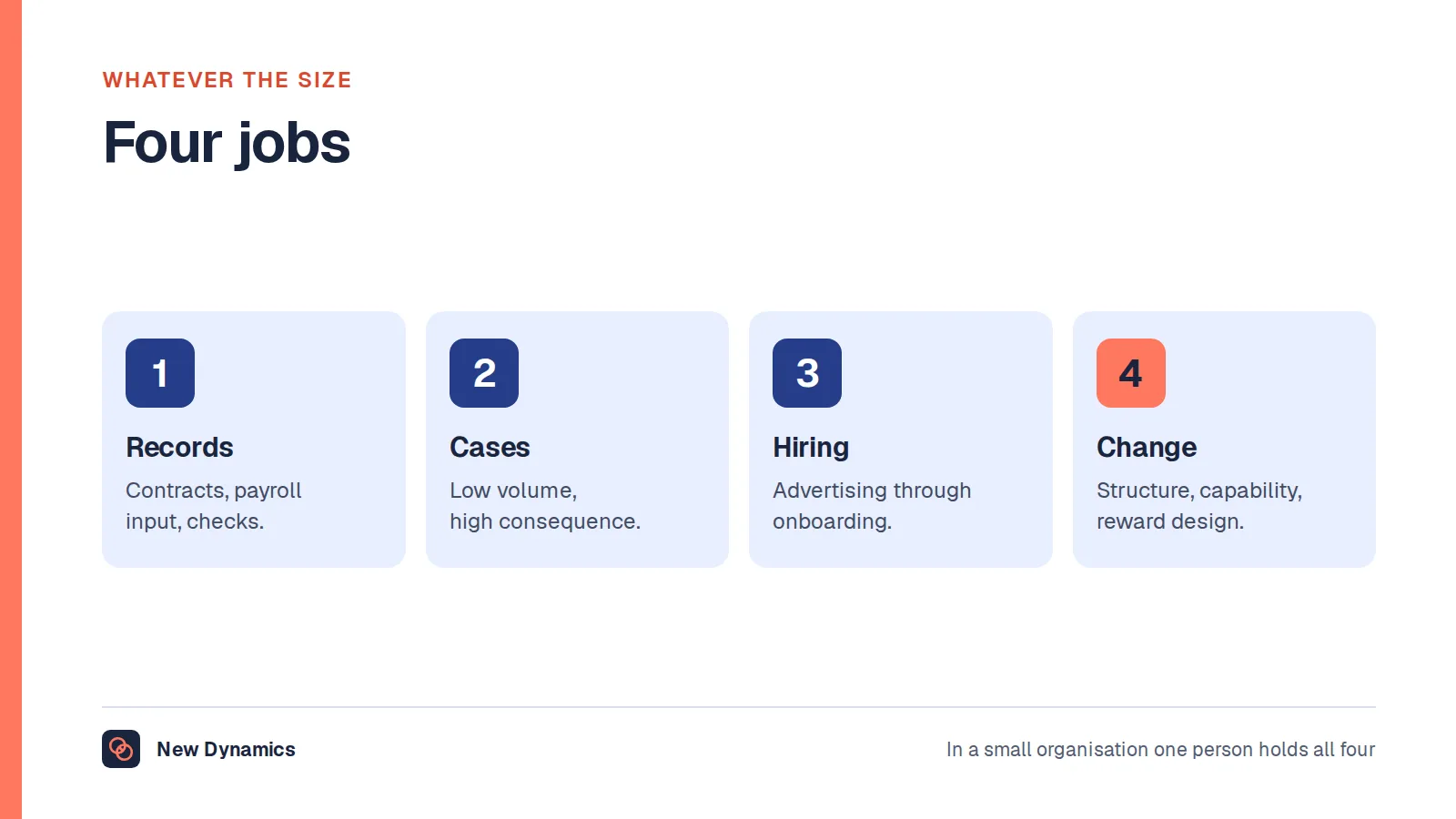
- Add roles in the right order as you grow. Our post on HR structure sets out the four jobs every function covers and the order roles get added.
What software does not fix, including ours
We make a performance management platform. It covers goals, feedback, recognition, reviews and onboarding, it can be configured to the review form you already use, and it will route the stages and send the reminders. That is the whole claim, and it is narrow on purpose.
What it honestly does: it removes keystrokes from the review cycle, keeps goals, feedback and review records in one place, and gives you a trail of what was agreed and when. That addresses part of one problem, the administrative load around the performance process.
What it does not do. It does not make employees trust HR, because trust depends on the confidentiality rule and whether anything visibly changed. It does not create HR capacity, because the transactional work it never touches arrives anyway. It does not get HR into the planning meeting, which a chief executive decides. It does not make a manager hold a difficult conversation, or an unfollowed process worth following. It does not resolve the two-master problem, which is structural and legal. It does not improve your measures, because it reports what you put in. And it does not solve the small-employer problem, where what is missing is judgement, not a database.
Anyone who tells you a platform fixes the trust problem, the authority problem or the resourcing problem is selling. We would rather you bought on the narrow claim and kept it for years.
Frequently asked questions
What are the main issues with human resource management?
Eight recur almost everywhere: HR seen as policing rather than help, administration crowding out judgement, no seat where decisions are made, being handed problems that belong to a manager, owning a process nobody follows, the tension between the employee's route to fairness and the employer's interest, measuring what is easy, and HR as half of somebody else's job.
What are the biggest challenges in HRM?
Administration crowding out judgement is the most commonly reported, and it is usually a resourcing and systems problem rather than a competence one. The most damaging is the trust problem, because a function told things late cannot advise or resolve anything early. The least fixable by HR alone is the missing seat at the table, which the executive team decides.
Why do employees stop telling HR things?
Three reasons. Nobody told them what would be passed on and to whom, so they assume the worst. The last person who raised something saw no visible result. And HR only appears once a formal procedure has started. Acas guidance expects many problems to be resolved informally, including with someone in HR, so a function that is only the formal route was designed that way locally.
Is HR there to protect the employee or the employer?
Both, which is the honest answer and a real tension. HR is employed by the employer and also operates the route by which an employee obtains fair treatment. Calling it business partnering does not dissolve that. Section 10 of the Employment Relations Act 1999 gives a worker at a disciplinary or grievance hearing the right to be accompanied by a trade union official or a fellow worker, not by HR. That applies in England, Wales and Scotland, and is general information rather than legal advice.
How do you stop HR being stuck in admin?
Count the work for four weeks by type rather than estimating it, move the transactions that need no HR judgement to self-service or a published answer, book the advice time in the diary as a commitment, and configure a system only for transactions you have already defined. If the work exceeds the hours available, that is a budget conversation, and the count is what you take to it.
What are the HR challenges for a small business?
Every problem larger employers have, compressed, plus no second opinion and no separation of roles when a case arrives. Get four things right: a correct written statement of employment particulars, accurate payroll, a short set of policies you will follow, and a fair complaints route. Then buy judgement rather than administration, and decide in advance who hears an appeal if your only HR person made the decision.
Your next step: name the one you actually have
- Read the eight symptoms and pick the one that describes your organisation this quarter. Not the most strategic sounding, the one people complain about.
- Apply the competence test. Would the same work, with the same hours and authority, produce a different result in different hands? If not, you need a decision about time, authority or rules.
- Write that decision down as one sentence, with the person who has to make it. "The executive team decides whether HR is in the planning meeting" is a real sentence. "Improve the HR brand" is not.
- Pick one measure that will tell you in three months whether it worked, and name who will act on it.
For the mechanism that carries most of the management half of this list, read and download our manager one-to-one guide. The guide is free to read, and the PDF uses our short download form.
If the problem you picked is the administrative load around your review cycle, that is the narrow part we can help with. Book a New Dynamics demo and bring the review form you run today. If it is one of the other seven, say so on the call and we will tell you plainly that software is not the answer. You can also email contact@new-dynamics.com.